
















Introduction
The grocery industry has become one of the most competitive sectors in retail. Consumers now compare prices across multiple supermarkets, online grocery stores, and delivery platforms before making purchasing decisions. To remain competitive, retailers need instant visibility into market pricing trends, competitor promotions, and product availability. This is where a Grocery Competitor Price Data Tracking Dashboard becomes a critical business asset.
Modern retailers increasingly rely on Grocery price comparison data scraping to gather large volumes of pricing information from various grocery channels. By consolidating this information into a centralized platform, businesses can quickly identify pricing opportunities and market trends. A powerful Real-Time Grocery Price Tracking Dashboard enables retailers to react immediately to competitor price changes, helping them optimize pricing strategies and improve customer retention.
As grocery markets continue to evolve, businesses that leverage real-time intelligence gain a significant advantage in maintaining profitability and market share.
The Growing Importance of Market Visibility

Pricing remains one of the most influential factors affecting customer purchasing decisions. Even small price differences can drive consumers toward competing retailers, especially when shopping for frequently purchased grocery items.
Traditional pricing research methods often involve manual data collection and periodic market reviews. While these approaches may provide limited insights, they cannot keep pace with the rapid changes occurring in today's grocery ecosystem. Competitors frequently adjust prices, launch promotional campaigns, and modify product assortments.
Having comprehensive visibility into competitor activities allows businesses to understand how products are positioned across different channels. Retailers can identify which categories experience frequent price changes and which products are most sensitive to competitive pricing pressures.
With access to timely and accurate market intelligence, organizations can make informed decisions that support long-term growth and profitability.
Converting Pricing Data into Actionable Intelligence
Collecting pricing information alone is not enough. Retailers must transform raw data into meaningful insights that support strategic decision-making. This is where Grocery Price Monitoring Data Analytics plays an essential role.
Advanced analytics platforms process large volumes of pricing data and identify trends that would be difficult to detect manually. These systems evaluate historical pricing patterns, promotional effectiveness, category performance, and competitor behavior.
Retailers can use analytics to determine whether specific products are priced competitively within their markets. They can also analyze how pricing changes affect sales performance and customer demand.
Furthermore, analytics solutions provide visual reports and dashboards that simplify complex market data. Decision-makers gain access to actionable insights that help them optimize pricing strategies, improve category performance, and strengthen competitive positioning.
By integrating analytics into daily operations, retailers can make data-driven decisions rather than relying on assumptions or outdated information.
Building a Strong Competitive Strategy
Successful retailers continuously monitor market conditions and competitor activities. The ability to understand pricing trends and anticipate market shifts provides a substantial competitive advantage.
Through Grocery Competitive Pricing Intelligence, businesses gain a deeper understanding of how competitors position their products and promotions. This intelligence helps retailers identify pricing gaps, benchmark performance, and uncover opportunities for differentiation.
Competitive intelligence allows organizations to evaluate market dynamics across multiple dimensions, including product categories, geographic regions, and promotional campaigns. Retailers can determine whether they are leading, matching, or trailing competitors in key product segments.
Rather than reacting after market changes occur, businesses can proactively adjust pricing strategies to maintain competitiveness. This approach improves customer acquisition, enhances retention, and supports sustainable revenue growth.
As competition intensifies across both physical and digital grocery channels, pricing intelligence becomes increasingly valuable for strategic planning and operational success.
Evaluating Market Performance Across Retailers
Understanding how prices compare across competing supermarkets is essential for effective retail management. Detailed Supermarket competitor pricing analysis helps organizations identify strengths and weaknesses within their pricing structures.
A comprehensive comparison examines pricing across multiple product categories, including fresh produce, dairy products, packaged foods, beverages, household essentials, and personal care items. These insights reveal where retailers are outperforming competitors and where adjustments may be necessary.
| Analysis Area | Strategic Benefit |
|---|---|
| Product-Level Comparison | Identifies pricing opportunities |
| Category Benchmarking | Supports category management |
| Promotion Monitoring | Evaluates discount effectiveness |
| Regional Analysis | Enables localized pricing |
| Market Position Tracking | Improves competitiveness |
This level of visibility helps retailers align pricing decisions with market realities while protecting profit margins. Regular competitor analysis also supports inventory planning, promotional scheduling, and supplier negotiations.
Organizations that consistently evaluate competitor pricing are better positioned to respond to changing consumer expectations and market conditions.
Leveraging Automation for Continuous Monitoring
Manual monitoring processes can no longer meet the demands of modern grocery markets. Retailers often manage thousands of products across multiple channels, making manual tracking both costly and inefficient.
This challenge has led to the adoption of automated grocery price tracking solutions that continuously collect and update pricing information. Automated systems operate around the clock, ensuring that businesses always have access to current market data.
Automation significantly improves efficiency by eliminating repetitive manual tasks. It also enhances data accuracy and enables large-scale monitoring across numerous competitors.
Retailers benefit from real-time alerts when competitors change prices, launch promotions, or adjust product availability. These notifications allow teams to respond quickly and maintain competitive positioning.
As grocery markets become increasingly dynamic, automation serves as a critical component of effective pricing intelligence strategies.
Collecting Large-Scale Retail Data Efficiently
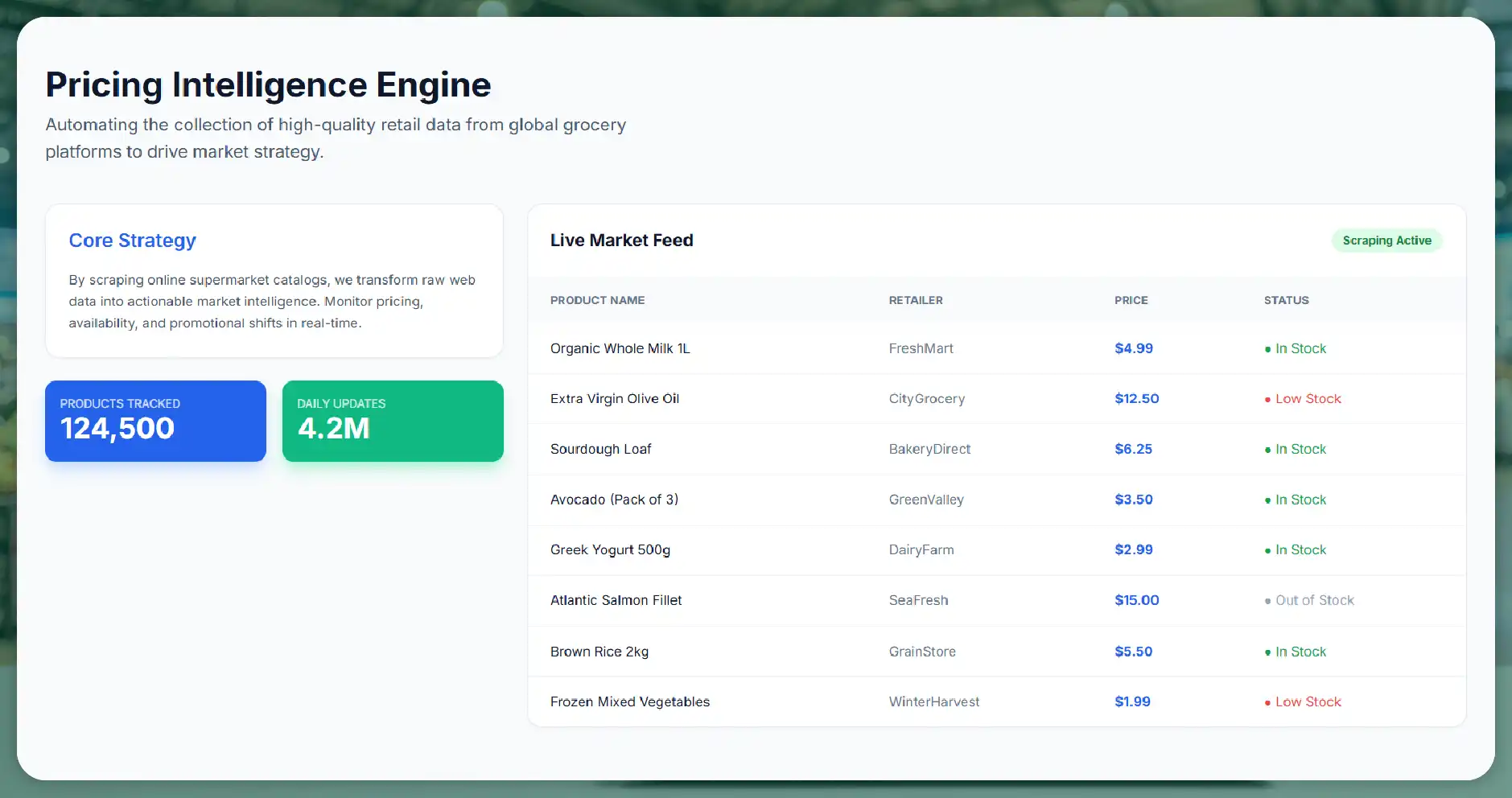
The foundation of any pricing intelligence platform is high-quality data. One of the most effective methods for gathering this information is Web Scraping Grocery Data from online grocery stores, supermarket websites, and delivery platforms.
Web scraping technologies automatically extract publicly available information, including product names, prices, promotional offers, product descriptions, availability status, and category classifications.
Unlike manual data collection methods, web scraping enables businesses to monitor thousands of products simultaneously. This scalability provides a comprehensive view of market conditions and competitor activities.
Organizations can build extensive pricing databases that support reporting, forecasting, and competitive analysis initiatives. As online grocery channels continue expanding, web scraping remains one of the most valuable tools for acquiring timely market intelligence.
The ability to continuously collect and update pricing information ensures that retailers maintain an accurate understanding of market dynamics.
Integrating Delivery Platform Insights
The rapid growth of grocery delivery services has created new opportunities and challenges for retailers. Consumers increasingly compare prices across traditional supermarkets and delivery applications before making purchasing decisions.
A Grocery Delivery Extraction API enables organizations to collect structured data directly from grocery delivery platforms. This information can then be integrated into pricing intelligence systems and business analytics tools.
APIs provide access to valuable information such as pricing details, promotional offers, inventory availability, delivery-specific fees, and regional product variations. Businesses can use this data to understand how products are positioned across different delivery channels.
The integration of delivery platform intelligence supports more accurate pricing decisions and helps retailers adapt to changing consumer shopping behaviors.
As e-commerce grocery sales continue to expand, delivery platform monitoring will become an increasingly important component of retail intelligence strategies.
CTA: Unlock real-time grocery pricing intelligence today—contact us to build a customized competitor tracking and market analytics solution.
Creating a Unified Decision-Making Platform
Retailers require a centralized system where pricing information, analytics, and competitive insights can be accessed efficiently. A comprehensive Grocery Price Dashboard serves as this central hub.
The dashboard consolidates data from multiple sources and presents it through intuitive visualizations and reports. Decision-makers can quickly assess market conditions, monitor competitor activity, and identify emerging trends.
Key performance indicators such as price competitiveness, promotion effectiveness, and category performance can be tracked in real time. Interactive dashboards also facilitate collaboration between pricing teams, category managers, analysts, and executives.
By providing a single source of truth, dashboards improve decision-making speed and accuracy. Organizations gain greater confidence in their pricing strategies and can respond more effectively to market developments.
The Future of Data-Driven Grocery Retail
Emerging technologies such as artificial intelligence, machine learning, and predictive analytics are transforming how retailers manage pricing strategies. These innovations enable businesses to move beyond descriptive reporting and toward predictive decision-making.
Future pricing intelligence platforms will increasingly forecast competitor behavior, estimate demand fluctuations, and recommend optimal pricing actions. Automated recommendation engines will help retailers identify opportunities before competitors respond.
Predictive models will also support more effective inventory planning, promotional management, and category optimization. Retailers that embrace these technologies will gain stronger competitive advantages and improved operational efficiency.
As consumer expectations continue evolving, data-driven decision-making will remain at the center of successful grocery retail strategies.
How Food Data Scrape Can Help You?
Real-Time Competitor Monitoring
Our data scraping services continuously track grocery prices, promotions, product availability,
and assortment changes across retailers, helping businesses react faster to market movements and
maintain competitive pricing strategies.
Comprehensive Market Intelligence
We collect and organize large-scale grocery data from multiple sources, enabling businesses to
understand competitor behavior, benchmark performance, identify pricing gaps, and uncover
emerging market opportunities effectively.
Automated Data Collection
Our automated scraping solutions eliminate manual research by gathering accurate pricing and
product information around the clock, reducing operational costs while improving data quality,
consistency, and coverage.
Custom Analytics and Dashboards
We deliver structured datasets and customized dashboards that transform raw grocery data into
actionable insights, supporting pricing optimization, promotional planning, category management,
and strategic decision-making processes.
Scalable Retail Data Solutions
Our scalable data scraping services support supermarkets, brands, distributors, and market
researchers by providing timely grocery intelligence that drives growth, improves profitability,
and strengthens competitive positioning.
Conclusion
Competitive pricing has become a critical success factor in modern grocery retail. Organizations that leverage advanced monitoring technologies can better understand market dynamics, identify opportunities, and respond quickly to competitor actions.
A robust Grocery Price Tracking Dashboard provides the visibility needed to monitor pricing activity across multiple channels while supporting faster and more informed decision-making. Combined with advanced Grocery Data Intelligence, retailers can transform raw market information into valuable strategic insights.
By utilizing comprehensive Grocery Datasets, automated monitoring systems, and advanced analytics capabilities, businesses can strengthen their market position, improve profitability, and stay ahead in an increasingly competitive grocery landscape.
Are you in need of high-class scraping services? Food Data Scrape should be your first point of call. We are undoubtedly the best in Food Data Aggregator and Mobile Grocery App Scraping service and we render impeccable data insights and analytics for strategic decision-making. With a legacy of excellence as our backbone, we help companies become data-driven, fueling their development. Please take advantage of our tailored solutions that will add value to your business. Contact us today to unlock the value of your data.