
The 2026 food and beverage industry is set to experience significant transformations driven by evolving consumer preferences, technological advancements, and sustainability initiatives. This report provides a detailed analysis of emerging trends, capturing shifts in demand for plant-based products, functional beverages, ready-to-eat meals, and global cuisine. By examining regional differences and seasonal variations, businesses can anticipate market opportunities and plan product launches, marketing strategies, and supply chain operations more effectively.
The study also highlights the role of real-time analytics and market monitoring in guiding decision-making, helping companies stay ahead in a competitive landscape. Insights from consumer behavior, menu innovations, and sales data offer a comprehensive understanding of what drives demand and how businesses can align their offerings with future expectations.

Consumer Preferences – Tracking shifts in taste, dietary habits, and health-conscious choices.
Market Opportunities – Identifying underserved regions and emerging product categories.
Operational Planning – Supporting supply chain and inventory optimization strategies.
Innovation Trends – Highlighting new product launches and creative culinary approaches.
Competitive Insights – Understanding competitor activities and market positioning for strategic advantage.

The food and beverage industry is undergoing rapid transformation, fueled by shifting consumer preferences, technological advancements, and evolving global market dynamics. Companies seeking to maintain a competitive edge must rely on accurate, timely data and actionable insights to anticipate emerging trends and adapt strategies effectively. The 2026 Food & Beverage Trends Data Scraping Report offers a comprehensive analysis of anticipated industry patterns, equipping businesses with the intelligence required to make informed, data-driven decisions. By employing sophisticated data collection and scraping methodologies, analysts can Scrape Food and Beverage Trend Insights for 2026, aligning business strategies with evolving consumer expectations and operational priorities.
Beyond tracking sales and menu offerings, the report emphasizes Food and Beverage Innovation Trends Scraping 2026, which captures information on new product launches, flavor innovations, sustainability initiatives, and regional consumption patterns. This forward-looking approach helps businesses understand current purchasing behavior while predicting future demand, enabling proactive decision-making for product development, marketing campaigns, and supply chain optimization.
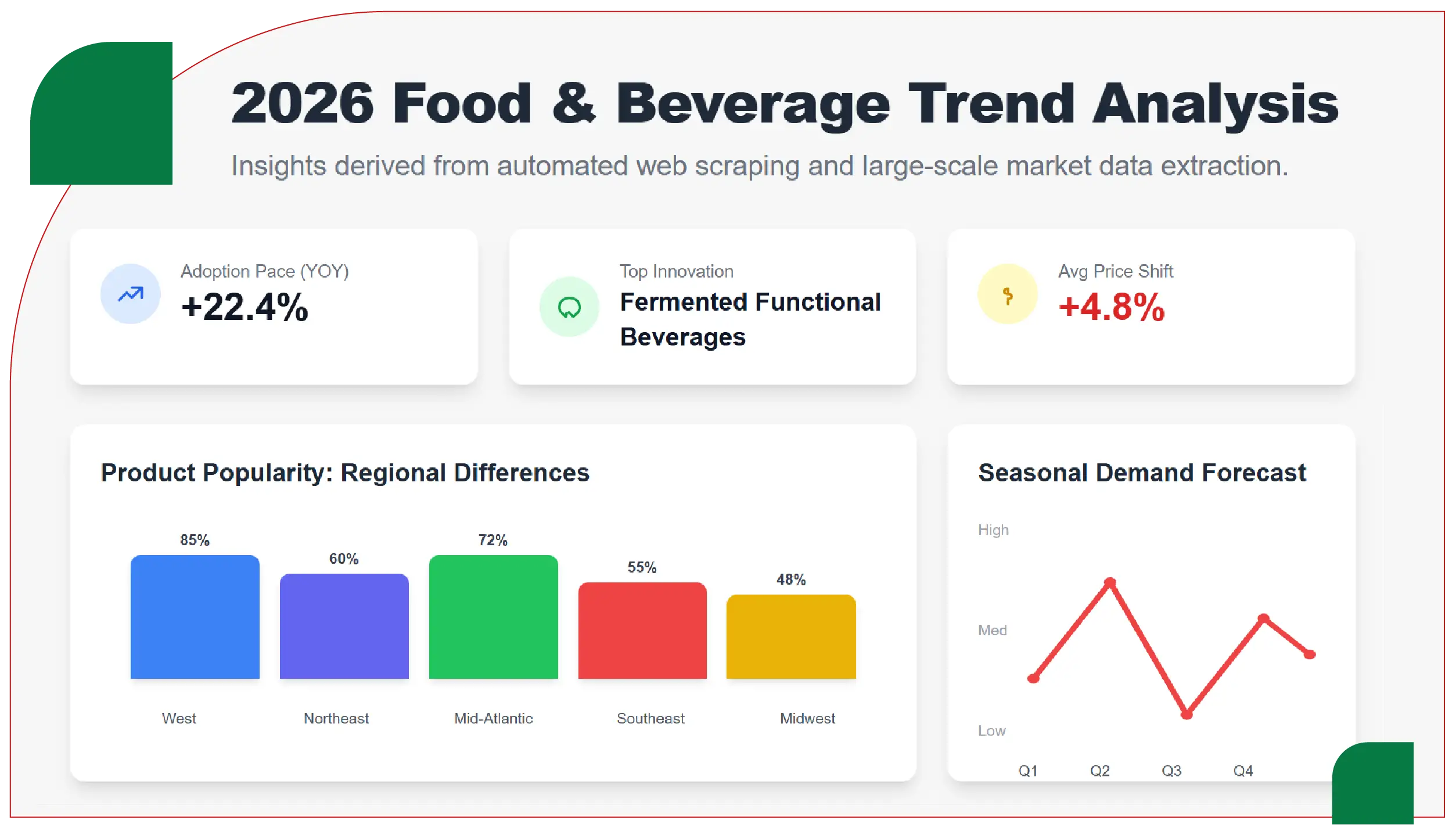
The research leverages automated Web Scraping F&B Trends Data for 2026 to gather structured datasets from multiple sources, including online menus, delivery apps, restaurant websites, and industry reports. By extracting large-scale information across regions, analysts obtain comprehensive insights into product popularity, pricing strategies, seasonal preferences, and promotional trends.
The process involves identifying key data points such as item names, categories, prices, ingredients, nutritional information, and customer reviews. Using machine learning algorithms, the collected datasets are analyzed to detect patterns, forecast demand, and identify emerging trends. Additionally, geospatial and temporal analyses help highlight regional differences and peak periods for various product categories.
Extract 2026 Food and Beverage Market Insights to understand which product innovations are gaining traction, the pace of adoption across demographics, and opportunities for new launches. Such insights are vital for manufacturers, retailers, and restaurant chains planning marketing campaigns, menu modifications, and supply chain adjustments.
| Food Category | Forecasted Demand Growth (%) | Key Drivers |
|---|---|---|
| Plant-Based Proteins | 25 | Sustainability, health-conscious trends |
| Functional Beverages | 18 | Wellness, immunity, natural ingredients |
| Gluten-Free Products | 12 | Health & dietary restrictions |
| Ready-to-Eat Meals | 15 | Convenience, urban lifestyle |
| Ethnic/Global Cuisine | 10 | Cultural exploration, diverse tastes |
Modern businesses rely heavily on Real-Time F&B Trend Intelligence Dataset 2026 to track real-time shifts in consumer preferences. Data scraping allows companies to monitor menu additions, product reviews, delivery trends, and promotional campaigns across multiple platforms.
By leveraging Food Industry Trend Forecast 2026 with Insights Data, businesses gain competitive advantages, including early identification of viral trends, customer sentiment analysis, and inventory planning. Additionally, integrating this data with sales and POS systems enables predictive modeling for supply chain optimization and demand forecasting.
Advanced scraping also supports secondary insights such as pricing trends, seasonal item popularity, and regional consumption patterns. Combining these insights with demographic and social media data enhances the ability to tailor marketing strategies and product offerings to specific consumer segments.
| Region | Trending Food Item | Expected Growth (%) | Key Consumer Segment |
|---|---|---|---|
| North America | Plant-Based Burgers | 28 | Millennials & Gen Z |
| Europe | Functional Beverages | 20 | Health-conscious adults |
| Asia-Pacific | Ethnic/Global Cuisine | 15 | Urban middle-class |
| South America | Ready-to-Eat Meals | 17 | Young professionals |
| Middle East | Gluten-Free Snacks | 13 | Health & lifestyle focused |
Incorporating Food Delivery Scraping API Services enhances decision-making by providing access to structured, continuously updated datasets. Restaurant Data Intelligence Services allow businesses to combine these insights with historical sales data to develop robust, data-driven strategies for market entry, pricing, and promotions.
The 2026 food and beverage landscape will be shaped by evolving consumer preferences, technological adoption, and sustainability demands. Companies equipped with comprehensive insights from Food delivery Intelligence services will be able to monitor trends and consumer behavior effectively. Integrated dashboards such as Food Price Dashboard help businesses visualize pricing patterns and market dynamics. Access to Food Delivery Datasets allows organizations to make informed, data-driven decisions for strategy, expansion, and operational planning.
Utilizing data scraping techniques not only provides real-time intelligence but also supports innovation, enhances customer engagement, and drives growth. By anticipating trends in plant-based products, functional beverages, convenience foods, and sustainable practices, businesses can ensure competitiveness and resilience in an increasingly dynamic industry. The insights derived from Food Delivery Datasets equip stakeholders with actionable knowledge to plan, innovate, and thrive in the market of tomorrow.
If you are seeking for a reliable data scraping services, Food Data Scrape is at your service. We hold prominence in Food Data Aggregator and Mobile Restaurant App Scraping with impeccable data analysis for strategic decision-making.