Introduction
ASDA is one of the UK's largest supermarket chains, serving millions of shoppers every week through its online groceries platform at groceries.asda.com. In 2026, the website lists over 40,000 grocery products — spanning fresh produce, chilled and frozen foods, bakery, ambient goods, household essentials, baby care, and a rapidly expanding range of plant-based and free-from products — all with real-time pricing, live stock availability, promotional offers, and home delivery or click-and-collect options.
The online grocery sector has continued to grow significantly through 2025 and into 2026, with UK consumers increasingly turning to digital supermarket platforms for convenience, value, and flexibility. ASDA has invested heavily in its digital infrastructure, expanding its same-day delivery network, launching its ASDA Rewards loyalty programme with Price Lock benefits, and broadening its click-and-collect capacity across hundreds of UK store locations.
For data professionals, retail analysts, price intelligence teams, e-commerce operators, and developers, scraping the ASDA Groceries website in 2026 is a highly valuable capability. This guide covers everything you need to know: what data is available on the site, the tools and techniques used to extract it, sample data outputs, and best practices for responsible, compliant data collection in the current technical and regulatory environment.
About ASDA Groceries in 2026
ASDA's online grocery platform (groceries.asda.com) has evolved substantially in recent years. The site now offers a significantly richer product catalogue and a more personalised shopping experience, powered by AI-driven recommendations, a streamlined delivery booking system, and the ASDA Rewards programme — which allows customers to earn cashback on selected products and access exclusive Price Lock deals that freeze prices for loyalty members.
In 2026, ASDA operates over 600 UK store locations with click-and-collect services and provides home delivery coverage across the majority of UK postcodes. The grocery platform covers product categories including Fresh Food, Bakery, Dairy & Eggs, Meat & Fish, Frozen, Drinks, Snacks & Confectionery, Plant Based, Free From, Health & Beauty, Baby & Toddler, Home & Garden, and Entertainment.
ASDA's pricing strategy continues to emphasise value, with the Rollback programme remaining a flagship promotion feature alongside multi-buy deals, clearance lines, and ASDA Rewards Price Lock pricing. The platform updates pricing, promotions, and availability in near real-time, making it one of the most data-dense and frequently refreshed grocery websites in the UK.
Why Scrape the ASDA Groceries Website in 2026?
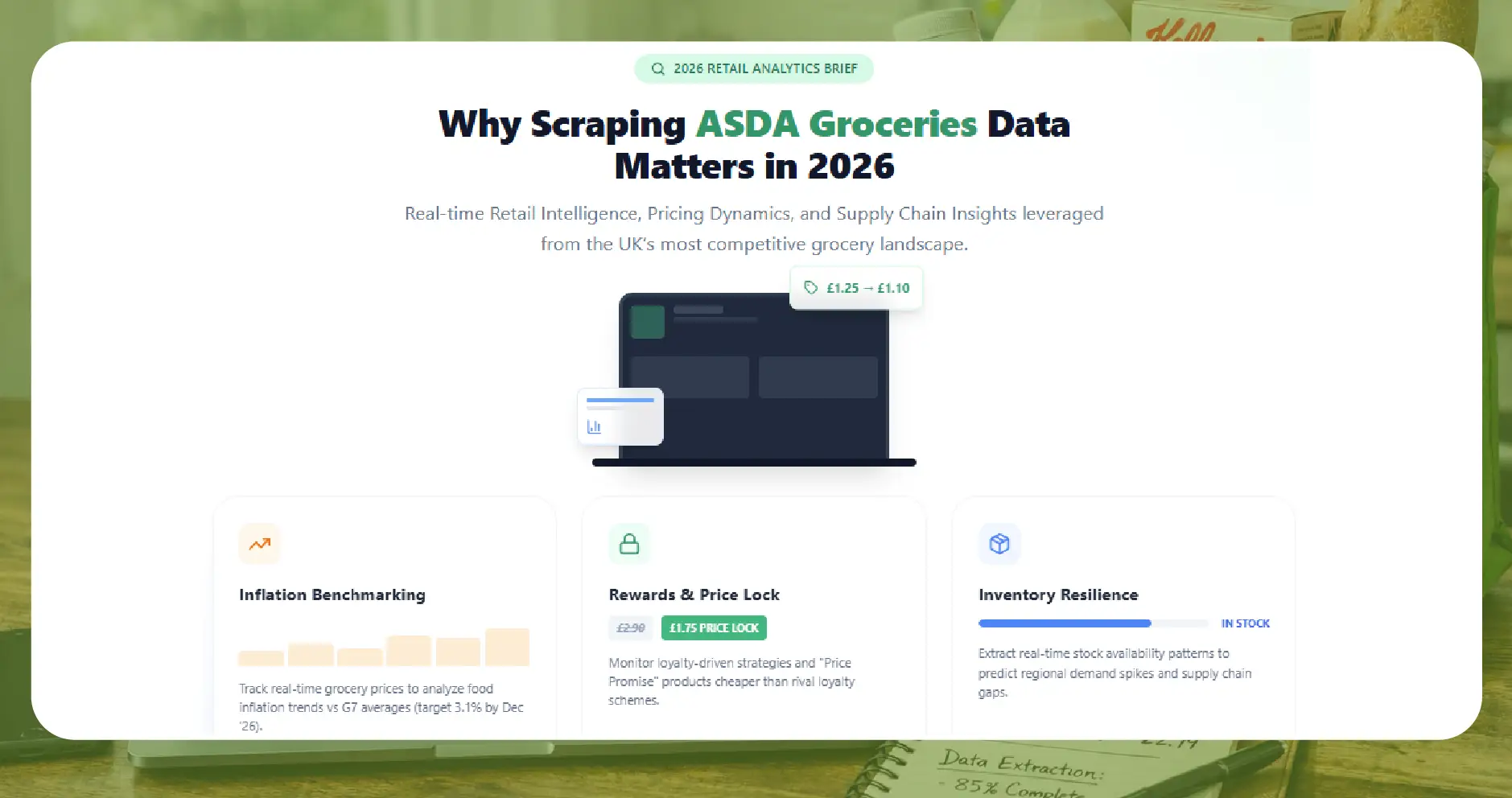
The demand for structured ASDA Groceries data continues to grow across commercial and research applications in 2026. Below are the most important and current use cases driving interest in ASDA grocery website scraping:
- Grocery Price Monitoring & Inflation Tracking
With UK food inflation remaining a significant consumer concern through 2025 and 2026, price monitoring has become one of the most commercially and socially important uses of grocery website data. Price comparison platforms, personal finance apps, and consumer watchdogs scrape ASDA's live prices alongside Tesco, Sainsbury's, Morrisons, Aldi, and Lidl to benchmark value and track inflation trends in essential food categories such as bread, dairy, eggs, and cooking oils. - ASDA Rewards & Price Lock Intelligence
The ASDA Rewards loyalty programme, which became a major feature of ASDA's digital strategy in recent years, introduces a new and valuable data layer for analysts in 2026. Price Lock products — items whose prices are frozen exclusively for Rewards members — create a two-tier pricing structure that is of significant interest to competitive intelligence teams, consumer advocacy organisations, and academic researchers studying loyalty pricing strategies in UK grocery retail. - Product Availability & Stock Monitoring
Retail intelligence teams and supply chain analysts continue to monitor ASDA's stock status data to identify out-of-stock patterns, track product restocking cycles, and model demand fluctuations. In 2026, product availability data has gained additional relevance as supply chain resilience remains a focus for FMCG manufacturers and logistics planners following ongoing global supply disruptions. - Delivery Slot & Fulfilment Intelligence
ASDA's expanded same-day and next-day delivery network in 2026 makes delivery slot data increasingly valuable. Logistics researchers, last-mile delivery platforms, and grocery technology companies track ASDA slot availability to understand fulfilment capacity, peak demand windows, and regional delivery patterns — insights critical for optimising competing delivery operations or informing investment decisions in the online grocery sector. - Plant-Based & Free-From Category Growth
The plant-based and free-from product ranges on ASDA Groceries have grown substantially by 2026, reflecting shifting consumer dietary preferences. Health-tech platforms, dietary app developers, and food industry researchers now specifically target this category for scraping to track new product launches, price trends, and nutritional profiles within the rapidly evolving alternative protein and allergen-free segments. - Promotions Strategy & FMCG Competitive Intelligence
FMCG manufacturers, brand managers, and category analysts extract ASDA's promotional data — Rollback prices, multi-buy deals, Price Lock products, and seasonal promotions — to understand ASDA's evolving pricing strategy, monitor their own brand visibility and pricing within the ASDA online channel, and benchmark against competitor brands within the same categories.
What Data Is Available on ASDA Groceries in 2026?
The ASDA Groceries website exposes a rich array of product and operational data across its product detail pages (PDPs), category listing pages, search results, and promotions sections. The 2026 data schema is notably richer than prior years, with the addition of ASDA Rewards fields, Price Lock indicators, same-day delivery flags, and expanded promotional labelling:
Table 1: ASDA Groceries Website — Extractable Data Fields (2026)
| Data Field | Data Type | Example Value | Use Case |
|---|---|---|---|
| Product Name | String | ASDA Whole Milk 4 Pints | Search indexing, cataloguing |
| Brand | String | ASDA / Kellogg's / Heinz | Brand vs own-label analysis |
| Category | String | Dairy & Eggs | Category benchmarking |
| Sub-Category | String | Milk | Granular shelf analysis |
| Current Price (£) | Float | 1.85 | Price intelligence, tracking |
| Promo / Was Price | Float | 1.40 | Discount & Rollback monitoring |
| Promotion Label | String | Rollback / 3 for £5 / Price Lock | Promo type classification |
| Unit Price | String | 81p per litre | Price-per-unit comparison |
| Stock Status | Enum | In Stock / Low Stock / Out of Stock | Availability monitoring |
| Weight / Volume | String | 2.272L | Product specification |
| Product URL | URL | groceries.asda.com/product/... | Deep link, deduplication |
| Image URL | URL | ui.assets-asda.com/dm/... | Visual cataloguing |
| EAN / Barcode | String | 05010029011600 | Cross-retailer matching |
| Delivery Slot | String | Today / Tomorrow / 3+ days | Fulfilment intelligence |
| Click & Collect | Boolean | true / false | Omnichannel availability |
| Rewards / Price Lock | String | ASDA Rewards Price Lock | Loyalty pricing tracking |
| Customer Rating | Float | 4.7 | Sentiment analysis |
| Review Count | Integer | 3,812 | Popularity scoring |
| Last Scraped | DateTime | 2026-03-11T08:32:00Z | Data freshness tracking |
Beyond individual product records, ASDA's category and search pages in 2026 also expose listing-level metadata including total product count per category, filter facets by brand, dietary requirement and price band, sponsored product placements, and AI-driven personalisation signals — each of which adds further layers of competitive and behavioural intelligence.
Sample Data from the ASDA Groceries Website (2026)
The following sample dataset illustrates the type and structure of data extractable from groceries.asda.com in 2026 across multiple product categories. Prices reflect the current inflationary environment and updated promotional structure, including the expanded plant-based and dairy-free range:
Table 2: Sample ASDA Groceries Data Extract (March 2026)
| Product Name | Category | Price (£) | Promo Price | Stock Status | Delivery Available |
|---|---|---|---|---|---|
| ASDA Whole Milk 4 Pints | Dairy & Eggs | £1.85 | — | In Stock | Yes – Same Day |
| ASDA Chicken Breast 500g | Meat & Fish | £4.75 | £3.75 | In Stock | Yes – Next Day |
| Heinz Baked Beans 4 Pack | Tins & Cans | £2.25 | £1.75 | In Stock | Yes – Same Day |
| ASDA Sourdough Loaf 400g | Bakery | £1.40 | — | In Stock | Yes – Next Day |
| Warburtons Crumpets 6pk | Bakery | £1.50 | £1.10 | Low Stock | Yes – Next Day |
| ASDA Free Range Eggs 12pk | Dairy & Eggs | £3.50 | — | In Stock | Yes – Same Day |
| Coca-Cola Original 8 x 330ml | Soft Drinks | £5.75 | £4.50 | In Stock | Yes – Same Day |
| ASDA Unsalted Butter 250g | Dairy & Eggs | £2.00 | — | Out of Stock | No |
| ASDA Plant Based Mince 500g | Chilled | £2.50 | £2.00 | In Stock | Yes – Same Day |
| Oatly Oat Drink Barista 1L | Dairy-Free | £1.80 | — | In Stock | Yes – Next Day |
Sample JSON Record (2026)
The following is a representative JSON output for a single ASDA grocery product record in 2026, including the new ASDA Rewards and Price Lock fields added to the data schema:
Sample JSON Output — ASDA Groceries Product Record (2026)
  {
  "product_name": "ASDA Whole Milk 4 Pints",
  "brand": "ASDA",
  "category": "Dairy & Eggs",
  "sub_category": "Milk",
  "price_gbp": 1.85,
  "promo_price_gbp": null,
  "promo_label": null,
  "price_lock": false,
  "asda_rewards_eligible": true,
  "unit_price": "81p per litre",
  "weight": "2.272L",
  "stock_status": "In Stock",
  "delivery_available": true,
  "click_and_collect": true,
  "next_available_slot": "Today",
  "customer_rating": 4.7,
  "review_count": 3812,
  "ean": "05010029011600",
  "product_url": "https://groceries.asda.com/product/1000001011035",
  "image_url": "https://ui.assets-asda.com/dm/asdagroceries/milk-4pints.jpg",
  "scraped_at": "2026-03-11T09:04:17Z"
}
Understanding the ASDA Groceries Website Structure in 2026
ASDA's grocery platform continues to use a React-based single-page application (SPA) architecture in 2026. Product data is loaded dynamically via internal API calls rather than being served as fully rendered HTML. This means that traditional static HTML scrapers will retrieve incomplete page content — the product data is injected into the DOM after initial page load via JavaScript.
In 2026, the most reliable approach to extracting ASDA grocery data remains either browser automation (using tools such as Playwright or Puppeteer) or direct interception of the underlying XHR and Fetch API calls that the browser makes when loading product or category pages. Intercepting these internal JSON API responses is typically the most efficient method, producing clean, structured data with minimal post-processing overhead.
Key URL Patterns on groceries.asda.com (2026)
- Homepage: groceries.asda.com
- Category pages: groceries.asda.com/shelf/{category-slug} e.g. /shelf/dairy-eggs
- Sub-category pages: groceries.asda.com/shelf/{sub-category-slug} e.g. /shelf/plant-based
- Product detail pages: groceries.asda.com/product/{product-id}
- Search results: groceries.asda.com/search?q={query}&page={n}
- Rollback & Offers: groceries.asda.com/offers
- ASDA Rewards Price Lock: groceries.asda.com/shelf/price-lock
- Extra Special range: groceries.asda.com/shelf/extra-special
- Plant Based range: groceries.asda.com/shelf/plant-based
- Click & Collect: groceries.asda.com/click-and-collect
Tools & Technologies for ASDA Groceries Scraping in 2026
The tooling landscape for grocery website scraping has matured further by 2026, with several new frameworks and cloud-based scraping infrastructure options now widely used. The following technologies are most commonly deployed for ASDA Groceries data extraction:
Browser Automation
- Playwright (Python / Node.js) — the leading tool in 2026 for scraping JavaScript-heavy SPAs like ASDA Groceries. Supports headless mode, request interception, context isolation, and the widely-used playwright-stealth plugin for bot evasion.
- Puppeteer (Node.js) — a Chromium-based headless browser library with excellent network request interception. Remains popular for Node.js-based ASDA scraping pipelines.
- Selenium (Python / Java) — a mature, broadly supported automation framework. Slightly slower than Playwright but well-suited to teams with existing Selenium infrastructure.
HTTP Clients & API Interception
- Python httpx / aiohttp — async-capable HTTP clients used to directly call ASDA's internal APIs, identified via browser developer tools network inspection. Fast and lightweight for large-scale product data extraction.
- curl-impersonate — a 2026-era tool that mimics real browser TLS fingerprints, improving success rates against advanced bot detection without requiring a full browser runtime.
Data Parsing, Storage & Processing
- Python (pandas, polars, json, csv) — polars has become the preferred high-performance DataFrame library in 2026 for processing large ASDA grocery datasets.
- PostgreSQL — the dominant relational database for structured ASDA product catalogues, price history tables, and promotional tracking.
- MongoDB — document store for flexible raw JSON product records from ASDA's API responses, particularly useful during prototyping.
- BigQuery / Snowflake / Databricks — cloud data platforms used by enterprise teams for large-scale, longitudinal ASDA price monitoring and trend analytics.
Infrastructure, Proxies & Scheduling
- Residential rotating proxies (Bright Data, Oxylabs, IPRoyal) — essential in 2026 for bypassing ASDA's IP-based rate limiting and Cloudflare protection layers.
- Apache Airflow / Prefect / Dagster — workflow orchestration tools for scheduling daily, hourly, or real-time ASDA data refresh jobs.
- Docker / Kubernetes / AWS ECS — containerised, cloud-native deployment of ASDA scrapers for scalable, reproducible, and fault-tolerant data pipelines.
- Scrapy with Playwright middleware — combines Scrapy's mature crawling framework with Playwright's JavaScript rendering capability for structured, large-scale ASDA catalogue crawls.
Challenges in Scraping ASDA Groceries in 2026
Several technical and operational challenges must be addressed when building reliable ASDA grocery data pipelines in 2026:
- Advanced bot detection — ASDA's enhanced Cloudflare integration, device fingerprinting, and behavioural analysis make naive scraping approaches increasingly unreliable in 2026. Stealth plugins and high-quality residential proxies are non-negotiable components of a production-grade pipeline.
- JavaScript rendering — ASDA's SPA architecture continues to require browser automation or API interception; static HTTP scrapers will not capture product data.
- ASDA Rewards pricing — Price Lock products display different prices for logged-in Rewards members versus anonymous visitors. Capturing both tiers requires authenticated session management alongside anonymous scraping.
- Same-day delivery slot data — slot availability is postcode-specific and updates in near real-time, requiring postcode-aware request handling and frequent data refresh cycles.
- Dynamic promotions — Rollback offers, multi-buy deals, and seasonal promotions change frequently; price intelligence applications require daily or intraday updates to remain accurate.
- Expanded category depth — ASDA's growing plant-based, free-from, and own-brand premium ranges have added further depth to the site taxonomy, requiring more comprehensive crawl coverage in 2026.
- Session and cookie management — loyalty pricing, personalised recommendations, and some delivery availability data require valid authenticated session cookies to display correctly.
Best Practices for Responsible ASDA Groceries Scraping in 2026
Responsible data collection from grocery websites requires balancing commercial objectives with respect for website infrastructure and adherence to applicable legal frameworks. The following best practices are widely adopted by data professionals operating ASDA scraping pipelines in 2026:
-
Rate Limiting & Ethical Crawling
Control your request rate — typically 1 to 3 requests per second — to avoid placing unnecessary load on ASDA's servers. Introduce randomised delays between requests, vary your crawl patterns, and avoid scheduling all requests simultaneously. Spread large crawls over extended time windows rather than burst-scraping entire categories.
-
Review robots.txt
Always review groceries.asda.com/robots.txt before initiating any automated crawl. This file reflects ASDA's preferences regarding automated access to specific URL paths. Respecting its directives is both an ethical obligation and a practical strategy for maintaining long-term scraper viability.
-
Data Minimisation
Collect only the specific data fields and product categories required for your use case. Avoid indiscriminate bulk-crawling of the full ASDA product catalogue when a targeted subset will suffice. Minimisation reduces server impact, lowers proxy costs, and simplifies data management.
-
Legal & Regulatory Compliance in 2026
Data professionals in 2026 must navigate an evolving legal landscape for web scraping in the UK and EU. Key considerations include ASDA's Terms and Conditions, UK database rights under the Copyright, Designs and Patents Act 1988, the Computer Misuse Act 1990, and UK GDPR (where any personal data may be involved). Legal guidance from a qualified solicitor is strongly recommended before operating any large-scale or commercial ASDA data extraction programme.
Real-World Applications of ASDA Groceries Data in 2026
Structured ASDA Groceries data powers a growing range of commercial, analytical, and social applications in 2026:
- Grocery price comparison engines — aggregate ASDA live prices with Tesco, Sainsbury's, Morrisons, Aldi, and Lidl to help UK consumers find the cheapest basket, particularly relevant as food affordability remains a priority concern in 2026.
- Food inflation dashboards — monitor ASDA grocery price changes over time across essential categories to provide consumers, policymakers, and journalists with longitudinal UK food price intelligence.
- ASDA Rewards & Price Lock monitoring — track which products carry Price Lock status and how Rewards pricing compares to standard shelf prices, enabling loyalty programme analytics and consumer advocacy reporting.
- Smart shopping and budgeting apps — integrate ASDA product data with household budget tools and meal planners to calculate real-time grocery spend and identify the most cost-effective shopping strategies.
- Plant-based & free-from market tracking — monitor ASDA's alternative protein and allergen-free product ranges for new launches, pricing trends, and assortment growth to support food industry investment and product development decisions.
- Retail competitive intelligence — help FMCG manufacturers track their own product listings, pricing accuracy, promotional placement, and review scores within the ASDA digital channel.
- Delivery slot analytics — model ASDA's same-day and next-day delivery capacity by UK postcode region to support last-mile logistics research and delivery infrastructure planning.
- Academic grocery research — supply standardised, longitudinal UK grocery price, availability, and promotions data to food poverty, public health, and consumer behaviour research programmes.
ASDA Groceries Datasets in 2026
Beyond real-time scraping, ASDA Groceries data is increasingly consumed in the form of structured datasets — pre-compiled, regularly updated data exports that can be directly integrated into analytics platforms, machine learning pipelines, research databases, and business intelligence tools without requiring a live scraping infrastructure.
In 2026, the market for UK grocery datasets has matured significantly. Several specialist data providers and aggregators compile and maintain continuously updated ASDA grocery datasets, making structured product data available via direct download, cloud storage feeds, or streaming data pipelines. These datasets are particularly valuable for teams that need historical pricing data, longitudinal stock availability records, or large-scale product catalogue snapshots that would be costly or complex to build from scratch.
Types of ASDA Grocery Datasets Available in 2026
- ASDA Product Catalogue Dataset — a full or partial export of ASDA's product range including product names, categories, sub-categories, EAN barcodes, pack sizes, image URLs, and product page URLs. Typically available as CSV, JSON, or Parquet format.
- ASDA Price History Dataset — longitudinal records of ASDA product prices, promotional prices, and Rollback events over time. Enables food inflation analysis, pricing trend modelling, and competitive benchmarking across months or years.
- ASDA Promotions Dataset — structured records of ASDA's promotional activity including Rollback offers, multi-buy deals, Price Lock products, and seasonal promotions, with start and end dates and discount values.
- ASDA Availability Dataset — time-series records of ASDA stock status (In Stock, Low Stock, Out of Stock) across the product catalogue, useful for supply chain analytics and demand forecasting.
- ASDA Nutritional Dataset — product-level nutritional data including calories, macronutrients, salt, fibre, and allergen declarations for ASDA own-brand and branded grocery products.
- ASDA Rewards & Price Lock Dataset — records of products with active Price Lock status and their corresponding Rewards member prices versus standard shelf prices, with validity dates.
- ASDA Delivery Slot Dataset — aggregated records of home delivery and click-and-collect slot availability by UK postcode district and time window, compiled from regular automated data collection runs.
Table 3: ASDA Grocery Dataset Formats & Delivery Methods (2026)
| Dataset Type | Format | Update Frequency | Typical Use Case |
|---|---|---|---|
| Product Catalogue | CSV / JSON / Parquet | Weekly | Product cataloguing, PIM systems |
| Price History | CSV / Parquet | Daily | Inflation tracking, price analytics |
| Promotions | JSON / CSV | Daily | Promo strategy, deal monitoring |
| Stock Availability | JSON / CSV | Hourly / Daily | Supply chain, demand forecasting |
| Nutritional Data | CSV / JSON | Monthly | Health apps, dietary research |
| Rewards / Price Lock | CSV / JSON | Daily | Loyalty pricing analytics |
| Delivery Slots | JSON | Hourly | Logistics research, fulfilment |
ASDA Groceries API in 2026
ASDA does not offer a publicly documented, commercial-grade product data API in 2026. There is no official developer portal or API key programme through which third parties can access ASDA grocery data in a structured, authorised feed. This is consistent with the approach of most major UK supermarkets, which have not opened their product data infrastructure to external developers in the way that e-commerce platforms such as Amazon or eBay have done.
However, ASDA's online grocery platform does operate a rich set of internal (undocumented) APIs that power the groceries.asda.com SPA frontend. These internal API endpoints return structured JSON responses containing product data, pricing, availability, promotions, and category taxonomy — and can be identified and called directly by experienced data engineers using browser developer tools to inspect network traffic.
ASDA's Internal API Architecture (2026)
When a user browses groceries.asda.com, the browser makes a series of XHR and Fetch requests to ASDA's internal API infrastructure. These requests return JSON payloads that are used to populate the React frontend. Key endpoint patterns identified through network inspection include:
- Product search endpoint — returns paginated JSON product listings for a given search query, including product name, price, promo price, image URL, and availability flag.
- Category / shelf endpoint — returns the full product listing for a given category or sub-category slug, with pagination metadata and filter facet data.
- Product detail endpoint — returns the full product record for a single item, including nutritional data, ingredients, allergens, pack size, and customer reviews.
- Delivery slot endpoint — returns available home delivery and click-and-collect windows for a given postcode, typically requiring a session cookie for accurate results.
- Promotions endpoint — returns current Rollback, multi-buy, and seasonal promotion listings, including Price Lock products for authenticated Rewards users.
- Search autocomplete endpoint — returns product name suggestions for partial search queries; useful for building product name normalisation and deduplication logic.
Table 4: ASDA Internal API Endpoints — Overview (2026)
| Endpoint Type | Method | Returns | Auth Required |
|---|---|---|---|
| Product Search | GET | Paginated product listings (JSON) | No (anonymous) |
| Category / Shelf | GET | Category product list + facets (JSON) | No (anonymous) |
| Product Detail | GET | Full product record incl. nutrition (JSON) | No (anonymous) |
| Delivery Slots | GET | Available slot windows by postcode (JSON) | Yes (session cookie) |
| Promotions / Offers | GET | Rollback & deal listings (JSON) | No (anonymous) |
| Price Lock Products | GET | Rewards Price Lock listings (JSON) | Yes (Rewards session) |
| Search Autocomplete | GET | Product name suggestions (JSON array) | No (anonymous) |
| Basket / Cart | POST | Cart state and pricing totals (JSON) | Yes (session cookie) |
Working with ASDA's Internal API in 2026
Data engineers working with ASDA's internal API in 2026 typically follow a three-stage workflow: first, use browser developer tools (Chrome DevTools Network tab) to identify the relevant API endpoint URLs, request headers, and query parameters during a manual browsing session. Second, replicate those requests programmatically using Python httpx or curl-impersonate, including the necessary session headers, cookies, and query parameters. Third, parse and normalise the returned JSON payloads into a structured data schema for storage and downstream analysis.
Key considerations when working with ASDA's internal API include: endpoint URLs and query parameter structures can change without notice as ASDA updates its frontend; rate limiting and bot detection apply equally to direct API calls as to browser-rendered page scraping; and some endpoints require valid session cookies that must be obtained through an authenticated browser session.
Conclusion
The ASDA Groceries website (groceries.asda.com) enters 2026 as one of the UK's most data-rich and dynamically updated online retail platforms. With over 40,000 product listings, real-time pricing that now incorporates ASDA Rewards Price Lock tiers, live delivery slot availability across an expanded same-day network, and a growing range of plant-based and free-from products, the platform represents an exceptional source of structured UK grocery market intelligence.
Building a reliable ASDA Groceries scraper in 2026 demands a clear understanding of the platform's JavaScript-driven SPA architecture, the deployment of browser automation or API interception techniques, robust proxy and session management to navigate enhanced bot detection, and a thoughtful approach to rate limiting, data minimisation, and legal compliance.
Whether your goal is to track ASDA grocery price inflation, monitor ASDA Rewards Price Lock products, analyse delivery slot availability patterns, or build a UK supermarket price comparison platform, ASDA Groceries data scraping in 2026 offers a powerful, continuously refreshed foundation of structured retail data to underpin data-informed decisions across the grocery sector.
Are you in need of high-class scraping services? Food Data Scrape should be your first point of call. We are undoubtedly the best in Food Data Aggregator and Mobile Grocery App Scraping service and we render impeccable data insights and analytics for strategic decision-making. With a legacy of excellence as our backbone, we help companies become data-driven, fueling their development. Please take advantage of our tailored solutions that will add value to your business. Contact us today to unlock the value of your data.