Introduction
Açaí Bowl Pricing Trends Data Analytics reveals a category that has moved beyond novelty-driven pricing into a phase defined by operational scale, repeat consumption, and controlled premiumization. Unlike emerging food trends that rely on rapid price spikes tied to virality, açaí bowls demonstrate steady price anchoring supported by habit-driven demand and format flexibility.
Web Scraping Açaí Bowl Pricing Trends shows that from Nov 2023 to Nov 2025, the category recorded 26.3% YoY growth, even as trend velocity softened. This combination signals maturity rather than decline. Price performance is no longer dependent on discovery cycles but on frequency, perceived nutritional density, and customization economics.
Scraping Açaí Bowl Menu Prices Across Food Apps confirms that pricing consistency has improved year over year. In 2021–2022, menu prices fluctuated heavily between $9.50 and $15.00 depending on market positioning. By 2023, pricing consolidated, and in 2024–2025, the dominant range stabilized between $14 and $16, reflecting consumer acceptance of bowls as full meals rather than snacks.
How Açaí Bowl Pricing Has Shifted Over the Last Three Years?
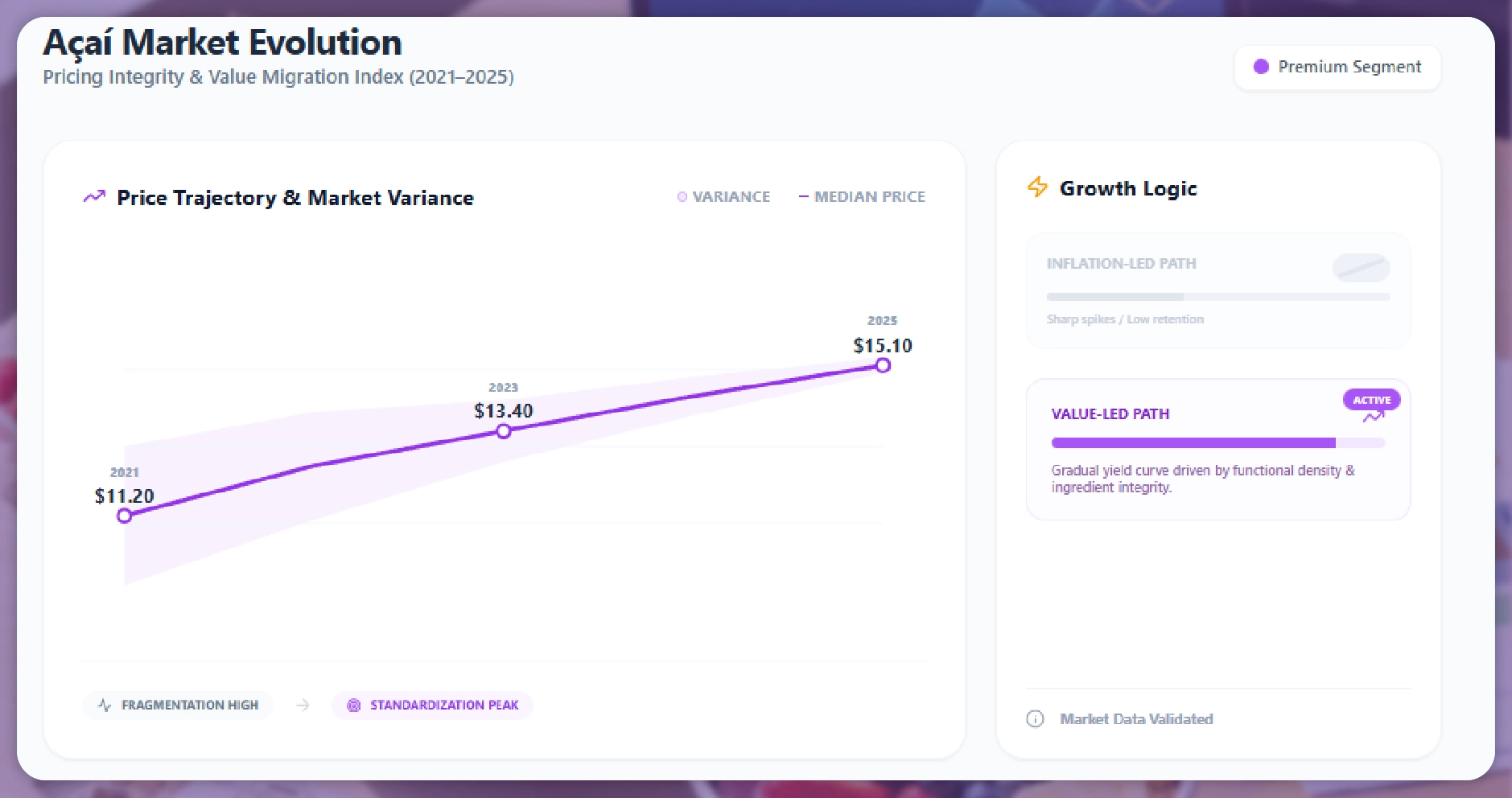
Between 2021 and 2022, açaí bowls were still benefiting from post-pandemic health surges. Pricing during this period was fragmented:
- Average menu price (2021): $11.20
- High regional volatility tied to ingredient shortages
- Limited protein upcharges and low customization depth
By 2022–2023, increased menu penetration and at-home replication pressured operators to justify higher prices:
- Average menu price (2023): $13.40
- Introduction of protein add-ons and calorie disclosures
- Rising alignment with smoothie-led fast-casual pricing
From 2023–2025, pricing behavior matured:
- Average menu price (2025): $15.10
- Narrower variance across platforms
- Premium perception anchored in ingredient density, not portion size
This evolution explains why current growth is not inflation-led. It is value-led.
Açaí Bowl Premium Pricing Data Extraction and Value Anchoring
Açaí Bowl Premium Pricing Data Extraction shows that premium pricing is no longer driven by rare or exotic bases. Instead, value is built through layered toppings, added proteins, and high visual density that signals abundance and quality. The menu data indicates most açaí bowls deliver 560–620 calories, reinforcing their role as full meal replacements rather than light snacks. As a result, consumers have shifted how they assess price. The question is no longer whether the bowl is expensive, but whether it delivers satiety, nutrition, and flavor in one format. This reframing supports scalable premium pricing while maintaining volume and protecting long-term demand.
Turn pricing data into profit—use our food data scraping services to track trends, optimize menus, and scale margins with confidence.
Demand Signals That Stabilize Price Performance
Web Scraping Açaí Bowl Demand and Pricing Signals shows that the category holds a 93% social share within its dish cluster, backed by:
- 91,986 social posts
- 81,440 dishes
- 15,530 restaurants
Unlike trend foods driven by spikes, açaí bowls generate consistent engagement tied to routine behaviors. Social content emphasizes freezing bases, cost control, and daily meals. This practical framing reduces elasticity and stabilizes pricing across delivery and dine-in channels.
Pricing Power Through Format Flexibility
Extract Açaí Bowl Pricing Trends Data alongside dish correlation metrics to explain why price erosion has not emerged even as the category matures. Strong cross-category overlaps with smoothie bowls (228x), smoothies (51x), and power bowls (48x) give operators the ability to shift formats without resetting consumer price anchors. Whether served as a spoonable bowl or a drinkable blend, the underlying value perception remains consistent. Consumers are paying for nutritional density, functional benefits, and meal-level satisfaction rather than format alone. This format flexibility allows brands to adapt offerings by season, daypart, or operational need while maintaining stable pricing. As a result, margins are protected, menu innovation scales efficiently, and pricing integrity remains intact across channels and consumption occasions.
Food Delivery Platforms and Menu Price Standardization
Web Scraping Food Delivery Data shows that açaí bowls exhibit less discounting than comparable dessert categories. Delivery pricing mirrors in-store menus more closely than ice cream or baked goods, reflecting lower impulse sensitivity and higher planned purchase behavior.
Extract Restaurant Menu Data across foodservice platforms to confirm that operators rarely use price promotions to drive volume. Instead, they introduce limited-time toppings, protein variants, or indulgent add-ons that raise ticket size without altering the base price.
APIs, Intelligence, and Scalable Pricing Insights
Food Delivery Scraping API solutions allow brands to monitor how toppings, protein layers, and indulgent additions affect final price architecture across regions. This matters because growth now happens at the margin—not the core.
Restaurant Data Intelligence shows that declining ingredients like banana and coconut remain essential but no longer influence price movement. Incremental pricing power comes from emerging toppings such as Skyr, pistachio, and chocolate strawberry rather than base substitutions.
How Food Data Scrape Can Help You?
- Market-Wide Price Visibility
Our data scraping services track açaí bowl prices across platforms, cities, and brands, helping you benchmark competitors, identify price gaps, and respond confidently to market-wide pricing shifts. - Customization-Level Revenue Insights
We extract add-on, topping, and protein pricing to show which combinations drive higher ticket values, enabling smarter menu engineering and premium pricing strategies without increasing base prices. - Format and Dish Correlation Intelligence
Our scraping reveals overlap between bowls, smoothies, and power formats, helping you flex menus seasonally while maintaining price consistency and protecting margins across dayparts. - Demand and Elasticity Monitoring
We scrape social, menu, and delivery data to identify habit-driven demand patterns, helping you reduce discounting, stabilize pricing, and forecast volume with greater accuracy. - Scalable Pricing and Expansion Strategy
Our data scraping services deliver structured datasets and dashboards that support regional expansion, pricing standardization, and real-time decision-making across food delivery platforms and locations.
Conclusion
Açaí bowls are no longer priced as trend foods. They are priced as infrastructure items within health-forward foodservice. Their ability to absorb innovation without destabilizing baseline pricing makes them a benchmark for mature category economics.
For brands and analysts, Food delivery Intelligence unlocks visibility into how routine consumption sustains premium pricing at scale. When paired with a real-time Food Price Dashboard, pricing movements shift from reactive monitoring to controlled strategy.
Supported by structured Food Datasets, decision-making becomes grounded in repeatable demand patterns rather than short-term noise. As a result, açaí bowl pricing trends become predictable, defensible, and strategically exploitable instead of driven by hype cycles.
If you are seeking for a reliable data scraping services, Food Data Scrape is at your service. We hold prominence in Food Data Aggregator and Mobile Restaurant App Scraping with impeccable data analysis for strategic decision-making.
If you are seeking for a reliable data scraping services, Food Data Scrape is at your service. We hold prominence in Food Data Aggregator and Mobile Restaurant App Scraping with impeccable data analysis for strategic decision-making.