Introduction
The American craft beer industry has transformed from a niche subculture into a multi-billion-dollar economic powerhouse. With more than 9,500 active craft breweries spread across all 50 states, and consumer demand fragmenting into ever more specific styles, regions, and price brackets, the era of one-size-fits-all pricing is officially over. Today, a New England IPA selling for $14.99 a four-pack in Brooklyn might be priced at $11.49 in Cleveland and $16.50 in San Francisco — and those gaps shift weekly.
For brewers, distributors, retailers, and investors, this hyperlocal volatility is both a challenge and an opportunity. The challenge is keeping up. The opportunity is unlocking insights that competitors miss. That is where Food Data Scrape steps in. Our craft beer pricing intelligence platform aggregates real-time pricing, availability, and product data from across more than 50 U.S. cities, giving stakeholders the granular, decision-ready intelligence they need to compete and grow.
In this blog, we explore how craft beer data scraping is reshaping the beverage industry, what kinds of data points matter most, the cities and channels we cover, and how Food Data Scrape's solutions translate raw web data into actionable strategy.
The Booming Craft Beer Market: Why Hyperlocal Data Matters
The U.S. craft beer market continues to evolve at a remarkable pace. According to recent industry analyses, craft brewers now account for nearly 25 percent of the entire beer market by retail dollar value, with annual sales surpassing $28 billion. While the days of double-digit volume growth have given way to a more mature, competitive landscape, this maturation has actually intensified the need for data — not reduced it.
Consider the diversity at play. A taproom in Asheville, North Carolina, may carry 40 rotating drafts at any given moment, while a bottle shop in Portland, Oregon, might stock 600 SKUs across hazy IPAs, barrel-aged stouts, sours, lagers, and emerging hard-seltzer crossovers. Pricing differs not just by city, but by neighborhood, by retailer, by store chain, and even by day of the week during promotional cycles.
This is where the term hyperlocal beer pricing becomes more than a buzzword. It refers to the granular, ZIP-code-level data that allows businesses to understand exactly how a six-pack of West Coast IPA performs in suburban Denver versus downtown Denver, or how seasonal pumpkin ales move in Boston compared with Austin. Without this level of detail, strategic decisions are essentially educated guesses.
Food Data Scrape was built specifically to solve this granularity problem at scale.
Why Craft Beer Pricing Intelligence Matters
Pricing intelligence is the discipline of systematically collecting, analyzing, and acting on competitor and market price data. In the craft beer world, it touches nearly every business decision worth making. Here is why it has become essential.
Competitive positioning. When a regional brewery launches a new hazy double IPA, its team needs to know how comparable beers from rivals like Tree House, Other Half, Monkish, or Trillium are priced in the markets they distribute to. Pricing too high can stall trial; pricing too low can erode brand equity.
Margin optimization. Distributors and retailers operate on famously thin margins. Understanding which SKUs command premium prices, which are discounted heavily, and how often promotions cycle can be the difference between a profitable month and a flat one.
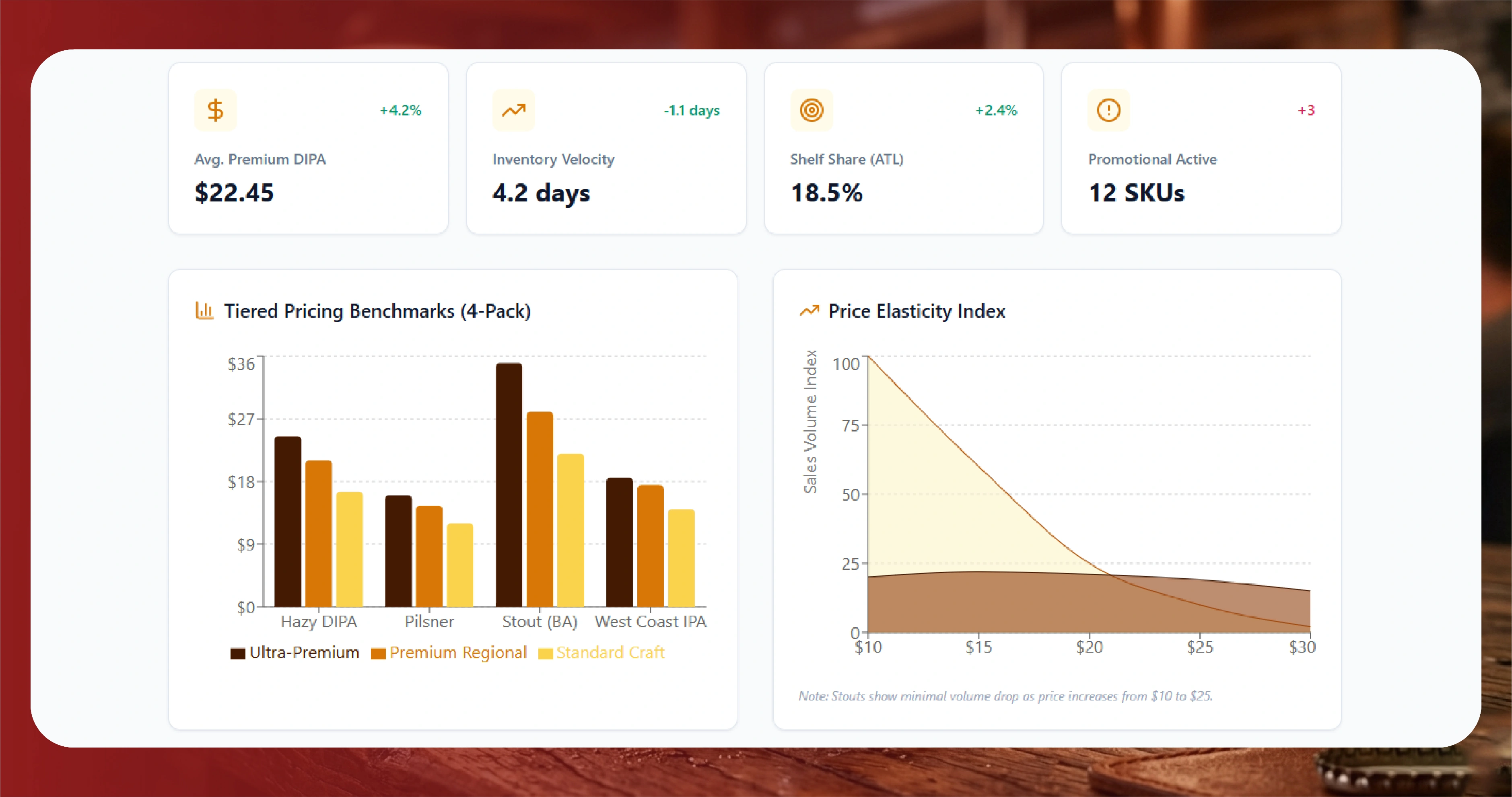
Demand forecasting. Price elasticity varies dramatically across beer styles. Lagers are remarkably price-sensitive; small-batch barrel-aged stouts often defy gravity, with consumers willing to pay $25 to $40 per bottle. Pricing data, when paired with availability and ratings data, becomes a powerful demand signal.
Distribution strategy. Should a Vermont brewery push into the Atlanta market? Pricing benchmarks, competitor density, and shelf-share analysis can answer that question with hard data instead of intuition.
Investor and M&A intelligence. Private equity firms and beverage conglomerates evaluating craft acquisitions rely on robust market data to validate revenue assumptions and growth projections. In each of these scenarios, craft brewery competitive analysis powered by web-scraped data delivers a decisive edge.
How Food Data Scrape Collects Craft Beer Data
At Food Data Scrape, we operate a purpose-built infrastructure for beer data scraping services that ingests information from a diverse network of public web sources every day. Our methodology rests on four pillars.
- Source diversity
We Scrape Beer Brand Data from brewery e-commerce websites, online liquor retailers (Total Wine, BevMo, Drizly partner sites, regional bottle shops), taproom digital menus, beer marketplaces, on-demand delivery platforms, and consumer rating communities like Untappd and BeerAdvocate. This breadth ensures no single channel skews the picture and that every major craft brand — from regional independents to nationally distributed labels — is captured consistently. - Geographic granularity
Our crawlers respect ZIP-code-level differentiation, meaning we capture not just "the price in Chicago" but the price at twenty-plus distinct retail outlets across Chicago neighborhoods. - Refresh cadence
Pricing for fast-moving SKUs is refreshed daily, while slower-moving categories such as cellar stouts may be refreshed weekly. Promotional flags trigger near-real-time recapture. - Quality assurance
Every dataset passes through automated validation layers — schema checks, outlier detection, currency normalization, ABV and IBU sanity ranges, and brand-name disambiguation — before reaching client dashboards or APIs.
Clients receive data through flexible delivery options:
a fully
documented beer data scraping API
(REST-based with token authentication), scheduled CSV or JSON exports, direct database
integration via Snowflake or BigQuery, and custom dashboards. The API supports filtering by
city, retailer, brand, style, and date range, making it easy to plug live craft beer
intelligence directly into your internal BI, pricing engine, or consumer-facing application.
Sample Craft Beer Pricing Data
To illustrate the structure and richness of the craft beer Dataset delivered by Food Data Scrape, here is a sample of the kind of records that flow through our pipelines daily. Every row in our dataset is normalized, deduplicated, and tagged with geographic and temporal metadata so it is ready for direct ingestion into analytics tools or dashboards.
Sample 1: Retail Pricing Snapshot
| City | Retailer | Brand | Beer Name | Style | ABV | Pack Size | Price (USD) | Date |
|---|---|---|---|---|---|---|---|---|
| New York, NY | Whole Foods Bowery | Other Half | Green City | Hazy IPA | 4.5% | 4 x 16 oz | $17.99 | 2026-04-28 |
| Brooklyn, NY | Top Hops | Sierra Nevada | Hazy Little Thing | Hazy IPA | 6.7% | 6 x 12 oz | $11.99 | 2026-04-28 |
| San Diego, CA | Bottlecraft | Stone Brewing | Stone IPA | West Coast IPA | 6.9% | 6 x 12 oz | $12.49 | 2026-04-28 |
| Denver, CO | Argonaut Liquor | New Belgium | Voodoo Ranger Imperial | Imperial IPA | 9.0% | 6 x 12 oz | $11.99 | 2026-04-28 |
| Austin, TX | Twin Liquors | Live Oak | Pilz | German Pilsner | 5.3% | 6 x 12 oz | $10.49 | 2026-04-28 |
| Portland, OR | Belmont Station | Great Notion | Juice Jr. | Hazy IPA | 6.0% | 4 x 16 oz | $14.99 | 2026-04-28 |
| Boston, MA | Craft Beer Cellar | Tree House | Julius | NEIPA | 6.8% | 4 x 16 oz | $19.99 | 2026-04-28 |
| Chicago, IL | Binny's | Revolution | Anti-Hero IPA | American IPA | 6.7% | 6 x 12 oz | $10.99 | 2026-04-28 |
Sample 2: Taproom Draft Pricing
| City | Taproom | Beer Name | Style | ABV | Glass Size | Price (USD) | Date |
|---|---|---|---|---|---|---|---|
| Asheville, NC | Wicked Weed | Pernicious IPA | American IPA | 7.3% | 16 oz | $7.50 | 2026-04-29 |
| San Francisco, CA | Cellarmaker | Coffee & Cigarettes | Imperial Stout | 9.2% | 10 oz | $9.00 | 2026-04-29 |
| Milwaukee, WI | Lakefront Brewery | Riverwest Stein | Amber Lager | 5.7% | 16 oz | $6.00 | 2026-04-29 |
| Tampa, FL | Cigar City | Jai Alai | American IPA | 7.5% | 16 oz | $7.00 | 2026-04-29 |
| Seattle, WA | Fremont Brewing | Lush IPA | Hazy IPA | 7.0% | 16 oz | $7.75 | 2026-04-29 |
Sample 3: Promotional Activity
| City | Retailer | Beer | Original Price | Promo Price | Discount % | Promo Type | Date |
|---|---|---|---|---|---|---|---|
| Atlanta, GA | Total Wine | Bell's Two Hearted 12pk | $19.99 | $16.99 | 15% | Multi-buy | 2026-04-27 |
| Phoenix, AZ | BevMo | Lagunitas IPA 6pk | $11.99 | $9.99 | 17% | Weekly Special | 2026-04-27 |
| Minneapolis, MN | Surdyk's | Surly Furious 4pk | $13.49 | $11.99 | 11% | Member Pricing | 2026-04-27 |
These tables represent only a tiny slice of the millions of data points Food Data Scrape captures monthly across the country.
50+ Cities Covered Coast to Coast
Our US craft beer market data coverage spans every major metropolitan area and many secondary markets where craft beer culture thrives. Coverage includes but is not limited to: Northeast: New York, Brooklyn, Boston, Philadelphia, Pittsburgh, Burlington, Portland (ME), Providence, Hartford. Mid-Atlantic & South: Washington DC, Baltimore, Richmond, Charlotte, Asheville, Atlanta, Nashville, Birmingham, New Orleans, Tampa, Miami, Orlando. Midwest: Chicago, Milwaukee, Detroit, Cleveland, Columbus, Cincinnati, Indianapolis, Minneapolis, Saint Louis, Kansas City.
Mountain & Southwest: Denver, Boulder, Fort Collins, Salt Lake City, Phoenix, Tucson, Albuquerque, Austin, Houston, Dallas, San Antonio. West Coast & Pacific Northwest: San Diego, Los Angeles, San Francisco, Oakland, Sacramento, Portland (OR), Seattle, Bend, Boise, Spokane. Each city is monitored across multiple retail tiers — chain liquor stores, independent bottle shops, taprooms, grocery, and on-demand delivery platforms — ensuring a 360-degree view of local pricing dynamics.
High-Value Use Cases for Craft Beer Data Scraping
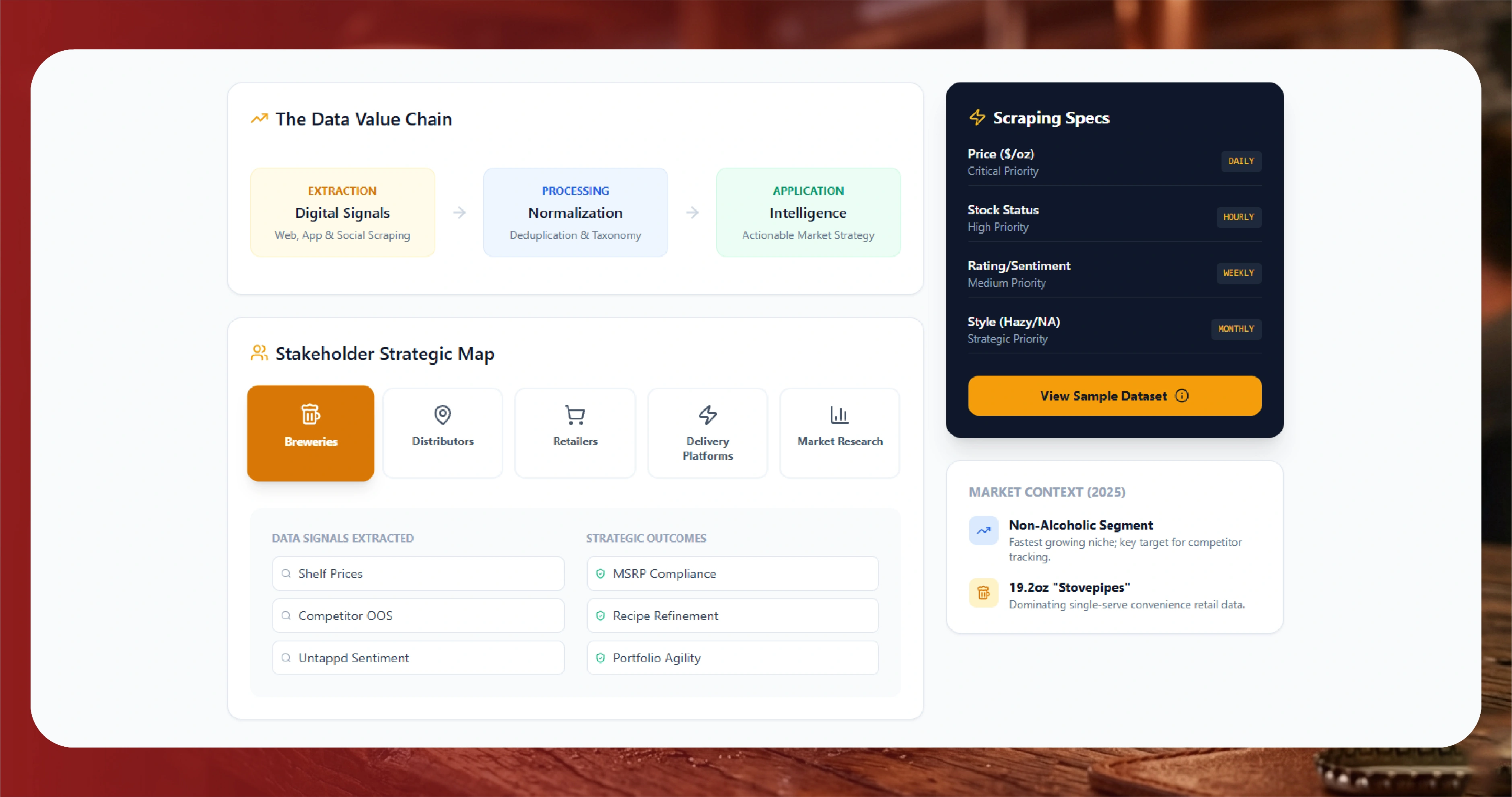
The applications of craft beer market intelligence extend across the entire value chain. For breweries: Benchmark your suggested retail pricing against actual shelf prices, identify markets where wholesalers may be deviating from MSRP, track competitor product launches, and measure the impact of seasonal releases on competing styles. For distributors: Monitor account-level pricing compliance, identify gaps in retail coverage, and prioritize sales territories based on growth signals from the data. For retailers and chains: Optimize SKU mix by neighborhood, time promotions to coincide with competitor activity, and adjust pricing in real time based on market movement.
For delivery platforms: Maintain price competitiveness, surface trending SKUs to consumers, and refine recommendation algorithms with style and rating data. For market research and investment firms: Build category dashboards, validate due-diligence assumptions, and produce data-backed reports on subsegments like hazy IPAs, non-alcoholic craft, hard seltzer crossovers, and premium imports. For consumer-facing apps: Power price-comparison features, send users hyperlocal deal alerts, and enrich product pages with cross-retailer context.
Key Data Points Captured by Food Data Scrape
A robust beverage pricing analytics dataset goes well beyond price tags. Our craft beer schema typically includes:
- Beer name, brand, brewery, and parent company
- Style classification (mapped to BJCP and craft industry taxonomies)
- ABV, IBU, and where available, original gravity
- Pack format, container type, and unit volume
- Retail price, unit price, promotional price, and discount percentage
- Retailer name, retailer type, ZIP code, and geocoordinates
- Stock availability and "out of stock" timestamps
- Untappd and BeerAdvocate ratings, review counts
- Release date, seasonal flag, and limited-edition indicators
- Image URLs and product page URLs
This rich schema enables not just price comparison but multi-dimensional analysis — for example, correlating Untappd score movement with price elasticity, or tracking how shelf availability shifts after a viral social media moment.
Why Choose Food Data Scrape
Many companies attempt in-house scraping only to discover that maintaining crawlers across hundreds of unique retailer websites, each with shifting layouts, anti-bot measures, and edge cases, is a full-time engineering burden. Food Data Scrape solves this with managed infrastructure, ethical and compliant data collection practices, and deep domain expertise in the food and beverage vertical. Key advantages include compliance-first architecture, scalable extraction across millions of pages daily, fully customizable schemas tailored to client needs, near-real-time refresh on priority SKUs, and dedicated analyst support for deeper interpretive work. Whether you need a one-time market snapshot or an always-on pipeline feeding your BI stack, our team configures a delivery model that fits.
Conclusion: Turning Data Into a Competitive Edge
The craft beer industry rewards those who understand their market in fine detail. As competition intensifies and consumer preferences continue to fragment, hyperlocal pricing intelligence is no longer a luxury — it is the foundation of sound strategy. Food Data Scrape exists to give breweries, distributors, retailers, investors, and analysts the cleanest, most comprehensive, and most timely craft beer pricing data available in the United States.
Across more than 50 cities, thousands of retailers, and millions of weekly data points, we transform the chaotic web of beer commerce into structured intelligence you can act on. If you are ready to replace guesswork with insight, get in touch with Food Data Scrape today and unlock the pricing visibility your business deserves. Looking for a custom craft beer Dataset, a one-time market study, or an always-on beer data scraping API? Contact Food Data Scrape to scope a solution tailored to your goals.