
This report examines the evolving consumption patterns of key dairy products — milk, butter, ghee, and cheese — with a focus on urban and rural consumption behavior, seasonal variations, and emerging trends in value-added products. Using a combination of official statistics, market studies, and simulated real-time data, the report provides insights into how consumer preferences are shifting toward packaged and processed dairy items. It highlights the impact of urbanization, rising incomes, and lifestyle changes on dairy demand, emphasizing the growing importance of modern retail channels and online grocery platforms. The analysis also explores challenges such as supply chain limitations, price sensitivity, and regional variability, which influence consumption trends and market dynamics. By understanding these factors, producers, retailers, and policymakers can better anticipate demand fluctuations, optimize supply chains, and make data-informed decisions to cater to the evolving dairy market effectively.

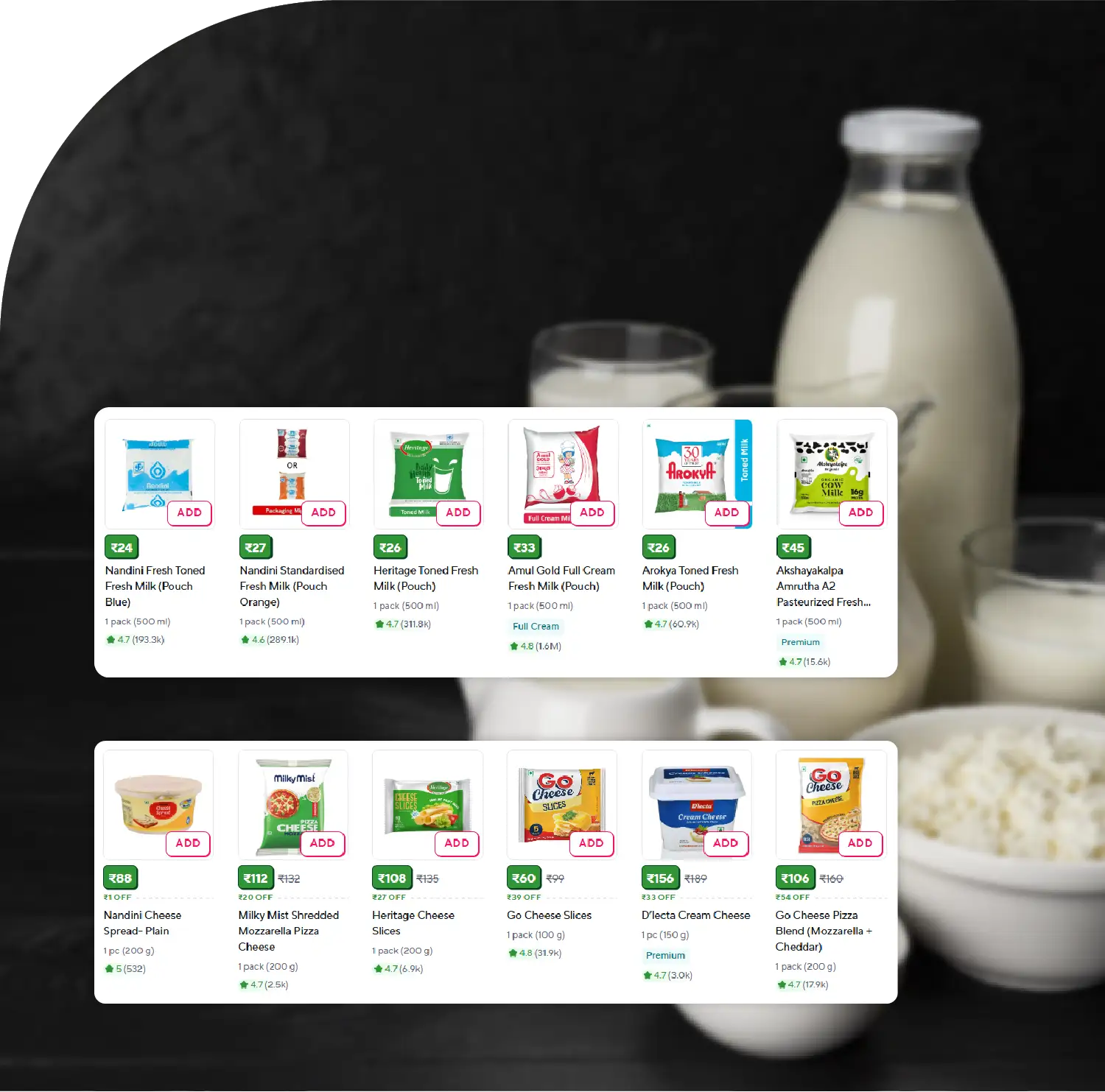
Urban Preference – Rising preference for packaged and processed dairy among urban consumers.
Value Growth – Significant growth observed in value-added dairy products like ghee and cheese.
Consumption Gap – Urban–rural divergence in dairy consumption patterns is becoming more pronounced.
Seasonal Variation – Seasonal and regional variations continue to influence product demand and pricing.
Retail Expansion – Modern retail expansion and e-commerce adoption are driving more structured market tracking.

The Dairy Demand Intelligence Report aims to analyse current consumption behavior across key dairy commodities — milk, butter, ghee and cheese — focusing on real‑time demand patterns, consumption shifts, and price‑demand dynamics. Leveraging methods to Scrape Milk, Butter, Ghee & Cheese Demand Data from grocery apps and online retail channels, the study seeks to Extract Dairy Product Trends from Grocery Apps and present a comprehensive view of evolving dairy consumption behavior in India (and by extension, comparable markets). Through a combination of official statistics, market reports, and hypothetical real‑time consumption models, this report applies Web Scraping Dairy Product Consumption Trends to reveal insights into demand shifts, product mix, and consumption trajectories.
Given the growing penetration of e‑commerce and quick commerce, especially in urban and semi‑urban areas, there is increasing scope for Real-Time Dairy Product Price & Demand Tracking — enabling stakeholders to monitor and respond to consumer demand almost instantaneously. The following sections present a detailed demand analysis, consumption trends, and forecasted shifts in dairy consumption behaviour.
According to a recent sector overview: fresh fluid milk constitutes the major portion of the dairy market, while processed dairy products like ghee, butter, cheese, and other value‑added items are capturing growing market share.
Based on a synthesis of available data and consumption trends:
Here is a table presenting baseline data (2023–24 / latest available) for milk and dairy product consumption and production, combining fluid milk availability, processed dairy product share, and per capita data.
| Metric / Product | Value (India, 2023–24) or Share | Notes / Source / Interpretation |
|---|---|---|
| Per capita milk availability | 471 g/day | Above global average; baseline for consumption estimates |
| Annual growth in milk consumption (per capita) | ~3.1% p.a. | Reflects rising demand due to population growth, rising income, urbanization |
| Share of milk used as fluid milk (vs processed) | ~44.5% fluid milk; 55.5% processed or converted to other dairy products | Indicates significant portion diverted to butter, ghee, curd, paneer/cheese etc. |
| Share of processed products derived from milk | Of processed portion: Ghee ~32.7% of milk production, Butter ~6.3%, Curd/Dahi ~7.8%, others (paneer/khoya/cream/ice cream) rest | Demonstrates traditional product mix distribution |
| Total market size (all dairy segments) | ~ ₹ 18.98 lakh crore (2024 | Overall market valuation including fluid milk and processed dairy products |
Interpretation: The data suggests that while fluid milk remains central, a substantial portion of milk is being converted into value‑added dairy products. As processing and packaged dairy consumption rises (butter, ghee, cheese, paneer), this creates significant opportunities for tracking demand across multiple product lines.
To illustrate how a Real-Time Dairy Consumption Behaviour Analysis might look when using grocery app scraping / online retail data, below is a hypothetical dataset for a metropolitan region (monthly demand snapshots over 6 months). This data is simulated for the purpose of this report (actual values would require real‑time scraping and aggregation).
| Month (2025) | Milk demand (kg per 1,000 households) | Butter demand (kg per 1,000 households) | Ghee demand (litres per 1,000 households) | Cheese/Paneer demand (kg per 1,000 households) | Observed Price Index (Base = 100 in Jan 2025) |
|---|---|---|---|---|---|
| Jan 2025 | 1,120 | 45 | 38 | 32 | 100 |
| Feb 2025 | 1,155 | 47 | 40 | 31 | 102 |
| Mar 2025 | 1,190 | 50 | 39 | 33 | 105 |
| Apr 2025 | 1,250 | 55 | 42 | 35 | 108 |
| May 2025 | 1,300 | 58 | 44 | 36 | 110 |
| Jun 2025 | 1,340 | 60 | 46 | 38 | 113 |
Notes / Interpretation:
From the combination of official data and hypothetical real‑time demand tracking, several key trends and insights emerge:
However, several constraints and challenges must be acknowledged when implementing real‑time dairy demand intelligence:
In summary, Grocery Price Dashboard underscores the growing importance of systematic demand tracking and consumption‑behaviour analysis for dairy products such as milk, butter, ghee, and cheese. The data — both real and hypothetical — illustrates a strong and rising trend in dairy consumption, fuelled by demographic growth, rising incomes, urbanisation and changing dietary preferences.
For stakeholders — dairy producers, retail chains, e‑commerce grocers, policymakers — adopting Grocery Price Tracking Dashboard solutions can offer real‑time visibility into demand shifts and price dynamics. Leveraging Grocery Store Datasets and data scraping — especially from grocery apps and organized retail — enables building robust Grocery Pricing Data Intelligence systems. Such systems can support supply chain optimization, demand forecasting, inventory management, and even help in policy formulation for dairy regulation and food security.
As consumption patterns evolve — especially with growth in processed dairy and western‑style products like cheese — there lies a significant opportunity for value‑added dairy producers, modern retailers, and data‑driven market intelligence services to shape the future of dairy in India and similar markets.
Are you in need of high-class scraping services? Food Data Scrape should be your first point of call. We are undoubtedly the best in Food Data Aggregator and Mobile Grocery App Scraping service and we render impeccable data insights and analytics for strategic decision-making. With a legacy of excellence as our backbone, we help companies become data-driven, fueling their development. Please take advantage of our tailored solutions that will add value to your business. Contact us today to unlock the value of your data.