Introduction: Two Giants of Australian Liquor Retail
The Australian liquor retail landscape is one of the most concentrated in the developed world, dominated by two retail powerhouses operating under two of the country's biggest supermarket groups. Dan Murphy's, owned by Endeavour Group, is Australia's largest specialty liquor retailer, with hundreds of large-format stores and a category-leading e-commerce presence. Liquorland, owned by Coles Group, operates a broad network of stores across both standalone and supermarket-attached formats and competes aggressively across price points.
Together, these two retailers shape what Australians pay for wine, beer, and spirits — from everyday cleanskins to ultra-premium single malts. For brands, distributors, importers, investors, and analysts, understanding how Dan Murphy's and Liquorland price the same products on the same day across the country is foundational to making sound commercial decisions.
That is exactly where Food Data Scrape delivers. Our platform extracts, normalizes, and harmonizes product, pricing, and availability data from both Dan Murphy's and Liquorland across Australia, giving you a single, decision-ready dataset. Web scraping Dan Murphy'sand Liquorland at scale demands more than a basic crawler — it requires postcode-aware coverage, loyalty-tier parsing, and rigorous quality controls applied every day. This guide explains why scraping both retailers matters, how the methodology works, what insights emerge when their data sits side by side, and how to operationalize the resulting intelligence into your commercial decision-making.
The Australian Liquor Retail Context
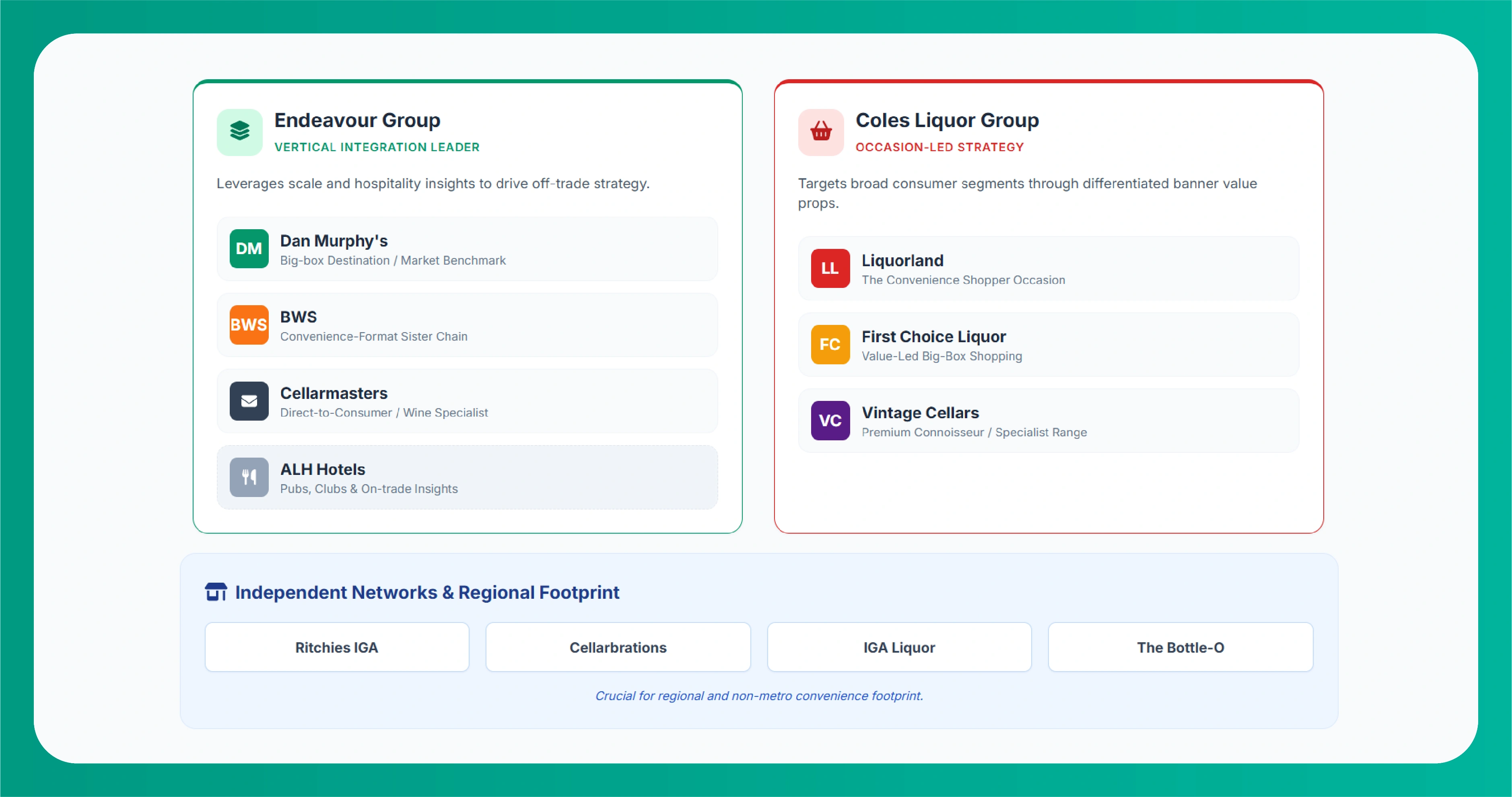
To understand the strategic value of comparing Dan Murphy's and Liquorland, it helps to appreciate the structure of Australian liquor retail more broadly. The market is shaped by a small number of large groups that hold the majority of off-trade share, alongside specialist independents and direct-to-consumer wineries.
Endeavour Group owns Dan Murphy's, BWS (Beer Wine Spirits — the convenience-format sister chain), Cellarmasters, and an extensive hospitality footprint of pubs and clubs. This vertical integration gives Endeavour scale advantages and a direct line into on-trade insights that flow back into off-trade strategy.
Coles Liquor Group owns Liquorland, First Choice Liquor, and Vintage Cellars. Each banner targets a different shopper occasion — Liquorland for convenience, First Choice for value-led big-box shopping, Vintage Cellars for premium connoisseur range — together giving Coles broad coverage across consumer segments.
Independents. Beyond the two groups, independents like Ritchies IGA Liquor, Cellarbrations, IGA Liquor, and Bottle-O networks fill in regional and convenience footprint, particularly in non-metro Australia.
State-by-state regulatory variation is also meaningful. Different states apply different licensing rules, different trading-hour restrictions, and different limits on co-located grocery and liquor retail. These nuances feed into pricing and assortment strategies in ways the data eventually reveals.
For any commercial decision in Australian alcohol — whether a brand launch, distributor scorecard, M&A evaluation, or category-management plan — Dan Murphy's and Liquorland are the two non-negotiable starting points.
Two Retailers, Two Different Playbooks
To appreciate why Dan Murphy's vs Liquorland comparison data is so valuable, you first need to understand how differently these two retailers approach the market.
Dan Murphy's positions itself as Australia's lowest-price specialist liquor retailer with the widest range. It runs a deep loyalty programme (Dan Murphy's Member rewards), aggressive Lowest Liquor Price Guarantee promises, and a sophisticated digital experience covering same-day delivery, click-and-collect, and a vast online catalog of premium and rare bottles. Its scale gives it strong negotiating leverage on direct buys and exclusive labels. The Dan Murphy's catalog is particularly deep in single malt whisky, Australian and New Zealand wine, craft beer, and premium tequila — categories where shopper expectations skew toward range and discovery rather than pure value.
Liquorland operates within the Coles ecosystem alongside First Choice Liquor and Vintage Cellars. Its positioning leans toward convenience, supermarket integration, and frequent promotional cycles tied to Coles' broader marketing calendar. The store footprint includes both standalone bottle shops and supermarket-attached liquor stores, which influences both range and pricing strategy. FlyBuys integration adds a loyalty layer, and category planning often aligns with Coles supermarket trading patterns — strong cross-promotion windows around holidays, sport tentpoles, and seasonal campaigns.
The result: two retailers carrying overlapping catalogs but applying noticeably different pricing logic. The same bottle of Wild Turkey 101 or Penfolds Bin 389 can show meaningful price differences between the two on the same day, and promotional cycles often run on different rhythms. Web scraping liquor stores Australia that captures only one chain tells half the story.
Why Compare Dan Murphy's and Liquorland Pricing
A robust liquor price comparison Australia strategy that includes both chains unlocks insights that single-source data cannot. Dan Murphy's price comparison scraping is most valuable when paired with simultaneous Liquorland capture, because the comparative signal is what drives most commercial decisions — pricing leadership, promotional reaction time, and distribution gap analysis all depend on seeing both retailers at once.
-
Channel benchmarking:
Brand owners can verify whether their premium SKUs are priced consistently across both retailers, or whether one chain is consistently undercutting the other on key products. Pricing leadership detection — knowing which chain leads on which category at which price points — is foundational for trade investment decisions. -
Promotional cadence detection:
Both retailers run heavy promotional cycles, but the structure differs. Dan Murphy's leans on its Lowest Price Guarantee mechanism; Liquorland leans on weekly catalogues and Coles' loyalty integrations. Tracking both sides reveals which promotional model drives more category disruption and how long competitors take to respond. -
Distribution gap analysis:
A SKU available at Dan Murphy's nationally but missing from Liquorland (or vice versa) is a clear distribution priority for brands and distributors. State-level gaps often surface differently, with some products listed in NSW and Victoria but missing from WA or Tasmania — actionable insights only visible when scraping captures multiple postcode anchors. -
Range depth:
Dan Murphy's typically carries deeper craft and premium ranges, while Liquorland often emphasizes high-volume mainstream SKUs. Quantifying these differences with hard numbers helps brands target the right channel for the right product. -
Forecasting and elasticity:
Statistically meaningful price-elasticity studies require multiple price points across time and geography. Capturing both retailers roughly doubles the observable variation, sharpening any model built on top. -
Member pricing vs special pricing dynamics:
Dan Murphy's Member rewards and FlyBuys-linked offers at Liquorland create dual-tier effective pricing. Brands that ignore the loyalty-price tier see only half the consumer cost picture.
How Food Data Scrape Captures Dan Murphy's and Liquorland Data
Food Data Scrape operates a purpose-built infrastructure for Australian alcohol e-commerce that ingests both Dan Murphy's and Liquorland catalogs daily and delivers harmonized datasets ready for direct analysis. Our methodology rests on six pillars
-
Dan Murphy's extraction:
We Scrape Dan Murphy's Data across postcodes nationally, picking up list price, member price, multi-buy offers, in-store availability, click-and-collect status, and same-day delivery eligibility. We also capture promotional flags including "Big Brand Hot Buy," "Member Exclusive," and event-driven specials. -
Liquorland extraction:
We capture Liquorland product pages across postcodes nationally, including standard price, special prices, multi-buy promotional flags, FlyBuys-linked offers, and store availability. Promotional flags like "Down Down" pricing and weekly catalogue specials are captured as structured fields. -
Schema harmonization:
The two retailers use different category taxonomies, different SKU naming conventions, and different size/format presentations. Our harmonization layer maps these into a unified schema so the same bottle of Glenfiddich 12 is identifiable as a single product across both retailers — even when one calls it "Glenfiddich 12 Year Old Single Malt 700ml" and the other calls it "Glenfiddich Single Malt 12YO 700ml." -
Postcode awareness:
Both retailers personalize availability and some pricing by postcode. Our crawlers capture data at multiple postcode anchors per state — typically inner-metro, outer-metro, and regional anchors — to build a representative national view. -
Refresh cadence:
Top-velocity SKUs refresh daily; long-tail and seasonal SKUs refresh weekly. Promotional changes trigger near-real-time recapture on both platforms. New SKU launches are detected and onboarded within 24 to 48 hours. -
Quality assurance:
Every record passes schema validation, brand-name disambiguation, ABV and volume sanity checks, currency normalization, and outlier detection before reaching client systems.
Clients access the data through a documented Australia alcohol pricing API, scheduled CSV/JSON exports, direct integration into Snowflake or BigQuery, and custom comparison dashboards.
Sample Comparison Data
Here are representative records from the Australian Liquor Dataset delivered by Food Data Scrape, harmonized into a single comparable view.
Sample 1: Same SKU, Two Retailers, Same Day
| Product | Dan Murphy's | DM Member | Liquorland | LL Special | Delta | Date |
|---|---|---|---|---|---|---|
| Jim Beam White 700ml | $48.00 | $46.00 | $49.00 | $46.00 | $0.00 | 2026-04-30 |
| Bundaberg UP Rum 700ml | $52.00 | $50.00 | $54.00 | $50.00 | $0.00 | 2026-04-30 |
| Penfolds Bin 389 | $89.00 | $85.00 | $95.00 | $89.00 | -$4.00 | 2026-04-30 |
| Wild Turkey 101 700ml | $59.00 | $55.00 | $62.00 | $58.00 | -$3.00 | 2026-04-30 |
| Glenfiddich 12 700ml | $79.00 | $74.00 | $82.00 | $78.00 | -$4.00 | 2026-04-30 |
| Bombay Sapphire 1L | $58.00 | $54.00 | $60.00 | $56.00 | -$2.00 | 2026-04-30 |
| Dom Pérignon 2013 750ml | $339.00 | $329.00 | $355.00 | $345.00 | -$16.00 | 2026-04-30 |
| 19 Crimes Cabernet Sauv | $13.00 | $11.00 | $14.00 | $11.00 | $0.00 | 2026-04-30 |
| XXXX Gold Carton 24x375 | $54.00 | $52.00 | $56.00 | $54.00 | -$2.00 | 2026-04-30 |
| Veuve Clicquot Brut 750ml | $79.00 | $75.00 | $85.00 | $82.00 | -$7.00 | 2026-04-30 |
Sample 2: Multi-Buy Promotional Tracking
| Retailer | Product | Standard | Multi-Buy | Trigger | Date |
|---|---|---|---|---|---|
| Dan Murphy's | Wolf Blass Yellow Label 750ml | $14.00 | $11.00 each | Any 6 wines | 2026-04-29 |
| Liquorland | Hardys VR 750ml | $13.00 | $10.00 each | Any 6 wines | 2026-04-29 |
| Dan Murphy's | Asahi Super Dry 24x330ml | $79.00 | $69.00 | Single carton special | 2026-04-29 |
| Liquorland | Carlton Dry 24x330ml | $59.00 | $54.00 | Special this week | 2026-04-29 |
Sample 3: Range Depth Comparison
| Category | Dan Murphy's SKUs | Liquorland SKUs | Gap |
|---|---|---|---|
| Single Malt Whisky | 480 | 220 | +260 DM |
| Australian Wine | 3,200 | 1,650 | +1,550 DM |
| Craft Beer | 850 | 410 | +440 DM |
| Premium Tequila | 95 | 38 | +57 DM |
| Champagne | 180 | 95 | +85 DM |
Sample 4: Stock Availability Snapshot
| Postcode | Product | Dan Murphy's Status | Liquorland Status |
|---|---|---|---|
| 2000 (Sydney CBD) | Penfolds Grange 2018 | In Stock | Not Stocked |
| 3000 (Melbourne CBD) | Hibiki Harmony 700ml | In Stock | In Stock |
| 4000 (Brisbane CBD) | Macallan 18 Sherry Oak | Low Stock | Not Stocked |
| 6000 (Perth CBD) | Bundaberg UP Rum 700ml | In Stock | In Stock |
Sample 5: State-by-State Pricing Variation (Glenfiddich 12 700ml)
| State | Postcode | Dan Murphy's | Liquorland | Delta |
|---|---|---|---|---|
| NSW | 2000 (Sydney) | $79.00 | $82.00 | -$3.00 |
| VIC | 3000 (Melbourne) | $79.00 | $82.00 | -$3.00 |
| QLD | 4000 (Brisbane) | $79.00 | $82.00 | -$3.00 |
| WA | 6000 (Perth) | $79.00 | $84.00 | -$5.00 |
| SA | 5000 (Adelaide) | $79.00 | $82.00 | -$3.00 |
| TAS | 7000 (Hobart) | $82.00 | $86.00 | -$4.00 |
Sample 6: 30-Day Price Movement (Penfolds Bin 389)
| Date | Dan Murphy's | Member | Liquorland | Special | Promo Active |
|---|---|---|---|---|---|
| 2026-04-01 | $94.00 | $89.00 | $98.00 | $94.00 | No |
| 2026-04-08 | $94.00 | $89.00 | $95.00 | $89.00 | Liquorland |
| 2026-04-15 | $89.00 | $85.00 | $95.00 | $89.00 | Both |
| 2026-04-22 | $89.00 | $85.00 | $95.00 | $89.00 | Both |
| 2026-04-29 | $89.00 | $85.00 | $95.00 | $89.00 | Both |
These tables represent only a small slice of the millions of cross-retailer records Food Data Scrape captures monthly across Australia.
Reading the Data: What Insights Emerge
When Dan Murphy's and Liquorland data sit side by side in a harmonized schema, several recurring patterns appear.
-
Dan Murphy's tends to anchor lower at the premium tier:
On premium and luxury SKUs, Dan Murphy's member pricing often runs $4 to $20 below Liquorland's special price. This reflects Dan Murphy's scale advantage and its Lowest Liquor Price Guarantee mechanic. -
Liquorland matches aggressively on volume staples:
On high-velocity mainstream SKUs (mainstream beer cartons, popular spirits, mass-market wines), Liquorland's promotional pricing frequently matches or undercuts Dan Murphy's, suggesting deliberate parity strategy on category-driving products. -
Range depth is Dan Murphy's structural advantage:
Across single malt whisky, Australian wine, and craft beer, Dan Murphy's SKU count is roughly 2x Liquorland's, reflecting the specialty retailer model versus convenience-supermarket model. -
Multi-buy promotions are standard in wine:
Both retailers use "any 6 wines" triggers heavily, with discount steps that meaningfully change the per-bottle math for consumers and brand investment for suppliers. -
Postcode availability creates micro-distribution patterns:
A premium SKU may be in stock in inner-city stores but unavailable across regional postcodes — visible only when scraping captures multiple geographic anchors. -
Tasmania consistently runs higher:
Both retailers price slightly above mainland averages in Tasmania, reflecting freight and operational cost differentials. Brands with Tasmanian distribution should plan accordingly. -
Promotional follow patterns are detectable:
When one retailer drops price on a flagship SKU, the other often matches within 5 to 10 days. Detecting these follow patterns informs trade investment timing.
These insights only emerge when the data is captured systematically, normalized rigorously, and compared at scale.
Implementation Roadmap: Operationalizing the Data
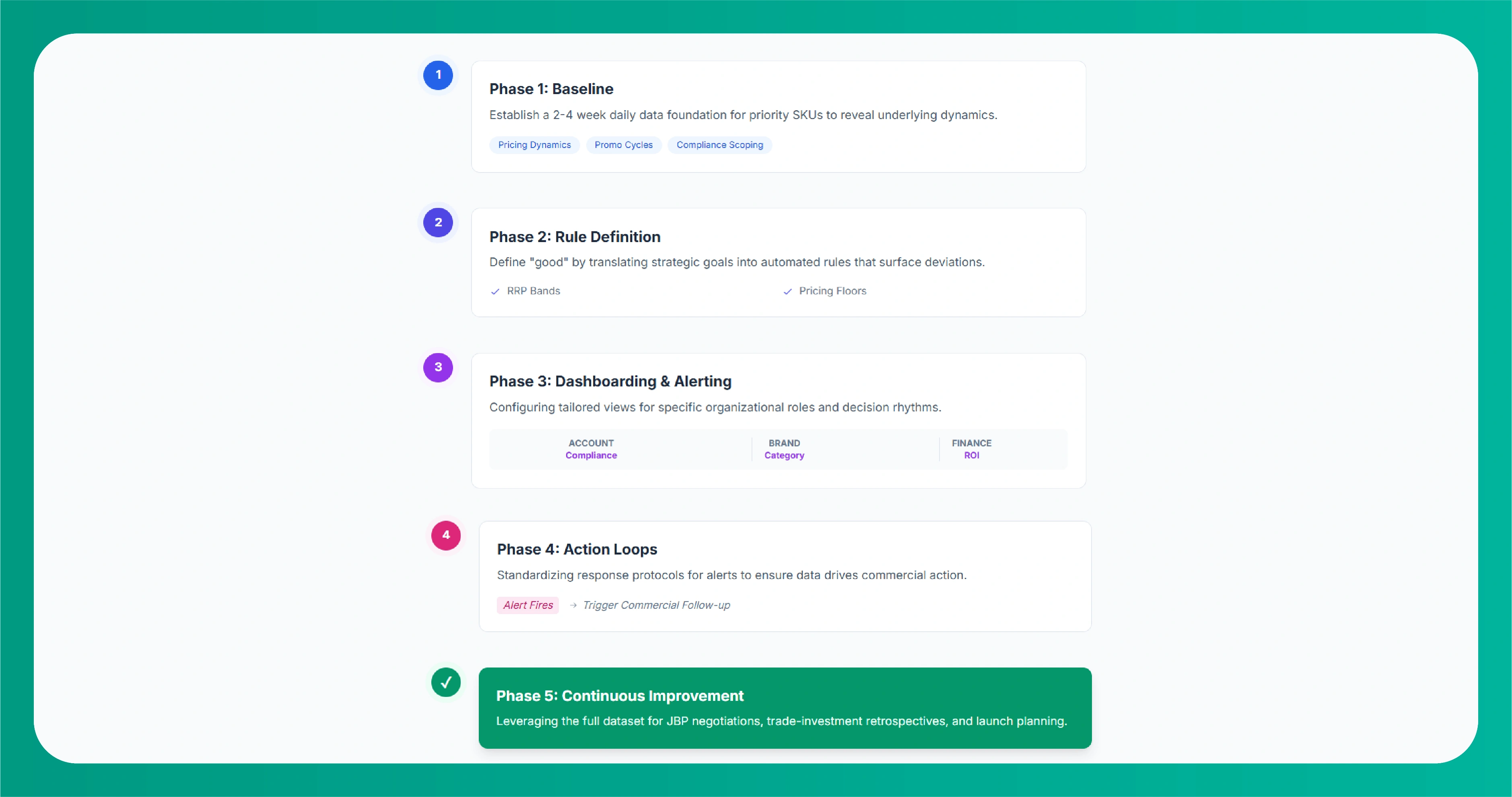
Capturing data is only the first step. To convert harmonized cross-retailer scraping into commercial impact, brands typically work through the following phased roadmap.
Phase 1: Baseline:. Capture two to four weeks of daily data across both retailers to establish a baseline for your priority SKU set. This baseline reveals existing pricing dynamics, promotional cycles, and any active compliance issues that may have gone unnoticed.
Phase 2: Rule definition: Define what "good" looks like — RRP bands, expected promotional windows, listing requirements, distribution priorities, and pricing floors. Translate these into automated rules that surface deviations.
Phase 3: Dashboarding and alerting: Configure dashboards that put the right view in front of the right team. Account managers care about their retailer's compliance posture; brand managers care about category dynamics; finance cares about promotional ROI. Each gets a dashboard tailored to their decision rhythm.
Phase 4: Action loops: Define what happens when an alert fires. A pricing deviation should trigger a follow-up to the retailer's commercial team. A delisting should trigger a distributor conversation. Without clear action loops, even the best data sits unused.
Phase 5: Continuous improvement:Use observed data in Joint Business Plan negotiations, in trade-investment retrospectives, and in launch planning. The longer the dataset runs, the more valuable it becomes for benchmarking and forecasting.
Coverage and Schema
Our alcohol pricing intelligence Australia covers the full Dan Murphy's and Liquorland online catalogs across all states and territories — New South Wales, Victoria, Queensland, Western Australia, South Australia, Tasmania, ACT, and Northern Territory.
A typical harmonized record includes product name, brand, parent company, category and sub-category, ABV, container size, country of origin, and varietal where applicable. Pricing fields cover Dan Murphy's price, member price, multi-buy price, and stock status alongside Liquorland price, special price, multi-buy price, and stock status. Postcode anchors and store availability flags are tagged on every record. Computed price delta and percentage difference are provided as derived fields, and promotional flags including Lowest Liquor Price Guarantee, weekly special, and multi-buy participation are captured as structured booleans. Image URLs and product page URLs from both retailers, plus consumer ratings and review counts where available, complete the schema.
Use Cases for Cross-Retailer Australian Liquor Data
The applications of harmonized cross-retailer data span multiple business functions.
-
For brand owners and importers:
Monitor pricing compliance across both major chains, detect distributor leakage, time new product launches, quantify range opportunity gaps, and benchmark promotional ROI across the two retailers. -
For distributors:
Identify accounts where pricing strays from agreed levels, prioritize markets where range expansion is feasible, and benchmark category share across the two chains. -
For pricing analysts:
Build elasticity models with twice the price-point variation, run scenario simulations, and produce defensible pricing recommendations. -
For investors and M&A teams:
Validate revenue and margin assumptions during due diligence on Australian alcohol brands, distributors, or retail platforms. -
For consumer-facing apps:
Power price-comparison and savings-alert features with reliable, frequently refreshed data covering both major Australian liquor chains. -
For category consultants:
Deliver client reports backed by hard market evidence rather than retailer-supplied figures alone.
Why Choose Food Data Scrape
Building Dan Murphy's and Liquorland scrapers in-house is harder than it appears. Both retailers run sophisticated digital storefronts with postcode-based personalization, dynamic promotional flags, and frequent UI changes. Member pricing on Dan Murphy's and FlyBuys-linked offers on Liquorland add additional parsing complexity. Most internal teams underestimate the engineering and quality assurance investment required to make the dataset trustworthy.
Food Data Scrape provides managed infrastructure, ethical and compliant data collection practices, and deep domain expertise in beverage retail. Our Dan Murphy's alcohol price comparison scraper runs alongside our Liquorland infrastructure to deliver harmonized cross-retailer data in a single feed. Our advantages include compliance-first architecture, scalable extraction across millions of pages daily, fully customizable harmonized schemas, near-real-time refresh on priority SKUs, dedicated analyst support familiar with the Australian market, and out-of-the-box dashboards highlighting cross-retailer deltas. Our team has worked with global brand owners, Australian distributors, hospitality groups, and investment firms — bringing the practical knowledge of how scraped data actually drives commercial outcomes.
Conclusion: Two Retailers, One Source of Truth
Dan Murphy's and Liquorland together define how most Australians experience packaged liquor retail. Each tells a different story — Dan Murphy's about specialist depth and member-driven value, Liquorland about supermarket-integrated convenience and aggressive everyday pricing. Neither alone is enough to guide brand, distribution, or pricing strategy with full confidence. Together, they deliver a panoramic view of the Australian liquor retail market.
Food Data Scrape exists to give you that panorama in clean, harmonized form. Across both chains, every state and territory, and millions of weekly data points, we transform raw alcohol e-commerce activity into structured intelligence ready to power decisions. Whether you need a one-time benchmarking study, a recurring compliance dashboard, or an always-on API feeding your BI stack, we configure a delivery model that fits your workflow and decision rhythm.
If you are ready to stop guessing about cross-retailer pricing dynamics and start acting on real data, get in touch with Food Data Scrape today.
FAQs
Get a Free Food Data Sample in 48 Hours.
Tell us your platforms, target markets and required fields — we'll map exactly what's possible with food data scraping, recommend the right approach, and send a working sample so you can verify quality before any commitment.
Request a strategy call
Thanks — our data team will reach out within 48 hours with your sample.