
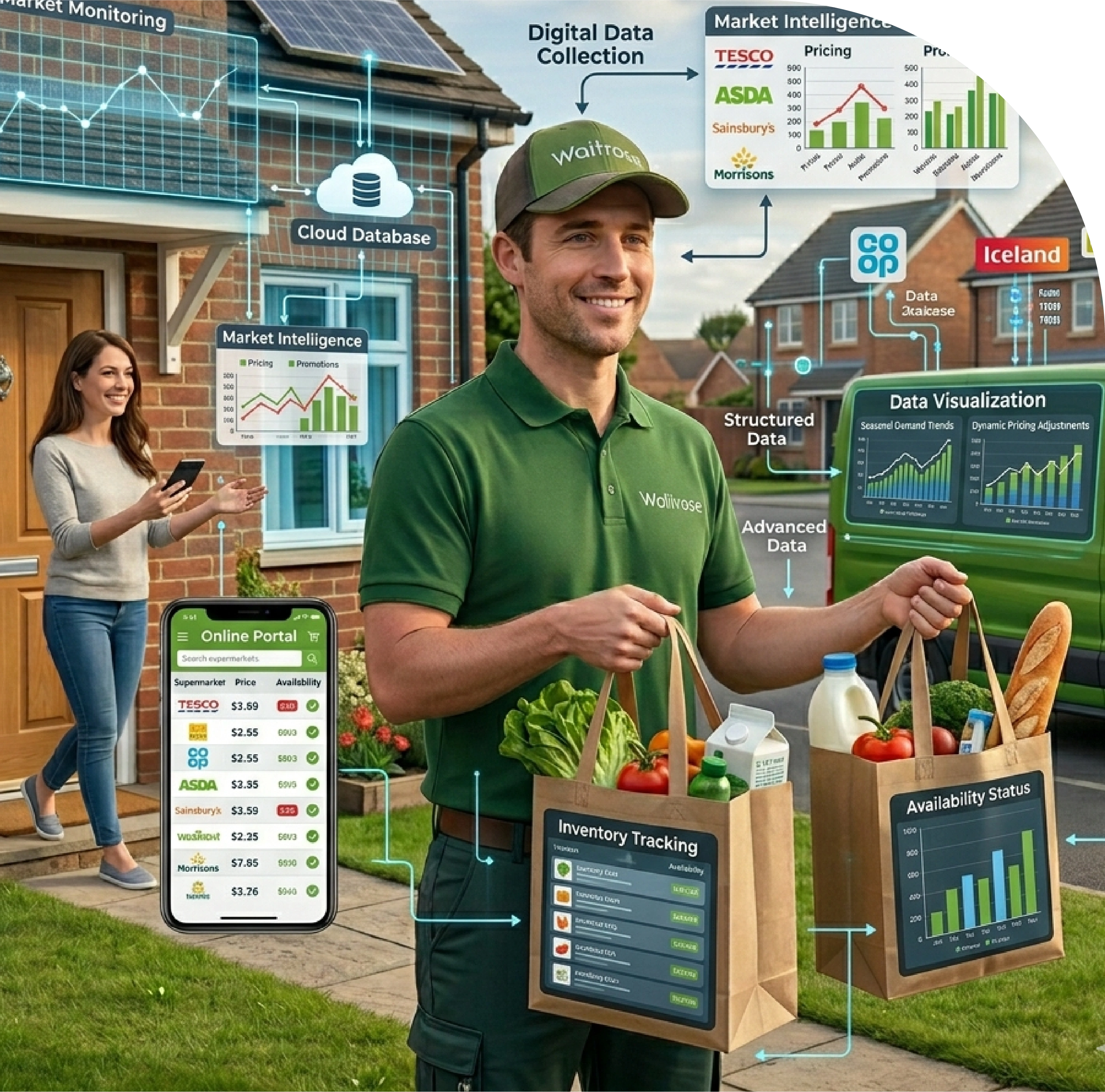
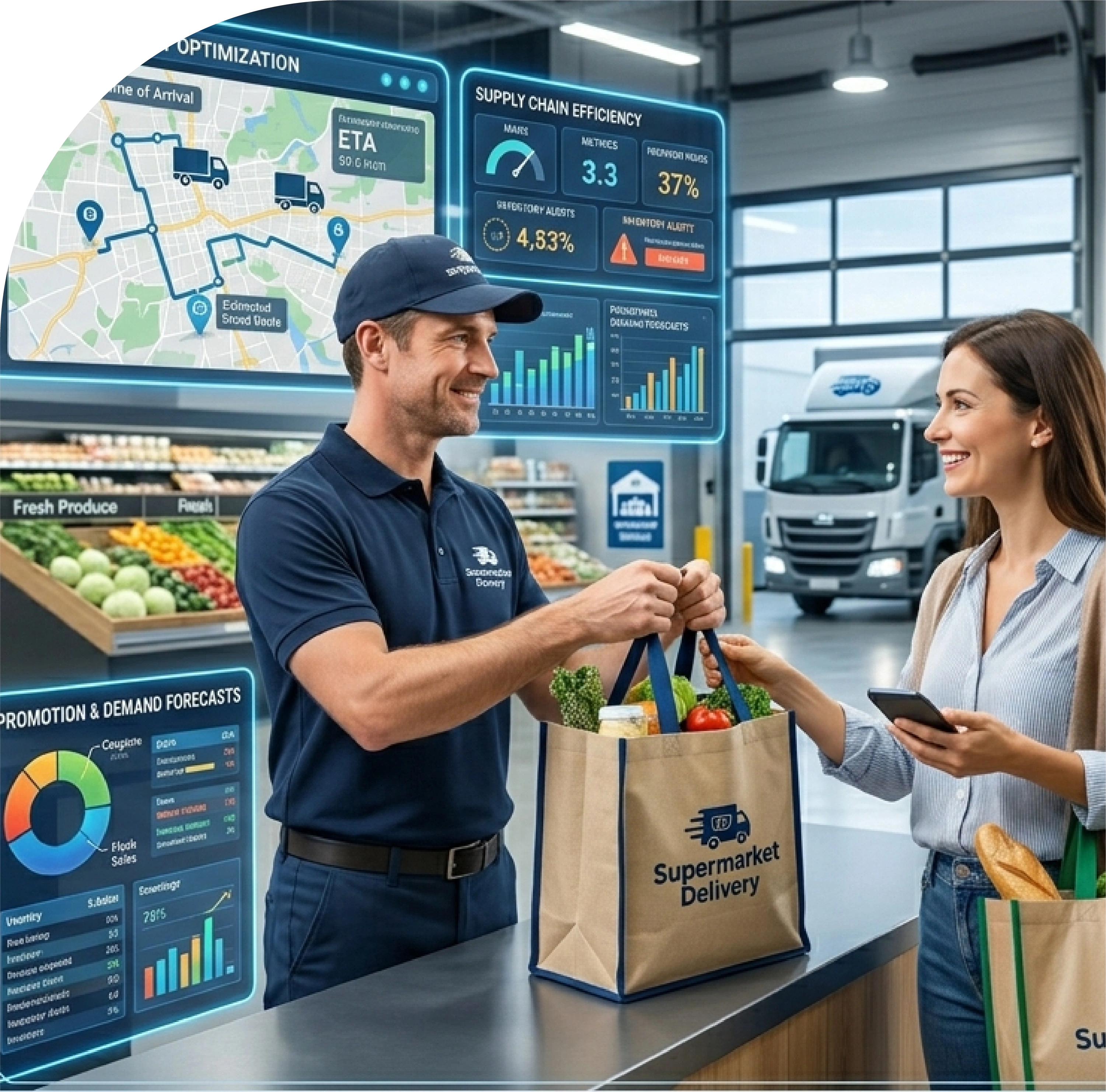
The UK supermarket industry is highly competitive, with major retailers including Tesco, Sainsbury’s, Asda, Morrisons, Co‑op, Iceland, Waitrose, and Ocado. Shifts in consumer preferences, seasonal trends, and dynamic pricing make market monitoring essential. Retailers increasingly rely on digital data collection to track product availability, prices, promotions, and inventory across both online and offline channels. Access to structured data enables better decision-making for pricing, stock management, and marketing strategies. By analyzing trends over time, businesses can identify growth opportunities, optimize product offerings, and respond quickly to competitor actions. Advanced data visualization tools and dashboards help convert raw data into actionable insights, allowing retailers to forecast demand, plan inventory, and enhance operational efficiency. Overall, systematic data collection and analysis are critical for maintaining a competitive edge in the evolving UK grocery market.
Price Tracking – Monitor pricing fluctuations across different retailers to maintain competitiveness.
Promotion Insights – Analyze discounts and special offers to inform strategy.
Stock Levels – Track product availability and identify shortages promptly.
Category Trends – Evaluate performance across grocery segments for strategic decisions.
Operational Intelligence – Use data to optimize inventory, marketing, and supply chain efficiency.

The United Kingdom grocery sector is one of the most competitive retail ecosystems in Europe, driven by dynamic pricing, digital transformation, and changing consumer preferences. Major retailers such as Tesco, Sainsbury's, Asda, Morrisons, Co-op, Iceland Foods, Waitrose, and Ocado operate extensive online and offline infrastructures offering thousands of grocery products across categories such as fresh produce, packaged foods, dairy, beverages, and household items.
Retailers and market intelligence firms increasingly rely on digital data collection techniques to monitor pricing, promotions, and product availability across these platforms. By leveraging automated extraction techniques, businesses can Extract UK Supermarket Data from online stores to monitor market trends, consumer behavior, and competitor pricing patterns.
Another critical application of data extraction is UK Supermarket Competitor Price Monitoring, which allows retailers to track pricing differences across competing supermarkets. Because price sensitivity remains high among UK shoppers, companies must maintain real‑time visibility into competitor pricing to remain competitive.
Similarly, automated collection enables UK Supermarket Product Pricing Data Extraction, capturing SKU‑level price information, promotions, discounts, and private‑label pricing strategies. These insights allow businesses to understand how different retailers position themselves within the market.
The purpose of this research report is to analyze the role of data extraction in monitoring the UK grocery market, highlight the competitive landscape among major supermarkets, and demonstrate how structured data can support market intelligence strategies.
The UK grocery sector is dominated by a handful of large supermarket chains often referred to as the “Big Four”: Tesco, Sainsbury’s, Asda, and Morrisons. These four retailers collectively account for more than 60% of total grocery spending in the country.
Among them, Tesco remains the market leader with a share of approximately 28% of the UK grocery market, followed by Sainsbury’s with about 15% and Asda with roughly 12%. Morrisons holds close to 8–9% of the market.
Other chains such as Co‑op, Waitrose, Iceland, and Ocado play important roles in niche segments including convenience retail, premium grocery products, and online delivery services. Ocado, for instance, has emerged as one of the fastest‑growing online grocers in the UK with strong digital sales growth.
With the rapid expansion of e‑commerce grocery platforms, the importance of UK Grocery Store Data Scraping for Competitive Analysis has increased dramatically. Retailers and analytics firms collect thousands of product listings daily to monitor changes in prices, promotions, and stock availability.
| Supermarket | Estimated Market Share (%) | Quarterly Sales (£ million) | Growth Trend | Key Strength |
|---|---|---|---|---|
| Tesco | 28.1 | 7,250 | Stable growth | Largest store network |
| Sainsbury’s | 15.2 | 3,925 | Moderate growth | Strong private-label strategy |
| Asda | 11.9 | 3,065 | Slight decline | Value pricing model |
| Morrisons | 8.4 | 2,165 | Slow growth | Fresh food supply chain |
| Co‑op | 5.3 | 1,370 | Stable | Convenience stores |
| Waitrose | 4.5 | 1,160 | Premium growth | High-quality product range |
| Iceland | 2.3 | 595 | Steady | Frozen food leadership |
| Ocado | 1.9 | 490 | Rapid growth | Online grocery platform |
| Aldi | 10.9 | 2,815 | Fast growth | Discount pricing |
| Lidl | 8.1 | 2,085 | Fast growth | Competitive discount model |
Market share data represents aggregated UK grocery sales trends based on industry estimates.
The UK grocery market experiences frequent price fluctuations due to seasonal promotions, supply chain costs, and inflation. Retailers frequently adjust product prices to remain competitive, making continuous monitoring essential.
This has led to the rise of Real-Time UK Supermarket Data Tracking, which collects information about prices, product listings, availability, and promotions from supermarket websites and mobile applications.
Key data categories commonly extracted include:
Organizations that Scrape UK Supermarket Product Listings and Prices can gain insights into competitor pricing strategies, private label positioning, and discount patterns.
Another emerging dataset category is the Real-Time UK Supermarket Price Tracking Dataset, which records historical pricing trends for thousands of products. This dataset helps retailers identify patterns such as seasonal price drops, promotional cycles, and competitive price wars.
| Product Category | Product Name | Supermarket | Price (£) | Discount | Availability | Delivery Option |
|---|---|---|---|---|---|---|
| Dairy | Semi‑Skimmed Milk 2L | Tesco | 1.65 | None | In Stock | Home Delivery |
| Dairy | Semi‑Skimmed Milk 2L | Asda | 1.60 | None | In Stock | Store Pickup |
| Dairy | Semi‑Skimmed Milk 2L | Sainsbury’s | 1.70 | Clubcard Offer | Limited | Home Delivery |
| Bakery | Whole Wheat Bread | Morrisons | 1.20 | 10% Off | In Stock | Delivery |
| Bakery | Whole Wheat Bread | Co‑op | 1.35 | None | In Stock | Store Pickup |
| Frozen Food | Frozen Pizza | Iceland | 2.50 | 15% Off | In Stock | Delivery |
| Frozen Food | Frozen Pizza | Tesco | 2.80 | Clubcard Price | In Stock | Delivery |
| Vegetables | Broccoli 500g | Waitrose | 1.75 | None | In Stock | Delivery |
| Vegetables | Broccoli 500g | Asda | 1.55 | Rollback | In Stock | Pickup |
| Snacks | Potato Chips 150g | Ocado | 2.00 | 5% Off | In Stock | Delivery |
| Snacks | Potato Chips 150g | Tesco | 1.85 | Promo | In Stock | Delivery |
| Beverages | Orange Juice 1L | Sainsbury’s | 1.90 | Nectar Price | In Stock | Delivery |
Retail analytics platforms use automated tools for Web Scraping Grocery Data from supermarket websites and mobile applications. This process collects structured data at scale, enabling businesses to analyze thousands of products across multiple retailers simultaneously.
Web scraping tools typically collect data from:
The extracted data is then processed and stored in centralized databases for analysis.
Modern systems also use APIs such as Grocery Delivery Extraction API, which retrieves information about delivery slots, service coverage areas, and pricing structures. These APIs enable analysts to evaluate delivery costs, service availability, and logistics efficiency.
Extracted supermarket data supports several strategic business applications across the retail ecosystem.
These insights are often visualized through dashboards such as the Grocery Price Tracking Dashboard, which provides real‑time views of competitor prices across thousands of SKUs.
Each UK supermarket employs a distinct strategy to attract customers and differentiate itself in the market.
The future of supermarket analytics will be shaped by advanced technologies including artificial intelligence, predictive analytics, and real-time data pipelines.
Retailers increasingly rely on data platforms to predict demand, optimize pricing, and personalize promotions. Data-driven decision making enables supermarkets to respond quickly to market changes and maintain competitiveness.
Furthermore, online grocery services are expanding rapidly. The growth of quick-commerce delivery services, dark stores, and automated fulfillment centers will generate even larger volumes of digital retail data.
The UK grocery sector is highly competitive and driven by dynamic pricing, promotions, and supply chain efficiency. Extracting structured data from major supermarket platforms provides valuable insights into product pricing, availability, and consumer trends.
Through large-scale data extraction, organizations can build datasets that support competitor analysis, pricing intelligence, and demand forecasting. These insights enable retailers to optimize pricing strategies and improve operational efficiency.
Looking ahead, automated analytics will continue to play a critical role in supermarket retail intelligence. Advanced monitoring systems will enable Supermarket Inventory Data Tracking across thousands of SKUs, helping businesses manage supply chains more effectively.
In addition, large-scale data aggregation will generate powerful Supermarket Chains Data Intelligence, providing deeper visibility into the competitive landscape of the UK grocery industry.
Finally, structured Grocery Datasets will become essential assets for retailers, market researchers, and technology companies seeking to understand the evolving digital grocery ecosystem.
Are you in need of high-class scraping services? Food Data Scrape should be your first point of call. We are undoubtedly the best in Food Data Aggregator and Mobile Grocery App Scraping service and we render impeccable data insights and analytics for strategic decision-making. With a legacy of excellence as our backbone, we help companies become data-driven, fueling their development. Please take advantage of our tailored solutions that will add value to your business. Contact us today to unlock the value of your data.