Introduction
In today’s highly competitive grocery and quick-commerce ecosystem, product-level insights alone are no longer sufficient. Businesses need deeper, more granular intelligence to stay ahead—especially at the variant level, where size, weight, packaging, and pricing differences significantly influence customer decisions. This is where the need to Extract Variant-Level Product Data from Grocery Stores becomes a game-changer for retailers, aggregators, and analytics firms.
Variant-Level Grocery Data Scraping enables organizations to capture detailed attributes such as pack size, volume, weight, and price variations across multiple SKUs. With evolving consumer preferences and dynamic pricing models, having access to such precise data helps brands optimize inventory, pricing strategies, and product positioning.
Grocery SKU-Level Data Extraction plays a crucial role in understanding how different product variants perform across locations, platforms, and timeframes. Whether it’s a 500g pack versus a 1kg pack or a combo offer versus a single unit, variant-level data provides clarity that aggregated product data simply cannot.
Why Variant-Level Data Matters in Grocery Retail?
The grocery industry operates on thin margins and high volumes. Small differences—like packaging size or bundle offers—can significantly impact sales and profitability. Variant-level data provides insights into:
- Consumer buying preferences (small packs vs bulk)
- Price sensitivity across regions
- Effectiveness of promotional bundles
- Competitor pricing strategies at SKU level
By leveraging Supermarket Product Variant Data Scraping, businesses can monitor how competitors structure their product offerings and pricing tiers.
Key Data Points Captured in Variant-Level Extraction
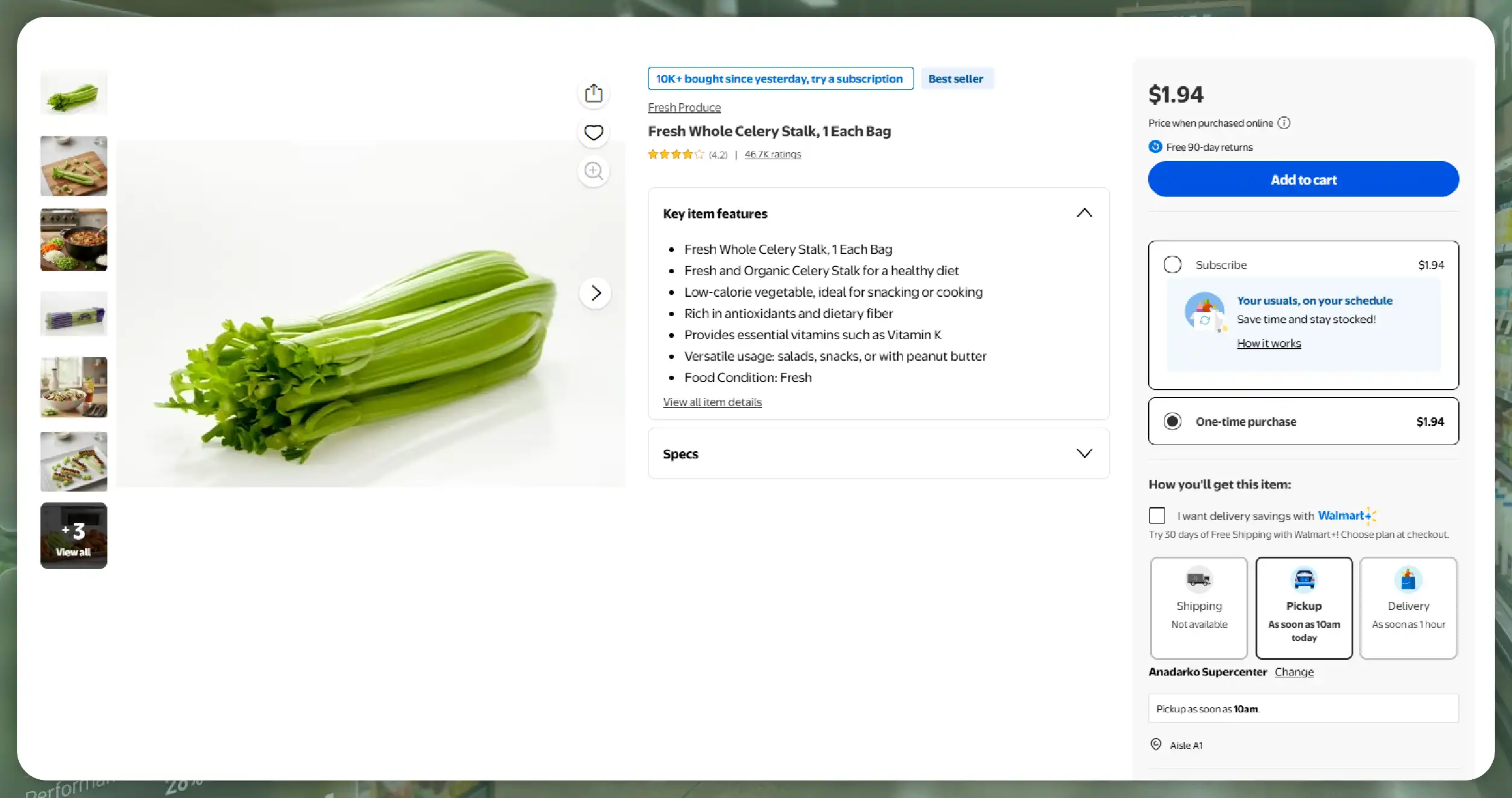
Variant-level data extraction focuses on collecting detailed attributes for each SKU. These include:
- Product name and brand
- Variant type (size, weight, pack)
- Pricing (MRP, discounted price)
- Availability status
- Delivery timelines
- Store/location-specific variations
Using advanced tools to Extract Product Size, Weight & Pack Data from Supermarkets, companies can build robust datasets that fuel analytics, forecasting, and decision-making.
Sample Variant-Level Grocery Data Across Stores
Below is an example table showcasing how variant-level data differs across grocery platforms:
| Product Name | Store | Variant (Size/Weight/Pack) | Price (INR) | Discount | Availability |
|---|---|---|---|---|---|
| Aashirvaad Atta | BigBasket | 5 kg Pack | 280 | 10% | In Stock |
| Aashirvaad Atta | Blinkit | 10 kg Pack | 540 | 8% | In Stock |
| Amul Milk | Instamart | 500 ml Pack | 28 | 0% | Out of Stock |
| Amul Milk | Zepto | 1 L Pack | 56 | 5% | In Stock |
| Fortune Oil | BigBasket | 1 L Bottle | 160 | 12% | In Stock |
| Fortune Oil | Blinkit | 5 L Can | 780 | 15% | Limited |
| Tata Salt | Instamart | 1 kg Pack | 28 | 2% | In Stock |
| Tata Salt | Zepto | 500 g Pack | 14 | 0% | In Stock |
This table highlights how the same product differs in variant, pricing, and availability across platforms—demonstrating the importance of SKU-Level Grocery Data Intelligence for Variant Data.
Applications of Variant-Level Grocery Data
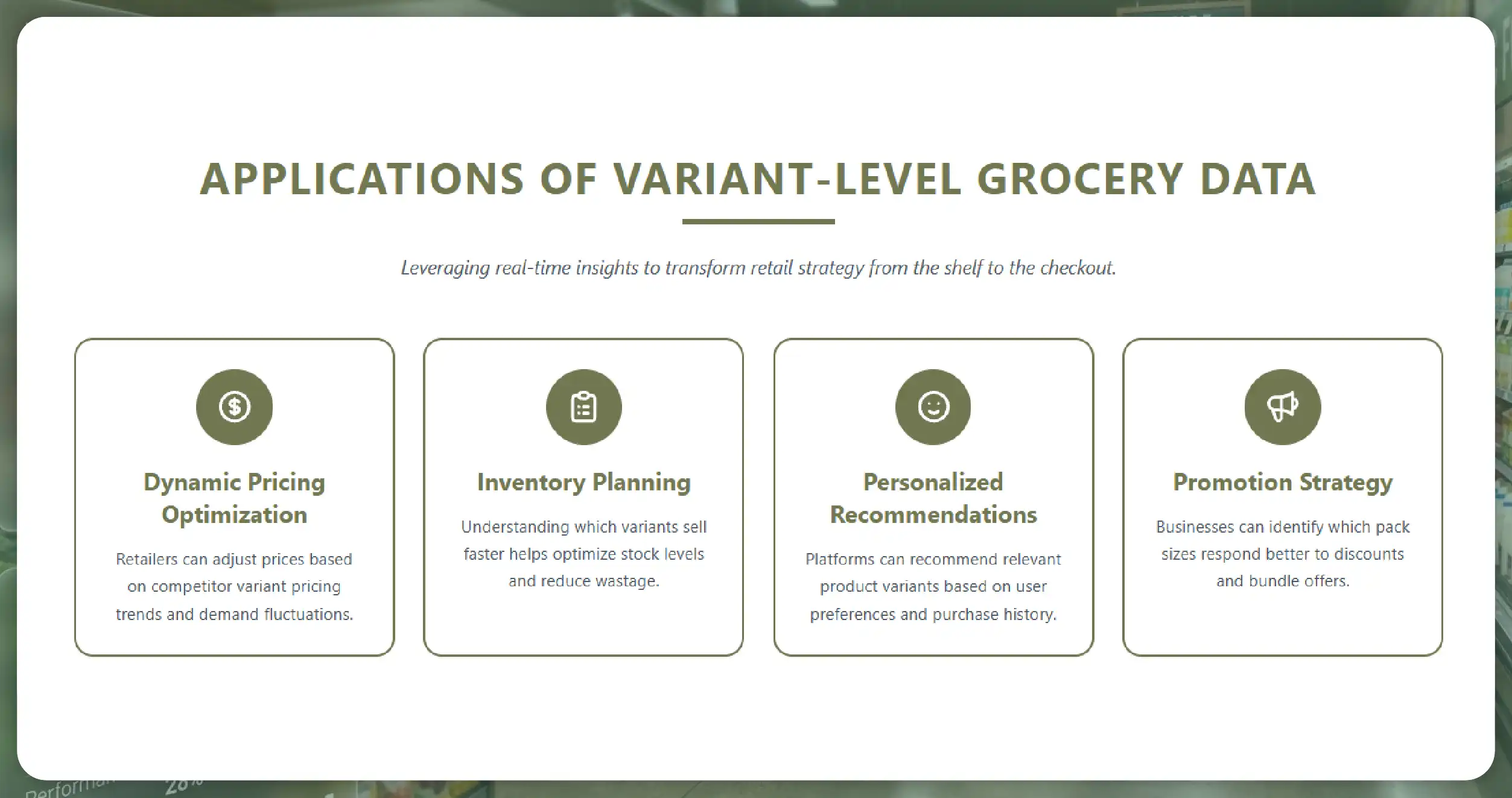
- Dynamic Pricing Optimization
Retailers can adjust prices based on competitor variant pricing trends and demand fluctuations. - Inventory Planning
Understanding which variants sell faster helps optimize stock levels and reduce wastage. - Personalized Recommendations
Platforms can recommend relevant product variants based on user preferences and purchase history. - Promotion Strategy
Businesses can identify which pack sizes respond better to discounts and bundle offers.
With the ability to Scrape Real-Time Variant-Level Grocery Data Insights, companies can make decisions based on live market conditions rather than outdated reports.
Technologies Powering Variant-Level Data Extraction
Modern data extraction relies on a mix of technologies:
- Web scraping tools
- APIs for structured data access
- Machine learning for data classification
- Cloud-based storage for scalability
Using a Grocery Product Data Extraction API, businesses can automate data collection and integrate it directly into their analytics systems.
Unlock powerful grocery insights today—partner with us to transform variant-level data into smarter pricing, better decisions, and faster growth.
Web Scraping for Grocery Data
Web Scraping Grocery Data remains one of the most effective methods for extracting variant-level information from online grocery platforms. It enables:
- Continuous monitoring of product listings
- Real-time price tracking
- Collection of structured and unstructured data
This approach is especially useful for aggregating data across multiple platforms like BigBasket, Blinkit, and Instamart.
Role of APIs in Grocery Data Extraction
APIs simplify the data extraction process by providing structured access to product data. A Grocery Delivery Extraction API can help businesses:
- Fetch real-time product availability
- Access pricing and discount information
- Retrieve variant-level details efficiently
APIs reduce dependency on manual scraping and ensure faster, more reliable data pipelines.
Building a Grocery Price Dashboard
Once data is collected, visualization becomes essential. A Grocery Price Dashboard helps stakeholders:
- Compare prices across stores
- Track changes over time
- Identify pricing anomalies
- Monitor promotional effectiveness
Dashboards transform raw data into actionable insights, enabling quick and informed decisions.
Challenges in Variant-Level Data Extraction
Despite its benefits, extracting variant-level data comes with challenges:
- Frequent changes in website structure
- Inconsistent naming conventions
- Dynamic pricing updates
- Captcha and anti-bot mechanisms
Overcoming these challenges requires robust scraping frameworks, intelligent parsing algorithms, and continuous monitoring.
Best Practices for Accurate Data Extraction
To ensure high-quality data, businesses should:
- Define clear data objectives
- Use reliable scraping tools and APIs
- Validate and clean data regularly
- Monitor extraction pipelines for errors
- Stay compliant with legal and ethical guidelines
These practices ensure that the extracted data remains accurate, consistent, and actionable.
Future of Variant-Level Grocery Data Intelligence

As quick commerce continues to grow, the importance of variant-level data will only increase. Emerging trends include:
- AI-driven demand forecasting
- Hyper-personalized product recommendations
- Real-time competitive benchmarking
- Integration with supply chain systems
Companies investing in variant-level data today will be better positioned to adapt to tomorrow’s retail landscape.
How Food Data Scrape Can Help You?
- Capture Granular Product Variants with Accuracy
We extract detailed SKU-level information including size, weight, pack type, and pricing across multiple grocery platforms. This enables you to gain precise visibility into how each variant performs in different markets, helping you make data-driven decisions with confidence. - Enable Real-Time Price and Availability Monitoring
Our solutions continuously track product prices, discounts, and stock availability across stores. This real-time intelligence allows you to respond quickly to market fluctuations, optimize pricing strategies, and stay competitive at all times. - Deliver Clean, Structured, and Ready-to-Use Data
We transform raw scraped data into well-structured, standardized datasets that are easy to integrate into your analytics systems. This reduces manual effort and ensures your team can directly use the data for dashboards, forecasting, and reporting. - Support Competitive Benchmarking and Market Analysis
Our scraping services help you monitor competitor offerings at the variant level, including bundle deals and pack variations. This empowers you to benchmark your products effectively and identify gaps or opportunities in your assortment and pricing. - Power Advanced Analytics and Custom Dashboards
We provide data feeds that seamlessly integrate with BI tools, enabling you to build powerful dashboards for price tracking, demand forecasting, and inventory planning. This helps you turn raw data into actionable insights that drive growth and operational efficiency.
Conclusion
Variant-level data extraction is no longer optional—it’s a necessity for businesses aiming to thrive in the modern grocery ecosystem. From pricing strategies to inventory management, the insights derived from detailed SKU-level data can drive significant competitive advantages.
Implementing a Grocery Price Tracking Dashboard allows businesses to continuously monitor market trends and optimize their strategies accordingly. By leveraging advanced Grocery Data Intelligence, organizations can transform raw data into meaningful insights that fuel growth and innovation.
Finally, building comprehensive Grocery Datasets ensures that businesses have a strong foundation for analytics, machine learning, and long-term strategic planning. As the grocery industry becomes increasingly data-driven, those who harness the power of variant-level insights will lead the way.
Are you in need of high-class scraping services? Food Data Scrape should be your first point of call. We are undoubtedly the best in Food Data Aggregator and Mobile Grocery App Scraping service and we render impeccable data insights and analytics for strategic decision-making. With a legacy of excellence as our backbone, we help companies become data-driven, fueling their development. Please take advantage of our tailored solutions that will add value to your business. Contact us today to unlock the value of your data.