Introduction
In today’s highly competitive grocery marketplace, consumers are increasingly price-sensitive and comparison-driven. Available delivery apps, online supermarkets, and quick-commerce services give buyers access to real-time pricing, review-based product decisions, and convenience-based purchasing. In such a situation, retailers and brands must adopt data-driven pricing strategies to avoid losing customers to competitors due to pricing gaps. The ability to Fix Price Gaps Using Grocery Product Mapping Insights has become essential for grocery chains aiming to improve sales, retain customer loyalty, and build transparency around price competitiveness.
To address this challenge, businesses are turning to advanced data extraction tools such as Product Mapping API for Grocery Price Comparison to compare identical SKUs across multiple grocery delivery platforms, retail chains, and quick-commerce apps. Mapping product variations across packaging sizes, weights, unit conversions, multi-language listings, and brand groups enables businesses to understand where price deficiencies exist and how they affect conversion and margins.
As competitive intelligence continues to evolve, retailers also rely on technologies like Cross-Platform Product Mapping for Grocery Price Monitoring to detect real-time price fluctuations enabled by promotions, stock shortages, demand surges, and seasonal changes. Price transparency has become an integral part of strategic pricing decision-making for retailers, FMCG companies, and distributors.
Why Grocery Price Mapping Matters Today?
The global grocery industry has rapidly shifted to online fulfillment models, and pricing differences across apps have become common. Consumers switch platforms instantly if they detect a more favorable offer—especially on everyday categories such as dairy, packaged foods, snacks, beverages, fresh produce, and personal care items.
To analyze this behavior accurately, businesses implement Product Mapping for Multi-App Grocery Prices Data, allowing them to create a unified SKU identity benchmark, compare identical or similar items across platforms, and understand competitive pricing at a granular level. This empowers decision-makers to adopt dynamic price corrections based on factual data rather than assumptions.
How Product Mapping Works in Grocery Pricing?
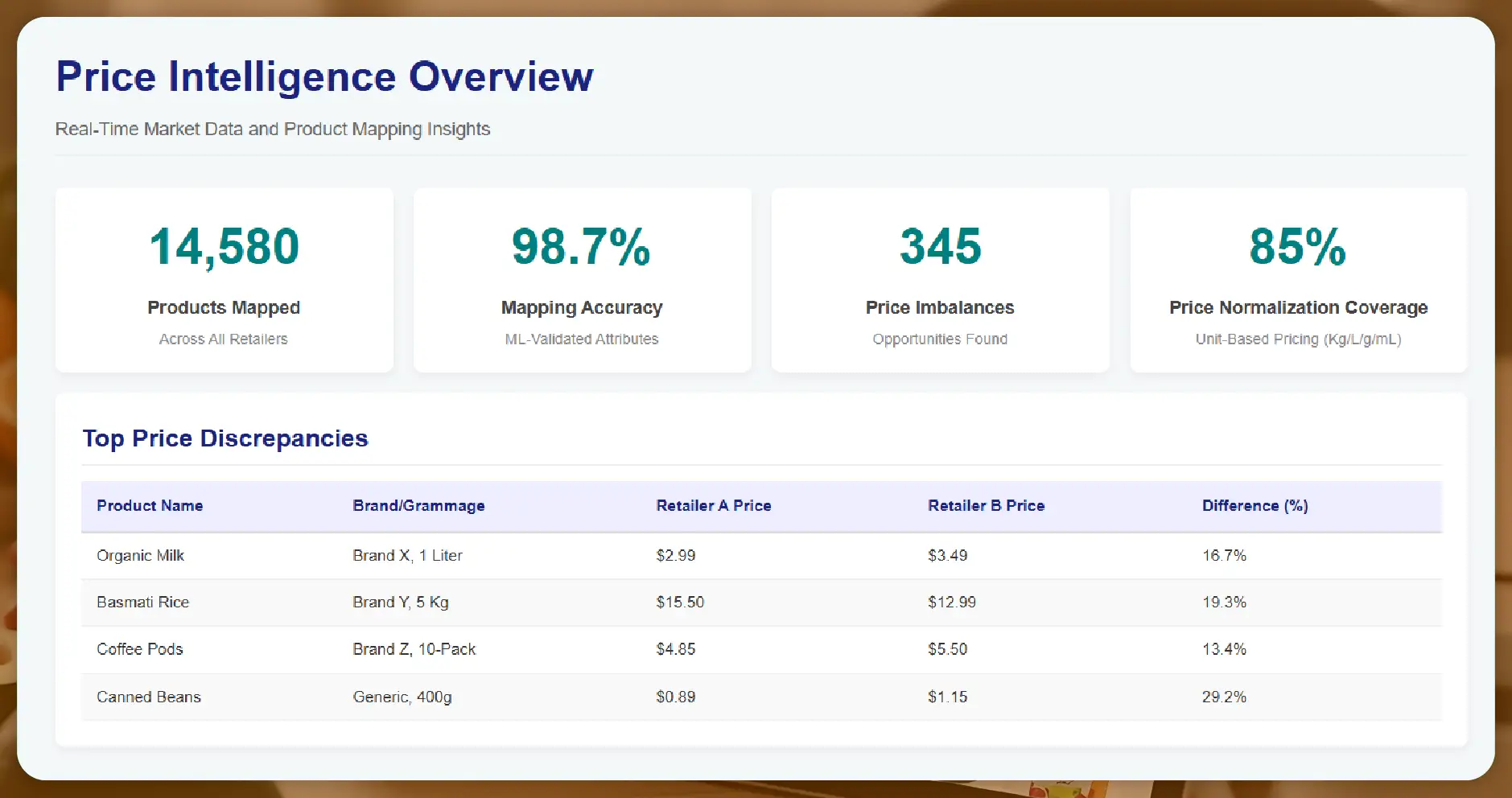
Product mapping matches the same product across platforms regardless of variation in naming, packaging format, size, or brand representation. This includes:
- Brand and grammage validation
- Barcodes and unique product identifiers
- NLP-based similarity matching
- Unit-based price normalization (Litre, Kg, g, ML, etc.)
- Data consolidation across retailers
- Machine learning-based attribute classification
Businesses leverage this intelligence to Scrape Grocery App Prices for Product Mapping, collecting real-time product prices and availability insights from different online platforms. This reveals pricing imbalances that directly influence buyer perception and channel performance.
Advanced scraping tools also help Extract Product Prices Across Multiple Grocery Apps, enabling teams to ensure accuracy in product positioning, price alignment, category assortment planning, and promotional visibility.
The Role of Data Scraping in Grocery Price Mapping
To achieve precise product mapping results, companies need structured datasets from diverse apps and websites. This requires automated extraction from platforms such as quick-commerce apps, grocery delivery services, supermarket portals, hyperlocal delivery networks, and e-commerce marketplaces.
Retailers also work with data providers to Extract Grocery Product Data to Identify Price Gaps, ensuring consistency in brand-to-platform comparisons. Proper analysis of SKU price variability helps determine contributing factors like location-based pricing, surge pricing, discount stacking, membership pricing, and supply-chain dependencies affected by vendor changes.
Meanwhile, external agencies offering Grocery App Data Scraping services support businesses that do not have internal scraping infrastructure. These services ensure reliable and scalable access to grocery datasets, always updated and aligned with platform changes.
For real-time automated extraction, businesses increasingly depend on Grocery Delivery Scraping API Services, integrating scraped data directly into analytics dashboards, pricing management systems, or decision engines without manual intervention.
Insights You Can Gain from Grocery Product Mapping
When data is analyzed correctly, product mapping reveals powerful insights:
| Grocery Insight | Value Delivered |
|---|---|
| Price difference between identical SKUs | Adjust pricing to remain competitive |
| Real-time promotion tracking | Understand discount patterns across platforms |
| Packaging-based price variation insight | Price per unit comparison for transparency |
| Cross-app demand insights | Predict customer channel switching behavior |
| Category-wise pricing comparison | Strengthen revenue strategy for best-selling items |
Using visual analysis dashboards such as Grocery Price Dashboard, businesses access comprehensive pricing intelligence that accelerates decision-making.
How Price Mapping Helps Retailers and FMCG Brands Win Market Share?
1. Maintain Competitive Pricing Position
Retailers prevent losing buyers by analyzing competitor price changes instantly and adjusting pricing at the right time.
2. Improve Customer Loyalty
Price fairness strongly influences retention; shoppers appreciate transparency and minimized manipulation.
3. Increase Sales Conversions
Competitive price matching increases conversion rates, particularly for high-volume essentials.
4. Reduce Revenue Leakage
Price mapping prevents unintentional losses caused by outdated pricing or misaligned vendor comparisons.
5. Build Price Prediction Models
Companies can use historical data to forecast promotion outcomes and optimize future discount cycles.
Benefits of Grocery Product Mapping for Manufacturers
Manufacturers gain clarity regarding retailer performance, visibility gaps, stock discrepancies, and marketplace pricing conflicts. Direct-to-consumer brands can assess whether pricing is consistent across channels or whether discrepancies are affecting profits.
Product mapping also identifies opportunities for bundle creation, packaging variation launches, and category-driven marketing.
Manufacturers can also avoid pricing conflicts with authorized distributors, maintaining MAP (Minimum Advertised Price) stability, thereby protecting brand value.
Industry Segments Benefiting from Grocery Price Mapping
| Stakeholder | Benefit |
|---|---|
| Grocery Retailers | Optimize pricing to increase market penetration |
| FMCG Brands | Monitor multi-channel pricing consistency |
| Quick-Commerce Apps | Improve competitive strategy in real-time |
| Consumer Pricing Platforms | Deliver reliable comparison results |
| Data Intelligence Firms | Build analytical dashboards with stronger accuracy |
| Distributor & Wholesale Channels | Avoid margin conflicts |
| E-commerce Marketplaces | Validate promotional impact |
The Future of Grocery Pricing Intelligence
As digital grocery expands, pricing transparency will become a standard expectation among customers. AI-driven pricing engines, bundle-based personalization, localized demand forecasting, subscription-based loyalty systems, and dynamic promotion adjustments will transform industry behavior.
Businesses that implement pricing analytics powered by real-time product mapping will have better control over inventory planning, distribution cost modeling, and promotional spending efficiency.
The future belongs to retailers that invest early in technology to track price variations, understand regional price sensitivity, and deliver value confidently.
Start leveraging advanced data scraping intelligence today—connect with our experts to unlock real-time competitive insights and smarter decision-making.
How Food Data Scrape Can Help You?
- Real-Time Competitive Insights: Gain accurate live pricing, availability, and product trend insights across platforms, enabling smarter decisions and stronger strategy alignment based on real market behavior.
- Automated Large-Scale Data Extraction: Eliminate manual research and reduce operational workload through fully automated scraping pipelines that capture structured data from multiple digital sources without errors or delays.
- Improved Pricing & Revenue Optimization: Access price benchmarking and historical trend analysis to optimize pricing decisions, reduce revenue leakage, and maintain competitive positioning in fast-changing markets.
- Enhanced Customer Personalization: Leverage behavioral, preference, and review-based insights to improve personalization engines, boosting engagement, conversions, and targeted product recommendations.
- Seamless API & Dashboard Integration: Integrate scraped datasets directly into BI dashboards, ERP systems, or pricing automation tools to support scalable expansion, advanced analytics, and informed business planning.
Conclusion
Product mapping, multi-source data extraction, and price benchmarking will define the competitive evolution of the grocery industry. Organizations that adopt automated analytics now will consistently outperform competitors through better decision-making and customer-centric pricing strategies.
To stay ahead, businesses must integrate data-driven pricing tools, Grocery Pricing Data Intelligence, and price-tracking dashboards into their operational systems. The ability to detect and correct price differences across apps directly impacts brand trust, profitability, and long-term sustainability.
As the industry shifts toward advanced digital transformation, we move into an era where automated pricing intelligence defines business leadership. Modern pricing success relies on unified product data, monitoring automation, and powerful visual intelligence layers such as Grocery Price Tracking Dashboard and predictive analytics solutions supported with large-scale structured Grocery Store Datasets essential for dynamic and transparent pricing ecosystems.
Are you in need of high-class scraping services? Food Data Scrape should be your first point of call. We are undoubtedly the best in Food Data Aggregator and Mobile Grocery App Scraping service and we render impeccable data insights and analytics for strategic decision-making. With a legacy of excellence as our backbone, we help companies become data-driven, fueling their development. Please take advantage of our tailored solutions that will add value to your business. Contact us today to unlock the value of your data.