Introduction
In an era where consumer tastes evolve faster than ever, beverage brands, hospitality groups, distributors, and retail platforms rely heavily on real-time data and predictive insights to remain competitive. The ability to boldly innovate and accurately forecast demand has become essential across beer, wine, and spirits categories, especially as next-generation drinkers seek unique experiences, sustainability, and cultural authenticity. With immense industry transformation ahead, understanding the Future of Drink 2026 will help businesses capture emerging demand and outperform in the modern marketplace. Today, the need to boldly Scrape Top Beverage Trends in Beer, Wine, and Spirits has never been more critical as global beverage preferences shift.
Brands and analysts now recognize the value of intelligent extraction tools and high-frequency datasets that enable them to Scrape Alcohol & Beverage Market Trends 2026 for both strategic growth and operational advantages. Whether exploring price volatility across venues, analyzing menu adoption cycles, or monitoring competitive product launches, real-time data is the foundation of decision-making. An ecosystem driven by experimentation, personalization, and sustainability requires continuous insight to keep ahead of changing consumer priorities—and to convert trends into market-ready innovation.
At the forefront of industry transformation is the demand for next-gen insights that support Real-Time Beer, Wine & Spirits Trend Monitoring, unlocking the patterns behind evolving taste expectations. From AI-designed flavor chemistry and botanical infusions to digital loyalty ecosystems and carbon-neutral production chains, every choice consumers make provides a signal of future opportunity.
Changing Beverage Culture: Consumers Want Discovery, Novelty & Function
Consumer lifestyle evolution is reshaping drink categories more aggressively than at any time in the past decade. Today’s drinkers prioritize personalization, sensory experimentation, wellness-driven ingredients, ethical sourcing, and elevated guest experiences. What was once considered niche is now mainstream. Cross-category hybrid drinks—such as wine-based cocktails, beer-spirit mixes, and barrel-aged fusion beverages—are seeing explosive adoption. In fact, research shows that 67% of consumers are interested in wine cocktails, demonstrating how blending formats drives curiosity and accessibility.
Meanwhile, heritage-rich beverages—such as Raicilla, Chicha, Soju, Arak, and Singani—are entering global markets supported by storytelling that honors origin and culture. With craft premiumization playing a leading role in consumer preference, traditional spirits are achieving modern revival through innovative branding, experiential tasting, and collaborations.
As sustainability becomes a value indicator rather than a marketing differentiator, 62% of female consumers express interest in regenerative agriculture wineries, proving the purchase power of eco-driven decision-making. Transparency across production, ingredients, packaging, and environmental impact influences loyalty more strongly than price promotions or traditional advertising.
Why Real-Time Beverage Data Matters in 2026?
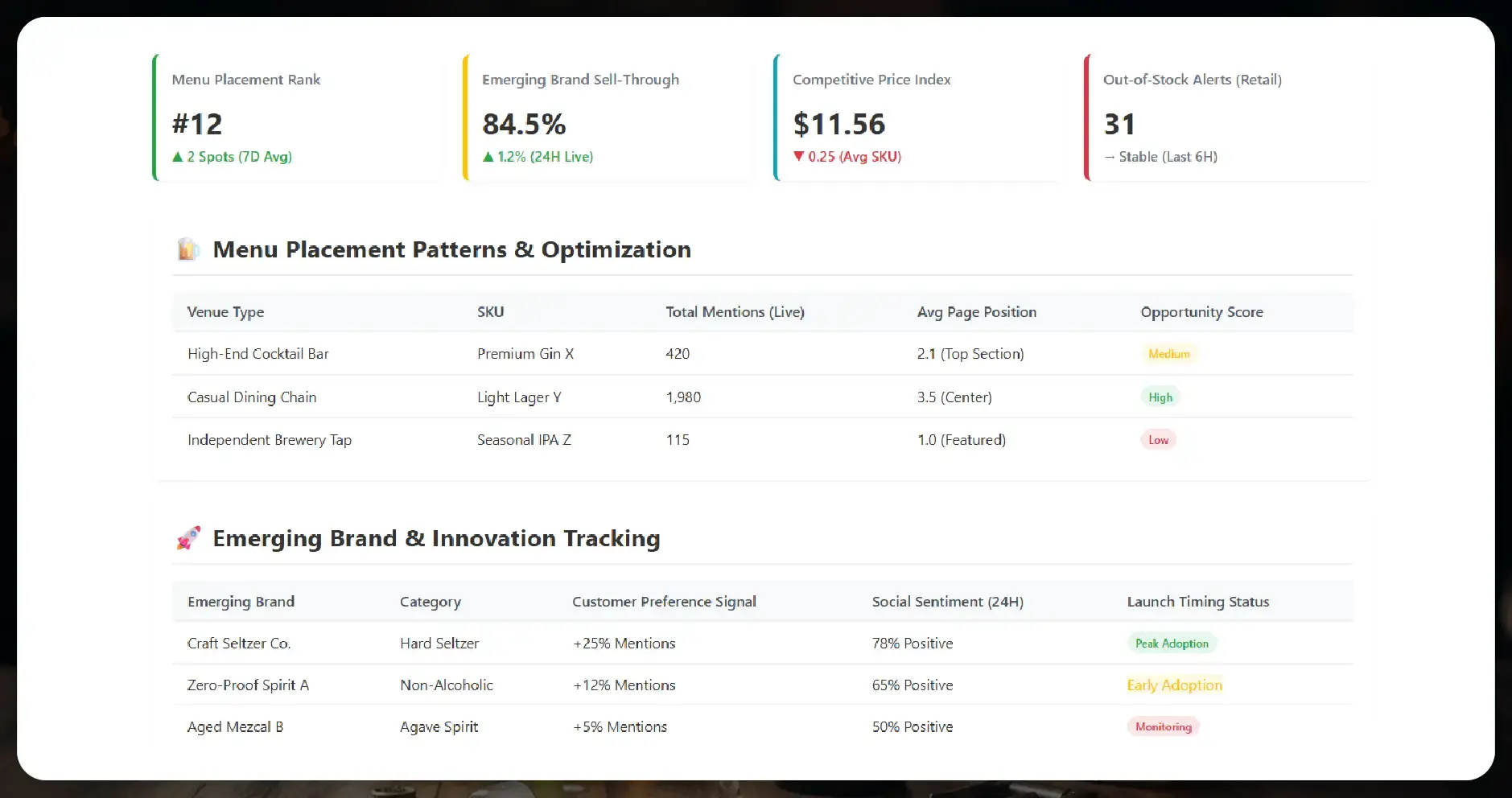
Businesses across the beverage chain—bars, restaurants, breweries, wineries, distilleries, retailers, distributors, and market research firms—need accurate insights to adapt rapidly. Capturing menu placement patterns, emerging brand performance, pricing trends, and distribution visibility are critical to identify innovation opportunities.
The ability to scale instantly through AI-enabled monitoring will define commercial success, especially as companies adopt tools for Real-Time Alcohol & Beverage Trend Tracking 2026 to measure live movement in competitive inventories, sell-through rates, and customer preference signals. Without real-time data, brands risk positioning at the wrong moment, launching unnecessary SKUs, or missing early adoption windows.
Menu Adoption Cycle (MAC): What’s Emerging, What’s Scaling
Menu evolution data indicates emerging trends that begin in experimental venues, move to premium locations, and finally reach mass market. For beverage companies, understanding MAC phases is essential to determining launch timing, pricing, and promotional strategy. Insights such as:
- Which drinks appear in early-adopter mixology bars?
- What products are gaining adoption in national chains?
- Which craft innovations are ready for scaling in retail?
Tracking this progression allows businesses to Extract Beer, Wine & Spirits Market Trends 2026 and respond faster than competitors.
Future of Drink 2026: Key Themes Redefining the Industry
- AI-Generated Flavors
AI flavor science is shaping beverage design and sensory mapping, enabling predictive taste creation based on data modeling. This technology reduces product development risk and fuels rapid innovation. - Cross-Category Hybrid Creations
From spritz-style wines to carbonated cocktails and ready-to-serve canned mixology, hybrid beverages bridge convenience with sophistication. Their adaptability aligns with millennial and Gen Z buying behavior. - Regenerative Agriculture & Zero-Waste Distilling
Environment-first production models are unlocking premium consumer value. Wineries and distilleries using organic farming, renewable material sourcing, and carbon-neutral cellars lead innovation. - Premiumization & Luxury Spirits
Rare cask releases, aged single-batch editions, and collector-driven bottles create exclusivity and high-margin segments within an increasingly experience-focused market. - Global Roots & Cultural Revival
Ethnic origins and indigenous techniques resonate with consumers who demand authenticity. Heritage drinks with rich narratives outperform generic labels in loyalty and price stability.
Unlock real-time beverage intelligence and stay ahead with predictive insights — contact us today to transform data into growth.
How Advanced Beverage Analytics Strengthens Industry Strategy?
Data-driven products powered by intelligent extraction allow businesses and research organizations to leverage advanced Beverage Trend Analytics for 2026, turning unstructured industry signals into actionable insights such as:
- Category-wise opportunity mapping—beer vs. spirits vs. wine
- Competitor launch insights and product benchmarking
- Live SKU availability and geographic distribution tracking
- Seasonal and regional consumption behavior
- Price shifts across store types and cities
- Consumer sentiment and review mining
With digital transformation accelerating, access to Liquor Price Data Scraping Services supports more transparent pricing strategy, portfolio expansion decisions, and profitability optimization for producers and retailers.
Modern beverage enterprises also rely on structured Alcohol and Liquor Datasets to analyze market share changes, evaluate trial-purchase behavior, assess innovation demand, and model risk factors across supply chains.
How Food Data Scrape Can Help You?
- Real-Time Beverage Market Visibility
Gain instant access to dynamic product listings, availability, and pricing shifts across global bars, restaurants, retail chains, breweries, and distilleries to support strategic decision-making and accurate market forecasting. - Competitive Intelligence & Product Benchmarking
Track competitor launches, packaging innovations, branding strategies, and menu placement performance, enabling brands to recognize emerging opportunities, benchmark growth, and refine product portfolios before trends peak. - Consumer Trend & Sentiment Insights
Analyze consumer preference signals from reviews, social feedback, menu adoption cycles, and purchase patterns to predict demand shifts and build products that better align with evolving lifestyle expectations. - Automated Price Tracking & Revenue Optimization
Monitor real-time price variations across markets, store formats, and geographies to improve margin strategy, eliminate manual research, and shape pricing policies with live data accuracy and profitability insight. - Structured & Custom Datasets for Decision Support
Receive tailored datasets for beer, wine, spirits, ready-to-drink innovations, and cross-over beverages, empowering data-driven teams with analytics-ready intelligence for investment, expansion, and innovation planning.
Conclusion
The next generation of beverage innovation will be defined by creative exploration guided by real-time data intelligence. From sustainability-centered wineries to AI-engineered spirits and cross-category flavor experimentation, the 2026 beverage marketplace rewards bold ideas backed by analytics. When businesses harness competitive intelligence, menu adoption signals, pricing visibility, and trend forecasting, their growth opportunities expand dramatically.
As the beverage landscape evolves, companies investing in advanced extraction and tracking capabilities will have the strongest advantage to scale rapidly and navigate volatility—especially when tools that Scrape Alcohol Price Data integrate with intelligent dashboards such as the Liquor Price Tracking Dashboard for strategic decision-making. In a competitive global market, high-value Liquor Data Intelligence Services empower brands, retailers, and hospitality organizations to anticipate consumer desires and drive measurable performance.
Are you in need of high-class scraping services? Food Data Scrape should be your first point of call. We are undoubtedly the best in Food Data Aggregator and Mobile Grocery App Scraping service and we render impeccable data insights and analytics for strategic decision-making. With a legacy of excellence as our backbone, we help companies become data-driven, fueling their development. Please take advantage of our tailored solutions that will add value to your business. Contact us today to unlock the value of your data.