Introduction: The Rise of On-Demand Alcohol in the UK
The way British consumers buy alcohol has changed dramatically over the past five years. What was once a planned grocery-shop or off-licence purchase has fragmented into an on-demand habit, with platforms like Gopuff, Deliveroo, Just Eat, Uber Eats, and a long tail of regional marketplaces delivering wine, beer, and spirits to UK doorsteps in 30 minutes or less. The convenience economy has firmly arrived in alcohol — and the data layer behind it has become essential intelligence for anyone serious about the UK drinks market.
For brands, distributors, market researchers, agencies, and investors, capturing pricing, assortment, and availability data across these on-demand platforms is no longer optional. Each platform operates with its own pricing logic, its own retailer partnerships, its own promotional architecture, and its own consumer demographics. Without comprehensive scraping, the on-demand slice of the UK alcohol market remains a black box — and that black box now represents a meaningful and rapidly growing slice of UK alcohol commerce.
That is exactly where Food Data Scrape delivers. Our UK alcohol delivery scraping infrastructure ingests data daily from Gopuff, Deliveroo, and other major platforms, harmonizing the output into a single structured dataset. This blog explains why on-demand alcohol scraping matters, what makes each platform unique, the methodology behind clean cross-platform data, the insights that emerge, and how to put the resulting intelligence to work in real-world commercial decisions.
The UK On-Demand Alcohol Landscape
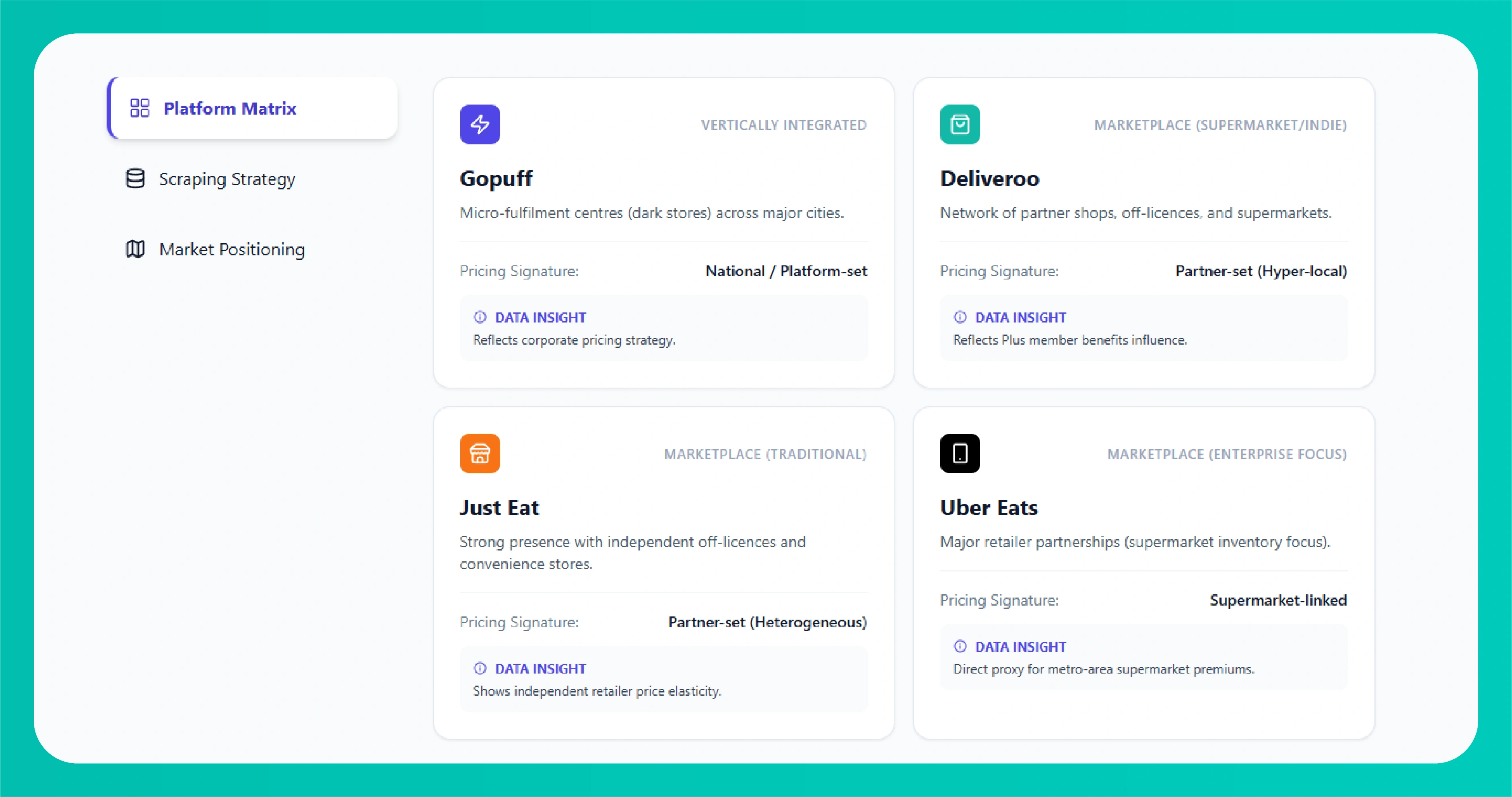
The UK on-demand alcohol space is far more fragmented than its US counterpart, with several platforms competing for share through different commercial models. Understanding each platform's structure is essential for designing a scraping strategy that captures the right data.
Gopuff A vertically integrated quick-commerce operator running its own micro-fulfilment centres across major UK cities. Pricing is set by Gopuff itself rather than by partner stores, giving the platform consistent national pricing — and a unique data signature compared with marketplace models. Gopuff competes primarily on convenience and assortment depth within the on-demand window.
Deliveroo A marketplace platform whose alcohol delivery offering pulls from a wide network of partner shops, including supermarkets (Co-op, Sainsbury's via partnership), off-licences, and convenience retailers. Pricing varies by partner store within a single city. Deliveroo has invested heavily in building an alcohol category and now offers Plus member benefits that interact with alcohol pricing.
Just Eat Operates a similar marketplace model in alcohol delivery, with a strong presence among independent off-licences and convenience stores. Coverage is broad but heterogeneous, with significant variation in partner-store pricing within the same neighbourhood.
Uber Eats Uber Eats has expanded its alcohol category meaningfully, partnering with major UK retailers and convenience operators to provide rapid delivery in metro areas. The Uber Eats alcohol experience often surfaces supermarket inventory directly, creating a direct comparison opportunity with traditional supermarket online shopping.
Specialist marketplaces Beyond the major players, the UK has a long tail of smaller alcohol-focused delivery apps and direct-to-consumer brand sites that complete the picture. These include local quick-commerce operators, dedicated wine clubs, and craft-focused platforms.
Snappy Shopper, Beelivery, and other fast-growing entrants A new generation of UK quick-commerce platforms continues to enter the alcohol space, with different commercial structures and partner-store relationships. Comprehensive scraping needs to accommodate their growth.
Each platform's data tells a different story. Gopuff reveals what a vertically integrated player thinks the right consumer price is. Deliveroo and Just Eat reveal how independent off-licences price under marketplace conditions. Uber Eats shows how supermarket inventory translates to on-demand pricing. Capturing all of them in one dataset is what makes on-demand alcohol UK data truly powerful.
Why Scraping On-Demand Alcohol Matters
A robust on-demand scraping program unlocks insights that traditional retail audits cannot.
-
Convenience-premium quantification
On-demand alcohol typically prices 10 to 30 percent higher than equivalent supermarket pricing. Quantifying this premium across categories, brands, and platforms reveals where consumers tolerate convenience markups and where price sensitivity remains. -
Assortment differentiation
The same brand may be available across all platforms but with different pack-size mixes, different RTD variants, and different limited-edition exposure. Mapping assortment differences exposes channel positioning opportunities. -
Promotional architecture
Each platform runs its own promotional mechanics — Gopuff vouchers, Deliveroo Plus offers, Just Eat partner promotions, Uber Eats' delivery-fee promotions on alcohol baskets. Tracking these reveals how platforms compete on effective price. -
Hyperlocal availability
On marketplace platforms, the same SKU's availability changes by postcode and partner store. Capturing this hyperlocal variation provides distribution insights invisible at the national level. -
Hour-of-day and day-of-week patterns
Pricing and availability on on-demand platforms shift with consumer demand cycles — a Friday evening pre-party rush behaves differently from a Sunday afternoon. Time-aware capture exposes these patterns. -
Category innovation tracking
New launches in RTDs, hard seltzers, low- and no-alcohol products, and craft spirits often appear first on quick-commerce platforms. Scraping is the fastest way to spot category innovation as it lands. -
Competitive moves on quick-commerce
When a new brand launches, the first signal of distribution depth is often quick-commerce listing presence. Brands and analysts who watch only supermarkets miss the leading edge of new-entrant penetration.
How Food Data Scrape Captures UK On-Demand Alcohol Data
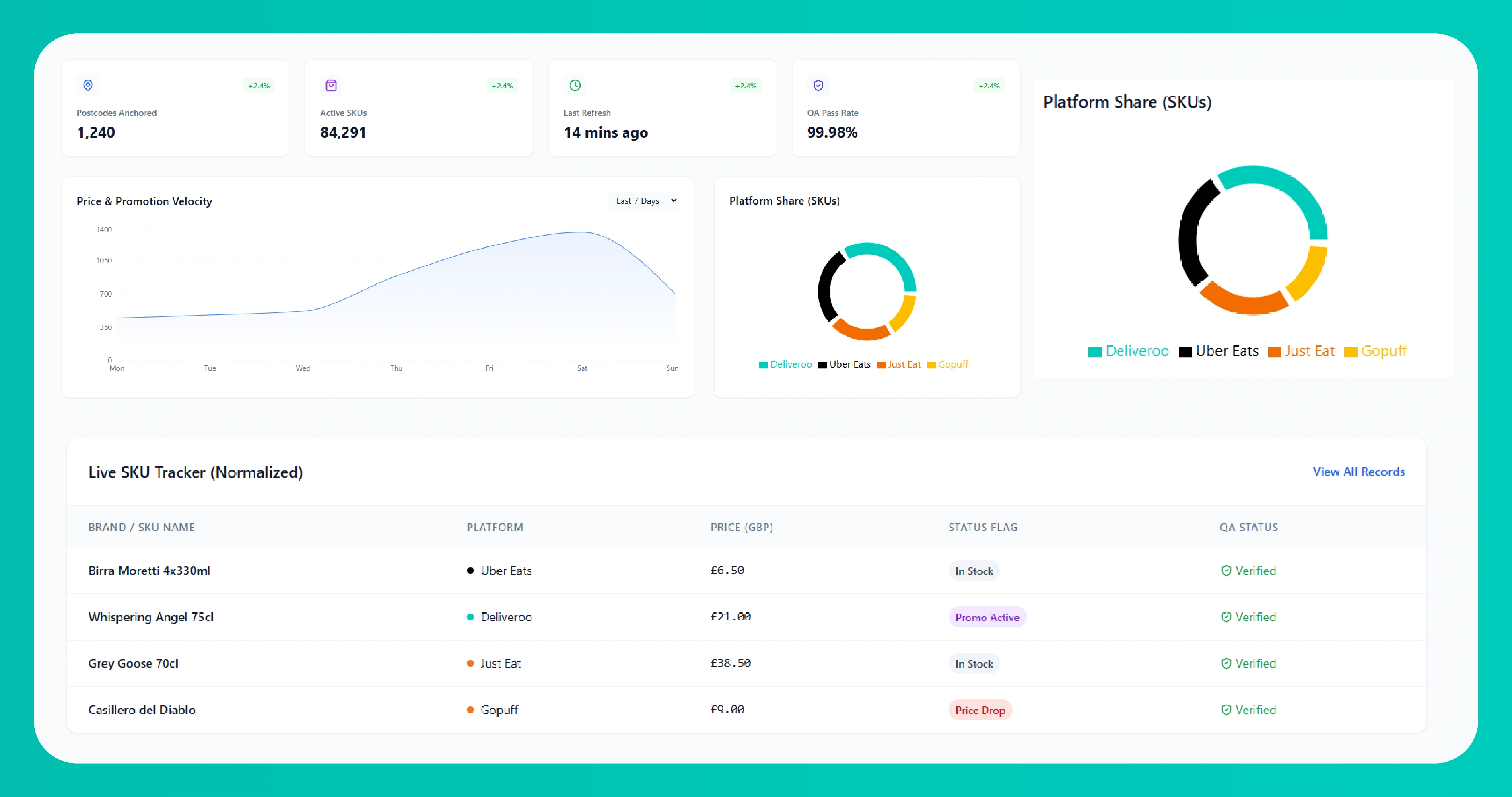
Food Data Scrape operates a purpose-built infrastructure for alcohol delivery platform scraping that ingests data daily from Gopuff, Deliveroo, Just Eat, Uber Eats, and other major UK delivery platforms. Our methodology rests on six pillars.
-
Multi-platform coverage
We capture the full alcohol catalog from each major platform, normalizing across different category taxonomies and SKU naming conventions. -
Postcode anchoring
For marketplace platforms (Deliveroo, Just Eat, Uber Eats), pricing and availability vary by postcode and partner store. Our crawlers anchor across multiple postcodes per major UK city to build representative coverage. -
Partner store identification
When marketplace platforms surface partner stores, we tag each listing with the underlying retailer (e.g., "Bestway Express", "Local off-licence", "Sainsbury's via Deliveroo") so analysts can trace which retailers drive which prices. -
Refresh cadence
Top-velocity SKUs and promoted lines refresh daily; long-tail SKUs refresh weekly. New launches and platform-specific promotions trigger near-real-time recapture. Hour-of-day capture is available for clients who need temporal patterns. -
Promotional flag detection
Vouchers, percentage discounts, free-delivery thresholds, and bundle offers are captured as structured fields rather than buried in raw text. -
Quality assurance
Every record passes schema validation, brand-name disambiguation, ABV and volume sanity checks, GBP currency normalization, and outlier detection.
Clients access data through a documented UK beverage delivery API, scheduled CSV/JSON exports, direct integration into Snowflake or BigQuery, and custom dashboards.
Sample UK On-Demand Alcohol Data
Here are representative records from the UK Alcohol Delivery Dataset delivered by Food Data Scrape. All prices in GBP.
Sample 1: Cross-Platform Pricing for the Same SKU
| Product | Platform | Partner / Source | Postcode | Price | Date |
|---|---|---|---|---|---|
| Smirnoff Red 70cl | Gopuff | Gopuff Direct | E1 6AN | £19.99 | 2026-04-30 |
| Smirnoff Red 70cl | Deliveroo | Local Off-Licence | E1 6AN | £21.50 | 2026-04-30 |
| Smirnoff Red 70cl | Just Eat | Bestway Express | E1 6AN | £22.00 | 2026-04-30 |
| Smirnoff Red 70cl | Uber Eats | Co-op | E1 6AN | £20.00 | 2026-04-30 |
| Smirnoff Red 70cl | Supermarket | ASDA standard | — | £15.00 | 2026-04-30 |
Sample 2: Convenience Premium by Category
| Category | Avg Supermarket Price | Avg On-Demand Price | Avg Premium |
|---|---|---|---|
| Mainstream Vodka 70cl | £15.50 | £20.50 | +32% |
| Premium Lager 4-pack | £6.00 | £8.50 | +42% |
| Mid-range Wine 75cl | £8.00 | £11.00 | +38% |
| Premium Gin 70cl | £24.00 | £29.00 | +21% |
| Champagne 75cl | £30.00 | £38.00 | +27% |
Sample 3: Postcode-Level Variation Within One City (London)
| Postcode | Smirnoff Red 70cl on Deliveroo | Partner Store |
|---|---|---|
| W1 (West End) | £23.00 | Late Night Off-Licence |
| E1 (East London) | £21.50 | Local Off-Licence |
| SE1 (South Bank) | £22.50 | Express Convenience |
| N1 (Islington) | £22.00 | Neighbourhood Wines |
| SW1 (Westminster) | £24.00 | Premium Wine Shop |
Sample 4: Promotional Activity Snapshot
| Postcode | Smirnoff Red 70cl on Deliveroo | Partner Store |
|---|---|---|
| W1 (West End) | £23.00 | Late Night Off-Licence |
| E1 (East London) | £21.50 | Local Off-Licence |
| SE1 (South Bank) | £22.50 | Express Convenience |
| N1 (Islington) | £22.00 | Neighbourhood Wines |
| SW1 (Westminster) | £24.00 | Premium Wine Shop |
Sample 5: Time-of-Day Pricing & Availability (Friday Evening Spike)
| Hour | Active SKUs Listed | Avg Price (Smirnoff Red 70cl) | OOS Rate |
|---|---|---|---|
| 17:00 | 248 | £20.50 | 4% |
| 19:00 | 245 | £20.50 | 8% |
| 21:00 | 230 | £21.00 | 14% |
| 23:00 | 198 | £21.50 | 22% |
| 01:00 (Sat) | 165 | £22.00 | 31% |
Sample 6: Platform-Level RTD Assortment Snapshot (Greater London)
| Platform | Total RTD SKUs | Hard Seltzer | Pre-mix Spirits | Wine-based RTD |
|---|---|---|---|---|
| Gopuff | 78 | 32 | 30 | 16 |
| Deliveroo (avg partner) | 48 | 18 | 22 | 8 |
| Just Eat (avg partner) | 35 | 14 | 16 | 5 |
| Uber Eats (avg partner) | 52 | 20 | 24 | 8 |
These tables represent only a small slice of the millions of on-demand alcohol records Food Data Scrape captures monthly across UK platforms.
Reading the Data: What Insights Emerge
When on-demand alcohol data is captured systematically across platforms, several recurring patterns appear.
The convenience premium is real and category-specific: On-demand alcohol
-
Convenience premiums remain substantial
On-demand alcohol consistently runs 20 to 40 percent above supermarket pricing, with steeper premiums on lower-priced commodity categories (lager, mainstream vodka) where the absolute uplift looks small but the percentage is large. -
Gopuff sits in the middle
As a vertically integrated player, Gopuff often prices below pure marketplace alternatives but above supermarket baselines, occupying a deliberate middle ground. -
Marketplace partner identity matters more than platform
On Deliveroo or Just Eat, the partner store driving the listing typically explains pricing variation more than the platform itself. A Co-op listing on Deliveroo prices similarly to the same Co-op listing on Uber Eats. -
Affluent postcodes carry premium pricing
Within a single city, postcodes like W1 and SW1 in London tend to host partner stores that price 5 to 15 percent above eastern or northern equivalents. -
RTDs and hard seltzers index higher on on-demand
Single-can and four-pack formats of RTDs and hard seltzers, which suit immediate consumption occasions, sell disproportionately well on on-demand platforms — and price aggressively to match. -
Promotional mechanics are first-order vouchers and delivery-fee waivers
Unlike supermarkets where rollback and multi-buy dominate, on-demand promotions typically sit at the basket level — voucher discounts, free delivery thresholds, and member benefits. -
Friday evening shows visible stress on availability
Out-of-stock rates climb steeply through Friday evening across all platforms in major metros, with late-night periods often showing 25 to 35 percent of priority SKUs unavailable. This pattern repeats consistently weekend after weekend. -
RTD assortment is a leading indicator of category innovation
New RTD and hard seltzer SKUs typically appear on quick-commerce platforms before reaching supermarket shelves at scale. Brands tracking quick-commerce assortment can spot category innovation 2 to 6 weeks ahead of traditional retail audits.
These insights only emerge when the data is captured systematically across platforms and harmonized into a single comparable view.
Implementation Considerations
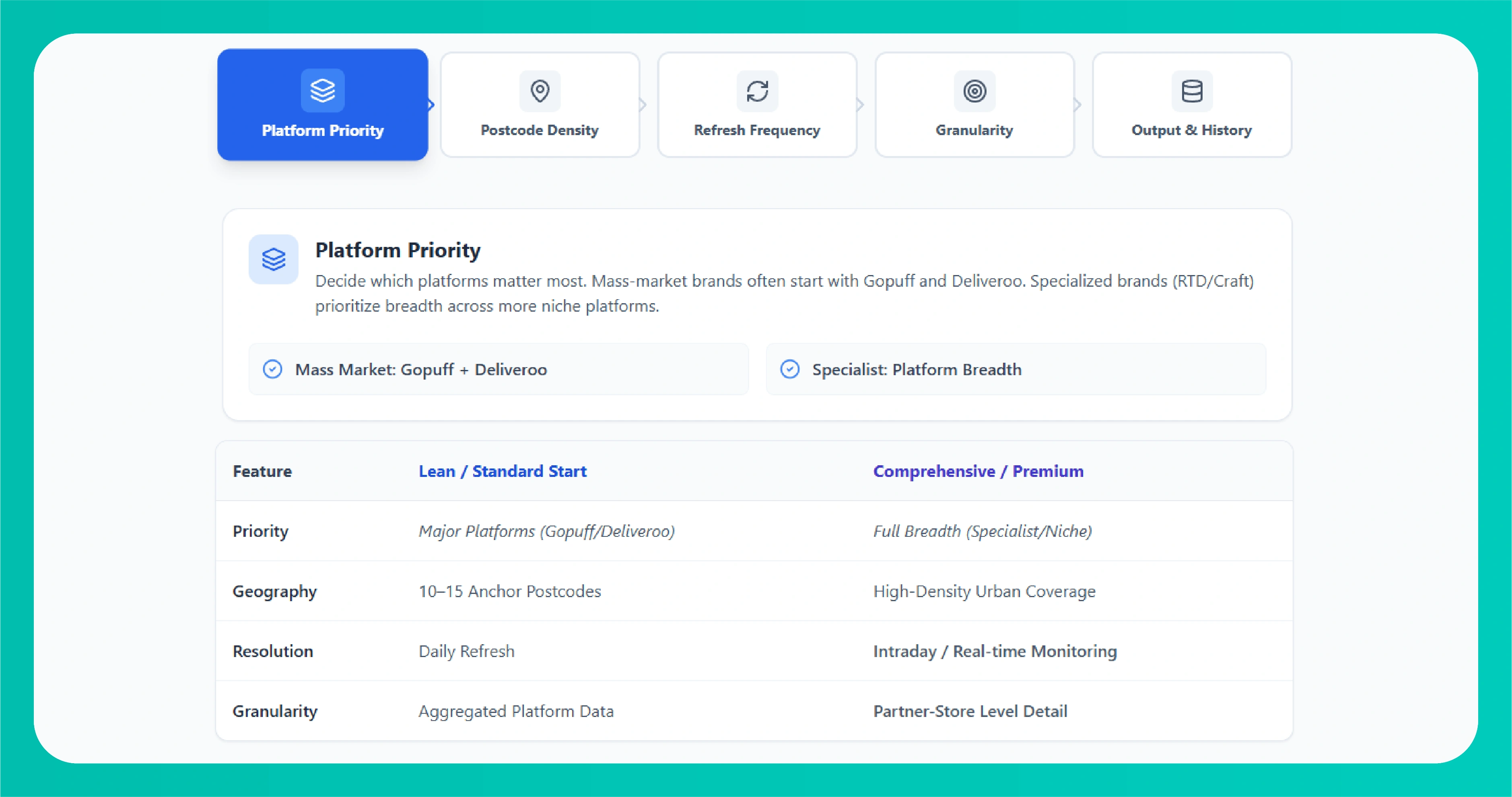
Brands and analysts adopting on-demand scraping for the first time typically face several implementation questions.
-
Platform priority
Decide which platforms matter most for your brand or analysis. For mass-market brands, Gopuff plus the largest marketplace (Deliveroo) is often the right starting point. Brands with strong RTD or craft positioning may prioritize platform breadth. -
Postcode anchor density
More postcodes mean better geographic representation but higher capture costs. A common starting point covers 10 to 15 anchors across London, Manchester, Birmingham, Leeds, Glasgow, and other major UK metros, with additional anchors added as needs evolve. -
Refresh frequency
Daily refresh meets most needs. For time-sensitive use cases — promotional ROI tracking, launch-day monitoring, weekend availability stress analysis — intraday capture provides better resolution. -
Partner-store granularity
Decide whether you need partner-store-level detail (most precise but most expensive) or aggregated platform-level data (cheaper, less precise). Both options are supported. -
Output integration
Choose between CSV exports for analyst-led work, an API for engineering-led integration, or pre-built dashboards for direct business consumption. Most clients use a combination. -
Historical data
Backfill of historical data is possible for a limited window. Most clients combine 1 to 3 months of backfill at onboarding with continuous capture going forward, building toward a 12-month time-series within a year.
Coverage and Schema
Our UK alcohol e-commerce data spans the alcohol catalogs of Gopuff, Deliveroo, Just Eat, Uber Eats, and other major UK on-demand platforms, with postcode anchors covering London, Manchester, Birmingham, Leeds, Liverpool, Glasgow, Edinburgh, Cardiff, and other major metros.
A typical harmonized record includes product name, brand, parent company, and category; sub-category (Shiraz, IPA, single malt, vodka, etc.) and varietal where applicable; ABV, pack size, container type, and country of origin; platform, partner store (where applicable), postcode, and city; listed price, voucher-eligible price, member price, and effective price; delivery fee, minimum basket, and free-delivery threshold; stock availability and out-of-stock duration; promotional flags (voucher, member offer, partner promo, BOGO); image URLs and product page URLs; and capture timestamp with day-of-week / hour-of-day flags.
Use Cases for UK On-Demand Alcohol Data
The applications of robust UK alcohol marketplace data span multiple business functions.
-
For brand owners and importers:
Monitor on-demand pricing across platforms, quantify the convenience premium your brand commands, time launches to align with on-demand category innovation cycles, and validate distributor presence on quick-commerce. -
For distributors:
Track which on-demand partners stock your portfolio, identify gaps where partner store coverage is weak, and benchmark on-demand assortment depth against supermarket equivalents. -
For market researchers:
Build category dashboards covering the full UK alcohol e-commerce landscape, including the on-demand slice that traditional retail audits miss. -
For investors and M&A teams:
Validate revenue and growth assumptions during due diligence on quick-commerce operators, alcohol brands with strong on-demand presence, or hospitality businesses with delivery integrations. -
For platform operators:
Benchmark your own pricing and assortment against competitor platforms, identify under-served categories, and validate promotional ROI. -
For trade-investment teams:
Quantify on-demand promotional ROI by combining scraped promotional data with internal sales reports.
FAQs
Why Choose Food Data Scrape
Scraping multiple on-demand alcohol platforms simultaneously is a non-trivial engineering challenge. Each platform uses different page structures, different category taxonomies, different promotional flags, and frequent UI changes. Marketplace platforms add complexity through partner store layers, postcode personalization, and dynamic pricing. Most internal teams underestimate the ongoing maintenance and quality assurance work required.
Food Data Scrape provides managed infrastructure, ethical and compliant data collection practices, and deep domain expertise in UK e-commerce. Our advantages include compliance-first architecture, scalable extraction across millions of pages daily, fully customizable harmonized schemas, near-real-time refresh on priority SKUs, hour-of-day capture where needed, dedicated analyst support familiar with the UK quick-commerce market, and out-of-the-box dashboards highlighting cross-platform deltas. Our team has deep experience configuring on-demand data capture for global brands, UK distributors, market research firms, and consumer-facing apps.
Conclusion: Bringing the On-Demand Slice Into Your Data Picture
On-demand alcohol is no longer a fringe channel in the UK — it is a meaningful and rapidly growing slice of the market that brands, distributors, and analysts cannot afford to ignore. Capturing this data requires a multi-platform, postcode-aware, promotionally aware scraping infrastructure that most teams cannot build in-house at the necessary quality.
Food Data Scrape exists to deliver this data in clean, harmonized, decision-ready form. Across Gopuff, Deliveroo, Just Eat, Uber Eats, and the long tail of UK alcohol delivery platforms, we transform the public web of on-demand alcohol commerce into structured intelligence ready to power your strategy. Whether you need a one-time benchmarking study, a recurring assortment dashboard, or an always-on API feeding your BI stack, we configure a delivery model that fits your workflow.
If you are ready to bring on-demand alcohol into your data picture and stop missing the convenience-economy slice of the UK market, get in touch with Food Data Scrape today.