

















 ?
?
Introduction: How GrabFood Powers Filipino Franchise Decisions
The Philippines is one of Southeast Asia's most dynamic food and beverage markets, with a thriving local restaurant scene, fast-growing franchise sector, and increasingly digital consumer behavior. From iconic local chains to emerging regional concepts, Filipino food brands operate in a competitive landscape where franchise expansion decisions can make or break long-term success.
Historically, those decisions relied on local market visits, anecdotal feedback from existing franchisees, and broad demographic data. Today, leading Filipino food brands and franchise consultants increasingly rely on structured GrabFood Philippines data to make smarter, faster, evidence-based expansion choices. GrabFood lists thousands of merchants across Metro Manila, Cebu, Davao, and secondary cities, providing the most comprehensive public view of how Filipino food brands compete in the digital channel.
That gap is exactly where Food Data Scrape delivers. Our infrastructure captures GrabFood Philippines data across priority cities daily, harmonizing merchant, menu, and pricing data into a single decision-ready dataset. This blog explores how Filipino food brands use GrabFood data to inform franchise expansion, what the data reveals, and how stakeholders can put it to work.
The Filipino Food and Franchise Landscape
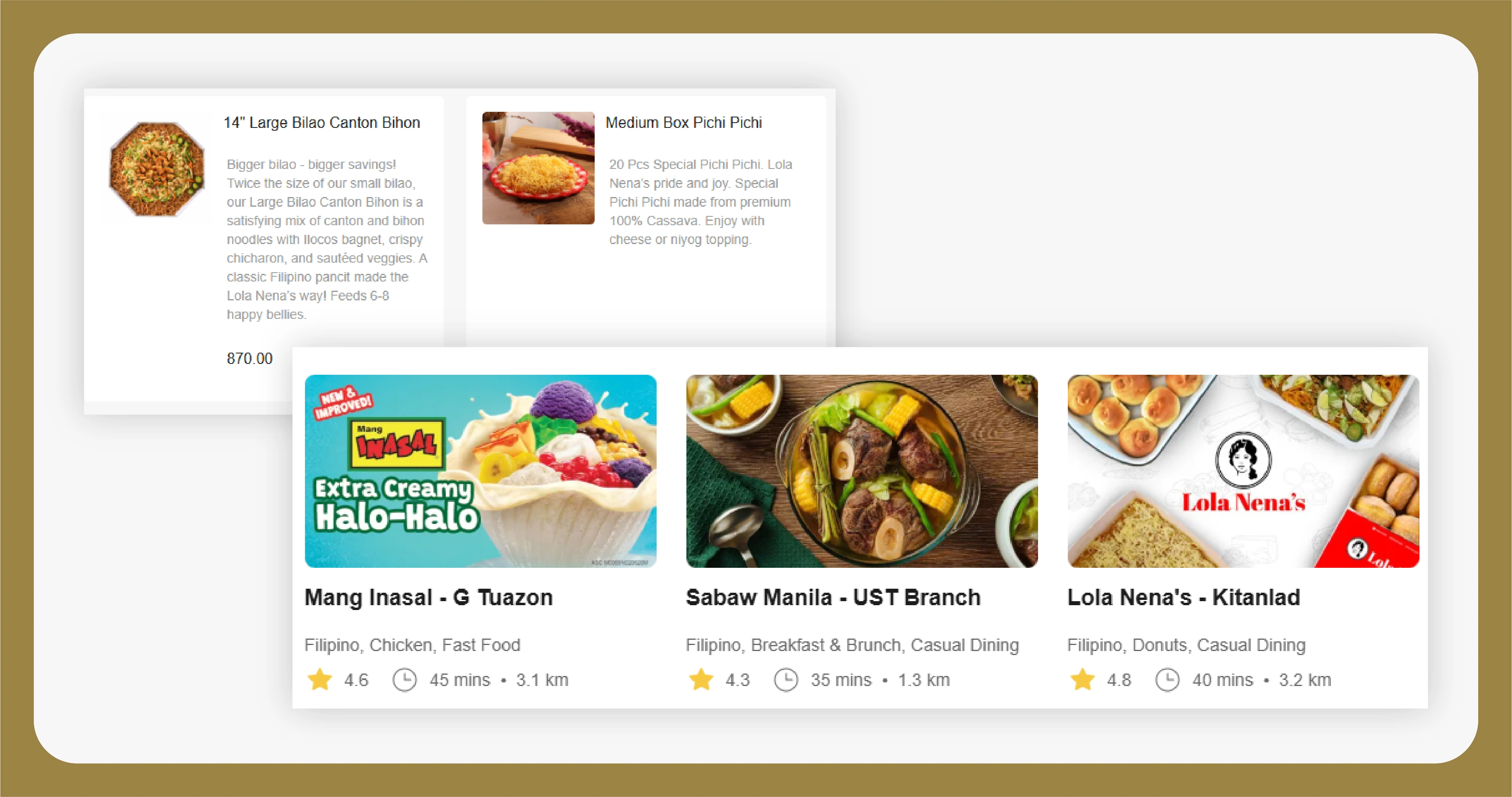
The Philippines food and beverage market is shaped by a strong franchise culture, deep loyalty to local heritage brands like Jollibee and Mang Inasal, and a fast-growing crop of newer concepts ranging from milk tea specialists to Korean-Filipino fusion brands. Quick service restaurants (QSR) dominate consumer recall, but cafe culture, casual dining, and dessert specialists have all expanded materially in recent years.
GrabFood is one of the leading food delivery platforms in the Philippines, alongside foodpanda. The platform lists local heritage brands, multinational chains, fast-growing local franchises, and a long tail of small Filipino-owned restaurants. Each merchant's GrabFood presence — pricing, ratings, review velocity, promotional intensity, and geographic footprint — provides essential intelligence for franchise expansion planning.
Metro Manila remains the country's largest market by far, with concentrated franchise activity across Quezon City, Makati, Bonifacio Global City (BGC), Pasig, and Manila proper. Cebu and Davao serve as the most important secondary cities, each with distinct consumer dynamics and franchise penetration patterns.
Why Franchise Expansion Decisions Need GrabFood Data
A robust analysis of Philippines franchise expansion opportunities using GrabFood data unlocks insights no other source delivers at the same speed and granularity.
Competitive footprint mapping: Before opening a new franchise location, a brand needs to know exactly which competitors operate in the target neighborhood, how they price, and how reviews trend. GrabFood scraping delivers this footprint mapping with one-week refresh cycles
Cuisine gap detection: Some neighborhoods have abundant Filipino-Western fast food but limited regional cuisine specialists. Identifying these gaps reveals where a franchise can launch with reduced direct competition.
Pricing benchmarks for new entrants: What does a typical chicken-rice bowl cost in BGC versus Quezon City versus Cebu? Hard pricing benchmarks anchor franchise pricing decisions in real market context.
Review velocity as demand proxy: While GrabFood does not publish order counts, review velocity and rating distribution serve as reliable proxies for relative demand. High review velocity in a neighborhood suggests strong consumer engagement and franchise opportunity.
Promotional landscape intelligence: Knowing how aggressively competitors promote in a target neighborhood informs the trade investment budget required to compete
Franchise scorecard for existing locations: Brands with existing franchisees can use GrabFood data to monitor each franchisee's competitive performance — average rating, response time, menu compliance — providing an objective scorecard alongside POS data
How the Data Is Captured
Our infrastructure is purpose-built to Extract Filipino Restaurant Data from GrabFood at scale. The methodology rests on six pillars designed to deliver actionable franchise-expansion intelligence.
Multi-city anchoring: We anchor delivery addresses across major Metro Manila districts (Makati, BGC, Quezon City, Pasig, Manila, Parañaque) plus Cebu City, Davao City, and other priority secondary cities to build comprehensive geographic coverage.
Neighborhood granularity: Within each city, we capture data across multiple barangays or districts to surface neighborhood-level pricing and competitive variation.
Brand attribution: Each merchant is mapped to its parent brand and franchise group where attributable, enabling brand-level aggregate analysis across cities
Currency normalization: Top-velocity merchants and trending concepts refresh daily; long-tail merchants refresh weekly. New launches and promotional changes trigger near-real-time recapture.
Refresh cadence: Top-velocity merchants and trending concepts refresh daily; long-tail merchants refresh weekly. New launches and promotional changes trigger near-real-time recapture.
Quality assurance: Every record passes schema validation, brand disambiguation, cuisine reclassification, and outlier detection.
GrabFood Philippines API scraping supports filtering by city, barangay, cuisine, brand, price band, and date range, making it easy to plug Filipino restaurant intelligence into franchise-planning workflows.
Sample GrabFood Philippines Data
Below are representative samples drawn from a typical Filipino restaurant intelligence dataset. All prices in PHP.
Sample 1: Filipino QSR Pricing Across Cities
| Brand | City | Neighborhood | Signature Dish | Price (PHP) |
|---|---|---|---|---|
| Jollibee | Metro Manila | Makati | Chickenjoy 1-pc Set | 99 |
| Jollibee | Metro Manila | Quezon City | Chickenjoy 1-pc Set | 99 |
| Jollibee | Cebu | Cebu City Center | Chickenjoy 1-pc Set | 95 |
| Jollibee | Davao | Davao City Center | Chickenjoy 1-pc Set | 95 |
| Mang Inasal | Metro Manila | BGC | Chicken Inasal w/ Rice | 159 |
| Mang Inasal | Cebu | Cebu IT Park | Chicken Inasal w/ Rice | 149 |
| Chowking | Metro Manila | Pasig | Lauriat Set | 189 |
| Chowking | Davao | Davao City Center | Lauriat Set | 179 |
Sample 2: Merchant Density by City and Cuisine
| Cuisine | Metro Manila | Cebu | Davao |
|---|---|---|---|
| Filipino QSR | 1,890 | 410 | 280 |
| Casual Filipino | 1,210 | 280 | 190 |
| Western Fast Food | 980 | 240 | 170 |
| Korean | 720 | 150 | 95 |
| Japanese | 540 | 130 | 80 |
| Chinese | 480 | 95 | 70 |
| Milk Tea / Beverage | 1,420 | 380 | 240 |
| Bakery / Dessert | 890 | 220 | 140 |
Sample 3: Promotional Intensity by Brand (Metro Manila)
| Brand | Active Promo Frequency | Avg Discount | Most Common Mechanic |
|---|---|---|---|
| Jollibee | High | 18% | Set Discount |
| McDonald's | High | 20% | Combo Deal |
| Mang Inasal | Medium | 15% | Bundle Promo |
| Chowking | Medium | 18% | Family Bucket |
| Goldilocks | Medium | 12% | Birthday Promo |
| Bo's Coffee | Low | 10% | Loyalty Member |
Sample 4: Franchise Expansion Opportunity Heatmap (Sample Cuisine: Filipino QSR)
| Neighborhood | Existing Filipino QSR Merchants | Avg Rating | Review Velocity | Opportunity Score |
|---|---|---|---|---|
| Makati CBD | 28 | 4.4 | High | Saturated |
| BGC | 32 | 4.5 | High | Saturated |
| Quezon City | 41 | 4.3 | High | Competitive |
| Parañaque | 22 | 4.2 | Medium | Emerging |
| Marikina | 15 | 4.1 | Medium | Opportunity |
| Cebu IT Park | 18 | 4.4 | High | Emerging |
| Davao Poblacion | 11 | 4.2 | Medium | Opportunity |
These tables represent a small slice of the millions of records captured monthly across GrabFood Philippines.
What the Data Reveals
Several consistent patterns emerge from systematic Filipino restaurant analysis.
Filipino QSR remains the dominant category by merchant count: Across Metro Manila, Cebu, and Davao, Filipino QSR concepts (Jollibee, Mang Inasal, Chowking, plus regional players) form the largest merchant share, reflecting deep consumer loyalty to local heritage brands.
Pricing differential between Metro Manila and provincial cities is real but modest: Most QSR brands price 3 to 8 percent lower in Cebu and Davao than in Metro Manila, reflecting local rent and wage economics. This gap is smaller than equivalent gaps in some other Southeast Asian markets.
Milk tea and beverage concepts grow fastest: Across all three cities, milk tea and beverage merchant counts have grown rapidly, with new entrants continuing to launch monthly. Franchise opportunity in this category remains active despite intense competition.
Korean and Japanese concepts under-penetrate secondary cities: Cebu and Davao show meaningfully lower Korean and Japanese merchant density relative to Metro Manila, suggesting franchise opportunity for brands willing to lead category development in those cities
Promotional intensity varies by brand strategy: Jollibee and McDonald's run frequent set-discount and combo promotions; specialty brands (Bo's Coffee, Goldilocks) lean lighter on promotion and heavier on loyalty programs. Franchise expansion plans should reflect category promotional norms.
BGC and Cebu IT Park show similar competitive dynamics: Despite different cities, both neighborhoods host high-density, high-rated, high-review-velocity merchant clusters, suggesting they share similar consumer profiles and franchise opportunity logic
Use Cases for Filipino Franchise Expansion Data
The applications of Filipino franchise market intelligence are wide-ranging.
Filipino food brands use the data to evaluate new franchise location candidates, benchmark existing franchisees, and validate expansion assumptions with real market evidence. Multinational F&B chains entering the Philippines use the data for market entry due diligence and competitive landscape mapping. Franchise consultants deliver clients defensible recommendations backed by hard data rather than anecdotal observation. Real estate developers evaluate mall and street-level demand patterns to inform tenant mix decisions. Investors validate Filipino restaurant group growth assumptions during due diligence. Government agencies and trade associations monitor franchise sector health and category innovation.
Schema and Coverage
A typical record includes merchant name, brand affiliation, franchise group attribution, address and geocoordinates, neighborhood and city, opening hours, average consumer rating and review count, cuisine taxonomy, dish-level pricing in PHP, VAT-inclusive flag, promotional flags, image URLs, and capture timestamp. Coverage spans Metro Manila (Makati, BGC, Quezon City, Pasig, Manila, Parañaque, Mandaluyong, San Juan, Marikina, Las Piñas), Cebu City, Davao City, plus Cagayan de Oro, Iloilo, Bacolod, and other priority secondary cities by client request.
Why Choose Food Data Scrape
Capturing reliable franchise-expansion intelligence on GrabFood Philippines is harder than it appears. Brand-to-franchisee attribution is rarely explicit on listings, cuisine taxonomy varies between merchants, district-based personalization affects what consumers see, and review velocity capture requires careful longitudinal logic. Most internal teams underestimate the engineering and Filipino market context required to deliver trustworthy data.
We bring managed infrastructure, ethical and compliant data collection practices, and deep domain expertise in Philippines and Southeast Asian food and beverage. Advantages include compliance-first architecture, scalable extraction across millions of public pages daily, brand and franchise attribution logic, fully customizable harmonized schemas, near-real-time refresh on priority merchants, dedicated analyst support familiar with Filipino market dynamics, and out-of-the-box dashboards highlighting city-by-city franchise opportunity.
Conclusion: From Franchise Intuition to Franchise Intelligence
Filipino food brands have always relied on instinct, relationships, and local knowledge to drive franchise expansion. Those remain essential — but in 2025 and beyond, the brands that combine instinct with structured GrabFood data will outpace those that rely on intuition alone. Cuisine gap detection, competitive footprint mapping, pricing benchmarks, review velocity, and promotional landscape intelligence together transform franchise planning from art to disciplined commercial practice.
Our team transforms GrabFood Philippines' public catalog into structured intelligence ready to power franchise expansion strategy. Whether you need a one-time market entry study, a recurring competitive dashboard, or an always-on data feed integrated into your franchise-planning workflows, we configure a delivery model that fits your needs. If you are ready to act on real Filipino restaurant data instead of guesswork, get in touch with our team today.