The Client
The client is a fast-growing retail analytics company specializing in competitive grocery pricing intelligence for brands and large retailers. Their mission is to provide accurate, real-time visibility into pricing trends, promotions, and SKU-level variations across leading U.S. grocery chains. By choosing to Extract Grocery Product Prices from Walmart, Target & Kroger, the client ensures consistent benchmarking and reliable market comparisons for its customers. Through the Walmart vs Target vs Kroger Grocery Intelligence Dataset, the client helps stakeholders identify price leaders, monitor inflation trends, and evaluate category performance across multiple stores and regions. This data plays a critical role in improving pricing strategies and assortment planning. To scale insights efficiently, the client integrates the Walmart-Target-Kroger Multi-Store Pricing API into internal dashboards and analytics platforms. This enables automated updates, faster decision-making, reduced manual effort, and stronger competitive positioning in a rapidly changing grocery retail landscape.
Key Challenges
- Fragmented Pricing Visibility Across Platforms
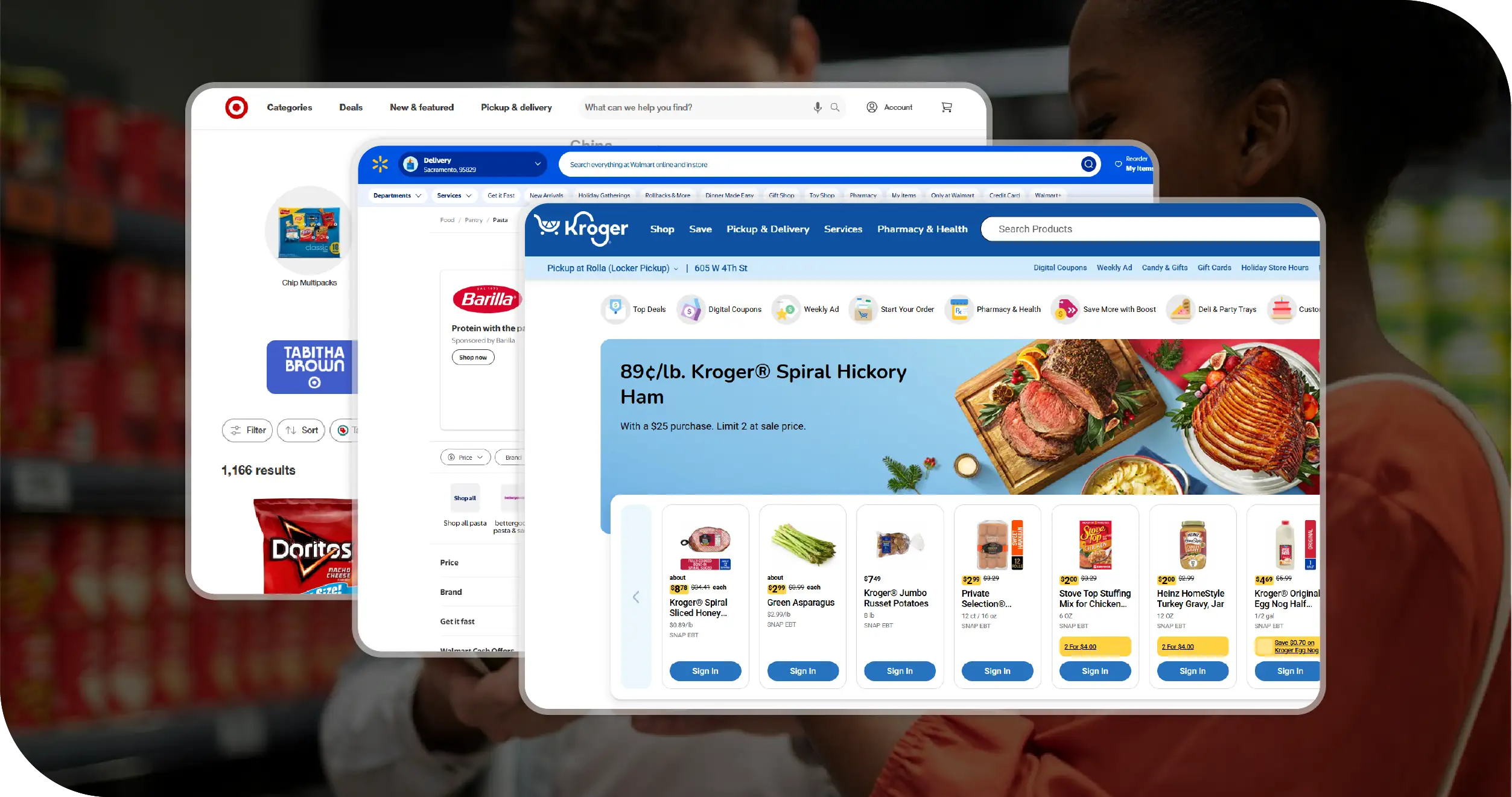
The client struggled with inconsistent and delayed pricing visibility because grocery prices and availability varied widely across platforms. Without a unified data source like Walmart Grocery Delivery Scraping API, comparing real-time delivery prices and promotions was time-consuming and often inaccurate. - Frequent Price Fluctuations and Promotions
Rapid changes in discounts, surge pricing, and delivery-specific offers created analytical gaps. The absence of automated tracking through Target Grocery Delivery Scraping API made it difficult to capture short-lived promotions, resulting in missed competitive insights and slower pricing responses. - Scalability and Data Accuracy Issues
Manual data collection could not scale across thousands of SKUs and locations. Lacking structured feeds such as Kroger Grocery Delivery Scraping API, the client faced data inconsistencies, higher operational costs, and challenges maintaining accuracy across multiple delivery regions.
Key Solutions
- Automated Multi-App Data Collection
We deployed scalable Grocery App Data Scraping services to capture SKU-level prices, pack sizes, discounts, and availability across multiple grocery platforms. This eliminated manual tracking, improved data freshness, and delivered consistent, structured datasets for accurate cross-retailer comparisons. - Real-Time API-Driven Intelligence
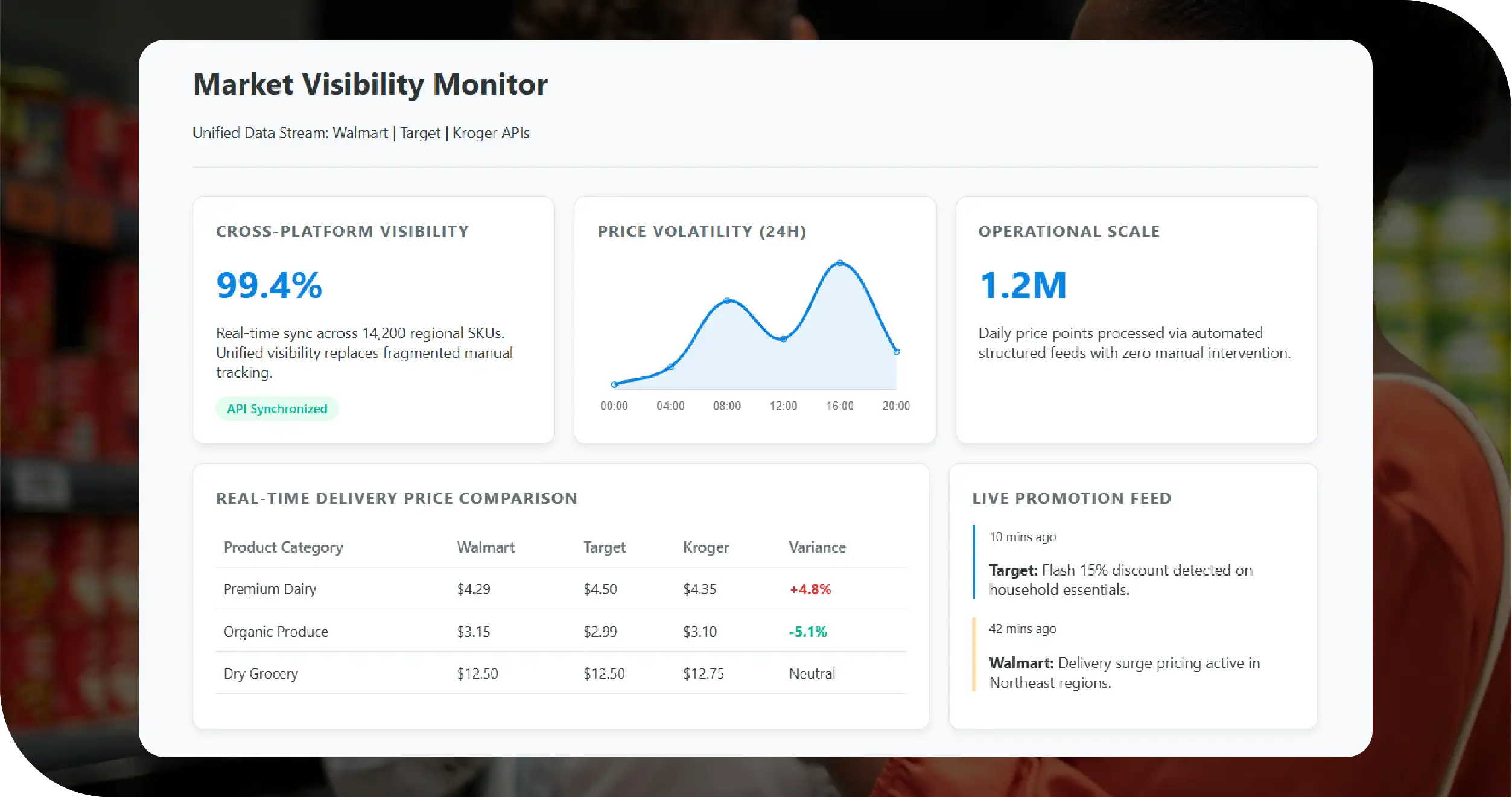
Through Grocery Delivery Scraping API Services, the client gained real-time access to frequently changing delivery prices and promotions. Automated updates ensured timely alerts on price drops and surges, enabling faster competitive responses and more precise pricing strategies. - Actionable Visualization & Reporting
All scraped data was integrated into a centralized Grocery Price Dashboard, offering clear visual comparisons, trend tracking, and SKU-level benchmarking. This empowered stakeholders to quickly identify pricing gaps, optimize assortments, and support data-driven decisions.
Sample Scraped Grocery Pricing Data
| Retailer | Product Name | Pack Size | Price (USD) | Discount |
|---|---|---|---|---|
| Walmart | Organic Milk | 1 Gallon | 4.28 | 5% |
| Target | Organic Milk | 1 Gallon | 4.49 | 0% |
| Kroger | Organic Milk | 1 Gallon | 4.19 | 7% |
| Walmart | Whole Wheat Bread | 400 g | 2.18 | 3% |
| Target | Whole Wheat Bread | 400 g | 2.29 | 0% |
Methodologies Used
- SKU Matching and Normalization
We standardized product names, pack sizes, and units across retailers to ensure identical SKUs were accurately matched. This eliminated comparison errors, improved data consistency, and enabled reliable price benchmarking across multiple grocery platforms and delivery formats. - High-Frequency Data Collection
Prices were captured at scheduled intervals throughout the day to account for dynamic pricing, promotions, and regional variations. This approach ensured time-sensitive changes were recorded, supporting precise trend analysis and short-term competitive insights. - Location-Based Price Mapping
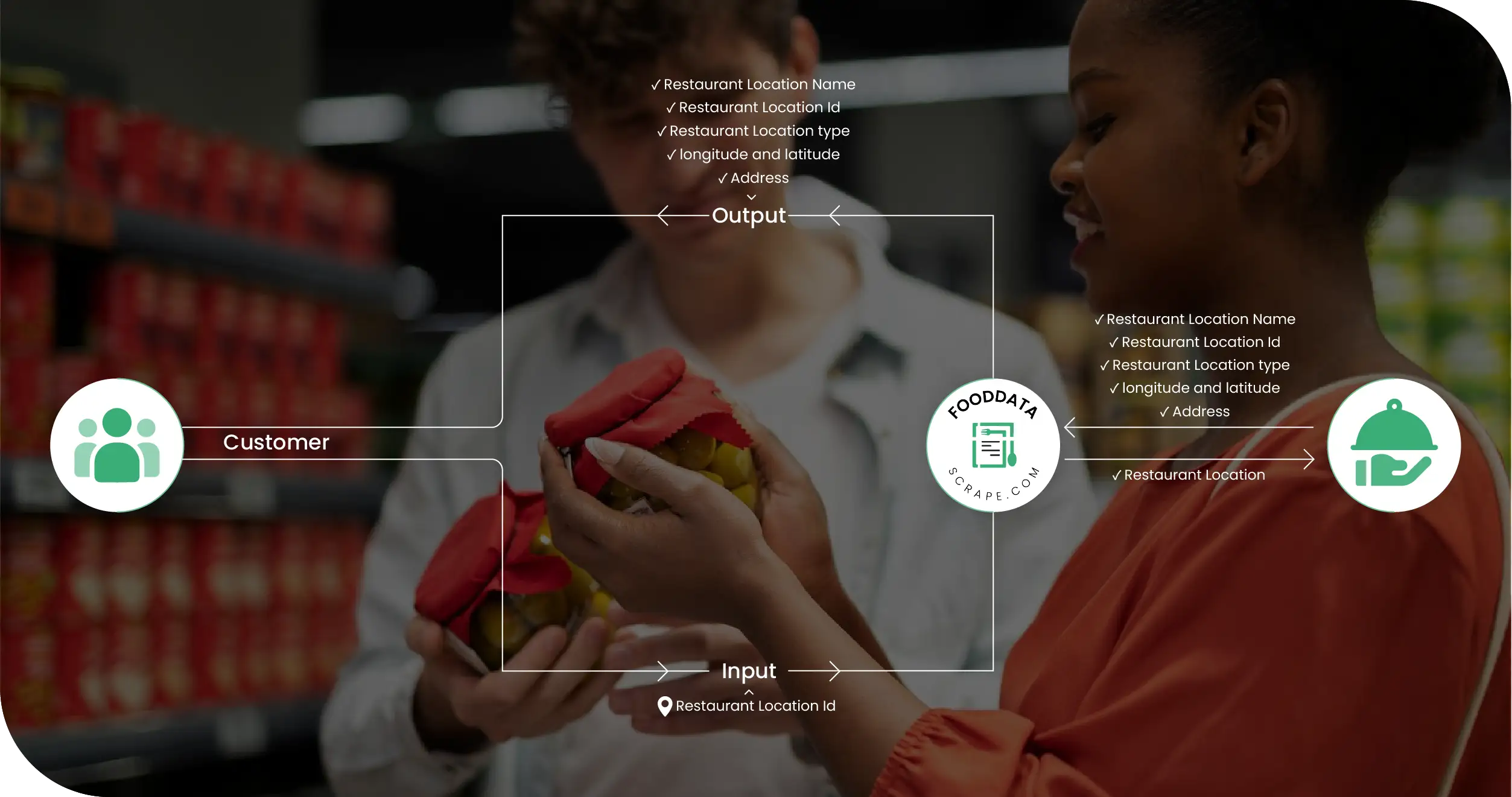
We collected data across multiple cities and delivery zones to reflect regional pricing differences. Mapping prices by location allowed the client to analyze local competition, optimize regional strategies, and understand geo-specific pricing behavior. - Data Validation and Quality Checks
Automated validation rules flagged missing values, extreme price deviations, and duplicate records. Regular quality audits ensured high accuracy, reduced noise in analysis, and maintained trust in the datasets used for strategic decision-making. - Structured Storage and Analytics Readiness
All collected data was transformed into clean, analytics-ready tables. This enabled seamless integration with BI tools, faster querying, and efficient reporting for both historical analysis and real-time monitoring.
Advantages of Collecting Data Using Food Data Scrape

- Real-Time Competitive Visibility
Our data scraping services deliver continuous access to up-to-date prices, promotions, and availability across platforms. This real-time visibility helps businesses respond faster to competitor moves, minimize pricing blind spots, and maintain strong market positioning. - Scalable Data Collection at High Accuracy
We collect large volumes of structured data across thousands of SKUs and locations with consistent accuracy. This scalability removes manual effort, reduces errors, and ensures reliable datasets that teams can confidently use for critical decisions. - Improved Pricing and Margin Optimization
Accurate competitor benchmarks enable smarter pricing adjustments and promotion planning. Businesses can identify underpriced or overpriced items, protect margins, and align pricing strategies with actual market conditions rather than assumptions. - Actionable Insights, Not Just Raw Data
Our services transform raw scraped information into clean, analytics-ready datasets. This allows faster analysis, clearer reporting, and easier integration into dashboards, empowering stakeholders with insights they can act on immediately. - Cost Efficiency and Faster Decision-Making
Automated scraping significantly lowers operational costs compared to manual tracking. With faster data availability and reduced analysis time, teams make quicker, data-driven decisions that improve efficiency and overall business performance.
Client’s Testimonial
"Partnering with this team has transformed our approach to grocery pricing intelligence. Their data scraping services provided us with accurate, real-time insights across multiple retailers, allowing us to monitor competitor pricing and promotions effortlessly. The structured datasets and dashboards delivered actionable intelligence that helped optimize our pricing strategies, improve margin management, and respond swiftly to market changes. Their professionalism, timely updates, and attention to detail exceeded our expectations. Thanks to their solutions, we can now make data-driven decisions with confidence, saving time while gaining a competitive edge in the dynamic grocery market."
Head of Pricing Strategy
Final Outcome
The final outcome of the project was a comprehensive and user-friendly Grocery Price Tracking Dashboard that allowed the client to monitor real-time prices, promotions, and availability across multiple grocery retailers. By leveraging accurate Grocery Pricing Data Intelligence, the client gained actionable insights into competitor strategies, pricing trends, and regional variations, enabling faster, data-driven decisions. Integration of detailed Grocery Store Datasets ensured all SKUs were tracked consistently, providing historical comparisons and trend analysis. This empowered the client to optimize pricing, improve margins, and identify opportunities for targeted promotions. Overall, the solution transformed their pricing strategy, reduced manual effort, and strengthened market responsiveness, giving them a sustainable competitive advantage in the highly dynamic grocery retail landscape.