Introduction
The American grocery landscape is undergoing one of the most significant demand shifts in decades — and the trigger is not a recession, a trend diet, or a viral TikTok food. It is a class of weight-loss medications known as GLP-1 receptor agonists: Ozempic, Wegovy, Mounjaro, and their rapidly multiplying successors.
As of early 2026, more than 16% of U.S. households include at least one GLP-1 user — up from 11% in late 2023. J.P. Morgan projects this number will reach 25 million Americans by 2030. Cornell University research published in the Journal of Marketing Research found that within just six months of starting a GLP-1 medication, households cut grocery spending by an average of 5.3%. For higher-income households, the drop exceeds 8%.
For FMCG brands, retail buyers, and category managers, these numbers are not an abstraction. They translate directly into SKU-level volume drops, shifting shelf allocations, and renegotiated trade deals. The question is no longer whether GLP-1 drugs are reshaping demand — it is whether your organization has the real-time data infrastructure to see those changes before they hit your P&L.
This is precisely where grocery web scraping and food data intelligence become indispensable. Food Data Scrape helps FMCG brands extract, normalize, and monitor product-level sales signals, availability shifts, and pricing changes across hundreds of US retail and quick-commerce platforms — giving teams the visibility they need to act on GLP-1 demand changes as they happen, not quarters later.
Understanding the GLP-1 Demand Shift: What the Data Actually Shows
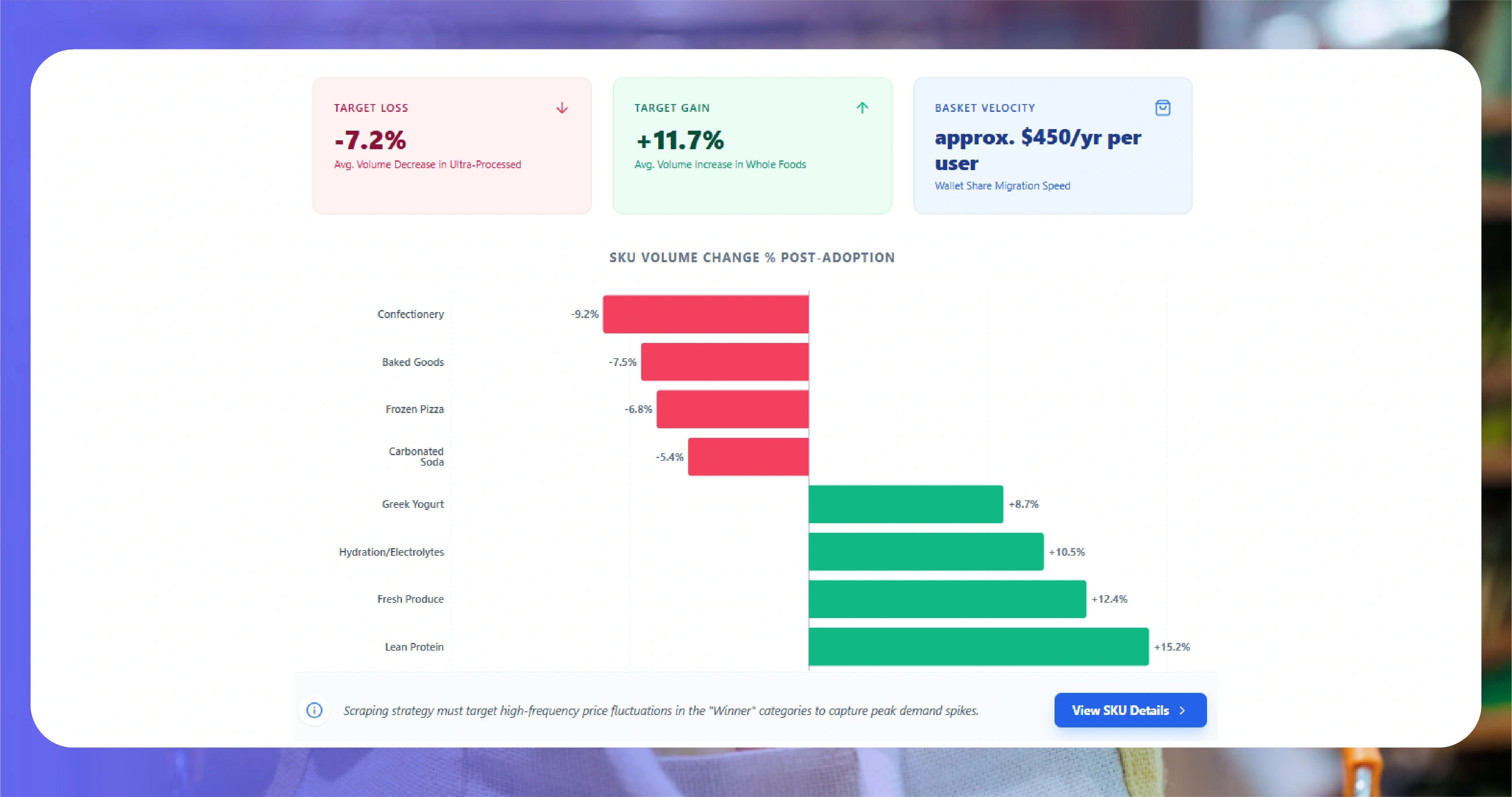
Before diving into scraping strategies, it is important to understand the precise nature of the GLP-1 demand shift — because it is not a uniform decline. It is a selective reallocation of grocery spending that creates both losers and winners at the SKU level.
Categories Declining
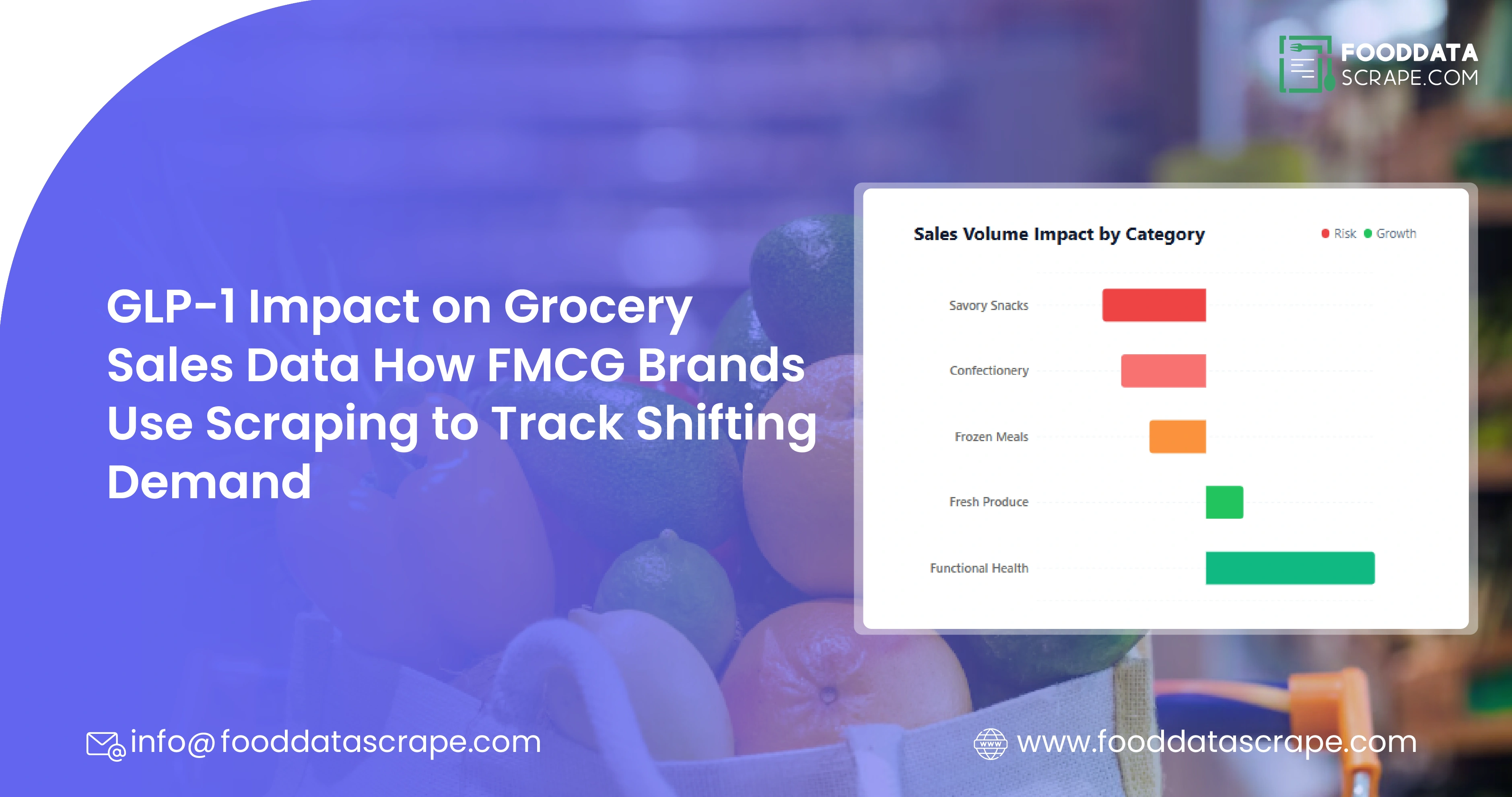
- Savory snacks: -10% spending within 6 months of GLP-1 adoption
- Sweets, baked goods, cookies: -9 to -11% — driven by reduced cravings
- Ultra-processed, calorie-dense foods: broadest category of decline
- Fast food restaurant spend: -8% (signals reduced impulse eating)
- High-sugar beverages: softening demand especially among Millennials/Gen Z
Categories Growing
- Yogurt: largest before-and-after increase observed in Cornell study
- Fresh fruit: steady gains as users seek nutrient density
- Protein bars and meat snacks: +25% growth in GLP-1 user households
- Liquid meal replacements: +10% as small-portion, high-nutrition formats win
- Fiber-enhanced products: FDA high-fiber products up 85% across grocery
Critically, these shifts do not show up evenly across geographies, retailers, or time. A Walmart in suburban Dallas will show different GLP-1 demand patterns than a Whole Foods in Manhattan or a Kroger in Cincinnati. Only granular, retailer-level, zip-code-level scraping can reveal these differences.
Sample Dataset 1: GLP-1 Demand Impact by Category — US Retailers (Food Data Scrape, Q1 2026)
| Category | Avg. Volume Change | Top Declining Retailer | Top Growing Retailer | Trend Direction |
|---|---|---|---|---|
| Savory Snacks | -9.8% | Walmart (US) | Whole Foods | ↓ Declining |
| Baked Goods & Cookies | -10.3% | Kroger | Trader Joe's | ↓ Declining |
| Yogurt (High Protein) | +18.4% | — | Target | ↑ Growing |
| Protein Bars | +24.7% | — | Costco | ↑ Growing |
| Meat Snacks | +22.1% | — | Walmart | ↑ Growing |
| Liquid Meal Replacements | +11.2% | — | Amazon Fresh | ↑ Growing |
| Sugary Cereals | -7.6% | Safeway | — | ↓ Declining |
| Fresh Fruit (Packaged) | +8.9% | — | Kroger | ↑ Growing |
Why Traditional Sales Data Is Too Slow for GLP-1 Intelligence
Most FMCG brands rely on syndicated data providers — Nielsen, Circana, IRI — for category-level volume tracking. These reports are powerful, but they have a fundamental limitation in the GLP-1 context: they are backward-looking.
By the time a quarterly syndicated report shows a 9% volume decline in your savory snack portfolio, your competitor may have already reformulated products, shifted pack sizes to single-serve formats, and renegotiated shelf space in 200 Kroger stores. The GLP-1 demand shift does not wait for quarterly reports.
Here is what FMCG brands specifically need that syndicated data cannot provide in real time:
- SKU-level availability changes across individual store locations
- Daily price movements that indicate a retailer is discounting to clear stock
- New product launches in protein, fiber, and functional categories by competitors
- Out-of-stock signals that reveal demand spikes in winning categories
- Private label positioning against national brands in GLP-1-friendly segments
- Loyalty card pricing at Kroger Plus, Target Circle, and Walmart+ — often different from shelf price
Food Data Scrape addresses all of these gaps through automated, daily-refresh grocery intelligence pipelines built specifically for FMCG use cases. Our systems extract product-level data from 100+ US retailers including Walmart, Kroger, Target, Costco, Whole Foods, Safeway, Publix, Aldi, and Amazon Fresh, delivering structured data via API, S3, or direct BI integration.
How FMCG Brands Use Food Data Scrape to Track GLP-1 Demand Shifts
The practical application of grocery scraping intelligence for GLP-1 monitoring falls into five core workflows:
Real-Time SKU Availability Monitoring
When a product starts going out of stock frequently, it signals demand is outpacing supply. When a product sits at 100% availability for weeks, it signals demand has softened. Food Data Scrape tracks availability status for millions of SKUs daily across all major US retailers, flagging both demand spikes and demand drops at the individual store level.
Competitor New Product Launch Detection
GLP-1 is creating a product innovation race. PepsiCo launched a prebiotic soda variant. General Mills reformulated certain cereals. Dozens of protein-forward snack brands are launching monthly. Food Data Scrape's product launch detection module identifies new SKUs appearing on retailer shelves within 24-48 hours of listing, giving brands early warning to respond with their own positioning.
Private Label Competitive Intelligence
Walmart, Kroger, and Target are aggressively expanding private label in protein, fiber, and functional food — the exact categories where GLP-1 users are spending more. Private label products now represent 20% of US grocery spend, up from 17% three years ago. Food Data Scrape tracks private label SKUs, pricing, and shelf positioning against national brand equivalents across all major retailers, updated daily.
Promotional & Discount Pattern Tracking
Retailers discount slow-moving inventory. When GLP-1-driven volume softens in a category, the first signal is often an increase in promotional frequency — BOGO offers, temporary price reductions, digital coupon availability. Food Data Scrape captures promotional mechanics across all retailer platforms, allowing brands to see when their category is under promotional pressure before it escalates.
Hyperlocal Demand Signal Mapping
GLP-1 adoption is higher in wealthier zip codes and specific metro areas. A brand with strong distribution in high-income suburban markets will feel the GLP-1 impact earlier and more intensely than brands concentrated in lower-income geographies. Food Data Scrape's hyperlocal scraping captures store-level data at ZIP code granularity, allowing demand modeling that reflects actual GLP-1 penetration by market.
Sample Dataset 2: Competitor Product Launch Monitor — Protein & Functional Snacks (Food Data Scrape, March 2026)
| Brand | New SKU Name | Category | Retailer First Listed | List Date | Price ($/unit) | GLP-1 Claim |
|---|---|---|---|---|---|---|
| Nature Valley | Protein Crunch Bar 30g | Protein Bars | Target | Mar 3, 2026 | $1.89 | Yes — 'Supports Satiety' |
| Frito-Lay | Simply Popcorn Light 4oz | Snacks (Reformulated) | Walmart | Mar 7, 2026 | $2.49 | No — Clean Label |
| Chobani | Zero Sugar Greek Protein 5.3oz | Yogurt | Kroger | Mar 10, 2026 | $1.99 | Yes — '15g Protein' |
| KIND | GLP Companion Bar | Functional Snacks | Whole Foods | Mar 14, 2026 | $2.79 | Yes — Explicit GLP-1 Positioning |
| Private Label (Kroger) | Simple Truth Protein Bites | Protein Snacks | Kroger | Mar 18, 2026 | $1.49 | Implicit — 'High Protein' |
| Danone | Oikos Pro 20g Protein | Yogurt | Walmart + Target | Mar 21, 2026 | $2.19 | Yes — '20g Protein / Low Sugar' |
Sample Data: GLP-1 Price & Availability Intelligence Across US Retailers
The following sample datasets illustrate the type of grocery intelligence Food Data Scrape delivers to FMCG clients on a daily basis. These represent a small subset of a typical data feed covering 50,000+ SKUs across 100+ retailers.
Sample Dataset 3: SKU-Level Availability & Pricing — Savory Snacks Category (Declining due to GLP-1)
| SKU / Product | Retailer | Store Location | Price | Availability | Price Change (7d) | Promo Active |
|---|---|---|---|---|---|---|
| Doritos Nacho 9.25oz | Walmart | Dallas TX 75201 | $4.98 | In Stock | -$0.50 (discount) | Yes — Rollback |
| Pringles Original 5.2oz | Kroger | Atlanta GA 30301 | $3.49 | In Stock | No change | No |
| Cheetos Crunchy 8oz | Target | Chicago IL 60601 | $5.49 | Low Stock (3 units) | -$1.00 TPR | Yes — Circle Deal |
| Lay's Classic 8oz | Safeway | Seattle WA 98101 | $4.79 | Out of Stock | N/A | N/A |
| Ritz Crackers 13.7oz | Publix | Miami FL 33101 | $4.29 | In Stock | +$0.20 | No |
| Cheez-It Original 12.4oz | Costco | Houston TX 77001 | $8.99 (bulk) | In Stock | No change | No |
| Pirates Booty 5oz | Whole Foods | Boston MA 02101 | $5.49 | In Stock | No change | No |
| SkinnyPop Popcorn 5.3oz | Amazon Fresh | NYC NY 10001 | $4.99 | In Stock | -$0.30 | Yes — Subscribe&Save |
Sample Dataset 4: Private Label vs. National Brand — Protein Yogurt Pricing Intelligence
| Product | Type | Retailer | Price | Protein (g) | Price/gram Protein | Shelf Rank |
|---|---|---|---|---|---|---|
| Chobani Greek Protein 5.3oz | National Brand | Walmart | $1.99 | 15g | $0.133 | #1 |
| Great Value Greek Protein 5.3oz | Private Label | Walmart | $1.29 | 12g | $0.108 | #2 |
| Oikos Triple Zero 5.3oz | National Brand | Kroger | $2.19 | 15g | $0.146 | #1 |
| Kroger Private Select Protein Yogurt | Private Label | Kroger | $1.39 | 12g | $0.116 | #3 |
| Fage Total 0% 7oz | National Brand | Whole Foods | $2.49 | 18g | $0.138 | #2 |
| 365 by WFM Greek Protein | Private Label | Whole Foods | $1.79 | 14g | $0.128 | #1 |
| Siggi's Plain 4% 5.3oz | National Brand | Target | $2.69 | 14g | $0.192 | #4 |
| Good & Gather Greek Protein | Private Label | Target | $1.49 | 12g | $0.124 | #1 |
Building a GLP-1 Demand Intelligence System with Food Data Scrape
Implementing a comprehensive GLP-1 demand monitoring system using Food Data Scrape involves five integrated data layers:
Layer 1 — Retailer Coverage & SKU Mapping
Begin with a complete SKU catalog covering all your brand's products and your top 5-10 competitor brands across your target retailers. Food Data Scrape maintains a continuously updated product matching engine with 95%+ accuracy across 200+ platforms, ensuring that the same SKU appearing under different product names or packaging variants is correctly unified in your dataset.
Layer 2 — Daily Availability & Price Feeds
Configure daily availability and pricing feeds for your mapped SKU universe. Food Data Scrape delivers these as structured JSON or CSV feeds, updated every 24 hours, with optional same-day refresh for high-velocity retailers like Amazon Fresh and Instacart. Each record includes store-level location, availability status, current price, historical price baseline, and active promotional flags.
Layer 3 — Competitive New Product Monitoring
Activate Food Data Scrape's new product detection module for your key categories. The system scans retailer product listings daily, identifies new SKUs matching predefined category and keyword parameters, and alerts your team within 24-48 hours of a new competitor launch appearing on shelf. In a GLP-1 market, where protein and functional food launches are accelerating weekly, this early warning system is a direct competitive advantage.
Layer 4 — Promotional Intelligence
Track promotional mechanics — temporary price reductions, BOGO structures, loyalty-exclusive pricing, digital coupon offers, and buy-more-save-more structures — across all retailer platforms. Food Data Scrape extracts promotional data from retailer websites, apps, and weekly digital circulars, structured with start date, end date, discount depth, and mechanic type.
Layer 5 — BI Dashboard & API Delivery
All data is delivered via Food Data Scrape's API, or pushed directly to your cloud warehouse (Snowflake, BigQuery, Redshift, S3) for integration into your existing Power BI, Tableau, or Looker dashboards. Our pre-built dashboard templates include GLP-1 demand tracking views, category win/loss analysis, and competitive positioning scorecards.
Real-World Use Cases: FMCG Brands Winning with GLP-1 Data Intelligence
Use Case A: Snack Brand Defending Shelf Space
A national snack brand noticed declining reorder rates from Kroger's buying team but lacked granular data to understand the pattern. Using Food Data Scrape's store-level availability monitoring across 1,200 Kroger locations, they identified that out-of-stock rates in their category had actually improved — meaning the issue was reduced order quantities, not supply problems. Further analysis revealed that three private-label protein snack SKUs had been added to the planogram in their section at 12 stores, signaling a test-and-rollout program. The brand used this intelligence to proactively meet with the Kroger buyer, present a protein-reformulated variant, and secure a test in those same 12 stores — before losing any permanent shelf slots.
Use Case B: Yogurt Brand Maximizing GLP-1 Tailwinds
A protein-yogurt brand saw internal sell-through data improving but wanted to understand whether competitors were capturing more of the GLP-1 demand wave. Food Data Scrape's competitive pricing dashboard revealed that their #1 competitor was being featured in Target Circle digital offers for two consecutive weeks — a promotional strategy that was driving trial. The brand responded by activating their own digital coupon program at Walmart and Kroger within 10 days, directly capturing the demand shift in their highest-penetration markets.
Use Case C: CPG Manufacturer Reformulating for GLP-1 Market
A mid-size CPG manufacturer producing breakfast cereals used Food Data Scrape's category-level volume signals — specifically tracking SKU availability gaps in fiber-enriched and protein-fortified cereals — to validate their reformulation investment case. The data showed consistent out-of-stock patterns in high-fiber SKUs at 40+ Whole Foods locations, confirming genuine shelf demand that justified a new product line launch within their existing manufacturing footprint.
Conclusion
The GLP-1 demand shift is not a temporary blip. With oral formulations making these medications more accessible than ever, with J.P. Morgan projecting 25 million US users by 2030, and with behavioral changes persisting even in users who discontinue — this is a structural realignment of the American grocery basket.
FMCG brands that rely on quarterly syndicated data reports will always be responding to a market that already moved. Brands that invest in real-time grocery scraping intelligence will see the shifts forming at the SKU level — in out-of-stock signals, promotional pressure, private label expansion, and competitor launches — while there is still time to act.
Food Data Scrape exists to give FMCG teams the real-time data infrastructure to turn GLP-1 market intelligence into tangible competitive action. Whether you need daily availability feeds for 50,000 SKUs, competitive new product launch alerts, or a complete private label pricing dashboard, our team can scope, build, and deliver your data pipeline — typically going live within 5-7 days.