
The Indian online grocery market is witnessing exponential growth, driven by rising internet penetration, evolving consumer preferences, and the convenience of app-based ordering. Understanding product availability, assortment patterns, and pricing variations across platforms is critical for retailers, FMCG brands, and delivery networks aiming to optimize operations and strategic planning. This report analyzes product-level insights, mapping inventory distribution, category performance, and competitive positioning across leading grocery delivery platforms. The study highlights urban and Tier-2 city variations, promotional impact, and seasonal fluctuations in product demand. By examining both staples and emerging categories, businesses can refine assortment strategies, forecast demand, and enhance customer satisfaction. Real-time monitoring of stock levels, price trends, and delivery options allows for efficient supply chain management, targeted promotions, and revenue optimization. This comprehensive analysis provides actionable intelligence for stakeholders seeking to strengthen market presence and respond effectively to India’s fast-growing digital grocery ecosystem.

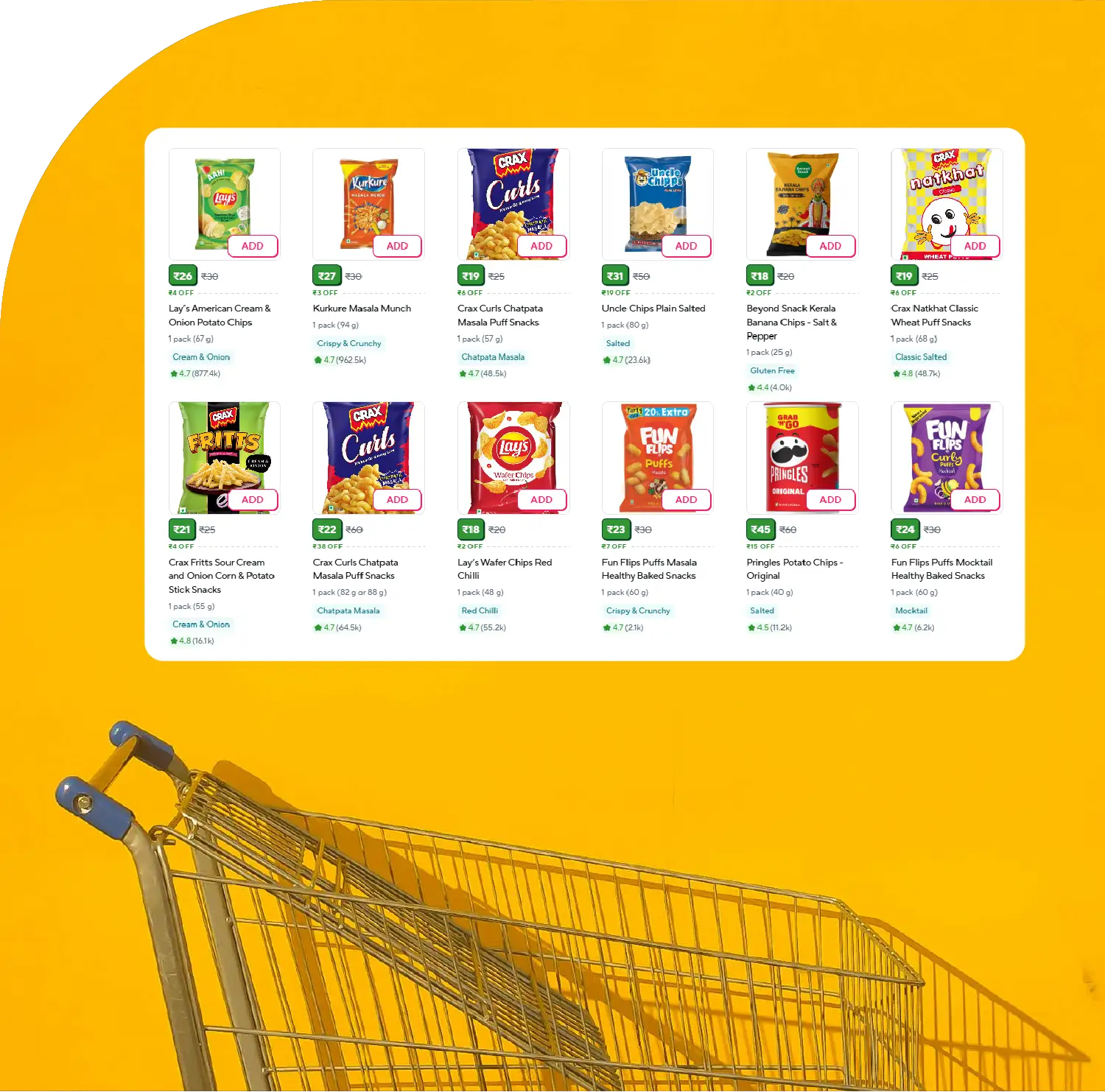
Market Overview: Rapid online grocery adoption across urban and Tier-2 markets.
Category Insights: Staples, dairy, snacks, and beverages dominate demand trends.
Pricing Patterns: Significant cross-platform price variation and promotional influence observed.
Inventory Tracking: Stock visibility and replenishment optimization critical for operational efficiency.
Strategic Planning: Product mapping informs assortment strategy, demand forecasting, and competitive benchmarking.

The India's Online Grocery Product Mapping Report offers an in-depth analysis of product availability, pricing trends, and category performance across the nation’s leading grocery platforms. By leveraging Grocery Product Mapping Analytics, stakeholders including retailers, FMCG brands, and supply chain managers gain actionable insights into assortment performance, pricing fluctuations, and evolving customer demand patterns. This level of detailed visibility enables businesses to make informed decisions regarding inventory allocation, promotional planning, and competitive benchmarking, ensuring that products are effectively positioned in both urban and Tier-2 markets.
Product Mapping for Indian Grocery Platforms allows organizations to monitor SKU-level performance and evaluate regional variations in consumption behavior. By systematically capturing data on stock availability, pricing changes, and category-specific growth, businesses can identify trends in consumer preferences, such as increased demand for convenience foods, premium staples, and health-oriented products. Insights derived from Online Grocery Product Data Extraction in India provide a foundation for predictive forecasting and strategic decision-making, helping companies allocate resources efficiently and minimize stock-outs.
Platforms like BigBasket, Zepto, Blinkit, Swiggy Instamart, and JioMart have significantly reshaped online grocery shopping patterns, highlighting the importance of comprehensive SKU-level tracking. Grocery Product Mapping Insights in India reveal opportunities for brands to optimize cross-platform promotions, identify whitespace in product offerings, and anticipate shifts in customer demand. Businesses can analyze category-specific growth rates, competitive pricing strategies, and regional adoption trends to fine-tune assortment decisions. By integrating structured data pipelines and real-time monitoring, companies are empowered to refine product placement, ensure consistent availability, and enhance customer engagement, thereby gaining a competitive advantage in India’s fast-evolving digital grocery ecosystem.
With Cross-Platform Grocery Product Mapping in India, businesses track SKU availability, pricing differences, and promotional activity across multiple delivery apps. Analysis reveals patterns in consumer preferences, including high-demand categories such as staples, dairy, beverages, snacks, and packaged foods.
Retailers benefit from monitoring stock-outs, price changes, and promotional performance in real time using strategy to Scrape Online Grocery Product Data in India. These insights help optimize logistics, enhance assortment decisions, and improve service reliability. Hyperlocal variations highlight how Tier-1 cities show higher demand for premium and specialty products, while Tier-2 markets focus on affordability and staples.
| SKU / Brand | BigBasket Availability | Zepto Availability | Blinkit Availability | Swiggy Instamart Availability | Key Insight |
|---|---|---|---|---|---|
| Amul Taaza Milk 1L | In Stock | In Stock | Out of Stock | In Stock | Tier-2 shortages in Blinkit |
| Aashirvaad Atta 5kg | In Stock | In Stock | In Stock | In Stock | Stable availability across platforms |
| Lay’s Classic Salted 95g | In Stock | Out of Stock | In Stock | In Stock | Zepto faces high stock-out frequency |
| Coca-Cola 1.25L PET | In Stock | In Stock | In Stock | In Stock | Popular beverage maintains consistency |
| Haldiram Bhujia 400g | In Stock | In Stock | In Stock | Out of Stock | Swiggy Instamart faces supply gaps |
The table illustrates how product availability varies across platforms, affecting sales and customer satisfaction. Businesses can use SKU-level mapping to predict shortages, plan restocking schedules, and adjust promotional strategies.
Analyzing category-level data reveals the highest demand segments, including staples, dairy, snacks, and beverages. Dynamic pricing strategies across platforms influence buying behavior, with weekend promotions and bundled discounts driving higher conversions.
Platforms utilize Grocery App Data Scraping services to collect data on stock levels, category performance, and pricing trends. These insights help optimize assortment planning, improve competitive benchmarking, and support data-driven marketing campaigns. Grocery Delivery Scraping API Services provide automated, scalable access to real-time data for ongoing monitoring and analysis.
| Category | BigBasket Avg Price (₹) | Zepto Avg Price (₹) | Blinkit Avg Price (₹) | Swiggy Instamart Avg Price (₹) | Pricing Insight |
|---|---|---|---|---|---|
| Milk 1L | 65 | 63 | 66 | 64 | Zepto slightly lower pricing |
| Atta 5kg | 410 | 395 | 400 | 405 | Zepto attracts price-sensitive buyers |
| Potato Chips 95g | 45 | 42 | 44 | 43 | Premium snack pricing consistent |
| Coca-Cola 1.25L | 55 | 53 | 54 | 54 | Minor platform differences |
| Biscuits 600g | 112 | 110 | 111 | 113 | Price stability drives repeat purchases |
These pricing patterns highlight cross-platform differences and help brands identify competitive pricing opportunities, optimize discounts, and plan promotions to maximize revenue.
Advanced analytics rely on automated pipelines for Grocery Product Mapping Analytics and SKU-level monitoring. Real-time data collection supports demand forecasting, stock optimization, and operational efficiency. By integrating Scrape Online Grocery Product Data in India, businesses capture product availability, pricing fluctuations, and competitor strategies across multiple platforms.
Monitoring tools also facilitate dynamic assortment adjustments, predictive replenishment, and hyperlocal targeting. Combined with advanced reporting Grocery Price Dashboards, these systems provide a unified view of cross-platform performance, enabling better decision-making at SKU and category levels.
The Indian online grocery market is projected to grow significantly by 2027, driven by urban adoption, Tier-2 market expansion, and increasing consumer reliance on digital ordering. SKU-level insights, hyperlocal monitoring, and cross-platform product mapping will remain crucial for operational excellence and market competitiveness. Retailers and brands equipped with scalable extraction pipelines and automated analytics will be better positioned to capture emerging opportunities, optimize supply chains, and respond to shifting consumption patterns.
Comprehensive product mapping allows retailers and FMCG brands to make well-informed decisions regarding assortment planning, pricing strategies, and inventory management. Utilizing a Grocery Price Tracking Dashboard provides clear visibility into cross-platform performance, helping businesses identify gaps and opportunities in real time. Leveraging Grocery Pricing Data Intelligence supports data-driven insights for adjusting promotions, optimizing product placement, and enhancing revenue strategies. Access to curated Grocery Store Datasets enables accurate demand forecasting, efficient supply planning, and strategic market expansion. Combining predictive analytics with automated data pipelines ensures continuous monitoring of SKU-level performance, allowing timely intervention for replenishment and pricing adjustments. These integrated approaches help improve operational efficiency, enhance customer satisfaction, and provide a sustainable competitive advantage in India’s rapidly growing online grocery ecosystem.
Are you in need of high-class scraping services? Food Data Scrape should be your first point of call. We are undoubtedly the best in Food Data Aggregator and Mobile Grocery App Scraping service and we render impeccable data insights and analytics for strategic decision-making. With a legacy of excellence as our backbone, we help companies become data-driven, fueling their development. Please take advantage of our tailored solutions that will add value to your business. Contact us today to unlock the value of your data.