The Brief: One India, Two Platforms, No Unified View
The client — a fast-casual Indian regional brand with strong presence in two metros — had identified eight new cities for expansion across tier-1 and tier-2 India. The Indian food delivery market is overwhelmingly shaped by Zomato and Swiggy, and any competitive analysis that captured only one platform was structurally incomplete.
The challenge was integration. Many Indian restaurants operate on both Zomato and Swiggy, sometimes with different pricing, different menu coverage, different promotional intensity, and even different operating hours per platform. A single-platform analysis could not answer the questions that mattered: How many genuinely distinct competitors operated in each target city? Which competitors operated on both platforms versus only one? Where did the same merchant price differently across platforms? How did cuisine concentration vary between Zomato and Swiggy in the same neighbourhood?
Standard sources fell short. Internal teams looking at one platform missed the other. Generic restaurant directories ignored platform-specific pricing dynamics. Existing market reports offered metro-level commentary but no merchant-level cross-platform reconciliation. The client needed an India-wide restaurant database that combined Zomato and Swiggy into a single deduplicated, cross-platform-aware resource for Restaurant Data Intelligence and Food Delivery Intelligence.
They engaged a specialist data partner to deliver it.
Methodology: How the Cross-Platform Database Was Built

The database rested on a multi-platform aggregation, cross-platform deduplication, and city-anchored geocoding methodology specifically designed for the Indian market's Zomato-and-Swiggy duopoly structure.
- Multi-platform aggregation. Public listings from both Zomato and Swiggy were captured across all major Indian metros (Mumbai, Delhi NCR, Bengaluru, Hyderabad, Chennai, Kolkata, Pune, Ahmedabad) and selected tier-2 cities (Jaipur, Lucknow, Indore, Chandigarh, Kochi, Coimbatore). Each record was tagged with its source platform.
- Cross-platform deduplication. A four-stage deduplication pipeline matched merchants across Zomato and Swiggy using name similarity, GPS proximity, address parsing, and operating-hours overlap. Matched merchants were collapsed into a single canonical record with platform-specific attributes (price, rating, promo activity) preserved separately for cross-platform analysis.
- Platform-presence flagging. Each canonical merchant record carried a flag indicating Zomato-only, Swiggy-only, or both-platforms presence. This flag became one of the most commercially valuable analytical dimensions in the dataset.
- City and neighbourhood anchoring. Within each metro, outlets were captured across multiple neighbourhood anchors — for Mumbai, Bandra, Andheri, Lower Parel, Powai, Borivali, and Thane; for Bengaluru, Koramangala, Indiranagar, Whitefield, HSR Layout, Jayanagar, and Marathahalli; with similar anchor depth for every covered city.
- Menu capture. Where menu data was publicly available on each platform, dish-level records — name, description, price in INR, category, dietary flags — were captured and linked to the parent merchant. Where the same merchant priced differently across Zomato and Swiggy, both prices were retained.
- Cuisine taxonomy. Each merchant and dish was mapped into a harmonized cuisine taxonomy spanning North Indian, South Indian, Mughlai, Biryani, Chinese (Indo-Chinese variant), Continental, Italian, Cafe, Desserts, Healthy bowls, Pan-Asian, Street Food, and emerging categories.
- Refresh cadence. Top-velocity merchants and active promotional periods refreshed daily; long-tail merchants refreshed weekly. New launches and platform-status changes triggered near-real-time updates.
- Quality assurance. Every record passed schema validation, cross-platform match verification, merchant disambiguation, menu-link verification, and outlier detection before reaching client systems.
Sample Data: What the Database Captured
The following sample tables illustrate the structure and depth of the India Restaurant Database. All prices in INR.
Sample 1: City-Level Merchant Density (Deduplicated)
| City | Total Unique Merchants | Zomato + Swiggy Both | Zomato-Only | Swiggy-Only |
|---|---|---|---|---|
| Mumbai | 38,400 | 24,200 | 7,800 | 6,400 |
| Delhi NCR | 42,100 | 26,800 | 8,400 | 6,900 |
| Bengaluru | 31,800 | 20,400 | 6,100 | 5,300 |
| Hyderabad | 22,600 | 14,300 | 4,400 | 3,900 |
| Chennai | 18,900 | 11,800 | 3,800 | 3,300 |
| Kolkata | 16,200 | 9,800 | 3,400 | 3,000 |
| Pune | 14,800 | 9,100 | 3,000 | 2,700 |
| Ahmedabad | 11,400 | 6,900 | 2,500 | 2,000 |
Sample 2: Cuisine Mix Across Major Metros
| Cuisine Category | Active Merchants | Share of Total |
|---|---|---|
| North Indian | 38,200 | 19.8% |
| South Indian | 24,100 | 12.5% |
| Chinese (Indo-Chinese) | 19,800 | 10.3% |
| Biryani / Mughlai | 17,400 | 9.0% |
| Cafe / Beverages | 14,900 | 7.7% |
| Desserts / Bakery | 13,800 | 7.2% |
| Italian / Pizza | 11,600 | 6.0% |
| Street Food | 10,200 | 5.3% |
| Healthy / Bowls | 6,800 | 3.5% |
| Continental | 5,900 | 3.1% |
| Other | 30,500 | 15.6% |
Sample 3: Cross-Platform Pricing Variance (Same Merchant, Same Dish)
| Dish | Zomato Price (INR) | Swiggy Price (INR) | Variance |
|---|---|---|---|
| Butter Chicken (Standard) | 380 | 365 | -3.9% Swiggy |
| Veg Biryani | 240 | 230 | -4.2% Swiggy |
| Paneer Tikka | 290 | 285 | -1.7% Swiggy |
| Chicken Biryani | 320 | 310 | -3.1% Swiggy |
| Dosa (Plain) | 110 | 105 | -4.5% Swiggy |
| Margherita Pizza (R) | 280 | 270 | -3.6% Swiggy |
| Cold Coffee | 165 | 160 | -3.0% Swiggy |
Sample 4: City-Level Promotional Intensity (Both-Platform Merchants)
| City | Zomato Promo Share | Swiggy Promo Share |
|---|---|---|
| Mumbai | 38% | 41% |
| Delhi NCR | 41% | 43% |
| Bengaluru | 36% | 39% |
| Hyderabad | 33% | 35% |
| Chennai | 31% | 33% |
| Pune | 34% | 37% |
Sample 5: Tier-2 City Coverage Sample
| Tier-2 City | Total Unique Merchants | Both Platforms | Single Platform |
|---|---|---|---|
| Jaipur | 7,800 | 4,400 | 3,400 |
| Lucknow | 6,200 | 3,500 | 2,700 |
| Indore | 5,400 | 3,000 | 2,400 |
| Chandigarh | 4,900 | 2,800 | 2,100 |
| Kochi | 4,200 | 2,300 | 1,900 |
| Coimbatore | 3,800 | 2,000 | 1,800 |
These tables represent a portion of the full Indian dataset, which captured merchant, platform-presence, menu, cross-platform pricing, and cuisine detail across every covered city.
Key Findings
The database surfaced several findings that directly shaped the client's expansion strategy.
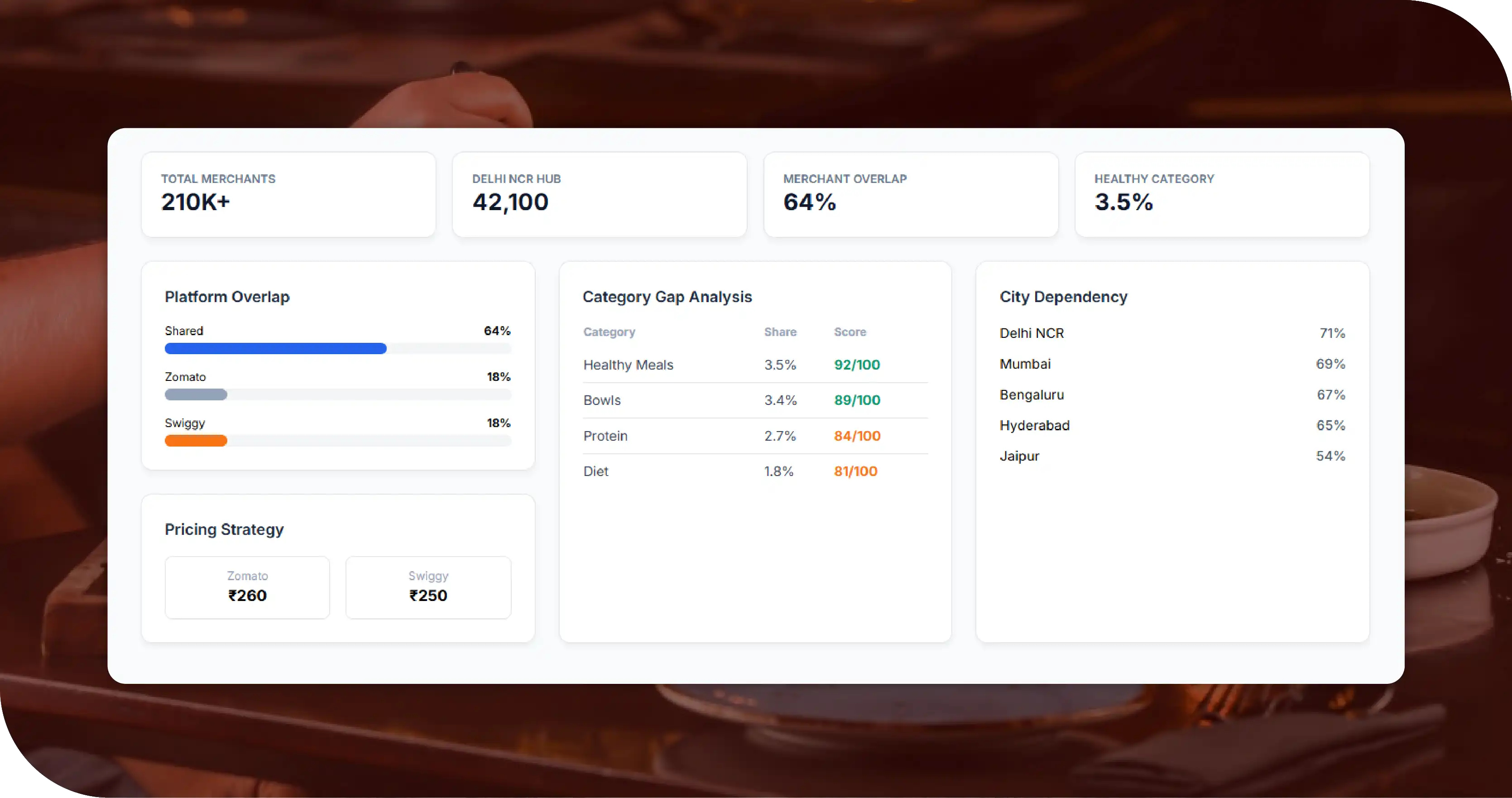
- Cross-platform overlap is high but not universal. Across major metros, roughly 63 to 65 percent of merchants operated on both Zomato and Swiggy, with the remainder split fairly evenly between Zomato-only and Swiggy-only operators. For a brand entering a new city, ignoring single-platform competitors would have understated the competitive set by roughly a third.
- Swiggy consistently shows slightly lower prices for the same merchant. Across the cross-platform pricing comparison, Swiggy listed an average of 3 to 4 percent lower than Zomato for the same dish at the same merchant. This pattern was structural enough that the client could anticipate it when planning its own dual-platform pricing.
- Promotional intensity is slightly higher on Swiggy in most metros. In every metro analyzed, Swiggy's share of merchants running active promotions exceeded Zomato's by 2 to 4 percentage points. The pattern signalled that Swiggy was the more promotionally aggressive platform, which had implications for the client's own promotional sequencing.
- North Indian and South Indian dominate at expected scales. North Indian led nationally at 19.8 percent merchant share, with South Indian close behind at 12.5 percent — confirming the central place of regional Indian cuisines on both platforms.
- Healthy and bowl categories are under-penetrated relative to demand signals. Healthy and bowl-format merchants formed just 3.5 percent of total merchants, despite review velocity and rating data suggesting strong demand. This signalled a category gap the client's healthier menu line could exploit.
- Tier-2 cities show meaningful single-platform skew. In Jaipur, Lucknow, and Indore, single-platform merchants formed a larger share of total than in tier-1 metros. For an entrant in tier-2 cities, single-platform competitive analysis was particularly risky.
- Delhi NCR is the largest unified market. With 42,100 unique deduplicated merchants, Delhi NCR exceeded Mumbai in raw count — a finding that surprised the client and reshaped its NCR expansion priority.
How the Client Used the Findings
Armed with the India Restaurant Database, the client made three concrete decisions.
First, they sequenced city entry based on cross-platform competitive economics rather than population alone. Delhi NCR's larger merchant base shifted it from a secondary priority to a primary entry market, while certain tier-2 cities with lower competitive density were elevated above tier-1 alternatives where the brand would have entered into saturated competition.
Second, they built a dual-platform pricing strategy from day one. Knowing that Swiggy systematically listed 3 to 4 percent lower than Zomato for the same merchant, the brand designed its launch pricing to be intentional across both platforms rather than uniform — protecting margin while staying competitive on each platform's pricing norms.
Third, they prioritized the healthy and bowl category as a differentiated entry concept. The data identified a clear under-penetration relative to demand signals, allowing the brand to position one of its menu lines explicitly into category white space rather than fighting for share in saturated North Indian or Biryani segments.
The result was a multi-city expansion program anchored to cross-platform competitive evidence rather than single-platform fragments — exactly the outcome the engagement was designed to deliver.
Why the Data Approach Mattered
The alternative to a cross-platform database would have been the traditional approach: separate analyses of Zomato and Swiggy, never reconciled, plus broker reports and intuition. That approach would have systematically over-counted merchants (by double-counting both-platform merchants), under-counted single-platform competitors, and missed the structural pricing differences between platforms.
The India Restaurant Database changed the decision entirely. By unifying Zomato and Swiggy into a single deduplicated cross-platform-aware resource, the database revealed the genuine competitive landscape rather than two distorted views of it. This is the core value of cross-platform restaurant data: it produces an accurate market picture where single-platform analysis produces an incomplete one.
Lessons for Other Markets
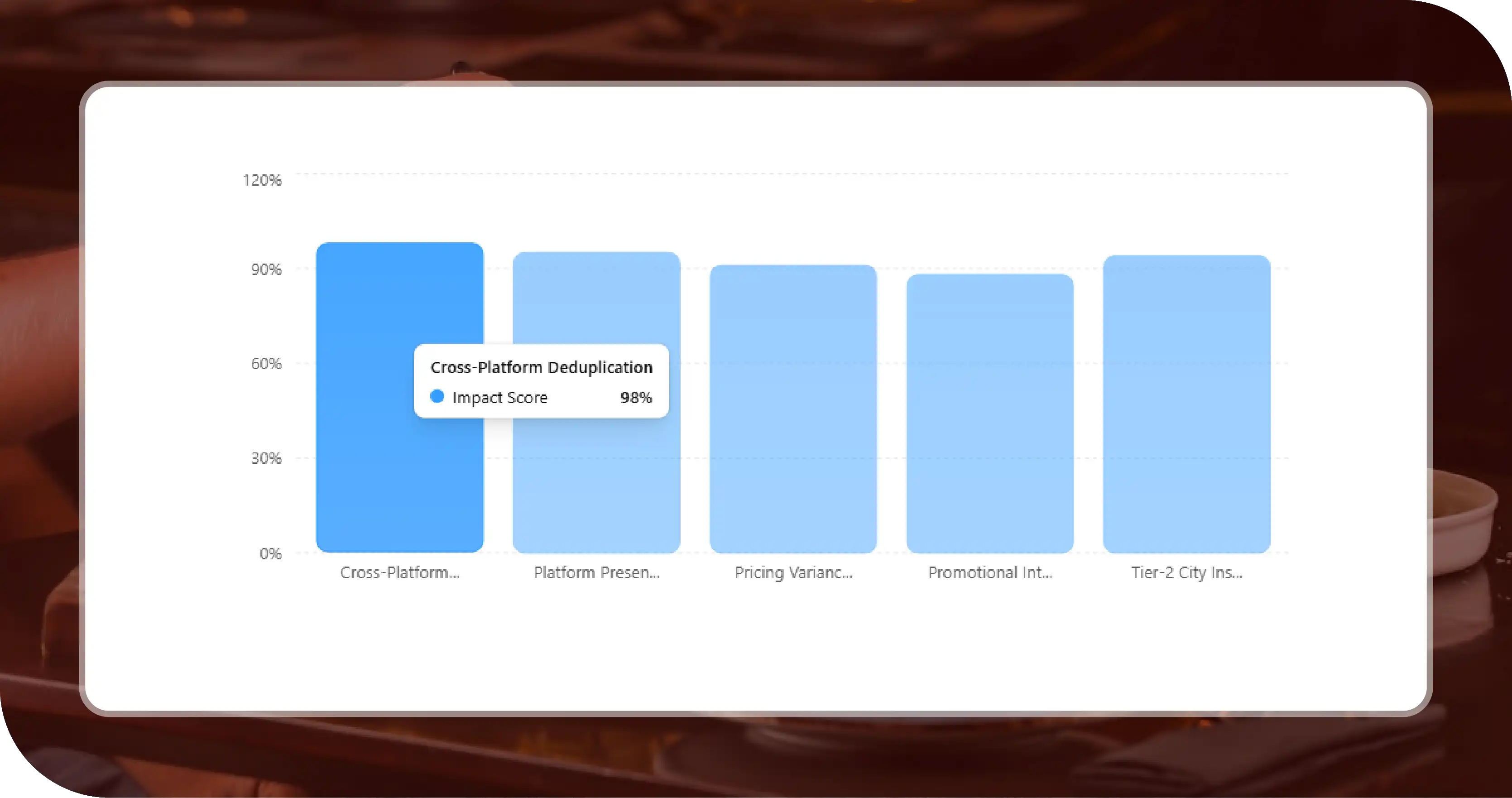
- Cross-platform deduplication is the foundation. Without it, multi-platform analysis double-counts both-platform merchants and undercounts single-platform competitors. Deduplication is non-negotiable for accurate competitive analysis.
- Platform-presence flagging changes the picture. Knowing which merchants operate on one platform versus both reveals competitive dynamics that flat-list data cannot show. This flag is one of the most commercially valuable analytical dimensions in any multi-platform market.
- Same-merchant cross-platform pricing variance is real and structural. In most multi-platform markets, the same merchant prices slightly differently across platforms, reflecting commission structures and platform-specific promotional architecture. Pricing strategy should anticipate this rather than assume uniformity.
- Promotional intensity varies by platform. Different platforms attract different promotional behaviour from the same merchants. Understanding the per-platform promotional norm is essential for designing efficient dual-platform campaigns.
- Tier-2 city dynamics differ from tier-1. In emerging markets, tier-2 cities often show stronger single-platform skew, different cuisine concentrations, and different pricing dynamics. National strategies built on tier-1 assumptions routinely misfire in tier-2 markets.
These lessons illustrate why comprehensive, cross-platform-aware restaurant data repays its cost many times over.
Engagement Outcomes at a Glance
The table below summarizes the measurable outcomes the client attributed t o the database within the first year of its Indian expansion program.
| Outcome Area | Before the Database | After Acting on the Database |
|---|---|---|
| City sequencing | Population-led | Cross-platform competitive economics |
| Platform pricing | Single uniform list | Dual-platform pricing strategy |
| Concept positioning | Generic fast-casual | Healthy / bowl white-space entry |
| Competitor count | Single-platform view | Deduplicated cross-platform reality |
| Tier-2 market planning | Tier-1 template applied | Tier-2-specific analysis |
The engagement converted a single-platform, intuition-led expansion thesis into a disciplined, dual-platform, evidence-anchored program.
Why Choose Food Data Scrape
Building a cross-platform Indian restaurant database that unifies Zomato and Swiggy is a specialized undertaking. It requires multi-platform aggregation; rigorous cross-platform deduplication that matches the same merchant across two different platforms with confidence; platform-presence flagging; menu capture in INR on both platforms; harmonized cuisine taxonomy including India-specific categories (Indo-Chinese, Mughlai, regional Indian); and sustained refresh capacity to keep pace with industry churn across both platforms simultaneously. Most internal teams and most generalist data providers lack the cross-platform deduplication capability that makes such a database actually useful.
We bring managed infrastructure, ethical and compliant data collection practices, and deep domain expertise in restaurant and food-service data. Advantages include compliance-first architecture, scalable extraction across millions of public pages daily on both Zomato and Swiggy, cross-platform deduplication logic, platform-presence flagging, harmonized India-aware cuisine taxonomies, fully customizable refresh cadence, dedicated analyst support familiar with Indian restaurant market dynamics, and out-of-the-box dashboards highlighting cross-platform competitive patterns, pricing variance, and category white space. The team has supported fast-casual chains, hospitality investors, franchise groups, FMCG suppliers, cloud kitchen operators, and research consultancies—bringing the practical experience of how comprehensive restaurant data drives real commercial outcomes.
This is powered by Food Delivery Scraping API and enriched with Food Datasets, enabling scalable extraction, normalization, and continuous intelligence across India's restaurant delivery ecosystem.
Final Outcome
The India Restaurant Database Case Study demonstrates how cross-platform-unified restaurant data transforms a multi-city expansion program. By combining Zomato and Swiggy into a single deduplicated, platform-presence-flagged, cross-platform-priced resource, the database revealed the genuine competitive landscape — not the two distorted views any single-platform analysis would have produced. The client launched its multi-city expansion with a plan grounded in cross-platform evidence, not single-platform fragments.
For any restaurant chain, cloud kitchen operator, franchise group, or investor evaluating Indian restaurant markets, the lesson is consistent: structured, cross-platform, deduplicated restaurant data turns expansion from a single-platform guess into a disciplined dual-platform commercial program.
If you are ready to base your next Indian expansion decision on a unified Zomato-and-Swiggy ground-truth view, get in touch with our team today.