The Client
The client is a fast-growing food-tech analytics company specializing in pricing intelligence for quick-commerce and food delivery platforms. They help restaurants, aggregators, and digital-first brands optimize pricing strategies across multiple online channels and improve revenue performance through data-driven insights. With a strong focus on scalability, the client operates across major Indian metro markets, enabling businesses to monitor competitors and adjust pricing in real time.
By integrating our Food Delivery Price Comparison API, the client streamlined large-scale price tracking across thousands of menu items and locations, reducing manual effort and improving data accuracy.
Their system leverages Real-time food delivery price scraping to continuously capture updates in menu prices, delivery charges, and promotional offers across platforms.
Additionally, the client relies on a Swiggy & Zomato price data intelligence API to power dashboards that support dynamic pricing decisions, competitive benchmarking, and market trend analysis for restaurant partners and enterprise clients.
Key Challenges
1. High Frequency Pricing Volatility
The client faced difficulties handling rapid price fluctuations across restaurants where menu prices, delivery charges, and offers changed multiple times a day. This made it challenging to maintain accurate benchmarking models and deliver stable insights for enterprise decision-making and pricing optimization workflows.
Food Delivery Dataset from Swiggy was useful for historical comparison, but real-time deviations still created inconsistencies in forecasting and limited the reliability of trend-based analytics models used by the client.
2. Platform-Level API Restrictions and Gaps
The client encountered restrictions due to limited access to structured APIs from delivery platforms, resulting in incomplete data capture for certain restaurants, regions, and promotional events. This led to gaps in coverage and reduced visibility into competitor pricing strategies across markets.
Swiggy Food Delivery Scraping API helped improve data extraction efficiency, but evolving platform restrictions and frequent endpoint updates continued to disrupt seamless data flow and required constant system adjustments.
3. Complex Multi-Platform Data Normalization
A key challenge was aligning heterogeneous data formats from different delivery platforms where naming conventions, pricing structures, and discounts varied significantly. This made it difficult to build a unified analytics layer for accurate comparison and actionable insights.
Zomato Food Delivery Scraping API supported structured ingestion, but harmonizing it with other platform datasets required extensive cleaning, mapping logic, and continuous validation to ensure data consistency across dashboards.
Key Solutions
1. Unified Multi-Platform Data Pipeline
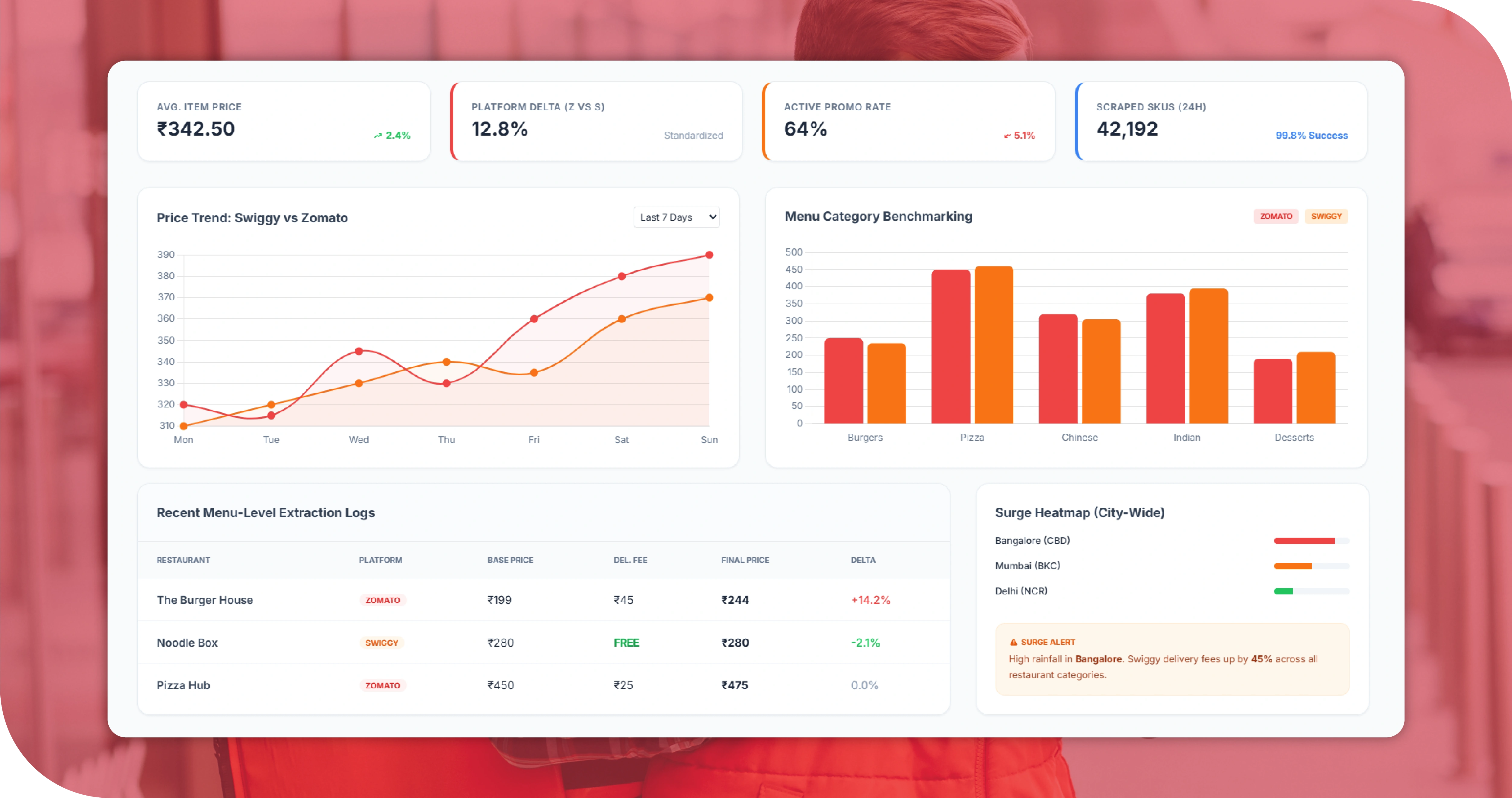
We implemented a centralized data ingestion system that harmonizes pricing data from multiple food delivery platforms into a single structured format. This enabled consistent analysis across Swiggy, Zomato, and direct restaurant channels, improving accuracy and reducing data fragmentation for the client’s pricing intelligence workflows.
Food Delivery Dataset from Zomato was integrated as a core structured source to standardize menu-level insights and improve cross-platform comparability for analytics dashboards.
2. Scalable Real-Time Scraping Architecture
We built a high-performance scraping framework capable of handling large-scale restaurant and menu data extraction with minimal latency. The system supports continuous updates, ensuring real-time visibility into pricing changes, surge fluctuations, and promotional offers across different geographies and restaurant categories.
Web Scraping Food Delivery Pricing Data was used to enable automated, high-frequency data collection, ensuring the client always had fresh and actionable pricing intelligence.
3. Advanced Menu-Level Data Structuring
We designed intelligent parsing and normalization layers to extract granular restaurant-level data such as item prices, combos, delivery fees, and discounts. This helped the client build deep analytics models for competitive benchmarking and dynamic pricing optimization across platforms.
Extract Restaurant Menu & Price Data allowed precise item-level extraction, enabling the client to generate structured datasets for faster insights and improved decision-making accuracy.
Sample Data
| Restaurant Name | Platform | Item Name | Base Price (₹) | Discount Price (₹) | Delivery Fee (₹) | Surge Pricing Factor | Last Updated |
|---|---|---|---|---|---|---|---|
| Burger King | Swiggy | Whopper Meal | 299 | 249 | 40 | 1.2x | 2026-05-06 11:30 |
| Domino’s Pizza | Zomato | Margherita Pizza | 199 | 179 | 30 | 1.1x | 2026-05-06 11:32 |
| KFC | Direct | Zinger Burger Combo | 249 | 229 | 0 | 1.0x | 2026-05-06 11:35 |
| Subway | Swiggy | Chicken Sub 6-inch | 180 | 165 | 35 | 1.3x | 2026-05-06 11:40 |
| McDonald’s | Zomato | McChicken Burger | 220 | 199 | 25 | 1.15x | 2026-05-06 11:42 |
| Pizza Hut | Direct | Veggie Supreme Pizza | 320 | 289 | 0 | 1.0x | 2026-05-06 11:45 |
Methodologies Used
- Multi-Source Data Aggregation Framework
We implemented a multi-source aggregation methodology that collects restaurant, menu, and pricing data from multiple food delivery platforms simultaneously using a Food Delivery Pricing & Surge API. This approach ensures wide coverage, reduces data blind spots, and enables consistent comparison across different aggregators and direct ordering systems for accurate intelligence generation. - Real-Time Streaming Data Architecture
A streaming-based architecture was deployed to continuously capture live updates in pricing, availability, and promotional changes. This methodology eliminates delays in data refresh cycles and ensures that the system always reflects the most recent market conditions for faster and more informed decision-making supported by Food Delivery Pricing Intelligence. - Data Normalization and Standardization Layer
We applied a structured normalization methodology to align inconsistent data formats across platforms. This includes standardizing restaurant names, menu items, pricing structures, and discount formats, ensuring all datasets follow a unified schema for seamless analytics and accurate cross-platform comparisons within Restaurant Pricing Data Intelligence systems. - Intelligent Parsing and Extraction Engine
An intelligent extraction methodology was used to identify and separate key data elements such as item-level pricing, add-ons, combos, and delivery charges. This ensures granular visibility into menu structures and supports deeper analytical modeling for competitive pricing strategies powered by Food Delivery Pricing Intelligence frameworks. - Data Validation and Quality Assurance Pipeline
We implemented a multi-stage validation methodology to ensure accuracy, completeness, and consistency of collected data. Automated checks, duplicate detection, and anomaly filtering were applied to maintain high-quality datasets, reducing errors and improving reliability for downstream analytics and visualization in a Food Price Comparison Dashboard.
Advantages of Collecting Data Using Food Data Scrapee
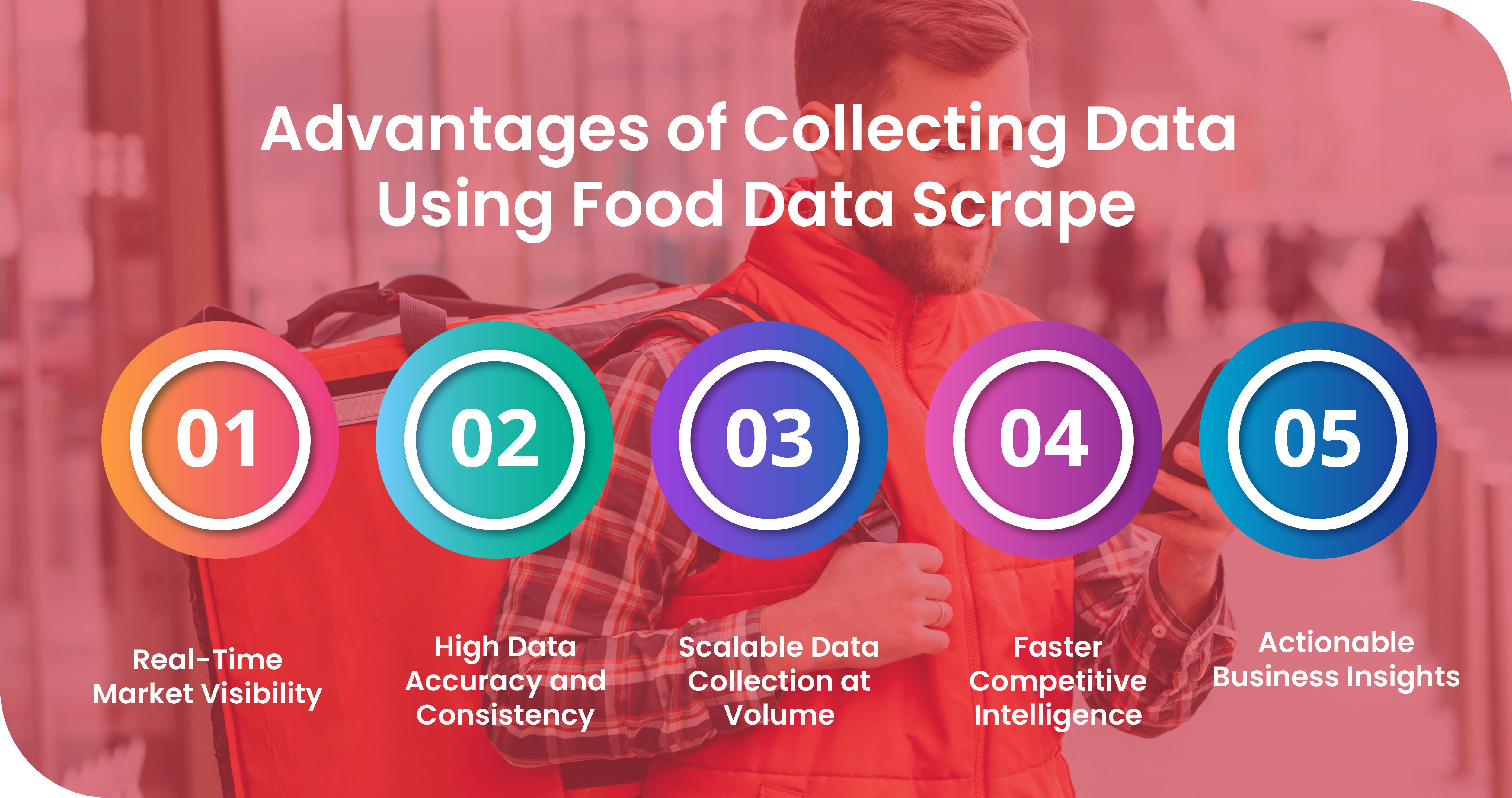
- Real-Time Market Visibility
Our data scraping services provide continuous access to live pricing, menu updates, and promotional changes across platforms. This ensures businesses always have up-to-date market intelligence, enabling faster reactions to competitor pricing shifts and improved strategic decision-making in highly dynamic food delivery environments. - High Data Accuracy and Consistency
We deliver clean, structured, and validated datasets that eliminate inconsistencies across multiple sources. By standardizing complex and fragmented data, businesses gain reliable insights that support accurate pricing analysis, performance benchmarking, and long-term strategic planning without errors or missing information. - Scalable Data Collection at Volume
Our solutions are designed to handle large-scale data extraction across thousands of restaurants and locations simultaneously. This scalability allows enterprises to expand their analytics capabilities effortlessly, ensuring uninterrupted data flow even during peak traffic and high-demand market conditions. - Faster Competitive Intelligence
We enable rapid access to competitor pricing, discounts, and surge patterns, reducing the time required for manual analysis. This speed advantage helps businesses identify market opportunities early, adjust pricing strategies instantly, and maintain a strong competitive position across platforms. - Actionable Business Insights
Beyond raw data collection, our services transform information into structured, analytics-ready datasets. This empowers businesses to build dashboards, forecast trends, optimize pricing strategies, and improve revenue performance through clear, actionable insights derived from real-time market behavior.
Client’s Testimonial
“Working with this data intelligence team has significantly transformed our pricing strategy across multiple food delivery platforms. Their ability to deliver accurate, real-time structured datasets has helped us gain deep visibility into competitor pricing, surge patterns, and menu-level changes. The insights derived from their solution have directly improved our decision-making speed and boosted our direct order performance. The system is reliable, scalable, and highly precise, which has made a measurable impact on our analytics capabilities. We truly value the partnership and the consistency in delivering high-quality data solutions that support our growth objectives.”
— Head of Product Strategy
Final Outcome
The final implementation delivered a fully integrated food delivery intelligence system that significantly improved the client’s ability to monitor, compare, and optimize pricing across multiple platforms. With real-time access to structured datasets, the client achieved complete visibility into menu pricing variations, surge fluctuations, and promotional strategies across Swiggy, Zomato, and direct channels. This enabled faster and more accurate pricing decisions, reducing dependency on manual tracking processes. The unified data pipeline improved operational efficiency, enhanced competitive benchmarking, and strengthened overall market responsiveness. As a result, the client recorded better pricing consistency, improved direct order conversions, and increased revenue optimization opportunities. The solution also reduced data processing time dramatically while ensuring high accuracy, scalability, and reliability for long-term strategic decision-making in the highly dynamic food delivery ecosystem.