Introduction
In many South Asian and fusion restaurant environments, mango beverages already have a clear anchor: mango lassi. That familiarity brings built-in demand, but it also creates structural constraints for adjacent formats. Recent Mango Milkshake Trend Analysis in Lassi-Dominated Markets shows a distinct pattern: mango milkshake mentions are rising year over year, yet menu positioning and pricing power remain closely tethered to lassi logic.
To navigate this environment, operators increasingly Scrape Mango Milkshake Menu Trends from Restaurants across regions to understand where growth is organic and where it is inherited from legacy formats. Layered with Mango Milkshake Consumer Preference Analytics, this data reveals that mango milkshake demand is real—but performance depends heavily on context, format, and competitive framing.
This blog explores how to convert that data into sell-in confidence, reposition mango milkshake effectively, and unlock growth inside menus historically dominated by lassi.
The Structural Constraint: Inheriting Lassi’s Ceiling
Across social and menu datasets, mango milkshake conversations are up over 20% year over year. However, growth spikes are uneven and closely linked to cuisine-led moments—Indian, Pakistani, or fusion dining contexts—rather than broad dessert beverage adoption.
The problem is correlation concentration.
Data shows that mango milkshake’s strongest menu and social association remains mango lassi. When one format dominates as a reference point, it sets expectations around:
- Price band (often $6–$8 in U.S. casual dining)
- Serving style (single glass, beverage-first positioning)
- Menu placement (beverage column, not dessert)
- Occasion (meal accompaniment vs indulgent treat)
But mango lassi growth has moderated. Menu share increases are incremental, social expansion has flattened, and pricing elasticity appears capped. When mango milkshake is framed as a lassi alternative, it competes in the same slowing lane.
That creates a ceiling: milkshake growth without format differentiation.
Where the Growth Is Actually Coming From?
A deeper look at Mango Milkshake Seasonal Demand Data Extraction shows demand clustering around warmer months, festival periods, and Ramadan-related dessert spikes. But standalone milkshake demand remains volatile outside these windows.
In contrast, mango falooda formats are expanding at a much faster pace:
- Menu item count growth exceeding +20% YoY
- Average menu pricing above $10
- Sustained 24-month stability in layered dessert categories
When operators Extract Mango Milkshake Trend Data across delivery apps and full-service menus, a pattern becomes clear:
Mango milkshake performs better as a base ingredient inside structured desserts than as a standalone hero beverage.
Falooda works because it delivers:
- Visual density (layering, color contrast)
- Textural diversity (noodles, basil seeds, ice cream)
- Dessert justification (supports premium price)
- Occasion upgrade (from drink to plated indulgence)
The lesson isn’t about copying falooda. It’s about understanding role shift.
Rethinking Role: From Beverage Logic to Dessert Logic
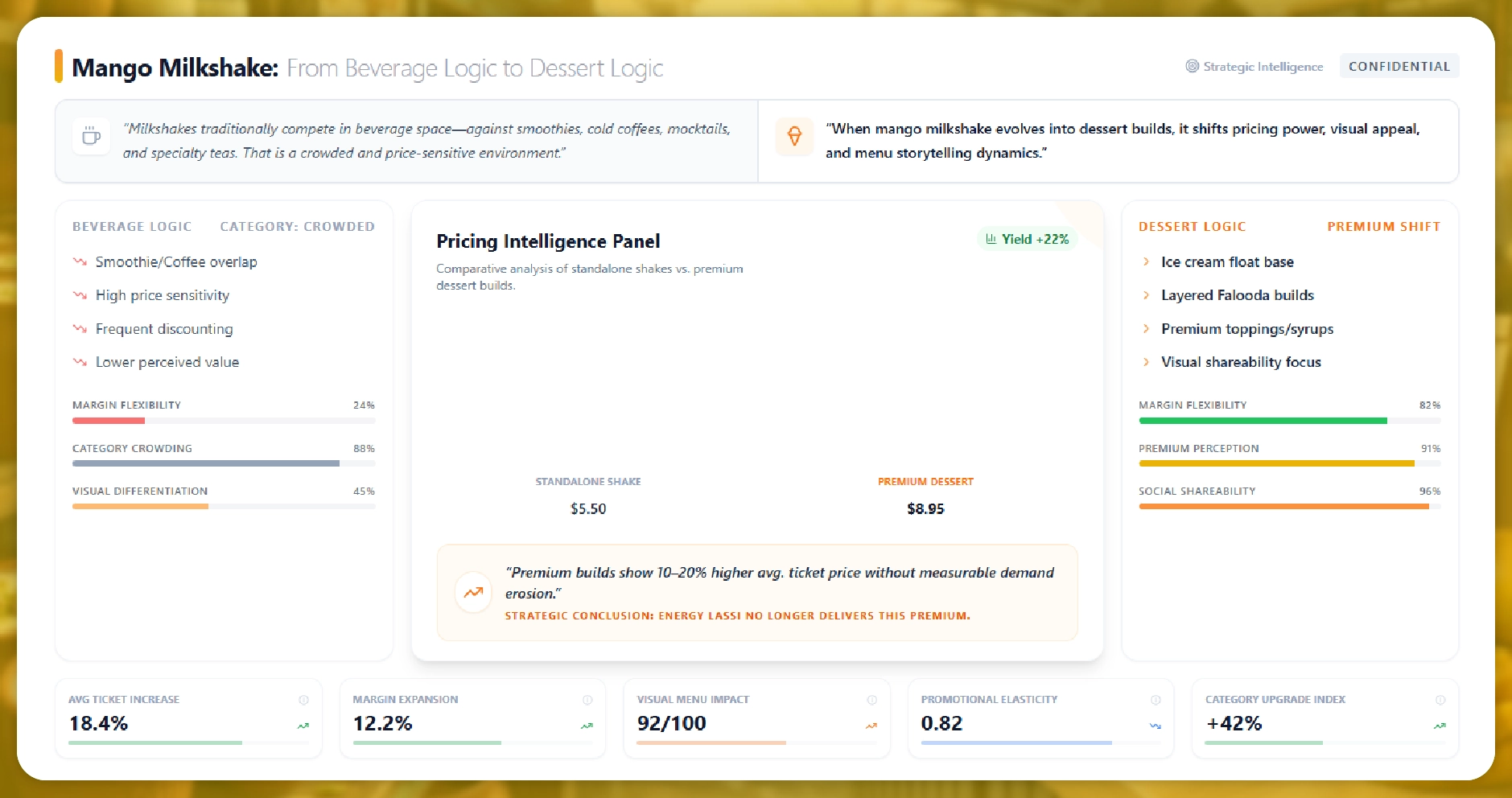
Milkshakes traditionally compete in beverage space—against smoothies, cold coffees, mocktails, and specialty teas. That is a crowded and price-sensitive environment.
But when mango milkshake becomes:
- A float base for ice cream
- A layering medium in falooda-style builds
- A premium dessert glass with toppings and syrups
- A limited-time festival indulgence
It enters dessert logic instead.
Dessert logic supports:
- Higher perceived indulgence
- More flexible price increases
- Greater visual shareability on social platforms
- Distinct menu storytelling
Data extracted via Mango Milkshake Pricing Strategy Data Intelligence confirms this: premium mango dessert builds show 10–20% higher average ticket prices compared to standalone milkshakes, without measurable demand erosion.
That’s competitive energy lassi no longer consistently delivers.
Sell-In Strategy: Reframing for Buyers and Operators
When presenting mango milkshake innovation to menu decision-makers, positioning matters more than ingredient novelty.
Instead of pitching:
“A new mango milkshake variation”
Reframe as:
“A layered mango dessert format that increases average check and adds visual differentiation.”
To support this, brands and analysts Extract Restaurant Menu Data across cuisines to show:
- Declining expansion rates in plain milkshake SKUs
- Stabilized pricing in lassi categories
- Accelerated growth in layered dessert beverages
- Premiumization patterns in mango-led desserts
The conversation shifts from flavor to format economics.
Competitive Set Migration
One of the most overlooked insights from structured scraping and panel analysis is competitive set migration.
Traditionally, mango milkshake competes with:
- Lassi
- Fruit smoothies
- Classic milkshakes
But data from Food Delivery Scraping API integrations shows consumers browsing mango dessert drinks often click into:
- Falooda
- Mango ice cream sundaes
- Mango kulfi floats
- Specialty seasonal dessert beverages
This signals a shift from refreshment intent to indulgence intent.
If mango milkshake remains anchored as “another beverage,” it competes for limited space in a saturated drink column. If repositioned as a dessert base, it enters a higher-value arena.
This migration isn’t theoretical—it is visible in menu adjacency analytics and cross-click behavior patterns.
Solving the Menu Real Estate Problem
Operators face a constant constraint: limited menu space.
For mango milkshake to earn placement, it must answer three buyer questions:
- What does it replace?
- How does it justify its price?
- Does it attract incremental demand or cannibalize lassi?
Through structured Restaurant Data Intelligence, operators can model:
- Overlap rates between lassi and milkshake orders
- Price sensitivity curves across formats
- Seasonal elasticity
- Add-on attachment rates (ice cream, toppings, extras)
Findings often show:
- High substitution risk when milkshake mirrors lassi
- Lower cannibalization when positioned as dessert
- Stronger upsell opportunity when layered or premiumized
The key is clarity of role. Ambiguity erodes performance.
Pricing Without Demand Loss
Mango lassi pricing in many markets shows limited upward movement. Inflation adjustments aside, consumers anchor expectations in the traditional price band.
In contrast, mango dessert builds demonstrate stronger price elasticity. When layered, garnished, and plated, the same mango milkshake base can support significantly higher average prices.
This demonstrates an important principle:
Pricing power depends on justification narrative, not ingredient cost.
By analyzing multi-market data and running Mango Milkshake Consumer Preference Analytics, operators see that indulgence framing increases tolerance for price increases more effectively than beverage framing.
Practical Steps to Sell Mango Milkshake Into a Lassi-Dominated Menu
- Use Data to De-Link From Lassi
Present evidence that growth clusters differ between lassi and layered mango desserts. Show separate demand curves. - Shift Menu Placement
Move from beverage section to dessert callout or specialty glass feature. - Highlight Visual Assets
Menu photos and delivery thumbnails matter. Dessert builds outperform plain beverages in click-through rates. - Build Limited-Time Stories
Festival-based mango dessert builds test premium elasticity safely. - Monitor Ongoing Performance
Continuous data tracking ensures that repositioning drives incremental, not substitutive, growth.
Unlock actionable mango milkshake insights today—partner with us to turn real-time menu data into smarter, profit-driven decisions.
Turning Format Evidence Into Confidence
The central takeaway is not that mango milkshake is underperforming. It is that its performance is highly sensitive to format context.
In a lassi-dominated menu set:
- Standalone milkshakes face inherited pricing ceilings.
- Growth depends on differentiation.
- Layered dessert formats unlock pricing elasticity.
- Competitive set framing determines margin potential.
Operators who rely on static assumptions miss these nuances. Those who continuously track menu evolution, social signals, and delivery behavior gain strategic advantage.
How Food Data Scrape Can Help You?
- Multi-Market Demand Benchmarking
We scrape and normalize menu data across cities, cuisines, and service formats to benchmark mango milkshake performance against lassi and other mango desserts. This reveals where true incremental growth exists versus simple substitution. - Adjacency & Cross-Category Mapping
Our data models map how mango milkshake connects to falooda, sundaes, smoothies, and festival desserts. Understanding adjacency shifts helps you reposition the product into faster-growing, higher-margin menu clusters. - Menu Expansion & Saturation Alerts
Through continuous scraping, we detect SKU expansion rates and saturation points. If mango milkshake listings begin clustering too tightly around lassi formats, you receive early warning signals to pivot strategy. - Visual & Delivery Performance Tracking
We analyze delivery platform listings to measure thumbnail positioning, description patterns, and add-on bundles. This insight supports better merchandising decisions that increase click-through and conversion rates. - Strategic Reporting for Buyer Sell-In
Our structured reporting translates raw restaurant data into executive-ready insights—highlighting growth velocity, pricing headroom, and format-driven margin opportunities—so your team can present confident, data-backed proposals.
Conclusion: From Familiar Flavor to Strategic Format
Mango milkshake demand remains visible across social platforms and restaurant menus. But familiarity alone is no longer enough to drive premium growth inside lassi-heavy environments.
The path forward lies in data-backed repositioning. By leveraging structured Food delivery Intelligence, brands and operators can identify where indulgence formats outperform beverage logic. A centralized Food Price Dashboard helps quantify elasticity and benchmark against adjacent desserts. Access to structured Food Datasets ensures decisions are grounded in multi-market evidence rather than anecdotal trend spikes.
When mango milkshake is framed as a dessert component rather than a lassi derivative, it moves from saturation risk to growth opportunity.
In a mature mango beverage ecosystem, success no longer depends on flavor novelty. It depends on format clarity, competitive migration, and the ability to sell a new role—backed by data.
If you are seeking for a reliable data scraping services, Food Data Scrape is at your service. We hold prominence in Food Data Aggregator and Mobile Restaurant App Scraping with impeccable data analysis for strategic decision-making.