Introduction
The global rise of Japanese-inspired convenience foods is entering a new phase, and onigiri is at the center of it. Once viewed as a niche import from Japan, onigiri is now establishing itself as a structured, repeatable, and operationally efficient menu format across foodservice. The momentum is not just cultural; it is commercial. Growth in menu penetration, protein-led demand, and stable pricing logic are combining to make onigiri one of the most scalable Asian convenience formats heading into 2026.
For brands and operators tracking Onigiri Trends Data Scraping, the signals are increasingly clear.
Businesses investing to Extract Onigiri Pricing & Promotion Intelligence are identifying durable pricing clusters that reinforce frequency over premiumization.
At the same time, structured Onigiri Category Growth Monitoring shows that menu adoption is accelerating faster than social awareness alone would suggest.
This blog explores why onigiri is transitioning from trend to scalable platform, and how brands can position themselves for sustained growth.
Menu Penetration Is Outpacing Social Buzz
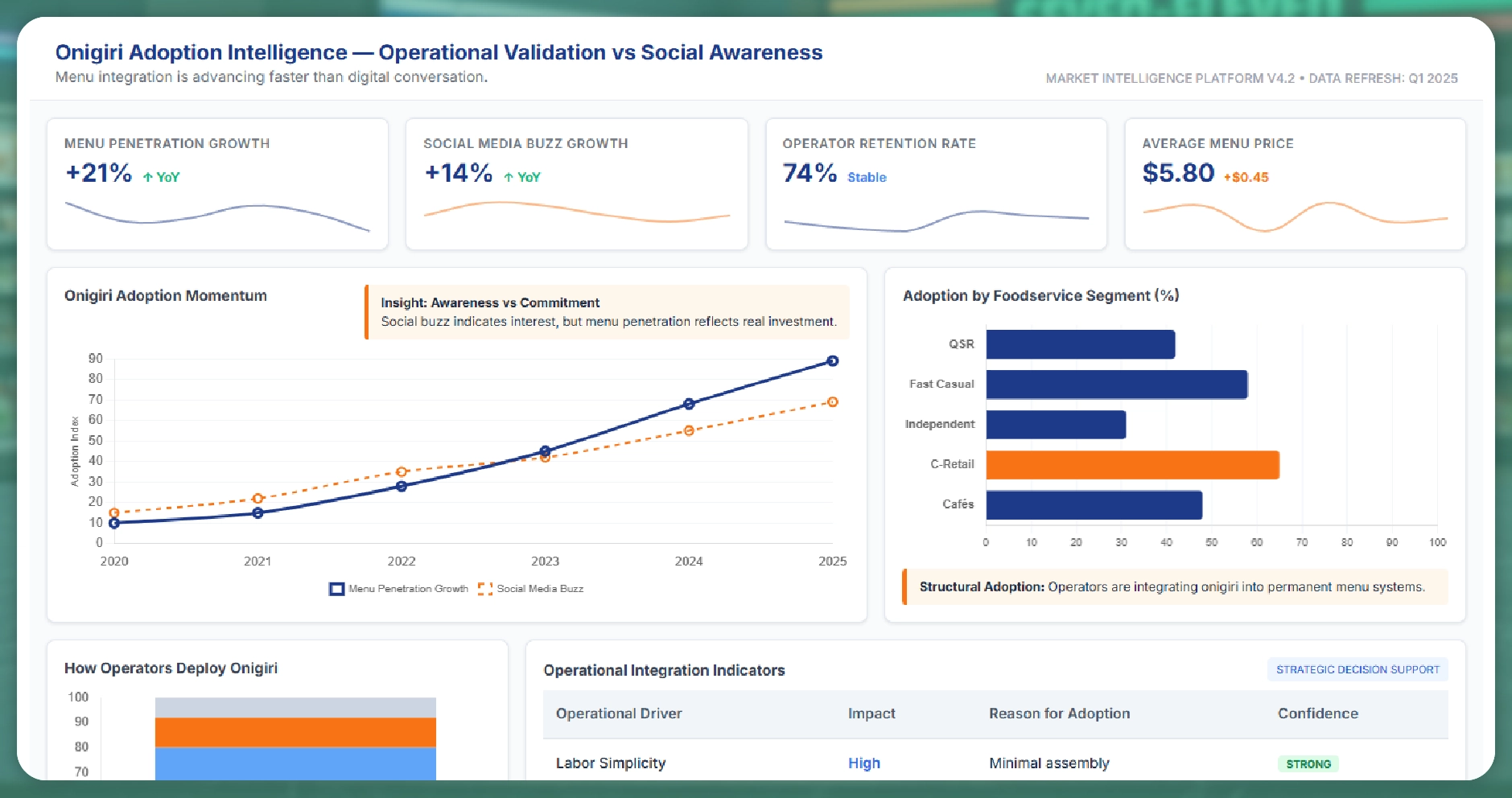
In recent performance panels, social mentions of onigiri are growing steadily year over year, but menu penetration across foodservice operators is expanding at an even faster rate. That difference is critical. Social engagement reflects curiosity and awareness; menu share reflects operational commitment.
When restaurants, fast casual chains, and QSR operators add a product and maintain it, they are locking in sourcing, training, packaging, and pricing strategies. That level of integration signals confidence in throughput and repeat demand. Onigiri is no longer just an experimental special; it is earning permanent placement.
This pattern suggests a structural shift. Operators are validating onigiri within the constraints of labor efficiency, ingredient stability, and margin targets. For internal stakeholders and retail buyers, that operational validation becomes stronger proof of long-term viability than fluctuating social chatter.
The Need-State: Familiar, Portable, Reliable
Demand mapping shows that nearly half of consumer associations tie onigiri to the broader “Asian” need-state, followed by descriptors like “tasty” and “convenient.” Indulgence and experimentation trail behind.
This profile matters. It means onigiri is winning as a dependable format rather than a novelty. Consumers are choosing it for low-friction eating occasions: lunch breaks, commuting, light dinners, and snackable add-ons.
The positioning lesson is straightforward. Over-indexing on exotic flavor experimentation may dilute clarity. The strongest demand is anchored in:
- Recognizable proteins
- Portable packaging
- Predictable pricing
- Quick consumption
Onigiri functions as a bridge between sushi familiarity and grab-and-go convenience. That balance gives it cross-channel potential: foodservice counters, grocery prepared foods, convenience stores, and delivery platforms.
Protein-Forward Fillings Anchor Repeat Purchase
Core protein fillings dominate engagement and menu presence. Fish-based varieties lead overall demand, with salmon and tuna holding strong positions, followed closely by chicken. These are established proteins within the broader Asian cuisine ecosystem, reducing ingredient risk and simplifying procurement.
Protein-first structure builds consumer trust. When a format centers around known flavors, it supports repeat behavior. Innovation works best as rotation around the core rather than replacement of it.
Secondary accents such as lemongrass or sweet-leaning variants show high growth rates from smaller bases. These flavors act as limited-time refreshers or seasonal extensions. However, they succeed because the base format is already trusted.
The strategic takeaway is that scaling onigiri requires protecting the protein anchor. Innovation should complement, not destabilize, the foundation.
Preparation Methods Support Operational Scale
One of onigiri’s strongest advantages lies in its simplicity. Preparation methods—grilled yaki-style variations or traditional seaweed-wrapped rice balls—rely on processes that most commercial kitchens can execute without specialized equipment.
Rice preparation is standardized. Fillings are pre-portioned. Assembly is quick. Wrapping or grilling steps fit within existing workflows.
From an operational lens, this lowers:
- Training time
- Equipment investment
- Service friction during peak hours
Formats that scale across multiple units must defend consistency. Onigiri’s production model allows for centralized prep with decentralized finishing, making it suitable for chain expansion and retail adaptation.
Pricing Clusters Reinforce Frequency
Pricing intelligence across foodservice indicates that onigiri typically clusters between $5 and $10, particularly in fast casual environments. This bracket positions the product as accessible rather than premium.
Stable pricing logic supports trial and repeat. Instead of pushing single-item price ceilings, operators are growing basket size through bundling—pairing onigiri with soups, salads, or beverage combos.
The absence of aggressive premium drift suggests that operators see greater long-term value in frequency over margin spikes. In convenience-led categories, volume and repeat behavior outperform one-time indulgence.
As part of Onigiri Market Trends Data Analysis 2026, this price stability signals that the category is forming sustainable guardrails rather than speculative pricing bubbles.
The Ecosystem Advantage: Operating Within Mature Categories
Onigiri does not exist in isolation. It benefits from adjacency to mature dishes such as sushi rolls, ramen bowls, curry plates, and noodle-based offerings. Core ingredients—salmon, tuna, rice, mayonnaise—already sit within stable supply chains.
This ecosystem maturity reduces execution risk in several ways:
- Consumers require minimal education.
- Ingredient sourcing is predictable.
- Menu placement feels intuitive.
Rather than introducing a foreign concept, onigiri slots naturally into existing Asian cuisine ecosystems. That alignment accelerates adoption across regions and channels.
Delivery Platforms Are Expanding Reach
Food delivery continues to reshape how convenience formats scale. Onigiri travels well, maintains structure during transit, and requires minimal reheating. These characteristics align with delivery-first kitchens and ghost kitchen models. Teams leveraging Web Scraping Food Delivery Data, operators gain visibility into geographic clusters where Asian grab-and-go items are outperforming broader snack categories.
Brands that Scrape Onigiri Trends Data can map which proteins, formats, and price points resonate most across delivery channels. Using Web Scraping Food Delivery Data, operators gain visibility into menu placement, bundle strategies, and competitor assortment shifts. When businesses Extract Restaurant Menu Data, they uncover adoption velocity across states and cities. Integrated through a Food Delivery Scraping API, these insights allow real-time tracking of assortment changes and price movements.
This layered Restaurant Data Intelligence approach transforms anecdotal signals into structured growth strategy. Delivery data reinforces the same pattern seen in brick-and-mortar channels: stable protein cores, accessible pricing, and portability driving repeat purchase.
Retail and C-Store Opportunities
Beyond restaurants, onigiri’s format lends itself to refrigerated retail placement. Individually wrapped units fit neatly into convenience store displays and grocery prepared sections.
Retail buyers evaluate new products through three lenses:
- Shelf fit
- Replacement logic
- Repeat potential
Onigiri checks all three when positioned correctly. It replaces other portable snacks, aligns with established Asian cuisine demand, and carries a price point compatible with daily purchase behavior.
Scaling into retail requires proof of velocity and margin logic. Menu penetration growth provides the narrative foundation, while pricing clusters support financial feasibility.
Start leveraging powerful data scraping insights today and stay ahead of every Super Bowl snack trend before your competitors do.
Risk Shifts from Awareness to Execution
Earlier stages of adoption often hinge on consumer education. In the case of onigiri, that hurdle is largely behind. Awareness is sufficient, and cultural familiarity with Japanese cuisine continues to grow globally.
The primary risks now center on execution:
- Overcomplicating flavors
- Misaligning price tiers
- Poor placement within menus
- Inconsistent packaging
Brands that maintain clarity—protein-forward fillings, visible rice quality, clean wrapping—will outperform those chasing novelty.
Execution discipline becomes the differentiator as the category matures.
Strategic Outlook for 2026
Looking ahead, the next phase of onigiri growth will depend on structured scaling rather than experimentation. Winning strategies will likely include:
- Core protein assortments with rotating accents
- Bundle-driven pricing models
- Cross-channel placement (in-store + delivery + retail)
- Centralized prep for multi-unit efficiency
- Data-backed assortment decisions
Operators that align format simplicity with disciplined pricing will build defensible positions. The opportunity is not to reinvent onigiri but to systematize it.
As convenience-driven Asian formats continue expanding, onigiri stands out because it blends familiarity, portability, and operational ease. Those three pillars form a durable growth equation.
How Food Data Scrape Can Help You?
- Real-Time Category Visibility
Our data scraping services give you continuous visibility into how onigiri and broader Asian convenience formats are evolving across foodservice and retail. Instead of relying on quarterly reports, you gain real-time updates on menu additions, removals, pricing shifts, and promotional changes—helping you react faster than competitors. - Competitive Menu Benchmarking
We systematically track competitor assortments, protein rotations, bundle strategies, and placement tactics. This allows you to benchmark your onigiri offerings against fast casual, QSR, and delivery-first brands, identifying whitespace opportunities and avoiding overcrowded flavor segments. - Pricing & Promotion Intelligence
Our scraping solutions capture granular pricing data, discount mechanics, combo structures, and regional price differences. With this intelligence, you can validate your $5–$10 pricing cluster, test bundle logic, and confidently defend margin strategies with data-backed evidence. - Demand Pattern & Flavor Tracking
By analyzing menu language, seasonal launches, and ingredient mentions, we uncover which proteins and flavor accents are gaining traction. This helps you prioritize high-repeat fillings like salmon or tuna while selectively introducing trending secondary flavors without destabilizing your core range. - Multi-Channel Performance Mapping
We integrate data from restaurant menus, food delivery platforms, and retail listings to provide a unified performance view. This ensures your scaling strategy aligns across dine-in, takeaway, delivery apps, and grocery shelves—reducing execution risk while maximizing distribution efficiency.
Conclusion
Onigiri is evolving from emerging trend to structured category. Its growth is reinforced by accelerating menu share, protein-led repeat demand, and stable pricing clusters that encourage frequency over premium spikes. The ecosystem of mature Asian dishes further reduces adoption risk, while delivery platforms extend reach into new consumption moments.
For brands and operators, the path forward requires turning signals into action. Advanced Food delivery Intelligence platforms help map performance across channels.
A centralized Food Price Dashboard can clarify pricing clusters and bundling effectiveness. Access to structured Food Datasets ensures that assortment decisions reflect real demand rather than assumption. The next scalable Asian convenience format is already taking shape. The brands that execute with discipline, align pricing with frequency, and anchor innovation around trusted proteins will define the category’s growth through 2026 and beyond.
If you are seeking for a reliable data scraping services, Food Data Scrape is at your service. We hold prominence in Food Data Aggregator and Mobile Restaurant App Scraping with impeccable data analysis for strategic decision-making.