Introduction
Pasta is not disappearing. It is being discussed, searched, shared, and recreated across social platforms at increasing rates. Yet menu placements are shrinking, recipe growth is flat, and revenue lift is inconsistent. The issue is not consumer rejection. It is conversion failure.
This blog explores where pasta demand stalls before it becomes sales, using insights similar to a Pasta Demand vs Sales Gap Analysis Dataset to understand structural friction.
To close that gap, brands need the ability to Scrape Pasta Pricing & Promotion Impact on Sales with precision and consistency.
They must also Scrape Pasta Consumer Demand Signal vs Retail Sales Data in real time to detect mismatches early.
The objective is simple: identify where pasta earns attention but fails to generate sustainable margin.
The Visibility–Revenue Mismatch
Social conversations around pasta continue to rise year over year. Consumers are posting cooking techniques, comfort meals, texture preferences, and fusion variations. However, restaurant menu penetration is slipping, and at-home purchase growth remains muted.
This imbalance signals one core issue: attention does not automatically translate into transactional urgency.
Pasta benefits from high familiarity. It is trusted, versatile, and widely accessible. But familiarity reduces perceived differentiation. When consumers talk about pasta, they often discuss execution—“al dente,” “creamy,” “baked,” “authentic.” When they buy pasta, they compare price, portion size, and convenience.
If the perceived upgrade is unclear, the category defaults to lowest-cost choice. That is where conversion weakens.
Execution Sensitivity Is Higher Than Operators Assume
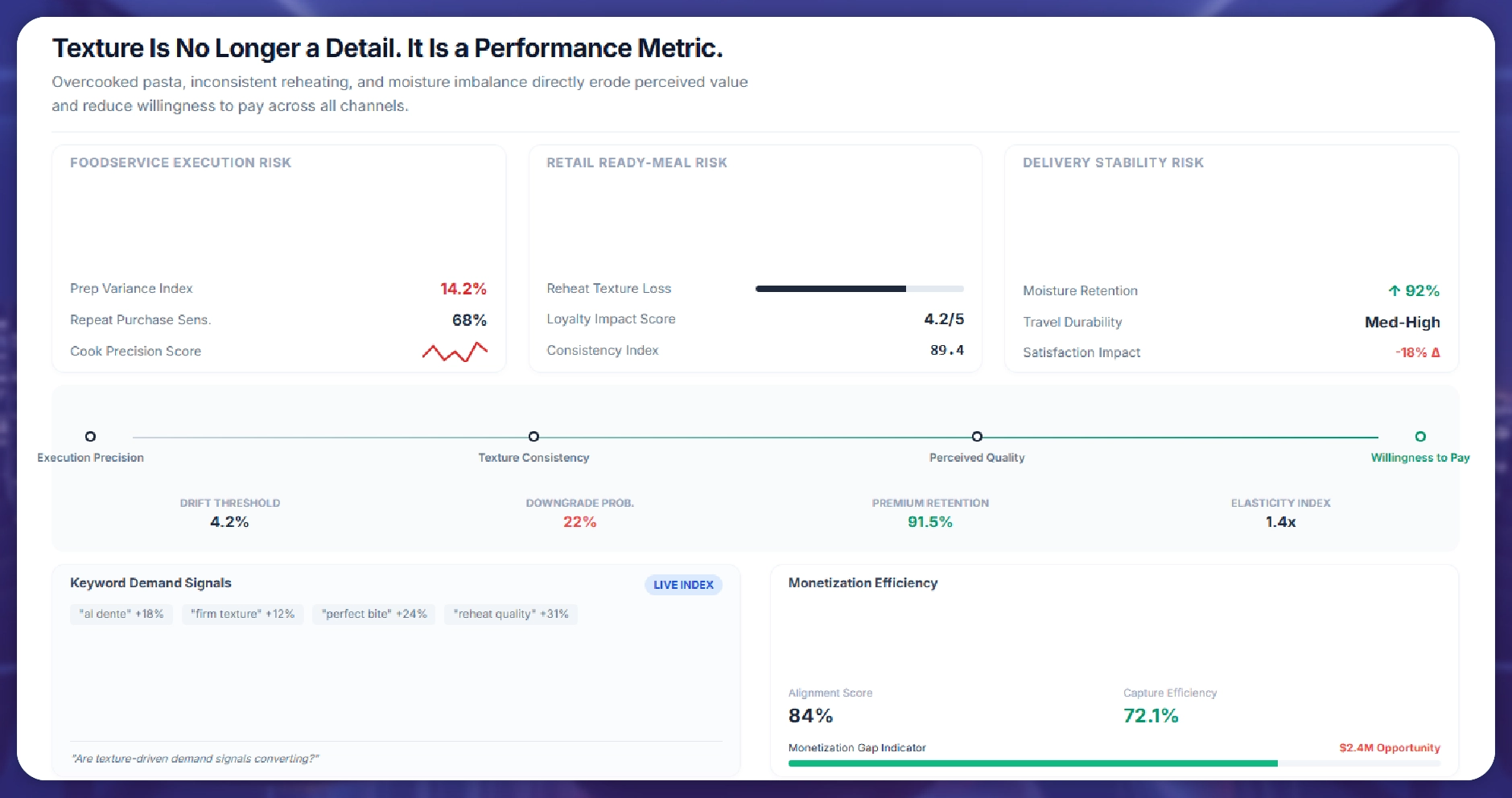
Texture is no longer a detail; it is a performance metric. Conversations disproportionately focus on bite, firmness, and cook precision. Overcooked pasta or inconsistent reheating directly erodes perceived value.
This has commercial implications:
- In foodservice, prep variance damages repeat purchase rates.
- In retail, ready-meal formats that lose texture during reheating reduce brand loyalty.
- In delivery, moisture retention and travel stability affect satisfaction scores.
When pasta is treated as operationally simple, quality drifts. When quality drifts, consumers downgrade willingness to pay.
To diagnose this accurately, brands increasingly rely on Pasta Keyword Demand vs Revenue Mapping. This reveals whether texture-related search spikes align with premium SKU growth—or whether operators are failing to monetize precision signals.
Comfort Drives Volume—But Innovation Distracts Investment
Mac and cheese, spaghetti, and lasagne consistently anchor engagement. Comfort-led pasta formats dominate both social discussion and stable demand pockets.
Yet many menus reduce these staples in favor of trend-driven experimentation. The logic is understandable: novelty appears exciting. However, data suggests comfort formats act as traffic engines. Removing them or downgrading quality weakens the conversion base.
Instead of replacing comfort, brands should layer innovation around it:
- Limited-time toppings
- Protein upgrades
- Heat-driven variations
- Premium cheese blends
Incremental innovation sustains relevance without destabilizing demand.
Fusion Growth Is Selective, Not Universal
Certain fusion styles show explosive growth, but the pattern is narrow. Successful experimentation maintains structural familiarity. The pasta shape, cook method, and plating remain recognizable. The novelty enters through sauce, garnish, or filling.
Where pasta fails to convert is in radical format changes that confuse expectation. When consumers cannot immediately categorize the dish, perceived risk rises.
Understanding which fusion signals convert requires structured tracking. Brands that Extract Pasta Search Demand vs Actual Purchase Data can detect which experimental flavors drive trial versus those that only generate curiosity.
The difference between attention and adoption is measurable. The mistake is assuming they are identical.
Menu Contraction Reflects Prioritization Pressure
Foodservice operators face SKU rationalization pressure. Labor costs are rising. Prep complexity increases operational risk. Dishes that require precision but deliver low margin get deprioritized.
Pasta often sits in this vulnerable middle zone:
- High familiarity
- Moderate pricing power
- Execution sensitivity
- Competitive substitution risk (rice, bowls, sandwiches)
By leveraging tools to Extract Restaurant Menu Data, brands can identify which pasta formats are being removed and which remain stable. Patterns usually show that poorly differentiated pasta dishes disappear first.
Menus are not rejecting pasta. They are rejecting generic pasta.
Retail Shelf Performance Is Driven by Perceived Upgrade
In grocery and ready-meal environments, pasta competes heavily on price. Without a visible premium cue—organic, high-protein, artisanal shape, imported origin—the product blends into the category.
Conversion gaps emerge when:
- Search interest grows for premium attributes.
- Shelf assortment does not reflect those attributes.
- Promotional strategies flatten price tiers.
By tracking structured retail signals and pairing them with digital interest data, brands can Scrape Pasta Pricing & Promotion Impact on Sales to understand elasticity thresholds.
If discounts drive volume spikes but erode margin without repeat purchase lift, the issue is positioning—not price.
Delivery Platforms Amplify Execution Risk
The rise of app-based ordering has shifted pasta’s conversion dynamics. Pasta travels differently than burgers or wraps. Steam accumulation softens texture. Sauce separation reduces presentation quality.
Monitoring this channel requires continuous Web Scraping Food Delivery Data to track ratings, pricing, packaging adjustments, and dish modifications. Advanced operators integrate a Food Delivery Scraping API to detect which pasta SKUs receive negative texture feedback.
Delivery creates a magnified feedback loop. If pasta underperforms during transport, conversion declines even if demand signals remain high.
Execution discipline—not flavor variety—protects this channel.
Ingredient Signals Confirm Familiarity Bias
Top correlated ingredients around pasta include chicken, tomato, garlic, beef, and pork. These are stable anchors. Consumers are not abandoning familiarity; they are enhancing it with small twists like hot honey or bacon jam.
Large-scale disruption underperforms. Subtle contrast performs better.
This reinforces a strategic principle: pasta demand responds to calibrated evolution. Radical reinvention creates conversation. Controlled upgrades create revenue.
Price Compression Is the Silent Threat
Because pasta is widely available and operationally understood, it is often treated as a margin buffer. Competitive pricing pushes average ticket values downward.
The result:
- Reduced perceived value
- Increased substitution
- Lower incentive for menu retention
Price compression does not immediately appear in demand metrics. It appears in revenue mapping. That is why pairing demand tracking with transactional analysis through Pasta Keyword Demand vs Revenue Mapping is critical.
If search volume grows while average selling price declines, brands are leaking margin.
Turn pasta demand insights into measurable sales growth with real-time data intelligence.
Data-Led Conversion Repair Strategy
To convert pasta demand into sales, brands must align five pillars:
- Execution Control – Standardize cook tolerance and texture retention.
- Comfort Anchoring – Protect high-volume staples.
- Selective Innovation – Innovate within recognizable formats.
- Channel Differentiation – Optimize for dine-in, retail, and delivery separately.
- Price Architecture Discipline – Protect premium tiers from unnecessary discounting.
These strategies are strengthened through structured Restaurant Data Intelligence, enabling operators to identify underperforming SKUs before full menu removal occurs.
Data clarity turns silent erosion into visible opportunity.
Where Pasta Actually Fails?
Pasta fails to convert when:
- Social buzz is not matched with premium positioning.
- Execution variability undermines perceived quality.
- Innovation breaks familiarity instead of enhancing it.
- Delivery packaging fails to preserve texture.
- Promotions flatten perceived value tiers.
- Menu rationalization removes traffic-driving comfort dishes.
None of these failures stem from declining interest. They stem from misalignment between expectation and delivery.
Reframing the Category
Pasta is not a novelty category. It is a precision category disguised as comfort. Consumers treat it as familiar but judge it intensely on texture and consistency.
That creates a narrow performance window. Brands that stay within it retain loyalty. Brands that drift lose conversion quietly.
The path forward is analytical discipline. Structured Food Datasets reveal where demand grows but sales lag. A real-time Food Price Dashboard exposes compression patterns before margins collapse. Integrated tracking across retail, menu, and delivery channels allows coordinated response.
How Food Data Scrape Can Help You?
- Comprehensive Multi-Channel Data Coverage
Our data scraping solutions capture insights across restaurant menus, retail shelves, e-commerce platforms, and delivery apps. By consolidating structured and unstructured data sources, we provide a unified view of demand signals, pricing shifts, promotions, and consumer engagement trends. - Real-Time Demand and Sales Signal Tracking
We monitor live changes in pricing, availability, rankings, and reviews to ensure you never miss a market shift. This enables faster decision-making, helping you respond to demand spikes, competitive moves, and promotional performance instantly. - High-Accuracy, Structured Data Delivery
Our advanced extraction systems clean, normalize, and validate raw data into ready-to-use formats. You receive consistent, analysis-ready datasets that reduce manual effort and integrate seamlessly with BI tools, dashboards, and forecasting models. - Scalable and Customizable Scraping Frameworks
Whether you need niche product tracking or large-scale category intelligence, our scraping infrastructure scales to your business goals. We customize data fields, frequency, geography, and competitor coverage to match your exact analytical needs. - Actionable Insights, Not Just Raw Data
Beyond scraping, we transform data into competitive intelligence. From pricing benchmarks to menu optimization signals, our insights empower you to close demand gaps, strengthen positioning, and drive measurable revenue growth.
Conclusion
In conclusion, pasta’s challenge is not relevance. It is monetization.
Demand is present. Conversations are increasing. Comfort remains strong.
The brands and operators that combine execution rigor with calibrated innovation—and use data-backed insights supported by advanced Food delivery Intelligence—will convert attention into sustained revenue.
Those that treat pasta as operationally simple will continue to experience silent sales erosion, even as demand appears healthy on the surface.
If you are seeking for a reliable data scraping services, Food Data Scrape is at your service. We hold prominence in Food Data Aggregator and Mobile Restaurant App Scraping with impeccable data analysis for strategic decision-making.