Introduction
The retail and FMCG industry is rapidly shifting toward data-driven pricing strategies where competition between private labels and national brands is becoming more analytical than ever. Companies now rely on structured datasets, automation, and real-time monitoring systems to understand pricing gaps, consumer behavior, and market positioning across categories.
Private label products are gaining strong momentum due to their cost advantage, while national brands continue to dominate through trust, recognition, and perceived quality. This balance creates a highly competitive pricing ecosystem that requires continuous tracking and benchmarking.
The concept of Private Label vs National Brand Pricing Data Analytics is now central to retail intelligence strategies, helping businesses compare pricing behaviors, promotional intensity, and margin structures across competing product categories.
Retailers and FMCG companies heavily depend on Private Label vs National Brand Products Price Analysis to evaluate how store brands and manufacturer brands differ in pricing patterns across grocery, dairy, packaged foods, and household essentials.
Modern retail intelligence systems increasingly rely on method to Scrape Private Label vs National Brand Pricing Data from e-commerce platforms, grocery apps, and delivery marketplaces to build structured datasets for competitive pricing evaluation.
Market Dynamics Between Private Label and National Brands
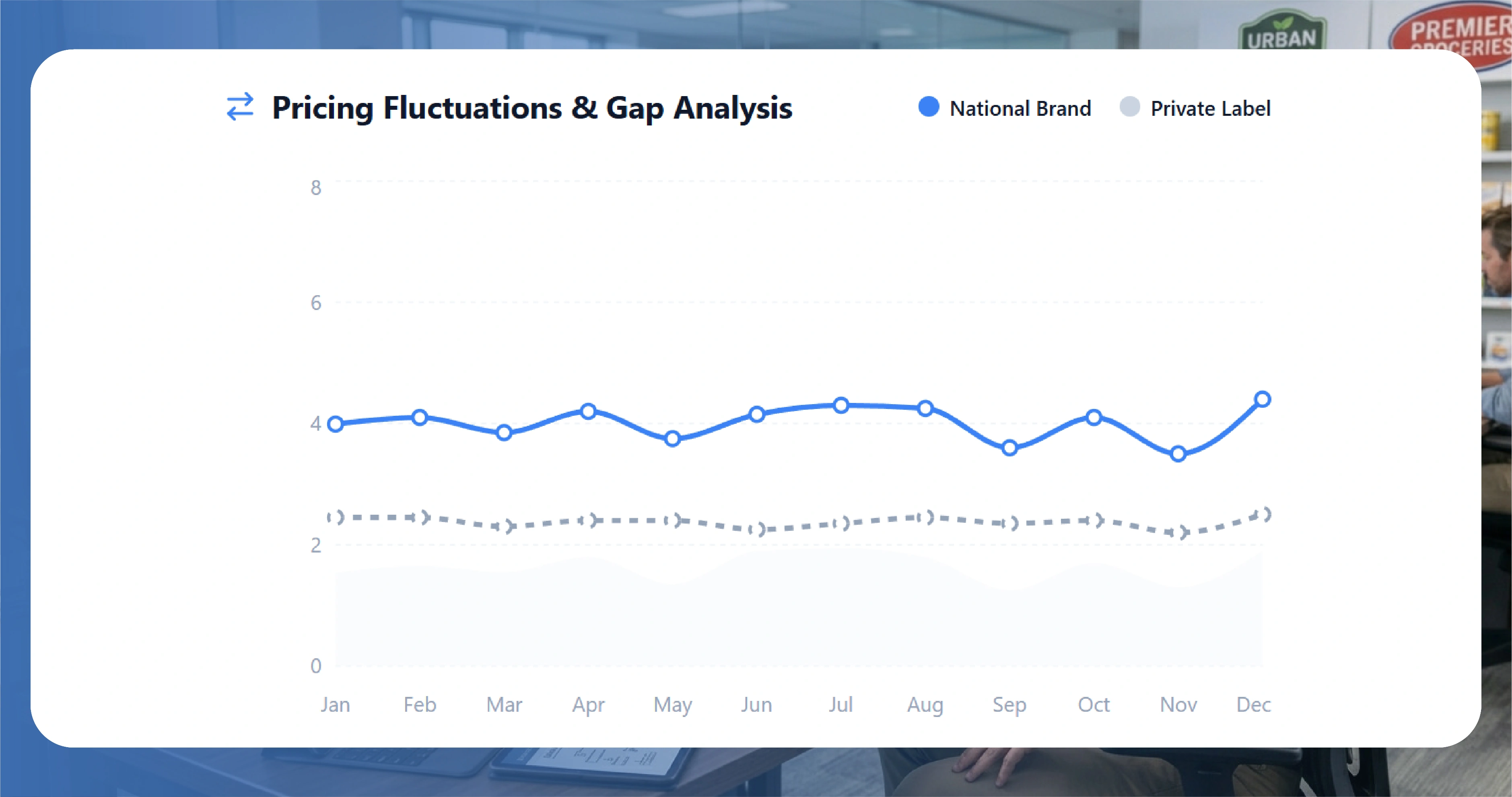
Private labels are strategically priced lower to attract price-sensitive consumers, while national brands maintain premium positioning through branding and loyalty. The pricing gap between these two segments plays a crucial role in shaping purchasing decisions.
Retailers continuously adjust promotions, discounts, and bundle offers to optimize sales performance across both categories. National brands, on the other hand, use strategic discounting to defend market share without permanently reducing base prices.
Tracking these movements through Private Label vs National Brand Products Price Tracking helps businesses identify pricing fluctuations, seasonal demand shifts, and promotional cycles across retail channels.
Role of Pricing Intelligence in FMCG Strategy
Pricing intelligence has become a core component of FMCG decision-making, enabling companies to react quickly to competitor changes and optimize pricing structures across thousands of SKUs.
Businesses rely on Private Label vs National Brand Price Benchmarking to compare their product pricing against competitors and ensure that private label offerings maintain the right value gap versus national brands.
This benchmarking process helps retailers determine whether their private label products are priced aggressively enough to drive volume or positioned strategically for margin optimization.
Strong Competitive Price Intelligence Table (Private Label vs National Brands)
| Category | Private Label Avg Price (₹) | National Brand Avg Price (₹) | Price Gap (₹) | Price Gap (%) | Demand Sensitivity | Promotional Intensity |
|---|---|---|---|---|---|---|
| Milk (1L) | 48 | 58 | 10 | 17.2% | High | Medium |
| Rice (1Kg) | 52 | 68 | 16 | 23.5% | High | High |
| Cooking Oil (1L) | 135 | 175 | 40 | 22.8% | Medium | High |
| Breakfast Cereal | 120 | 165 | 45 | 27.2% | Medium | Very High |
| Biscuits | 30 | 45 | 15 | 33.3% | High | Very High |
| Detergent Powder | 85 | 120 | 35 | 29.1% | High | High |
| Instant Coffee | 180 | 250 | 70 | 28.0% | Low | Medium |
Real-Time Data and FMCG Transformation
The FMCG sector is undergoing a major transformation driven by automation, APIs, and real-time analytics platforms that continuously capture pricing changes across digital retail ecosystems.
With Real-Time FMCG Pricing Data Intelligence, companies can monitor competitor pricing shifts instantly, identify underpriced or overpriced SKUs, and react to market changes without delay.
This real-time visibility helps retailers avoid revenue loss, improve promotional timing, and optimize category-level profitability across multiple retail platforms.
Importance of Data Collection and Scraping
Modern pricing analytics depends heavily on structured data collection from multiple online sources including grocery marketplaces, delivery apps, and retailer websites.
Web Scraping Grocery Data enables companies to gather large-scale pricing, discount, and availability information that forms the foundation of competitive intelligence systems.
This data is then normalized and analyzed to identify pricing trends, competitor behavior, and category performance across different regions and retail channels.
Visualization Through Pricing Dashboards
Raw data becomes actionable only when it is transformed into intuitive visual dashboards that allow decision-makers to quickly interpret market trends and pricing gaps.
A Grocery Price Dashboard consolidates pricing information across categories, brands, and retailers, enabling easy comparison between private label and national brand products.
Meanwhile, a Grocery Price Tracking Dashboard continuously updates pricing changes, offering near real-time visibility into competitor movements and promotional strategies across FMCG platforms.
Strategic Applications in Retail and FMCG
Retailers use pricing analytics to optimize assortment planning, improve promotional effectiveness, and increase category profitability. Private labels are often positioned as value-driven alternatives to national brands, while national brands focus on differentiation through quality and branding.
By analyzing pricing behavior across both segments, companies can design smarter pricing strategies that balance volume growth with margin protection.
These insights also support demand forecasting, inventory planning, and revenue optimization across multi-channel retail ecosystems.
Advanced Competitive Intelligence Systems
Modern retail intelligence platforms integrate automation, machine learning, and big data to deliver deeper insights into pricing behavior and consumer response patterns.
This allows businesses to simulate pricing scenarios, test promotional strategies, and predict competitor reactions before making pricing decisions in the market.
Such systems are becoming essential for FMCG companies operating in highly competitive and price-sensitive environments.
Get in touch with us today to unlock real-time market insights and smarter pricing decisions through advanced data scraping solutions.
Future of Grocery Pricing Analytics
The future of retail pricing will be shaped by AI-driven forecasting models and predictive analytics that go beyond historical tracking to anticipate future market behavior.
Automation will further streamline pricing updates, allowing retailers to adjust thousands of product prices dynamically based on demand, competition, and inventory levels.
This evolution will make pricing intelligence a core driver of profitability in FMCG ecosystems.
How Food Data Scrape Can Help You?
- Real-Time Market Price Monitoring
Our data scraping solutions continuously collect updated pricing information from multiple online retail and grocery platforms. This helps you stay aware of competitor pricing changes as they happen, allowing faster reactions to market shifts, discount strategies, and demand fluctuations. - Better Competitive Comparison Across Products
We enable structured comparison between different product categories, brands, and store labels by organizing large-scale pricing data. This makes it easier to understand how products are positioned in the market and where pricing gaps or opportunities exist. - Large-Scale Automated Data Collection
Instead of relying on manual research, our systems gather product-level data across thousands of listings automatically. This includes prices, discounts, availability, and promotional patterns, helping businesses save time while improving accuracy and coverage. - Clear Insights Through Dashboards and Reporting
We transform raw data into easy-to-understand dashboards and reports that highlight key trends and pricing movements. This helps decision-makers quickly identify opportunities, risks, and performance patterns without needing technical expertise. - Continuous Data Flow for Smarter Decision-Making
Our services ensure a steady and automated flow of updated data into your systems, enabling ongoing analysis and forecasting. This helps businesses make faster, more informed decisions based on current market conditions rather than outdated information.
Conclusion
The competition between private label and national brands is no longer just about branding or quality—it is fundamentally a data-driven pricing battle shaped by analytics, automation, and real-time intelligence.
Modern systems powered by Grocery Delivery Extraction API enable seamless collection of structured pricing data from multiple retail platforms, supporting scalable analytics and automation workflows.
Businesses leveraging Grocery Data Intelligence can transform raw pricing data into actionable insights that improve decision-making, optimize pricing strategies, and enhance competitiveness in the FMCG market.
High-quality Grocery Datasets form the backbone of these systems, enabling accurate benchmarking, forecasting, and strategic planning across both private label and national brand ecosystems.
Ultimately, companies that effectively combine analytics, automation, and real-time intelligence will lead the next generation of retail pricing innovation.
Are you in need of high-class scraping services? Food Data Scrape should be your first point of call. We are undoubtedly the best in Food Data Aggregator and Mobile Grocery App Scraping service and we render impeccable data insights and analytics for strategic decision-making. With a legacy of excellence as our backbone, we help companies become data-driven, fueling their development. Please take advantage of our tailored solutions that will add value to your business. Contact us today to unlock the value of your data.