Introduction
The quick commerce revolution has fundamentally changed how consumers shop. Speed is no longer the only differentiator—availability and precision in product selection now define success. When customers open an app expecting instant delivery, they also expect to find exactly what they need. If a product is missing, they don’t wait—they switch platforms. This is where Q-Commerce Assortment Gap Analysis plays a crucial role in identifying missing opportunities and strengthening catalog performance. Alongside this, Assortment Gap Analysis in Q-Commerce helps businesses systematically evaluate product coverage gaps. By leveraging Competitive SKU Gap Analysis Using Scraped Data, companies can uncover hidden inefficiencies and align their assortment with real-time market demand.
Understanding Why Assortment Gaps Matter
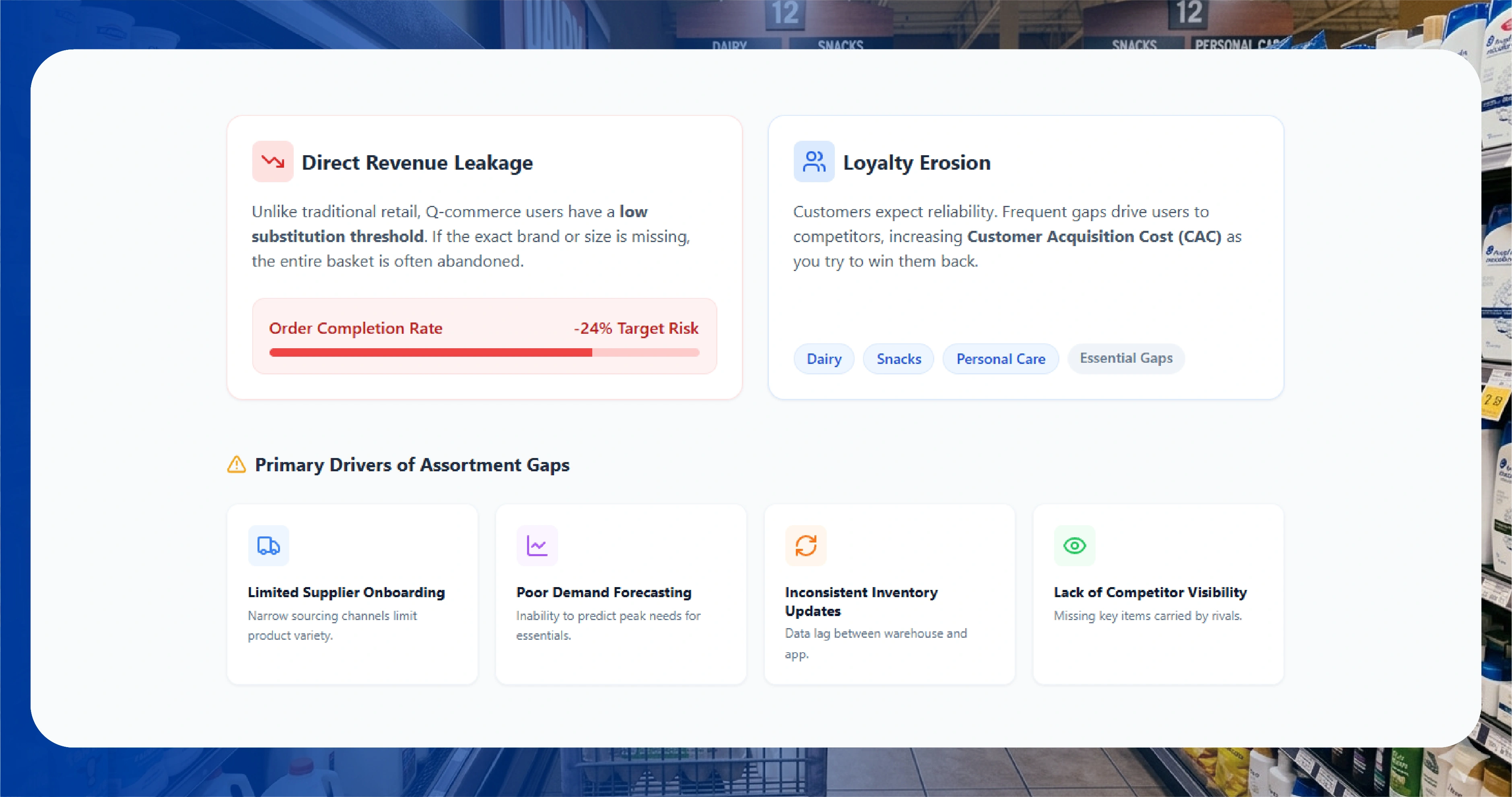
In Q-commerce, every missing product directly translates to lost revenue. Unlike traditional retail, customers are less willing to substitute items. They expect exact matches—specific brands, sizes, or variants.
Assortment gaps often result from:
- Limited supplier onboarding
- Poor demand forecasting
- Inconsistent inventory updates
- Lack of competitor visibility
Even a small gap in high-demand categories like dairy, snacks, or personal care can significantly impact order completion rates. Businesses that fail to address these gaps risk losing not only transactions but long-term customer loyalty.
Types of Gaps Businesses Commonly Overlook
Not all gaps are obvious. Many exist beneath the surface and require deeper analysis to uncover:
- Brand-level gaps: Missing popular or emerging brands
- Variant-level gaps: Absence of specific flavors, sizes, or packaging
- Price-tier gaps: Lack of budget-friendly or premium options
- Seasonal gaps: Missing products during peak demand periods
- Regional gaps: Differences in availability across locations
Understanding these categories helps businesses prioritize which gaps to address first for maximum impact.
Building Smarter Assortments with Data
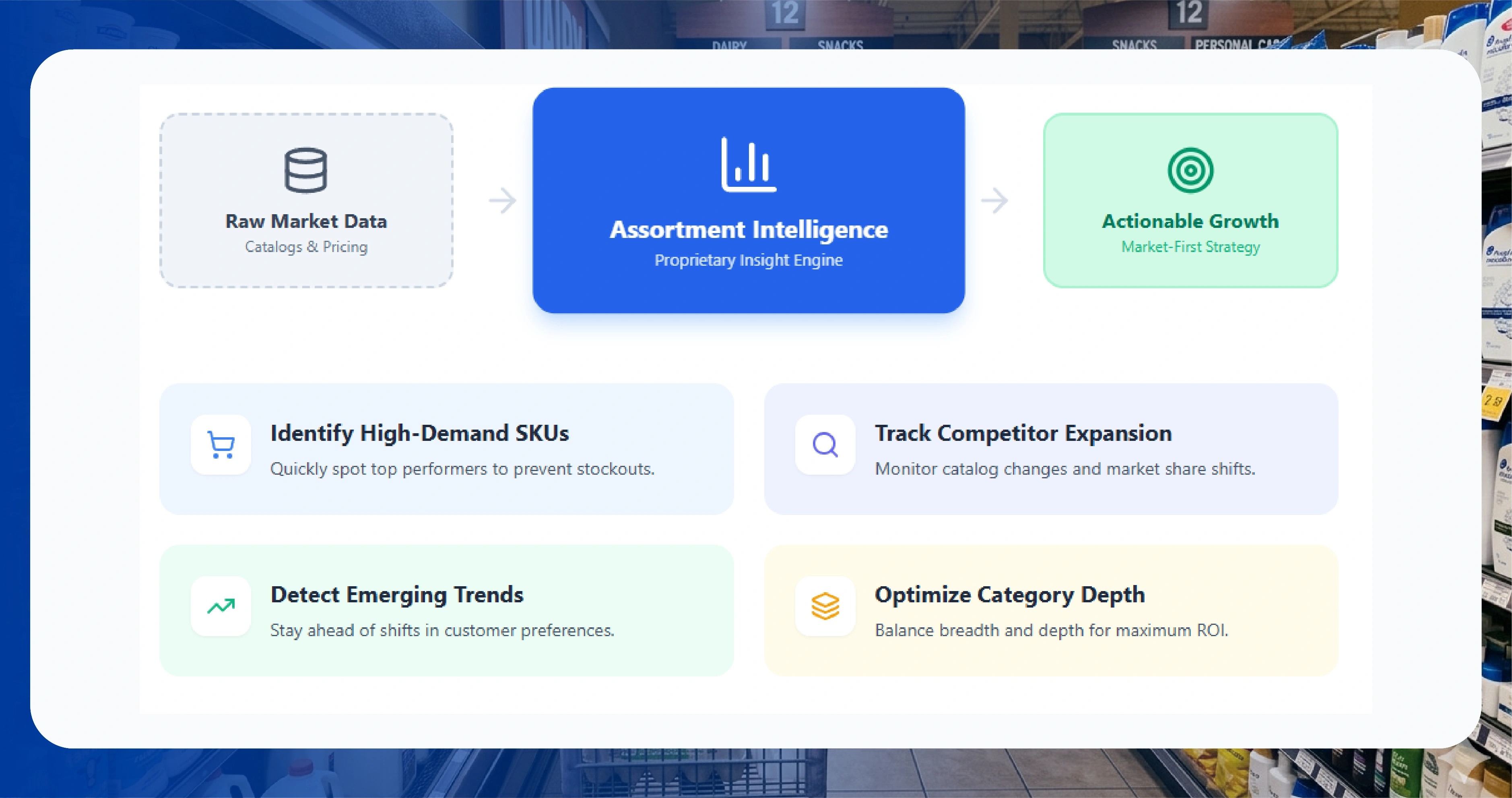
Modern businesses rely on Q-Commerce Assortment Intelligence to transform raw data into actionable insights. This intelligence allows companies to continuously monitor competitor catalogs and customer preferences.
With strong data-backed insights, businesses can:
- Identify high-demand SKUs quickly
- Track competitor assortment expansion
- Detect emerging product trends
- Optimize category depth
Instead of guessing what customers want, companies can make informed decisions based on real market behavior.
Comparing Catalogs to Identify Missed Opportunities
A structured Q-Commerce Catalog Comparison & Gap Analysis approach enables businesses to benchmark their offerings effectively. This involves aligning internal catalogs with competitor listings to identify:
- Missing SKUs
- Underrepresented categories
- Pricing inconsistencies
- Product visibility differences
For example, if competitors are offering multiple pack sizes for a product while your platform has only one, you are limiting customer choice and reducing potential basket value.
Extracting Data for Accurate Analysis
To perform meaningful comparisons, businesses must rely on Q-Commerce Data Extraction for Assortment Analysis. This process gathers detailed product-level data from multiple sources, including:
- Product descriptions and specifications
- Category classifications
- Pricing and discount details
- Stock availability
- Customer ratings and feedback
This structured data enables precise mapping and comparison, ensuring that no gap goes unnoticed.
Staying Competitive with Real-Time Monitoring
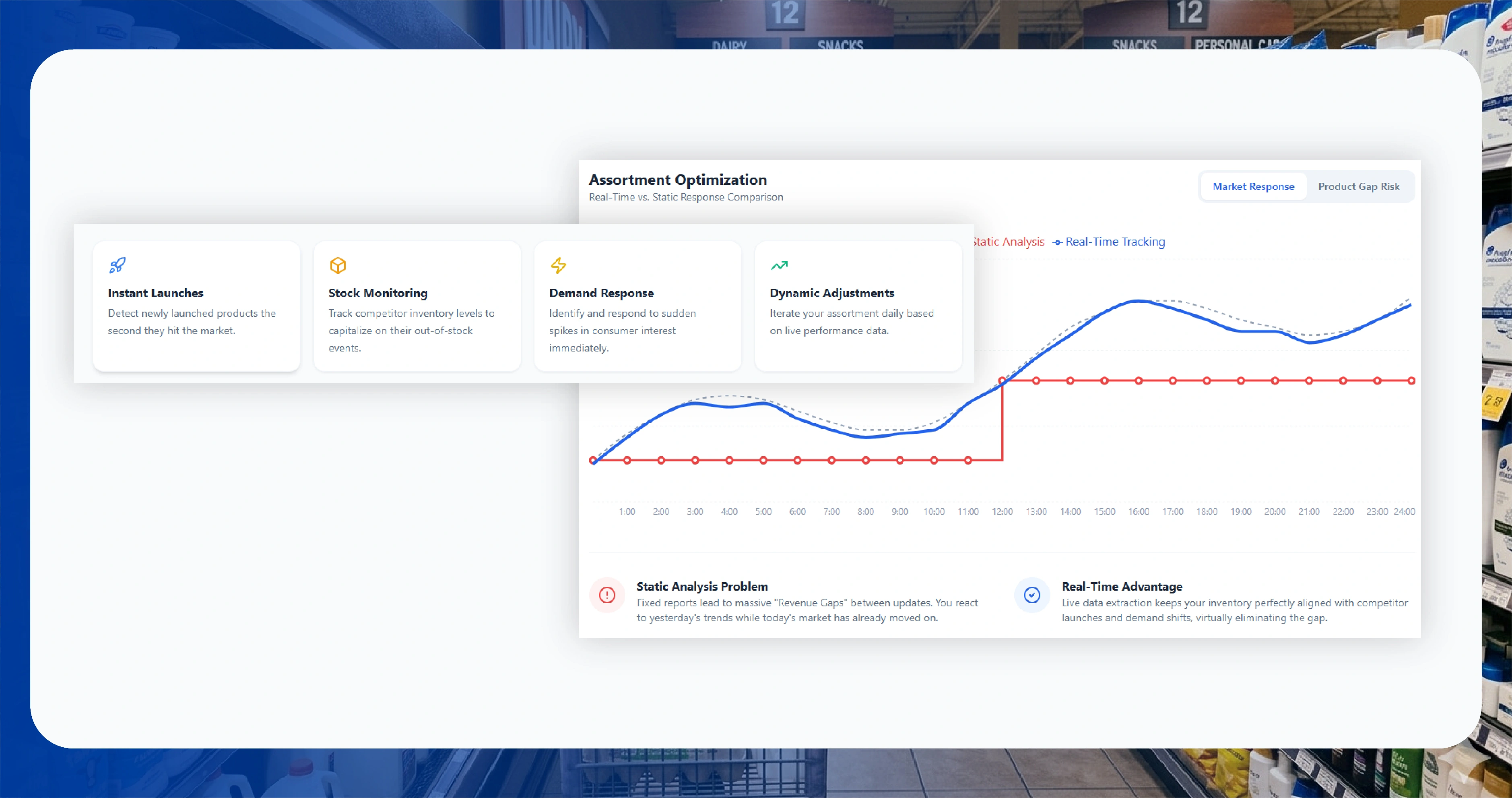
The Q-commerce landscape changes rapidly—new products are introduced daily, and stock availability fluctuates constantly. Static analysis is no longer enough. Real-Time Product Gap Tracking Using Extracted Data ensures businesses stay updated with every market shift.
Real-time tracking helps:
- Detect newly launched products instantly
- Monitor competitor stock levels
- Respond to sudden demand spikes
- Adjust assortments dynamically
This agility allows businesses to stay ahead rather than reacting too late.
Leveraging Data for Long-Term Strategy
Access to well-structured Quick Commerce Datasets provides long-term strategic advantages. These datasets enable businesses to:
- Analyze historical trends
- Forecast future demand
- Benchmark performance across regions
- Identify consistent high-performing categories
Over time, these insights help build a more resilient and scalable assortment strategy.
Business Impact of Closing Assortment Gaps
Addressing assortment gaps delivers measurable benefits across multiple dimensions:
- Higher Conversion Rates
Customers are more likely to complete purchases when they find all desired items in one place. - Increased Average Order Value
A broader assortment encourages customers to add more items to their cart. - Improved Customer Retention
Consistent availability builds trust and repeat usage. - Stronger Competitive Positioning
A well-optimized catalog reduces the risk of losing customers to competitors. - Better Inventory Efficiency
Data-driven decisions minimize overstocking and stockouts.
Common Challenges in Implementation
Despite its importance, assortment gap analysis is not without challenges:
- Data inconsistency across platforms
- Frequent catalog updates requiring continuous monitoring
- Complex SKU mapping due to naming variations
- Scalability issues with large datasets
- Integration difficulties with existing systems
Overcoming these challenges requires automation, advanced analytics, and scalable infrastructure.
Best Practices for Effective Execution
To maximize the effectiveness of assortment gap analysis, businesses should:
- Automate data collection and updates
- Standardize product naming and categorization
- Focus on high-impact categories first
- Use AI-driven tools for demand prediction
- Continuously track competitor activities
These practices ensure that insights are not only accurate but also actionable.
Unlock growth by identifying product gaps and optimizing your assortment with our data scraping solutions.
Role of Advanced Data Techniques
Modern analytics techniques have made it easier to identify and act on assortment gaps. Automated tools can process vast amounts of data, identify patterns, and generate recommendations in real time.
These capabilities allow businesses to:
- Scale analysis across thousands of SKUs
- Detect subtle trends and anomalies
- Optimize assortments with minimal manual effort
As competition intensifies, adopting advanced data techniques is no longer optional—it’s essential.
Looking Ahead: The Future of Assortment Strategy
The future of Q-commerce will be driven by personalization and predictive intelligence. Businesses will move toward:
- Hyper-localized assortments
- AI-powered product recommendations
- Real-time inventory synchronization
- Demand forecasting based on behavioral data
Companies that invest in these capabilities will be better positioned to meet evolving customer expectations.
How Food Data Scrape Can Help You?
- Comprehensive Competitor Product Tracking
Our data scraping services continuously monitor competitor platforms, capturing detailed SKU-level data including pricing, availability, variants, and categories, helping you identify missing products and expand your assortment strategically and efficiently. - Accurate Catalog Comparison and Gap Identification
We enable precise comparison between your catalog and competitors by structuring and standardizing product data, allowing you to quickly detect assortment gaps, underrepresented categories, and opportunities to improve product coverage effectively. - Real-Time Market and Inventory Insights
Our solutions provide real-time visibility into competitor inventory changes, new product launches, and stock fluctuations, enabling faster decision-making, proactive assortment updates, and improved responsiveness to shifting customer demand patterns. - Scalable Data Extraction Across Multiple Platforms
We collect and process large-scale data from multiple quick commerce platforms simultaneously, ensuring comprehensive coverage, consistent data quality, and the ability to analyze thousands of SKUs without manual effort or operational complexity. - Actionable Insights for Growth and Optimization
Our analytics transform raw scraped data into meaningful insights, helping you optimize pricing, improve product availability, refine assortment strategies, and ultimately increase conversions, customer satisfaction, and long-term business growth.
Quick Commerce and Grocery Intelligence Ecosystem
The rise of instant delivery platforms has created a new layer of retail complexity. Companies now rely on Quick Commerce Datasets to analyze fast-moving consumer behavior in hyperlocal markets. These datasets capture real-time demand, product popularity, and delivery patterns across cities and zones.
To deepen insights, businesses use Quick Commerce Data Intelligence Services, which transform raw delivery data into structured intelligence. This helps understand peak demand hours, regional product preferences, and order frequency patterns, especially in FMCG and grocery categories.
In traditional grocery retail, a Grocery Price Tracking Dashboard plays a key role in monitoring price fluctuations across essential product categories. It helps retailers stay competitive while managing margins effectively in a highly price-sensitive market.
How Food Data Scrape Can Help You?
- Real-Time Market Visibility
Our data scraping services continuously collect retail data from multiple platforms, enabling you to monitor pricing, stock levels, and competitor activities in real time for faster, smarter business decisions. - Competitive Pricing Optimization
We help you analyze competitor pricing trends and fluctuations, allowing your business to adjust strategies dynamically, improve price positioning, and maximize profitability while staying competitive across rapidly changing retail markets. - Inventory and Demand Insights
Our solutions provide accurate insights into product availability and demand patterns, helping you prevent stockouts, optimize inventory planning, and ensure the right products are available at the right time. - Promotion and Discount Analysis
We extract and analyze promotional and discount data across platforms, helping you understand campaign effectiveness, identify seasonal trends, and design better offers that attract customers while maintaining healthy margins. - Scalable Data Integration for BI
Our scraping services seamlessly integrate with BI tools like Power BI, delivering clean, structured datasets that support advanced analytics, interactive dashboards, and data-driven strategies across all retail operations.
Conclusion
Retail intelligence is evolving from simple reporting to advanced, real-time decision systems. By combining scraping technologies with Power BI, businesses gain a continuous view of market dynamics, competitor strategies, and consumer behavior.
The integration of Grocery Data Intelligence will further enhance this ecosystem by improving retail insights and decision-making. The use of Quick Commerce Data Scraping API will enable faster and more efficient real-time data collection across platforms.
The availability of Grocery Datasets will support advanced analytics, helping businesses predict trends, automate pricing decisions, and optimize inventory in real time, making retail operations more intelligent and responsive.
Are you in need of high-class scraping services? Food Data Scrape should be your first point of call. We are undoubtedly the best in Food Data Aggregator and Mobile Grocery App Scraping service and we render impeccable data insights and analytics for strategic decision-making. With a legacy of excellence as our backbone, we help companies become data-driven, fueling their development. Please take advantage of our tailored solutions that will add value to your business. Contact us today to unlock the value of your data.