Introduction
The quick commerce industry has transformed how consumers purchase groceries, medicines, snacks, personal care products, and household essentials. Platforms offering deliveries within minutes have created a highly competitive digital ecosystem where customer searches reveal valuable purchasing intent. Businesses now rely on Quick Commerce Search Keywords Data Scraping to understand what shoppers are actively searching for, trending products, seasonal demand spikes, and category-level buying patterns across quick commerce applications.
With the rapid expansion of instant delivery platforms, brands and retailers are investing heavily in consumer intelligence. Search keyword data provides unmatched visibility into customer preferences, product demand fluctuations, and regional purchasing behavior. Companies that monitor these insights can optimize inventory, pricing, advertising campaigns, and product positioning faster than competitors.
In today’s hyper-competitive market, High-Intent Quick Commerce Keywords Data Scraping helps businesses identify keywords that directly influence purchasing decisions. Unlike traditional eCommerce browsing behavior, quick commerce users usually search with urgency and high purchase intent. Capturing this behavior allows brands to predict buying trends and improve product discoverability across platforms.
Businesses are increasingly using Quick commerce keyword trend analysis to monitor rapidly changing consumer interests. From instant grocery needs to festival-based product surges, keyword trends reveal emerging demand before competitors recognize market shifts. This intelligence helps companies make data-driven decisions related to promotions, stock allocation, and campaign planning.
Why Quick Commerce Search Data Matters?
Quick commerce platforms generate enormous volumes of user search activity every second. Every keyword typed by a consumer represents intent, demand, urgency, or curiosity. Analyzing this search data offers businesses actionable insights into customer psychology and shopping patterns.
Search data helps companies understand:
- Which products are trending in specific regions
- What customers search during weekends, festivals, or weather changes
- Seasonal demand spikes for grocery and FMCG products
- High-conversion keywords influencing purchases
- Popular brands within different categories
- Price-sensitive search behavior
- Emerging product trends before they become mainstream
For FMCG companies, grocery brands, and retailers, these insights are critical for optimizing digital shelf visibility and improving marketing performance.
Understanding Buyer Intent Through Search Queries
Modern businesses increasingly aim to Extract buyer intent data from quick commerce apps because it reflects real-time customer needs more accurately than traditional surveys or reports. Search intent analysis enables organizations to distinguish between informational searches and transactional buying behavior.
For example:
- “Organic milk 1 litre”
- “Instant noodles combo”
- “Cold drinks near me”
- “Baby diapers large size”
These queries indicate immediate purchase readiness. Such intent-rich keywords help brands optimize inventory placement, improve sponsored listings, and target customers with highly relevant advertisements.
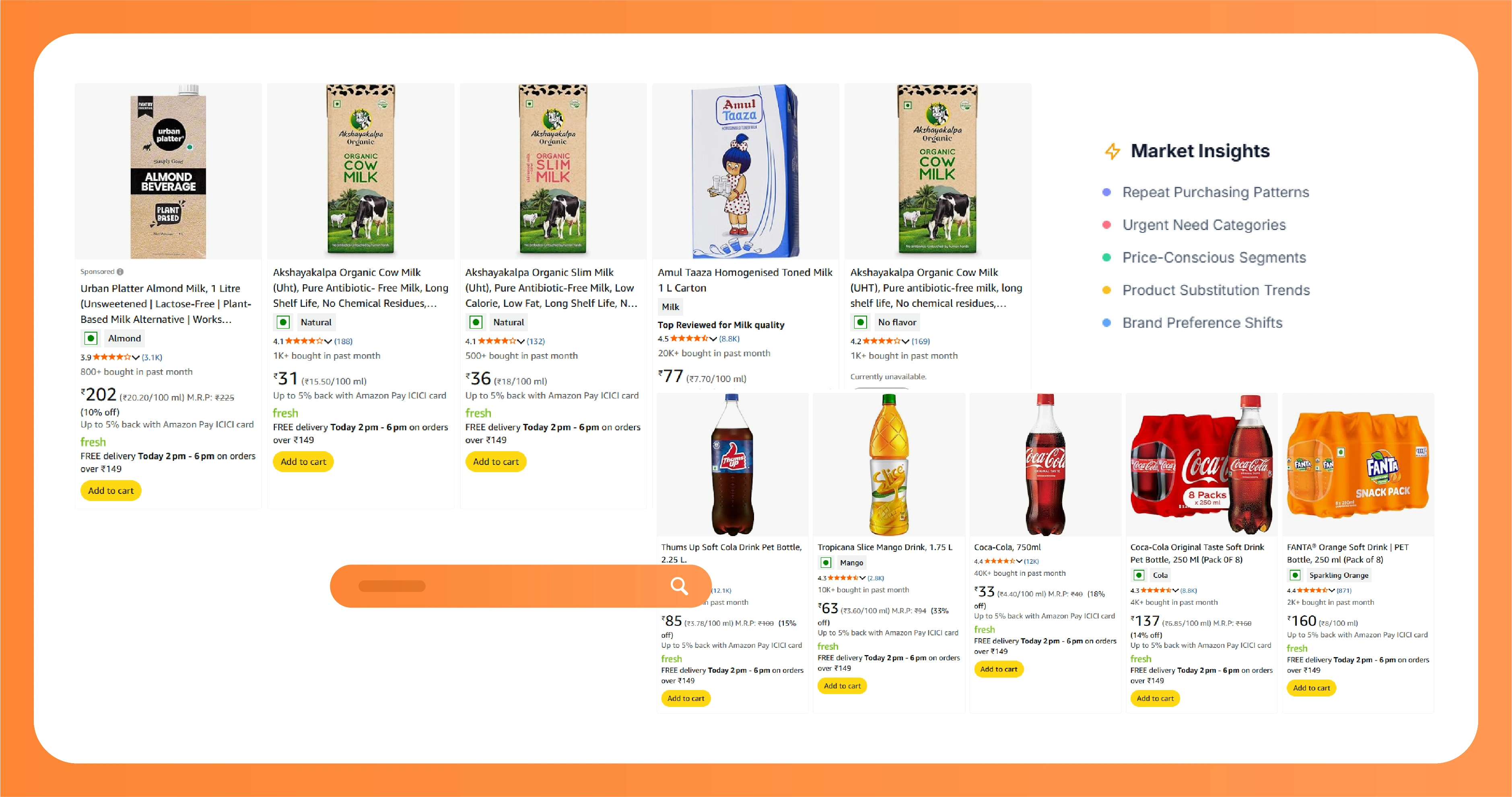
Buyer intent analysis also helps identify:
- Repeat purchasing patterns
- Urgent need categories
- Price-conscious customer segments
- Product substitution trends
- Brand preference shifts
Companies leveraging these insights can improve conversion rates and customer retention strategies effectively.
Role of Search Keyword Scraping in Competitive Intelligence
Quick commerce markets are evolving rapidly, making competitor monitoring essential. Search keyword scraping helps brands evaluate which products appear most frequently in search results, which sponsored listings dominate visibility, and which competitors are gaining traction.
Competitive intelligence from keyword data enables businesses to:
- Track ranking positions for branded products
- Monitor competitor promotions
- Analyze search visibility performance
- Identify new category entrants
- Compare pricing strategies
- Discover untapped keyword opportunities
Brands can use these insights to improve digital shelf strategies and maximize search discoverability across quick commerce ecosystems
Importance of Search Behavior Analytics
Understanding consumer behavior has become a top priority for retailers and FMCG brands. Through Q-Commerce Search Behavior Analytics, businesses gain deeper visibility into how customers interact with quick commerce applications.
Search behavior analytics helps organizations analyze:
- Search frequency patterns
- Time-based demand spikes
- Regional product preferences
- Search abandonment trends
- Click-through behavior
- Trending categories by city
- Product popularity shifts
For example, searches for cold beverages may surge during hot afternoons, while medicine-related queries may spike during monsoon seasons. Businesses using behavioral analytics can proactively prepare supply chains and optimize marketing campaigns accordingly.
Data Sources for Quick Commerce Keyword Scraping
Keyword scraping solutions typically gather data from:
- Grocery delivery applications
- Instant delivery platforms
- Pharmacy quick commerce apps
- Hyperlocal delivery marketplaces
- FMCG-focused delivery platforms
- Retail search result pages
The collected datasets may include:
| Data Field | Description |
|---|---|
| Search Keyword | Customer-entered search term |
| Search Volume | Frequency of keyword appearance |
| Product Ranking | Product visibility position |
| Sponsored Listings | Paid advertisement placements |
| Category Tags | Product category information |
| Brand Mentions | Frequently searched brands |
| Pricing Data | Associated product pricing |
| Availability Status | In-stock or out-of-stock indicators |
| Delivery Time | Estimated fulfillment duration |
| Region Data | City or locality-based demand |
These insights allow organizations to build powerful market intelligence dashboards for strategic decision-making.
Benefits of Extracting Customer Search Query Data
Businesses increasingly seek to Extract customer search queries Data because it provides direct access to real-time customer interests and evolving consumption patterns. Search queries reveal not only what consumers buy but also what they struggle to find.
Key benefits include:
Improved Product Discovery
Brands can optimize titles, descriptions, and
metadata based on high-performing keywords to increase visibility.
Better Inventory Planning
Retailers can predict upcoming demand spikes and
maintain optimal stock levels.
Smarter Advertising Campaigns
Marketers can target high-conversion search
terms for better ROI.
Trend Forecasting
Emerging product demand can be identified before market
saturation occurs.
Regional Personalization
Businesses can tailor promotions based on
city-specific search behavior.
Enhanced Customer Experience
Understanding search behavior helps improve
navigation and product recommendations.
Applications Across Industries
Quick commerce keyword scraping is beneficial across multiple sectors:
- FMCG Brands: Track product demand trends, visibility rankings, and promotional performance.
- Grocery Retailers:Understand daily shopping patterns and optimize product placements.
- Pharmaceutical Companies: Monitor medicine-related searches and seasonal healthcare demand.
- Beverage Companies: Track weather-driven demand fluctuations and regional preferences.
- Beauty & Personal Care Brands: Identify trending skincare and cosmetic product searches.
- Market Research Firms:Build consumer intelligence reports using real-time keyword datasets.
Building Advanced Quick Commerce Datasets
Businesses increasingly rely on Quick Commerce Datasets to power machine learning models, forecasting systems, and advanced analytics dashboards. Structured datasets allow organizations to uncover deep insights into customer demand and market dynamics.
These datasets may include:
- Keyword frequency history
- Product ranking changes
- Regional search trends
- Hourly search fluctuations
- Conversion-focused keywords
- Sponsored ad visibility
- Competitor keyword performance
- Search-to-purchase correlation
Advanced analytics teams use these datasets for:
- Demand forecasting
- Dynamic pricing models
- Market basket analysis
- Personalized recommendations
- Customer segmentation
- Promotional planning
As quick commerce expands globally, the demand for scalable keyword datasets continues to rise significantly.
CTA: Unlock real-time quick commerce insights with our powerful data scraping solutions designed for smarter business growth.
Challenges in Quick Commerce Data Collection
Dynamic Platform Structures
Quick commerce platforms frequently update
layouts and APIs, requiring adaptive scraping solutions.
Anti-Bot Detection
Platforms implement CAPTCHA systems, rate limits, and bot
detection mechanisms to prevent automated scraping.
Real-Time Data Processing
Massive keyword volumes require scalable
infrastructure for processing and analytics.
Regional Variations
Search trends differ significantly across cities and
demographics, increasing data complexity.
Data Accuracy Maintenance
Continuous validation and cleaning are necessary to
ensure reliable datasets.
Organizations often use advanced automation frameworks and AI-powered parsing systems to overcome these challenges efficiently.
Future of Quick Commerce Keyword Intelligence
The future of quick commerce analytics is becoming increasingly data-centric. Search keyword intelligence will continue playing a crucial role in:
- AI-driven demand prediction
- Personalized shopping experiences
- Hyperlocal inventory optimization
- Real-time competitor tracking
- Dynamic ad targeting
- Predictive consumer analytics
As consumer expectations evolve toward faster and more personalized experiences, businesses will depend more heavily on search behavior analytics to stay competitive.
AI and machine learning technologies will further improve keyword clustering, sentiment analysis, and predictive trend modeling. This evolution will help companies make faster, smarter, and more profitable business decisions.
Conclusion
Quick commerce platforms are generating unprecedented volumes of real-time consumer search data. Businesses that effectively analyze these search patterns gain a significant competitive advantage in understanding customer intent, forecasting demand, and improving digital shelf visibility.
Modern enterprises increasingly rely on Web Scraping Quick Commerce Data to capture actionable keyword intelligence from rapidly evolving delivery ecosystems. By leveraging advanced analytics and automation, companies can identify high-conversion search trends, monitor competitors, and optimize customer engagement strategies.
Organizations are also adopting scalable Quick Commerce Data Scraping API solutions to automate large-scale keyword extraction and real-time market monitoring. These APIs enable seamless integration of keyword intelligence into dashboards, forecasting tools, and AI-powered analytics systems.
As the quick commerce industry continues expanding, businesses investing in Quick Commerce Data Intelligence Services will be better positioned to understand consumer demand, improve operational efficiency, and drive long-term growth through data-driven decision-making.
Are you in need of high-class scraping services? Food Data Scrape should be your first point of call. We are undoubtedly the best in Food Data Aggregator and Mobile Grocery App Scraping service and we render impeccable data insights and analytics for strategic decision-making. With a legacy of excellence as our backbone, we help companies become data-driven, fueling their development. Please take advantage of our tailored solutions that will add value to your business. Contact us today to unlock the value of your data.