Introduction: Why the GCC Is the World's Most Strategic Alcohol Market
The Gulf Cooperation Council (GCC) — comprising the United Arab Emirates, Bahrain, Oman, Qatar, Kuwait, and Saudi Arabia — represents one of the most distinctive and strategically important regions for global alcohol brands. The market is highly regulated, extremely premium-skewed, dominated by tourism and hospitality, and shaped by a complex mosaic of country-by-country licensing frameworks. For premium spirits, fine wines, prestige champagnes, and luxury beers, the GCC delivers per-capita basket sizes that rival or exceed nearly every other region globally.
Yet for brands looking to enter or expand here, the GCC is also one of the most opaque markets in the world. There is no single public dataset that maps distribution networks, channel pricing, hospitality penetration, or consumer trends across the region. Country-by-country regulatory variation creates additional complexity. Without robust market intelligence, brands often enter the GCC blind — and the cost of that blindness is significant.
That is precisely the gap that Food Data Scrape fills. Our regional data scraping GCC infrastructure delivers harmonized, multi-country, multi-channel intelligence that gives global alcohol brands the clarity they need to plan, enter, and scale across the Gulf. This blog explains how regional data scraping powers GCC market entry strategies, what the data looks like, and how Food Data Scrape's solutions help brands move with speed and confidence.
Understanding the GCC Alcohol Market in 2026
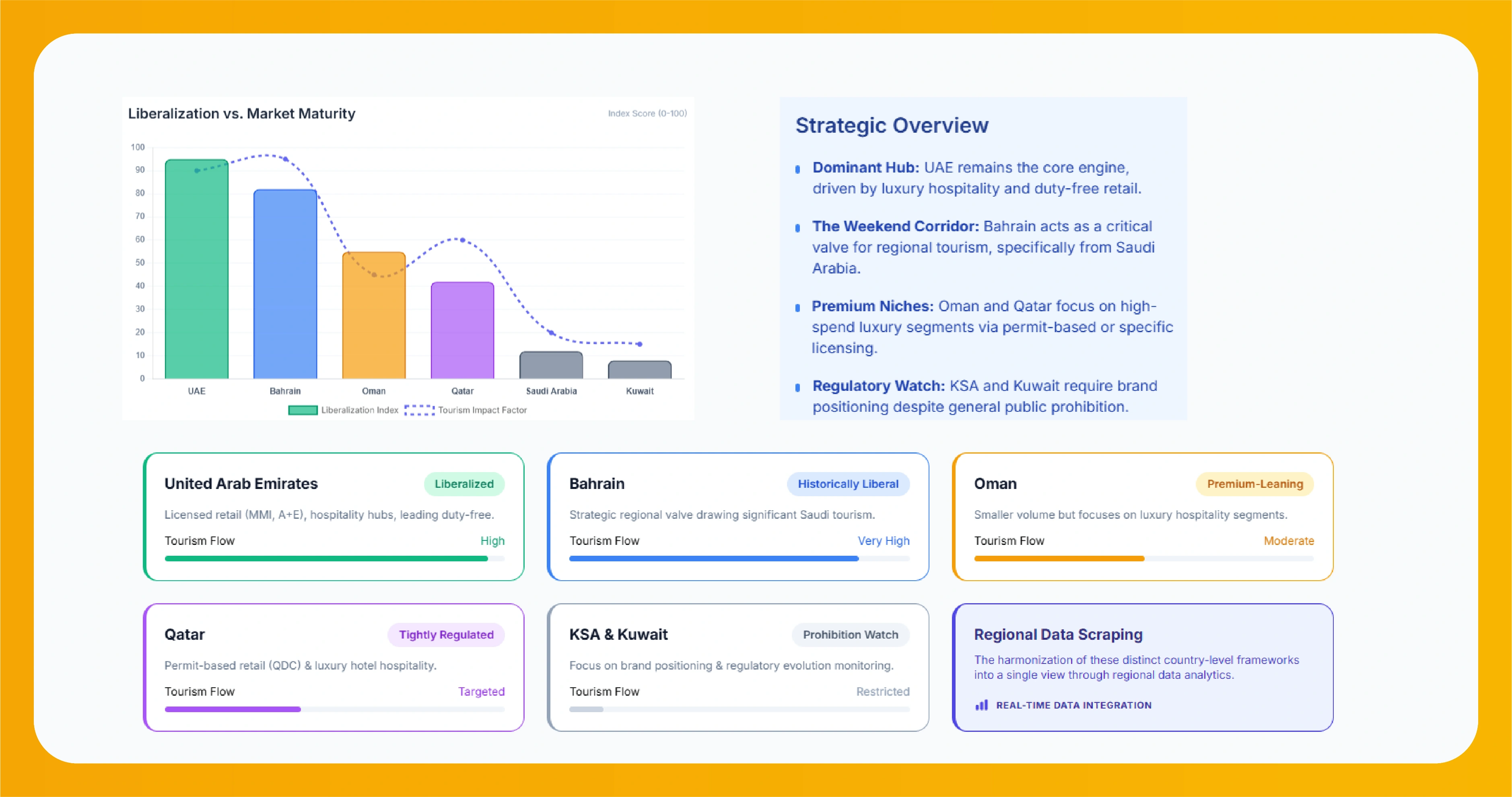
The GCC alcohol landscape is not a single market — it is a region of distinct country-level markets bound together by overlapping consumer flows, particularly tourism.
-
United Arab Emirates
The largest and most liberalized GCC alcohol market by far, with licensed retail (MMI, African+Eastern), a vast hospitality channel, and one of the world's leading duty-free retail engines. Pricing varies by emirate. -
Bahrain
A historically liberal GCC market for alcohol, with licensed retail and a hospitality sector that draws significant Saudi and regional weekend tourism, making it strategically important well beyond its small resident population. -
Oman
Licensed retail and hospitality channels operate under specific regulatory frameworks. The market is smaller in absolute volume but premium-leaning. -
Qatar
A tightly regulated market with licensed retail (Qatar Distribution Company) operating under permit-based access, plus a hospitality channel concentrated in luxury hotels. -
Kuwait and Saudi Arabia
Both currently operate under prohibition for the general public, though hospitality channels in select diplomatic and international zones may differ. Brand strategy in these markets focuses on awareness, positioning, and watching for any future regulatory evolution.
This patchwork of frameworks means a single regional strategy cannot be built without country-specific data, harmonized into a single comparable view. That harmonization is exactly what regional data scraping enables.
Why Regional Data Scraping Is Essential for GCC Market Entry
Brands attempting GCC alcohol market entry without comprehensive data face a series of compounding challenges.
-
Channel mapping is non-trivial
Identifying every licensed retailer, hospitality account, duty-free outlet, and approved e-commerce platform across multiple GCC countries — and understanding how each prices and stocks luxury alcohol — cannot be done from a desk in London or New York. It requires systematic data collection across public sources in each country. -
Pricing benchmarks vary enormously
A 750ml bottle of premium tequila might retail at AED 1,599 in Dubai, BHD 169 in Bahrain, OMR 175 in Muscat, and QAR 1,499 in Doha — and each of those prices reflects different duty structures, license fees, and channel margins. A brand cannot set a regional pricing strategy without seeing all of those numbers in one place. -
Competitive landscapes diverge
The competitive set in luxury Scotch is not the same in Manama as it is in Dubai. Some brands distribute heavily across the entire GCC; others have concentrated presence in only one or two countries. Understanding competitor footprint by country is essential for go-to-market planning. -
Hospitality is half the story.
In the GCC more than almost any other region, hospitality drives a disproportionate share of luxury alcohol consumption. Capturing on-trade menus, pour pricing, and bottle service rates is essential for sizing the addressable market. -
Tourism flows shift demand
Major events — Formula 1, World Cup spillover hospitality, EXPO legacy programming, peak winter tourism — create demand spikes that are visible in pricing and stock data weeks before they appear in formal sales reports. Brands that track this in real time gain meaningful planning advantage.
How Food Data Scrape Powers GCC Market Entry
Food Data Scrape operates a purpose-built infrastructure for Middle East alcohol market data that ingests data daily from public web sources across each GCC country where alcohol is legally sold. Our methodology rests on five pillars.
-
Country-by-country coverage
We Scrape GCC Beverage Data from licensed retailers, hospitality menus, duty-free public listings, and approved e-commerce platforms across the UAE, Bahrain, Oman, and Qatar, with continued monitoring of regulatory developments in other GCC states. -
Channel diversity within country
Within each country, we capture off-trade retail, on-trade hospitality, and travel retail, ensuring stakeholders see the full picture of where and how their brand and competing brands appear. -
Currency normalization
All records are stored in local currency with a normalized USD equivalent, plus explicit fields for any duties, fees, or taxes included in the displayed price, so cross-country comparisons are like-for-like. -
Refresh cadence
Top-velocity SKUs and limited editions refresh daily; long-tail luxury SKUs refresh weekly. New product launches and promotional changes trigger near-real-time recapture. -
Quality assurance
Every record passes schema validation, brand-name disambiguation across English and Arabic listings, ABV and volume sanity checks, and outlier detection before reaching client systems.
Clients access the data through flexible delivery options: a fully documented GCC data scraping API, scheduled CSV or JSON exports, direct database integration, and country-specific or regional dashboards.
Sample GCC Regional Data
To illustrate the structure of the GCC Alcohol Dataset delivered by Food Data Scrape, here are representative samples across countries and channels.
Sample 1: Cross-Country Pricing for a Single SKU (Macallan 18 Sherry Oak 700ml)
| Country | Channel | Retailer / Venue | Local Price | USD Equivalent | Stock Status | Date |
|---|---|---|---|---|---|---|
| UAE (Dubai) | Off-Trade | MMI | AED 3,499 | $952 | In Stock | 2026-04-30 |
| UAE (Abu Dhabi) | Off-Trade | African+Eastern | AED 3,599 | $980 | In Stock | 2026-04-30 |
| Bahrain | Off-Trade | Licensed Retailer | BHD 365 | $968 | In Stock | 2026-04-30 |
| Oman | Off-Trade | Licensed Retailer | OMR 379 | $985 | Low Stock | 2026-04-30 |
| Qatar | Off-Trade | QDC | QAR 3,499 | $960 | In Stock | 2026-04-30 |
| UAE (Dubai) | Duty-Free | Dubai Duty Free | AED 3,299 | $898 | In Stock | 2026-04-30 |
Sample 2: GCC Hospitality Pour Pricing
| Country | Venue Type | Beverage | Serve | Local Price | Date |
|---|---|---|---|---|---|
| UAE (Dubai) | 5-Star Hotel Bar | Hennessy XO single | 30 ml | AED 220 | 2026-04-30 |
| Bahrain | Hotel Bar | Macallan 12 single | 30 ml | BHD 14 | 2026-04-30 |
| Oman | Hotel Lounge | Glenfiddich 12 single | 30 ml | OMR 9 | 2026-04-30 |
| Qatar | Luxury Hotel | Don Julio 1942 single | 30 ml | QAR 250 | 2026-04-30 |
| UAE (Abu Dhabi) | Fine Dining | Hibiki Harmony single | 30 ml | AED 130 | 2026-04-30 |
Sample 3: Distribution Footprint Snapshot for a Premium Brand
| Country | Off-Trade SKUs | On-Trade Venues Spotted | Duty-Free SKUs | Distribution Notes |
|---|---|---|---|---|
| UAE | 14 | 120+ | 8 | Comprehensive presence across emirates |
| Bahrain | 9 | 35+ | 2 | Strong urban retail and hospitality |
| Oman | 6 | 18+ | 1 | Concentrated in capital region |
| Qatar | 11 | 45+ | 3 | Hospitality-led footprint |
Sample 4: Promotional Activity Monitoring
| Country | Retailer | Product | Original | Promo | Date |
|---|---|---|---|---|---|
| UAE | MMI | Glenmorangie Signet 700ml | AED 1,499 | AED 1,299 | 2026-04-29 |
| Bahrain | Licensed Retailer | Bombay Sapphire 1L | BHD 17 | BHD 14 | 2026-04-29 |
| UAE | African+Eastern | Veuve Clicquot Yellow Label | AED 359 | AED 299 | 2026-04-29 |
These samples illustrate only a fraction of the regional data Food Data Scrape captures across the GCC each month.
A Strategic Playbook: Using Data to Enter the GCC
Across our work with global alcohol brands, a clear data-driven playbook for alcohol brand market entry strategy in the GCC has emerged.
Step 1: Map the regulatory and channel landscape. Begin by understanding which GCC countries are addressable for your category, and which channels exist legally in each. Data scraping confirms the active retailers, hospitality venues, and duty-free outlets carrying your competitive set.
Step 2: Benchmark pricing across countries. Use harmonized data to understand how comparable products are priced across the GCC. This informs MSRP setting, distributor negotiations, and profit projections at the country level.
Step 3: Quantify competitor footprint. For each priority country, count the number of competing SKUs, the number of hospitality venues carrying them, and the duty-free placements. This builds the competitive baseline against which your entry will be measured.
Step 4: Identify white space. Look for sub-segments where your portfolio has differentiated positioning and where the existing competitive set is shallow. Data exposes these gaps faster than any consultant report can.
Step 5: Build distributor scorecards. Once you appoint distributors, use ongoing data scraping to monitor pricing compliance, retail breadth, and hospitality penetration over time. Distributor performance becomes measurable rather than anecdotal.
Step 6: Time launches strategically. GCC tourism, sporting events, and seasonal patterns create predictable demand peaks. Data scraping reveals when competitor activity is highest and lowest, informing launch and promotional timing.
Use Cases for GCC Beverage Intelligence
The applications of harmonized GCC beverage intelligence span the entire commercial value chain.
-
For brand owners and importers
Plan country-by-country market entry, negotiate distributor agreements grounded in real data, and quantify the addressable opportunity by channel and country. -
For distributors and importers already in the region
Demonstrate brand-building progress to global principals, monitor competitor pricing, and identify accounts where distribution is missing. -
For hospitality groups
Benchmark drink list pricing across GCC peer venues and optimize premium spirits programs. -
For investors and market research firms
Build category dashboards on Middle East alcohol consumption, validate revenue assumptions during M&A, and produce defensible reports on emerging premium sub-segments. -
For travel retail strategists
Compare GCC duty-free dynamics across Dubai, Abu Dhabi, Bahrain, Muscat, and Doha airports to optimize travel retail allocations.
Key Data Points Captured Across the GCC
A robust GCC liquor pricing dataschema includes:
- Product name, brand, parent company, and category
- Sub-category and age statement (single malt 18yr, blended 12yr, XO cognac, etc.)
- ABV, bottle size, and country of origin
- Country, emirate or city, and venue or retailer name
- Channel type (off-trade, on-trade, duty-free)
- Local-currency price, USD equivalent, included tax/duty fields
- Promotional flags, member pricing, and discount percentages
- Hospitality serve format and corresponding price
- Stock availability and out-of-stock duration
- Limited-edition and travel-retail-exclusive indicators
Why Choose Food Data Scrape
Building reliable in-house scraping for the GCC region is a daunting undertaking. Each country has different regulatory considerations, different retailer ecosystems, and different language conventions. Hospitality data is fragmented across hundreds of venue websites and digital menus. Duty-free dynamics overlay everything. Most internal teams underestimate the engineering cost and the data quality work required to make a multi-country GCC dataset trustworthy.
Food Data Scrape brings managed infrastructure, ethical and compliant collection practices, and deep domain expertise in Middle East drinks market analytics. Our advantages include compliance-first architecture, scalable extraction across thousands of public pages daily, fully customizable schemas tailored to client priorities, near-real-time refresh on priority luxury SKUs, dedicated analyst support familiar with the GCC market, and out-of-the-box dashboards highlighting cross-country dynamics.
Conclusion: The Data Foundation for GCC Success
Entering or scaling in the GCC alcohol market is a high-reward but high-complexity proposition. The brands that succeed treat data as the foundation of their strategy, not an afterthought. Country-level regulatory variation, multi-channel pricing dynamics, and the central role of hospitality and travel retail mean that intuition simply is not enough.
Food Data Scrape exists to give global alcohol brands, distributors, hospitality operators, and investors the cleanest, most comprehensive, and most timely regional liquor market intelligence available across the Gulf. From the UAE's licensed retailers to Bahrain's hospitality scene, from Oman's quiet premium market to Qatar's hotel-led ecosystem, we transform the public web into structured intelligence ready to power your strategy.
If you are planning to enter or expand in the GCC, get in touch with Food Data Scrape today and unlock the visibility your business needs.