Business Challenge
Lack of Transparent Price Comparison
Brands and analysts often ask:
- Which retailer offers lower prices for the same SKU?
- Where are discounts deeper and more frequent?
- How consistent are prices across cities?
Without automated data extraction, answering these questions accurately was not possible.
SKU Overlap and Assortment Complexity
Although Reliance Retail and D-Mart sell many overlapping FMCG products, each retailer also carries exclusive SKUs, private labels, and region-specific assortments. Manual comparison could not capture this complexity at scale.
City-Level Variations
Prices and availability differ by city due to logistics, competition, and demand. Clients needed city-wise price comparison data, not just national averages.
No Unified Dataset
There was no single dataset that:
- Mapped identical SKUs across both retailers
- Tracked price changes over time
- Captured stock availability consistently
Why Reliance Retail vs D-Mart Comparison Matters
Comparing Reliance Retail and D-Mart data enables businesses to:
- Benchmark pricing competitiveness
- Identify underpriced or overpriced SKUs
- Track promotion and discount strategies
- Analyze private label penetration
- Improve channel strategy and negotiations
For FMCG brands, this data directly impacts pricing decisions, margin planning, and retailer relationships.
Solution Overview: Retail Comparison via Data Scraping APIs
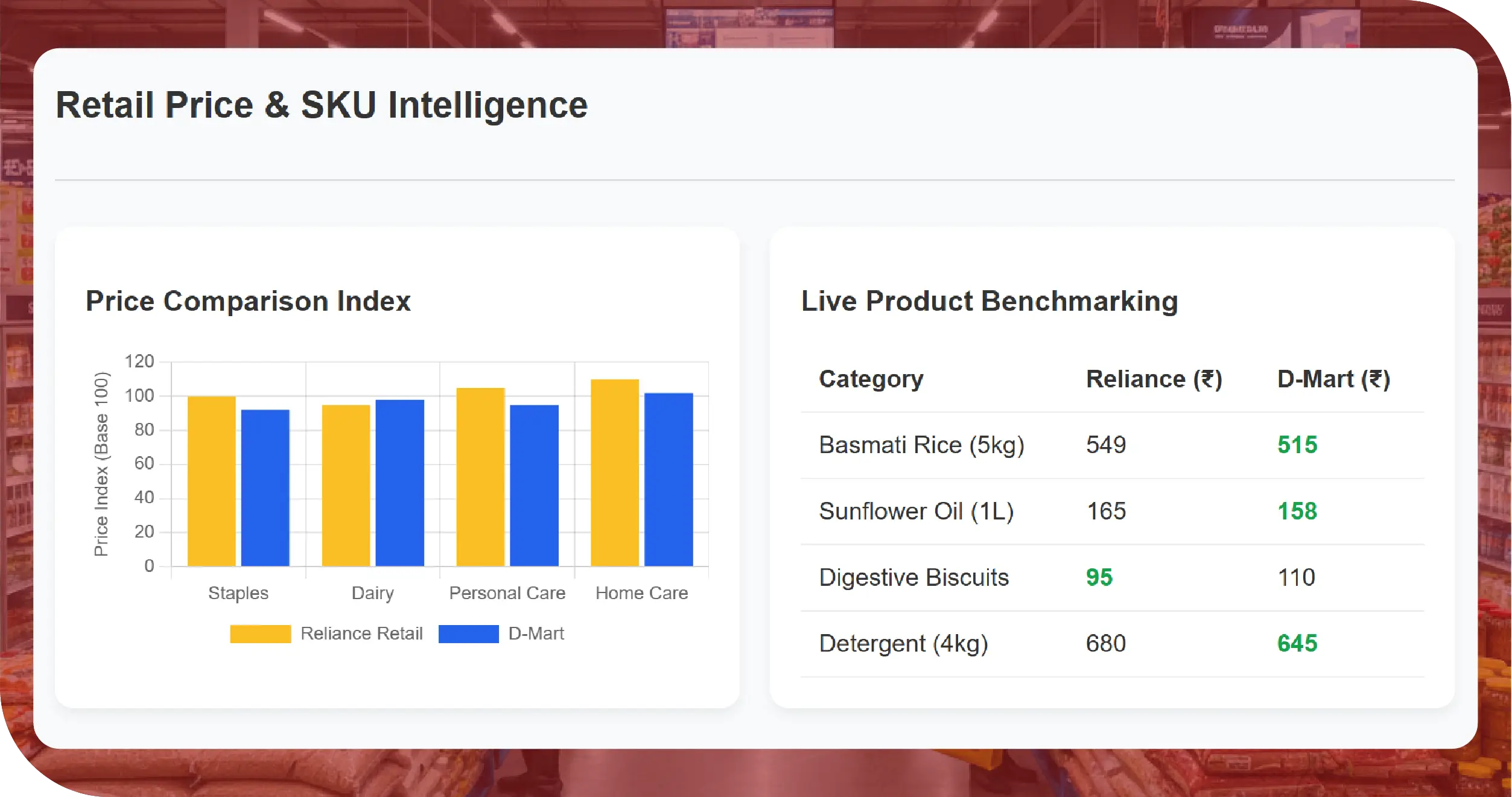
Food Data Scrape implemented a dual-source retail data scraping solution that extracts and standardizes product data from both Reliance Retail and D-Mart.
Key Objectives
- Scrape product listings, prices, and SKUs from both retailers
- Normalize identical products across platforms
- Track price, discount, and availability changes
- Enable city-wise and category-wise comparison
- Deliver analytics-ready datasets
Data Points Captured from Both Retailers
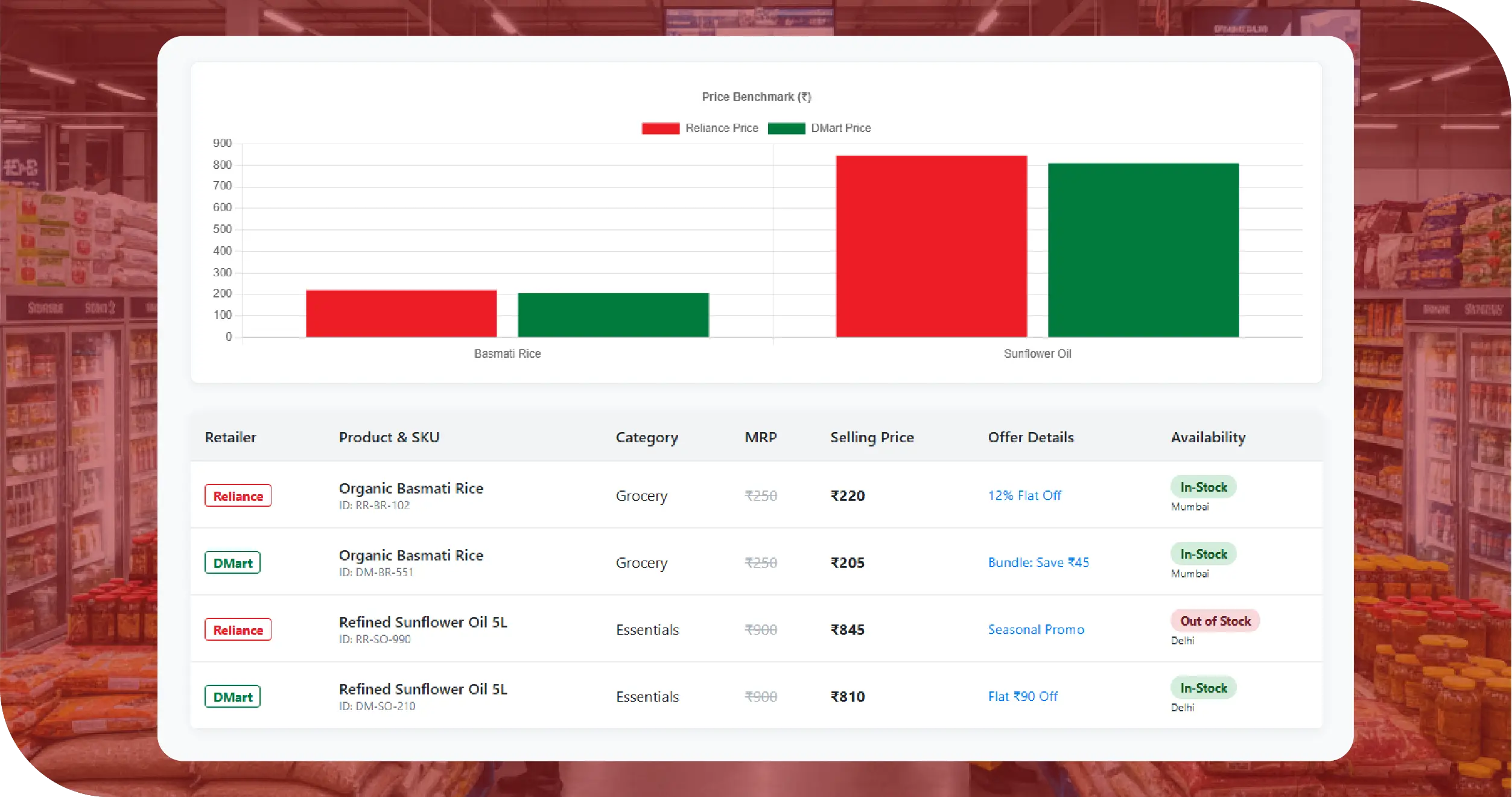
Product-Level Data
- Product name
- Brand
- SKU / product ID
- Category and subcategory
- Pack size and unit
- Product image URL
Price-Level Data
- MRP
- Selling price
- Discount amount
- Discount percentage
- Offer type (flat, bundle, seasonal)
Availability Data
- In-stock / out-of-stock status
- City or store availability
- Delivery or pickup eligibility
Sample SKU Mapping (Reliance Retail vs D-Mart)
| Product Name | Brand | Pack Size | SKU Match |
|---|---|---|---|
| Fortune Sunflower Oil | Fortune | 1 Ltr | Yes |
| Tata Salt | Tata | 1 Kg | Yes |
| Surf Excel Detergent | Surf | 2 Kg | Yes |
| D-Mart Toor Dal | D-Mart | 1 Kg | No (Private Label) |
Sample Price Comparison Data
| Product Name | City | Reliance Price (₹) | D-Mart Price (₹) | Price Difference |
|---|---|---|---|---|
| Fortune Sunflower Oil | Mumbai | 165 | 158 | D-Mart Lower |
| Tata Salt | Delhi | 26 | 25 | D-Mart Lower |
| Surf Excel 2 Kg | Bengaluru | 425 | 435 | Reliance Lower |
Technical Architecture
Food Data Scrape designed a scalable architecture to support multi-retailer comparison.
Core Components
- Distributed scraping infrastructure
- Retailer-specific parsing logic
- SKU matching and normalization engine
- Price and availability validation
- API-based and file-based data delivery
This ensures consistent and comparable data across platforms.
Price Monitoring & Change Detection
The comparison system enables:
- Daily and intraday price tracking
- Detection of sudden price drops or hikes
- Promotion start and end tracking
- City-wise pricing anomalies
Clients can set alerts when price gaps cross defined thresholds.
API Output Formats
Food Data Scrape delivers comparison data in:
- REST API (JSON)
- CSV files
- Excel spreadsheets
- Cloud-based delivery
Sample JSON Output (Simplified)
{
  "product": "Fortune Sunflower Oil 1L",
  "city": "Mumbai",
  "reliance_price": 165,
  "dmart_price": 158,
  "price_gap": -7,
  "lower_priced_retailer": "D-Mart",
  "timestamp": "2025-12-18T10:45:00"
}
Use Case 1: FMCG Brand Pricing Strategy
An FMCG brand used the comparison data to evaluate channel pricing.
Outcome
- Identified where D-Mart consistently undercut prices
- Adjusted wholesale pricing strategy
- Reduced channel conflict
Use Case 2: Distributor Margin Analysis
Distributors tracked retailer pricing to understand margin pressure.
Outcome
- Better negotiation with retailers
- Improved inventory allocation
- Reduced low-margin exposure
Use Case 3: Retail Analytics & Consulting
Consulting firms used the dataset to analyze retail competitiveness.
Outcome
- Clear insights into discount-led vs everyday-low-price strategies
- Data-backed market reports for clients
Private Label vs Branded SKU Analysis
The data revealed clear patterns:
- D-Mart had higher private label penetration in staples
- Reliance Retail offered broader branded SKU variety
- Price gaps were widest in high-volume essentials
Historical Trend Analysis
Food Data Scrape enabled long-term tracking of:
- Monthly price trends
- Promotion frequency
- SKU churn (additions and removals)
This allowed clients to forecast pricing behavior during festivals and peak seasons.
Data Accuracy & Quality Control
Each dataset passes through:
- SKU duplication checks
- Price validation rules
- Category standardization
- Availability verification
This ensures enterprise-grade reliability.
Scalability & Coverage
The solution supports:
- Multiple cities and regions
- Thousands of SKUs per category
- High-frequency refresh cycles
- Multi-client integrations
Compliance & Responsible Data Collection
Food Data Scrape follows responsible scraping practices:
- Only publicly visible data
- No consumer or personal data
- Client-aligned compliance standards
SEO Keyword Coverage
Primary keywords included:
- Reliance Retail vs D-Mart comparison
- Retail price comparison data scraping
- FMCG price intelligence API
- SKU price monitoring India
- Retail product data scraping API
Business Impact Summary
The Reliance Retail vs D-Mart comparison delivered:
- Clear price leadership insights
- Better SKU and assortment planning
- Stronger pricing negotiations
- Reduced manual research effort
- Scalable retail intelligence
Conclusion
This case study demonstrates how Food Data Scrape enables deep, data-driven comparison between Reliance Retail and D-Mart using automated product data scraping APIs. In a highly competitive retail environment, access to accurate price and SKU intelligence is no longer optional. By transforming raw retailer listings into structured comparison datasets, Food Data Scrape empowers brands, distributors, and analysts to make faster, smarter, and more profitable retail decisions.