Introduction
The San Joaquin Valley produces 25% of the nation's food supply. Almonds, pistachios, walnuts, table grapes, stone fruit, tomatoes, dairy, cotton — all within 200 miles of a Save Mart or FoodMaxx store. From Modesto in the north through Fresno at the centre to Bakersfield in the south, the Save Mart Companies operate the most geographically complete grocery network inside an active agricultural production zone in the United States. The Save Mart Central Valley California data scraping 2026 pipeline captures what that position actually produces in retail pricing terms — category by category, season by season, city by city — across a single corporate network that sources and sells within the same agricultural geography.
The commercial case for a multi-city Central Valley pipeline is built on three observable pricing phenomena that city-level datasets miss entirely. First: seasonal produce prices at harvest-window lows that differ by $0.50–$1.80 per pound between the Valley and Bay Area Save Mart stores, visible only in a concurrent collection run. Second: the FoodMaxx warehouse-format internal price gap — widest in Bakersfield, narrowest in Stockton — that reveals how the company calibrates its banner segmentation to local income demographics. Third: the Vallarta and Cardenas Supermarkets competitive pressure on produce and meat pricing across the entire Valley's majority-Hispanic shopper base. Food Data Scrape built the California agricultural grocery data infrastructure to capture all three phenomena in a single Airflow DAG.
The Central Valley Save Mart Network — Four Cities, Two Banners, One Supply Chain
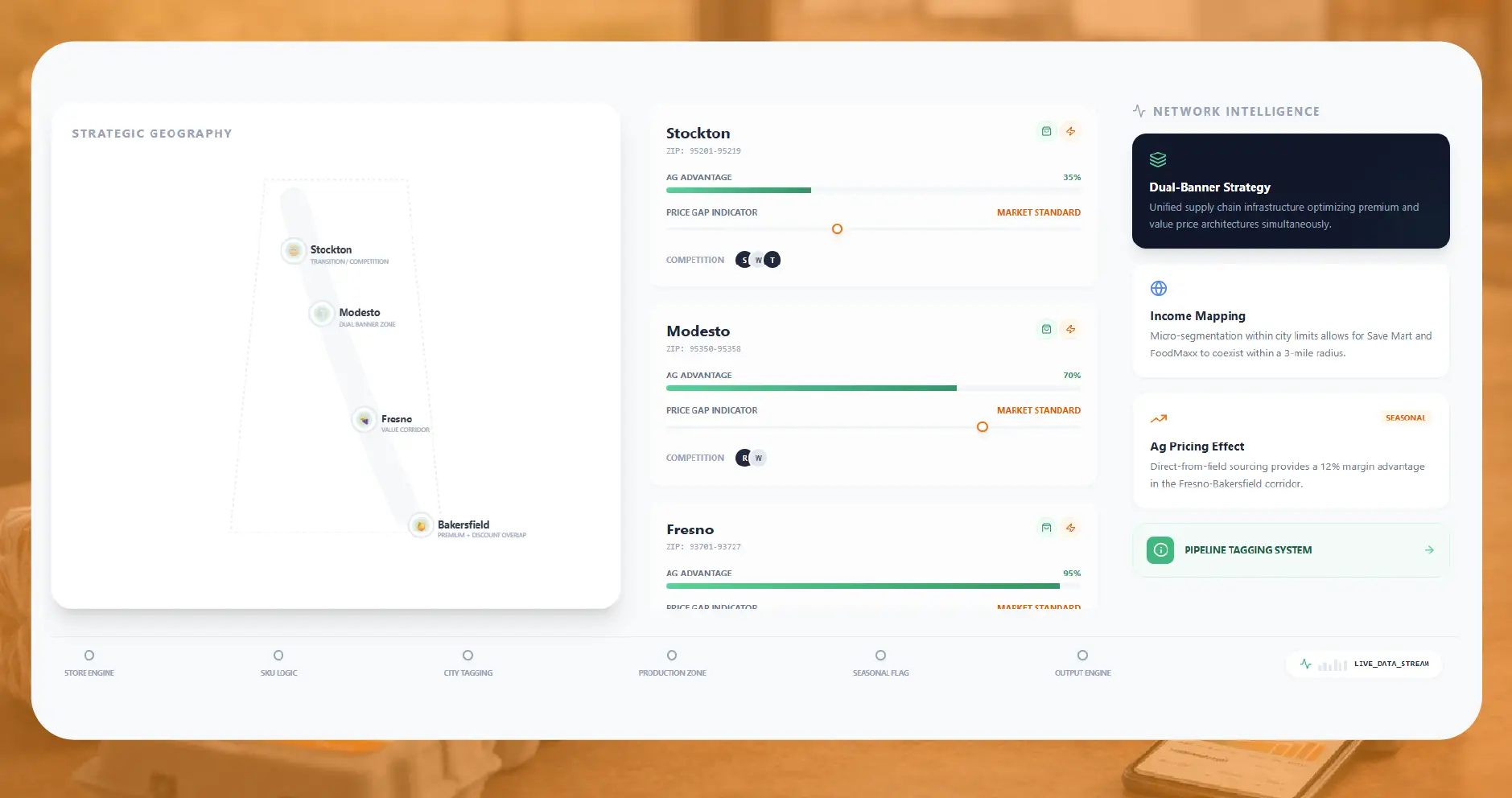
Save Mart and FoodMaxx together cover the Central Valley in a dual-banner structure that responds to local income geography. In Modesto's higher-income north-side suburbs, Save Mart's mid-market format dominates. In Modesto's west-side working-class corridors, FoodMaxx's warehouse format serves the same household needs at $2–$4 lower per protein SKU. Fresno reproduces this pattern at larger scale — eight-plus Save Mart locations in premium and mid-market zones, FoodMaxx anchoring the east and west-side value corridors. Stockton sits between Modesto and the Bay Area economically and geographically, with a shopper demographic that leans toward FoodMaxx more heavily than Modesto does. And Bakersfield — at the southern end of the Valley, farther from Bay Area income spillover — runs the widest Save Mart-to-FoodMaxx price gap in the network and the deepest FoodMaxx deal structure anywhere in California.
The agricultural proximity effect runs differently across the four cities. Fresno, inside the stone fruit and grape production zone, shows the deepest seasonal produce price advantage over Sacramento during peak harvest. Modesto, adjacent to the Northern Valley dairy belt, shows competitive dairy pricing year-round. Bakersfield, in Kern County's citrus and oil country, shows citrus and nut pricing advantages from December through March. Stockton, at the Valley's northern transition zone, shows limited agricultural produce advantage but carries the most direct competitive pressure from Bay Area grocery chains — Safeway, Lucky, Grocery Outlet — whose footprint extends into the 95207–95212 ZIP codes. The scrape Save Mart prices Central Valley pipeline that tags each record with its city, production_zone, and seasonal_advantage_flag captures that geographic variation in a structured analytical form.
Four-City Coverage Map — Modesto to Bakersfield
| City | Banners Present | Key ZIP Codes | Ag Proximity Advantage | Primary Competition | Pipeline Value |
|---|---|---|---|---|---|
| Modesto | Save Mart + FoodMaxx | 95350–95361 | Dairy year-round, stone fruit May–Sep | Walmart, Grocery Outlet, Raley's | Dual-banner internal gap data — widest meat and prepared foods gap in network |
| Stockton | Save Mart + FoodMaxx | 95204–95215 | Limited — Valley transition zone | Safeway, Lucky, Walmart, Grocery Outlet | Bay Area chain competition — Save Mart vs Safeway pricing gap data |
| Fresno | Save Mart + FoodMaxx | 93702–93722 | Strongest — stone fruit, grapes, citrus | Walmart, Vallarta, Grocery Outlet | Deepest agricultural price signal — Vallarta produce competition, highest Latino market |
| Bakersfield | Save Mart + FoodMaxx | 93301–93313 | Citrus Dec–Apr, almonds Aug–Oct | Walmart, Vons, Vallarta, Cardenas | Widest FoodMaxx discount vs Save Mart — lowest income band, deepest value-format data |
The Cross-City Price Gradient — What the Full Pipeline Reveals
Run Modesto, Fresno, and Bakersfield Save Mart collection concurrently and the produce price gradient appears immediately. Table grapes in late August: $2.99 at Save Mart Fresno (Tulare County harvest 40 miles away), $3.49 at Save Mart Modesto (100 miles from the harvest), $3.99 at Save Mart Bakersfield (in the same production zone but a different crop variety), $4.49 at Save Mart Sacramento (outside the production zone entirely). That $1.50 spread across four cities in the same chain, on the same SKU, in the same week — is the Modesto to Bakersfield price comparison dataset core value proposition. No single-city collection produces it.
The FoodMaxx discount gap gradient adds a second cross-city analytical dimension. The internal Save Mart-to-FoodMaxx gap on ground beef runs $2.20 in Modesto, $2.60 in Fresno, and $3.10 in Bakersfield. The gap widens as you move south through the Valley because Bakersfield's lower median household income ($48,000) creates stronger downward pressure on FoodMaxx everyday prices — the company calibrates FoodMaxx's price floor to local income demographics, and that calibration is only visible in cross-city comparison data. The Central Valley Save Mart FoodMaxx dataset that captures all four cities simultaneously reveals how the parent company manages its banner segmentation strategy across a 200-mile agricultural corridor.
Sample Save Mart Central Valley Cross-City Data Records — 2026
The records below show the same SKUs priced across all four Central Valley cities — Save Mart shelf price, S3 Rewards price, and FoodMaxx everyday price — with the cross-city produce gradient visible on seasonal items.
| Product | Category | Modesto SM | Fresno SM | Bakersfield SM | Fresno FMx | Bakers FMx | Season |
|---|---|---|---|---|---|---|---|
| Table Grapes 2lb | Produce | $3.49 | $2.99 | $3.29 | $2.49 | $2.79 | Peak Aug–Nov |
| Peaches 2lb | Produce | $3.99 | $3.49 | $4.29 | $2.99 | $3.49 | Peak Jun–Sep |
| Navel Oranges 4lb | Produce | $4.29 | $3.99 | $3.49 | $3.29 | $2.99 | In season Jan–Apr |
| Ground Beef 80/20 1lb | Meat | $5.49* | $5.49* | $5.29* | $5.29 | $4.39 | Year-round |
| Chicken Breast 2lb | Meat | $6.99* | $6.99* | $6.79* | $6.29 | $5.79 | Year-round |
| Whole Milk 1 Gal | Dairy | $3.29* | $3.29* | $3.49* | $3.69 | $3.59 | Year-round |
| Large Eggs 12ct | Dairy | $2.99* | $2.99* | $3.29* | $3.29 | $3.09 | Year-round |
| Almonds Raw 1lb | Nuts | $6.99* | $5.49* | $5.99* | $4.99 | $5.29 | Year-round |
| Roma Tomatoes 1lb | Produce | $1.49 | $0.99 | $1.29 | $0.89 | $0.99 | Peak Jul–Oct |
| White Bread 20oz | Bakery | $2.79* | $2.79* | $3.29* | $2.49 | $2.29 | Year-round |
* S3 Rewards member price shown for Save Mart; FoodMaxx columns show everyday low prices (no loyalty programme)
Sample JSON Record — Save Mart Central Valley Multi-City Schema
 {
  "product_name": "Table Grapes Red Seedless 2lb",
  "category": "Produce",
  "origin_county": "Tulare County, CA",
  "production_zone": "San Joaquin Valley South",
  "modesto_sm_s3_price": 3.49,
  "fresno_sm_s3_price": 2.99,
  "bakersfield_sm_s3_price": 3.29,
  "fresno_foodmaxx_price": 2.49,
  "bakersfield_foodmaxx_price": 2.79,
  "cross_city_price_spread": 1.00,
  "farm_proximity_flag": true,
  "harvest_season_flag": true,
  "seasonal_advantage_flag": true,
  "promo_week": "2026-08-18",
  "scraped_at": "2026-03-18T10:00:00Z",
  "pipeline_id": "centralvalley-multicity-grapes",
  "data_provider": "Food Data Scrape"
}
Central Valley Save Mart and FoodMaxx Dataset Types — 2026
The following formats cover the full range of what the Central Valley agricultural grocery benchmark dataset market demands — from cross-city produce gradient tracking to the dual-banner internal gap analysis and the Vallarta competitive benchmark.
| Dataset | Format | Refresh | Best For |
|---|---|---|---|
| Save Mart Central Valley Full Catalogue | CSV / JSON | Weekly | All four cities, both banners — production_zone, seasonal_advantage_flag, cross_city_price_spread |
| California Central Valley Grocery Price Dataset | CSV / Parquet | Weekly | Cross-city produce price gradient — Modesto, Fresno, Bakersfield, Stockton same-SKU weekly |
| Central Valley Save Mart FoodMaxx Dataset | CSV / Parquet | Weekly | Internal banner gap by city — Bakersfield gap widest, Stockton narrowest, weekly tracking |
| California Farm-Gate Grocery Data 2026 | CSV / Parquet | Monthly | Farm-to-retail price transmission — origin county, harvest window, Save Mart shelf price |
| Modesto to Bakersfield Price Comparison Dataset | CSV | Weekly | Four-city same-SKU comparison — seasonal and non-seasonal categories across the full Valley |
| Central Valley Grocery Intelligence Dataset | CSV | Weekly | Save Mart + FoodMaxx + Vallarta + Walmart — full Valley competitive matrix by city |
| Save Mart Multi-City Central Valley Data | CSV / JSON | Weekly | Unified multi-city collection output — all banners, all cities, one schema, weekly refresh |
Central Valley API Configuration — Multi-City Pipeline Architecture
The Save Mart Central Valley API 2026 runs on savemart.com with a single authenticated S3 Rewards session covering all four cities — Modesto, Stockton, Fresno, and Bakersfield store IDs in a single collection run. The Save Mart California multi-city store locator API returns all California Save Mart and FoodMaxx store IDs in one GET call — the store locator doesn't filter by region, so a single call returns the complete California footprint including Sacramento and Las Vegas Nevada stores, which should be filtered to Central Valley ZIP codes before the product collection run begins.
The Central Valley grocery price feed API 2026 built across Save Mart and FoodMaxx — with Vallarta and Cardenas reference prices added from concurrent collection — produces the most complete Central Valley grocery intelligence dataset available. The Save Mart FoodMaxx Central Valley API configuration runs both banner domains (savemart.com authenticated, foodmaxx.com unauthenticated) within the same Airflow DAG, with store ID parameters set to the nearest city cluster for each of the eight-plus Save Mart and four-plus FoodMaxx Central Valley locations. The California agricultural grocery API 2026 enriches the price data with USDA AMS California terminal market produce pricing — providing the farm-gate reference point that makes each retail shelf price interpretable in agricultural context. The Save Mart Bakersfield Fresno Modesto API covers the three core production-zone cities in a minimum-viable three-city collection configuration.
| Endpoint | Method | Returns | Auth | Central Valley Note |
|---|---|---|---|---|
| Product Search (SM) | GET | Catalogue with shelf and S3 Rewards prices by store ID | S3 Rewards login | Run 4 store IDs — one per city — as minimum viable Central Valley run |
| Product Search (FMx) | GET | FoodMaxx catalogue with everyday low prices | None | Run 2 store IDs — Fresno and Bakersfield — for banner gap analysis |
| Store Locator | GET | All California Save Mart + FoodMaxx locations | None | Filter to Central Valley ZIPs: 95xxx (Stockton/Modesto), 93xxx (Fresno), 93301+ (Bakersfield) |
| Weekly Ad Feed (SM) | GET | Wednesday circular — Central Valley store clusters | None | Wednesday 9:30am PST — same release across all four cities simultaneously |
| USDA AMS CA Markets | GET | California terminal market produce prices by commodity | None | External enrichment source — farm-gate reference for agricultural proximity analysis |
| Price by Store ID | GET | Shelf and S3 comparison across all Central Valley store IDs | None | Cross-city price gradient calculation requires concurrent same-week collection |
Stack and Configuration — Four-City Central Valley Pipeline
Tag production_zone and seasonal_advantage_flag from the Harvest Calendar
Build a centralvalley_harvest_calendar.json mapping each Central Valley production zone to its peak harvest windows by crop: Northern Valley dairy (Stanislaus, Merced counties) year-round, Fresno-area stone fruit and grapes May–November, Kern County citrus December–April, tomatoes across all zones July–October. Feed this calendar as a collection input — when a produce SKU's origin county is active in the harvest window, set seasonal_advantage_flag: true. This flag is the primary analytical field that transforms the California farm-gate grocery data 2026 from a raw price dataset into a structured farm-to-retail intelligence product.
Run Both Banners in the Same DAG — Not Separate Pipelines
Save Mart and FoodMaxx collection should run within the same Airflow DAG — not as independent pipelines that are joined after the fact. The internal_banner_gap field calculated at collection time requires that both banners' prices for the same SKU are captured within the same Wednesday collection window. A FoodMaxx collection run that happens Thursday, joined with a Save Mart run from Wednesday, produces an internal_banner_gap inflated by any overnight price changes — a structural error that grows during weeks when FoodMaxx updates its EDLP structure. The Save Mart multi-city Central Valley data schema built from in-DAG dual-banner collection is structurally cleaner than any post-hoc join approach.
Central Valley California Proxy Configuration
Use city-specific residential IPs for each of the four collection nodes: Modesto (95350), Fresno (93711), Bakersfield (93301), Stockton (95207). Running all four cities from a single Modesto IP will produce correctly localised Store Locator responses but occasionally returns Modesto-calibrated S3 Rewards deal structures for Fresno and Bakersfield store IDs — the AdvantEdge equivalent of geographic deal pricing contamination. Each city in a multi-city Central Valley pipeline should have its own residential IP address drawn from the local area code: 209 for Modesto and Stockton, 559 for Fresno, 661 for Bakersfield.
Who Builds the Central Valley Dataset and Why
California agricultural economists and food supply chain researchers use the California Central Valley grocery price dataset to measure farm-to-retail price transmission across the most productive food-producing region on Earth. The Save Mart and FoodMaxx network — distributed directly within the production zone — offers the closest available approximation of minimum achievable retail grocery prices when distribution costs approach zero. The cross-city produce price gradient from Fresno to Sacramento quantifies how much of the farm-gate pricing advantage survives distribution and reaches the retail shelf.
CPG produce brands selling into Save Mart use the four-city Central Valley dataset to time promotional investments by city and season. A brand with a San Joaquin Valley stone fruit product that runs an S3 Rewards promotion during Fresno's peak harvest season competes against Save Mart's own deeply discounted local fruit — a competitive dynamic that doesn't exist in Sacramento or Las Vegas. The Central Valley agricultural grocery benchmark dataset built from four concurrent city pipelines identifies those seasonal competitive windows with a precision that no single-city dataset can match.
Retail investment analysts use the Bakersfield FoodMaxx data as the Southern Valley affordability anchor — the California grocery market where income demographics, agricultural labour wages, and grocery pricing intersect most directly. Kern County's agricultural workforce earns wages at the lower end of California's income distribution, and the FoodMaxx price floor in Bakersfield is calibrated to that demographic reality. The cross-city comparison between Bakersfield FoodMaxx and Modesto FoodMaxx reveals how the Save Mart Companies' value-format pricing strategy responds to local income demographics across a 200-mile agricultural corridor.
Final Thoughts
The San Joaquin Valley is the most productive agricultural region on Earth, and Save Mart sits inside it — not downstream from it. The retail grocery pricing that emerges from a Modesto to Bakersfield collection run captures something no national grocery dataset produces: farm-gate proximity priced into retail shelves, dual-banner income segmentation calibrated to local agricultural labour wages, and a Vallarta and Cardenas competitive pressure that reflects the Valley's majority-Hispanic demographic reality. One pipeline. Four cities. Two banners. 200 miles of agricultural production.
Build the Central Valley pipeline with city-specific residential IPs for each of the four collection nodes, the harvest calendar as a mandatory collection input, both banners running in the same Airflow DAG, production_zone and seasonal_advantage_flag fields from run one, and Wednesday 9:30am PST collection timing for all four cities simultaneously. That configuration produces the most complete California agricultural grocery intelligence dataset available — and the only one that places farm-gate produce pricing in direct retail context.
Food Data Scrape delivers the complete Save Mart Central Valley California data scraping 2026 infrastructure — four-city multi-city pipeline architecture, dual-banner session management, harvest calendar integration, agricultural produce origin tagging, Save Mart Central Valley API 2026 configuration, and pre-compiled Central Valley Save Mart FoodMaxx dataset and California farm-to-retail benchmark datasets in CSV, JSON, and Parquet.
Are you in need of high-class scraping services? Food Data Scrape should be your first point of call. We are undoubtedly the best in Food Data Aggregator and Mobile Grocery App Scraping service and we render impeccable data insights and analytics for strategic decision-making. With a legacy of excellence as our backbone, we help companies become data-driven, fueling their development. Please take advantage of our tailored solutions that will add value to your business. Contact us today to unlock the value of your data.