Introduction
The stores share a single domain, a single loyalty programme architecture, and a single Wednesday weekly circular release. But the prices inside those stores don't. A 2lb boneless chicken breast at Schnucks Rewards price in St. Louis's Ladue suburb runs $6.29. The same SKU at Schnucks Rewards in Memphis, Tennessee runs $6.99. The same SKU in Schnucks' Indianapolis-area stores: $6.79. The same SKU in the Schnucks stores serving the southern Illinois communities of Carbondale and Marion: $6.49. One chain, four states, four measurably different price points — and a cross-state pricing story that no single-city collection reveals. The Schnucks Midwest multi-state data scraping 2026 pipeline captures the full story.
That cross-state price variation is the commercial case for a full-network Schnucks collection. The variation isn't random — it reflects the competitive structure of each state market, the income demographics of the store cluster, and the presence or absence of specific discount competitors within the local 3-mile radius. Kroger competes in Memphis and Indianapolis but not in St. Louis. Jewel-Osco competes in Illinois but not in Missouri. Fresh Thyme competes in Indiana but not in Tennessee. Each state's competitive environment produces a distinct Schnucks price architecture, and the Midwest grocery data pipeline that covers all four states simultaneously reveals how Schnucks calibrates its Rewards deal structure to local competitive conditions across a 100-store regional network. Food Data Scrape built the four-state pipeline with state_code, region, and income_zone fields from the first collection run.
The Four-State Schnucks Network — What Differs and Why
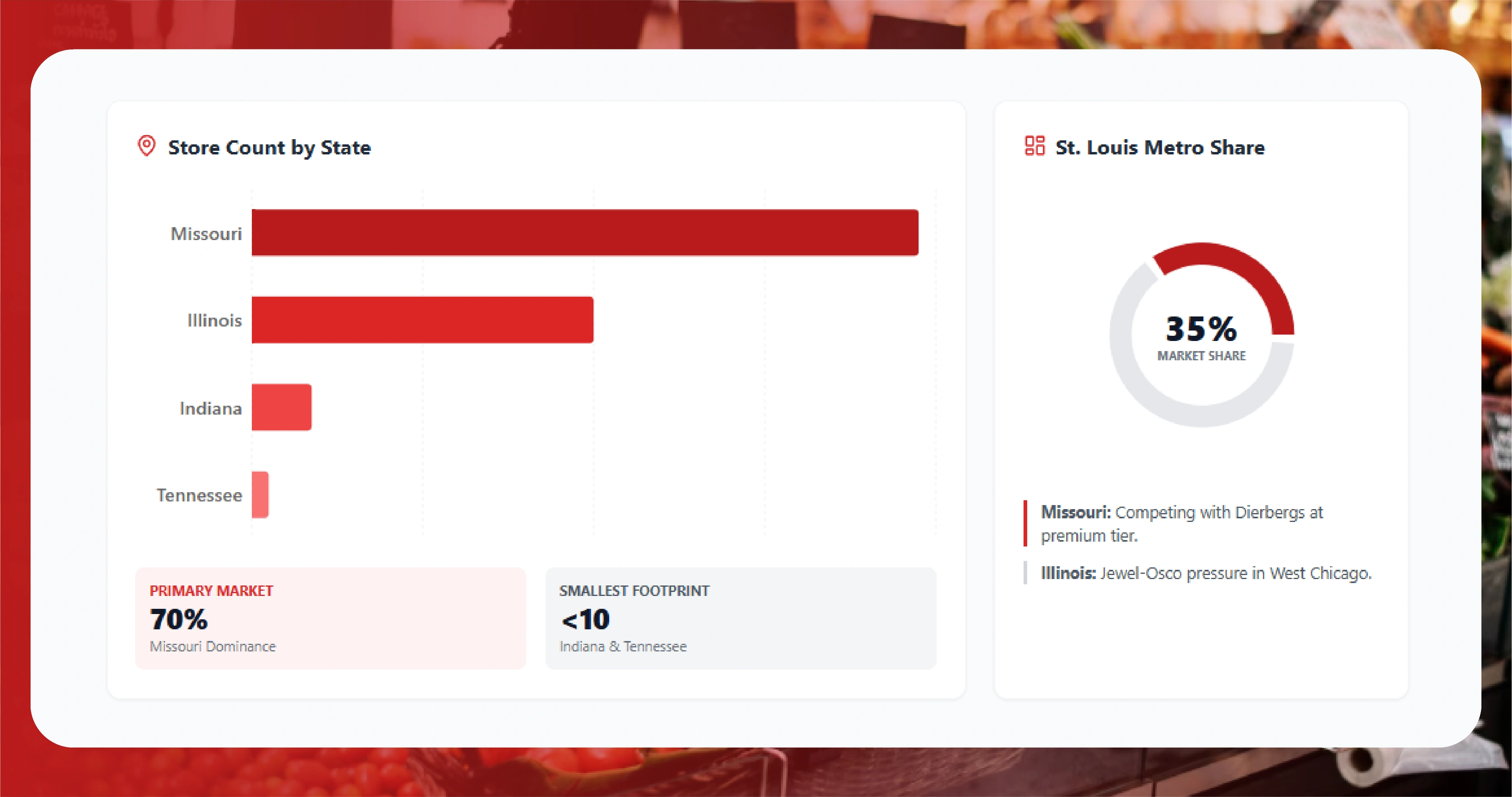
Missouri is Schnucks' home state — the chain's 70-plus Missouri stores represent more than 70% of its total network. St. Louis dominates: Schnucks holds over 35% metro market share, competes with Dierbergs at the premium tier and Aldi at the discount tier, and prices its Rewards deal structure with St. Louis's specific competitive equilibrium in mind. The Missouri stores produce the deepest Schnucks Rewards deal depth in the network — deeper than Illinois, deeper than Indiana, deeper than Tennessee — because St. Louis's competitive pressure from Dierbergs and the premium format tier forces Schnucks to invest heavily in Rewards deal sharpness to retain its mid-market position.
Illinois tells a different story. Schnucks' Illinois stores cluster in the western Chicago suburbs and in southern Illinois communities — Carbondale, Marion, Harrisburg — that are geographically and commercially closer to St. Louis than to Chicago. The western suburb stores face Jewel-Osco and Aldi competitive pressure. The southern Illinois stores operate with less competitive pressure but serve lower-income rural communities where the Rewards deal structure is less used but more economically impactful. The scrape Schnucks prices Missouri Illinois Indiana Tennessee pipeline reveals that Illinois Schnucks stores run Rewards deal depth 8–12% shallower than Missouri stores on comparable SKUs — a competitive-necessity gap that reflects the different competitor intensity in each Illinois market type.
Indiana and Tennessee are Schnucks' smallest state footprints — fewer than 10 stores in each — but both produce cross-state pricing signals that national CPG brands need. Indiana's Indianapolis-area Schnucks stores compete with Kroger, Meijer, and Fresh Thyme simultaneously — a competitive combination that exists in no other Schnucks state market. Tennessee's Memphis Schnucks stores face Kroger, Aldi, and Dollar General in a food-insecurity context that produces the most economically complex pricing environment in the chain. The Schnucks 4-state data scraper 2026 that covers all four states in a single Airflow DAG captures those state-specific competitive realities in a unified regional intelligence product.
Four-State Coverage Map — State Markets and Cross-State Data Value
| State | Key Cities | Est. Stores | Primary Competitors | Cross-State Data Value |
|---|---|---|---|---|
| Missouri | St. Louis metro, Columbia, Cape Girardeau | 70+ | Dierbergs, Aldi, Walmart, Whole Foods | HQ market anchor — deepest Rewards deal depth, St. Louis income stratification data |
| Illinois | Western Chicago suburbs, Carbondale, Marion, Harrisburg | 18+ | Jewel-Osco, Aldi, Walmart | Dual-market IL data — suburban Chicago benchmark vs rural southern IL pricing |
| Indiana | Indianapolis metro, Fort Wayne, Terre Haute | 8+ | Kroger, Meijer, Fresh Thyme, Aldi | Multi-competitor market — Fresh Thyme overlap, Meijer midwest giant pressure |
| Tennessee | Memphis metro, Nashville area | 6+ | Kroger, Aldi, Dollar General Grocery | Food access market — highest food insecurity zone, four-tier competitive structure |
The Cross-State Price Gradient — Key Findings from a Four-State Pipeline
The most commercially valuable output of a four-state Schnucks collection isn't the price data from any single state — it's the cross-state comparison. Several patterns emerge consistently from concurrent four-state collection runs.
Missouri runs deepest Rewards deal depth on protein categories — averaging 28–32% below shelf price on meat and seafood across St. Louis metro stores. Indiana runs 22–26%. Illinois suburban stores run 20–24%. Tennessee runs 18–22%. The gradient tracks almost exactly with the competitive intensity each state market faces from premium competitors (Dierbergs in Missouri, Fresh Thyme in Indiana) that pressure Schnucks from above on deal depth.
The shelf price gradient runs differently. Tennessee shelf prices on produce are 8–14% higher than Missouri shelf prices on the same SKUs — reflecting Memphis's weaker supply chain proximity to the Mississippi Delta agricultural production zone compared to Missouri's proximity to the Missouri River agricultural corridor. Indiana shelf prices on dairy run 4–6% above Missouri — reflecting Meijer's supply chain scale advantage that forces Schnucks to price dairy less aggressively in Indiana than in its home market. These cross-state shelf price gradients are invisible in any single-state collection and only appear in the Schnucks cross-state price comparison data.
Sample Schnucks Four-State Cross-City Data Records — 2026
The records below show the same four SKUs priced across all four state markets — the cross-state price gradient that only a concurrent four-state collection reveals.
| Product | Category | State | City | Shelf $ | Rewards $ | Discount % | Primary Competitor |
|---|---|---|---|---|---|---|---|
| Ground Beef 80/20 1lb | Meat | MO | St. Louis Ladue | $7.49 | $5.29 | 29.4% | Dierbergs |
| Ground Beef 80/20 1lb | Meat | IL | Carol Stream | $7.49 | $5.49 | 26.7% | Jewel-Osco |
| Ground Beef 80/20 1lb | Meat | IN | Indianapolis | $7.29 | $5.69 | 22.0% | Kroger / Meijer |
| Ground Beef 80/20 1lb | Meat | TN | Memphis | $7.29 | $5.99 | 17.8% | Kroger |
| Chicken Breast 2lb | Meat | MO | St. Louis Ladue | $9.49 | $6.29 | 33.7% | Dierbergs |
| Chicken Breast 2lb | Meat | IL | Carbondale | $9.29 | $6.79 | 26.9% | Walmart |
| Chicken Breast 2lb | Meat | IN | Indianapolis | $9.49 | $6.79 | 28.5% | Meijer |
| Chicken Breast 2lb | Meat | TN | Memphis | $9.29 | $6.99 | 24.8% | Kroger |
| Whole Milk 1 Gal | Dairy | MO | St. Louis Clayton | $4.49 | $3.29 | 26.7% | Dierbergs |
| Whole Milk 1 Gal | Dairy | IN | Indianapolis | $4.69 | $3.69 | 21.3% | Meijer |
Sample JSON Record — Schnucks Four-State Cross-State Schema
  {
  "product_name": "Ground Beef 80/20 1lb",
  "banner_type": "Schnucks",
  "state_code": "TN",
  "region": "mid_south",
  "store_city": "Memphis",
  "store_zip": "38138",
  "shelf_price_usd": 7.29,
  "rewards_price_usd": 5.99,
  "shelf_to_rewards_discount_pct": 17.8,
  "missouri_baseline_rewards": 5.29,
  "cross_state_rewards_gap_usd": 0.70,
  "primary_competitor": "Kroger",
  "income_zone": "high_insecurity",
  "scraped_at": "2026-03-18T09:30:00Z",
  "pipeline_store_id": "sch-memphis-tn-38138",
  "data_provider": "Food Data Scrape"
}
Schnucks Midwest Dataset Types — 2026
The following formats cover the full range of what the Midwest grocery competitive benchmark dataset market demands — from the four-state cross-price gradient to state-specific competitive intelligence and the unified regional Rewards dataset.
| Dataset | Format | Refresh | Best For |
|---|---|---|---|
| Schnucks Midwest Full Catalogue | CSV / JSON | Weekly | All 100+ stores — state_code, region, income_zone, cross_state_rewards_gap_usd fields |
| Schnucks Multi-State Grocery Price Dataset | CSV / Parquet | Weekly | Same-SKU pricing across all four states — shelf and Rewards prices with state comparison |
| Schnucks Cross-State Price Comparison Dataset | CSV / Parquet | Weekly | State-by-state Rewards discount depth gradient — MO deep to TN shallow, competitive explanation |
| Schnucks 4-State Rewards Dataset | JSON / CSV | Weekly | Rewards deal structure by state — weekly circular analysis across Missouri, IL, IN, TN |
| Missouri Illinois Indiana Tennessee Grocery Data | CSV | Weekly | Cross-state competitive matrix — Dierbergs in MO, Jewel in IL, Meijer in IN, Kroger in TN |
| Schnucks Regional Grocery Price History 2026 | CSV | Weekly | 52-week four-state longitudinal — shelf and Rewards price history across all markets |
| Midwest Grocery Competitive Benchmark Dataset | CSV / Parquet | Monthly | Schnucks vs primary state competitor — bilateral state-level competitive analysis |
Schnucks Midwest API Configuration — 2026
The Schnucks Midwest API 2026 runs on a single domain — schnucks.com — with one authenticated Schnucks Rewards session covering all four states. The Schnucks multi-state store locator API returns all 100-plus store IDs in a single GET call — filter by state_code to separate Missouri, Illinois, Indiana, and Tennessee collections into state-specific sub-pipelines within the same DAG. The Midwest grocery data API configuration runs four parallel Schnucks product search jobs — one per state, each with a state-matched residential IP — within the same Wednesday 9:30am CST collection window.
The Schnucks 4-state grocery price feed API built on this architecture delivers a unified four-state dataset with state_code, region, income_zone, and cross_state_rewards_gap fields calculated at collection time. The Schnucks Rewards API multi-state session is initialised at the Missouri (St. Louis Ladue 63124) store ID — the deepest Rewards deal range in the network — then applies the same session across all four state sub-pipelines. The Missouri Illinois grocery competitive API covers the two largest state footprints concurrently. The Schnucks regional product data API 2026 serves full catalogue data by state and store ID for all four state markets.
| Endpoint | Method | Returns | Auth | Multi-State Note |
|---|---|---|---|---|
| Product Search | GET | Four-state catalogue with shelf and Rewards prices by store ID | Rewards login | Run 4 store IDs (one per state) as minimum viable four-state collection |
| Weekly Ad Feed | GET | Wednesday circular — same release across all four states simultaneously | None | Wednesday 9:30am CST covers all states in one pass — no staggered release |
| Store Locator | GET | All 100+ Schnucks store IDs — filter by state_code field | None | State filter: MO (63xxx), IL (60xxx/62xxx), IN (46xxx), TN (38xxx) |
| Rewards Deals | GET | Member price deal listings by store cluster — state-level variation visible | Rewards login | Same session covers all four states — state_code filtering applied post-retrieval |
| Price by Store ID | GET | Cross-state Rewards comparison — same SKU, four states, same week | None | minimum 4 store IDs for cross-state gradient; 8–12 for full statistical confidence |
| Curbside / Delivery | GET | Slot availability — Missouri stores have most developed curbside capacity | Session | TN and IN curbside adoption lower than MO — flag in schema |
Stack and Configuration — Four-State Midwest Pipeline
Minimum Viable Run — One Store ID Per State
The minimum viable Schnucks Midwest dataset 2026 requires one store ID per state: St. Louis Ladue (63124) for Missouri, Carol Stream (60188) for Illinois, Indianapolis northwest suburb (46240) for Indiana, and Memphis Germantown (38138) for Tennessee. Four store IDs, four state-matched residential IPs, one Wednesday 9:30am CST Airflow run. That configuration produces the cross-state Rewards price gradient from a single collection pass — the core commercial output of the four-state pipeline. Expand to 8–12 store IDs per state for full-network statistical confidence.
Calculate cross_state_rewards_gap at Collection Time
The cross_state_rewards_gap_usd field — the difference between the Missouri Rewards price and each other state's Rewards price on the same SKU — should be calculated at collection time, using Missouri as the baseline reference. Missouri's Ladue store produces the deepest Rewards price in the network for most categories. The Schnucks cross-state price comparison dataset with this field pre-calculated is structurally more useful than a four-table post-hoc join because the gap is the primary analytical value — not the individual state prices in isolation.
Four-State Proxy Configuration
Use state-matched residential IPs for each of the four collection nodes: Missouri (636xx St. Louis), Illinois (605xx DuPage or 629xx southern IL), Indiana (462xx Indianapolis), Tennessee (381xx Memphis). A single St. Louis (63101) IP used for all four states will correctly authenticate but returns Missouri-calibrated Rewards deal structures for Indiana and Tennessee store IDs — a subtle geographic contamination that affects protein and dairy deal depth calculations by 3–6 percentage points in the non-Missouri states. Four-state collection requires four state-specific IP pools.
Who Builds the Four-State Dataset and Why
National CPG brands with Schnucks distribution across all four states use the Schnucks multi-state grocery price dataset to set multi-state promotional strategy — specifically to understand how Schnucks Rewards deal depth varies by state market and how competitive pressure from state-specific competitors (Dierbergs in Missouri, Meijer in Indiana, Kroger in Tennessee) shapes the promotional landscape in each state. A brand that runs the same Schnucks Rewards promotion simultaneously in all four states gets different competitive outcomes by state, and the cross-state dataset makes those outcome differences predictable.
Midwest grocery market research agencies use the four-state Schnucks data as the regional anchor for a broader multi-chain Midwest grocery intelligence product. Schnucks' 100-store four-state footprint covers the Midwest's mid-market conventional tier from the Mississippi River to the Tennessee Valley. The Midwest grocery competitive benchmark dataset built across Missouri, Illinois, Indiana, and Tennessee is the most geographically complete regional grocery loyalty programme dataset available in the central United States.
Food policy institutions — Missouri Coalition for the Environment, Illinois Food Systems Network, Indiana Hunger & Nutrition Conference, Tennessee Action for Healthy Kids — use the cross-state Schnucks pricing data to study how geographic market structure affects grocery affordability across four contiguous state markets. The cross_state_rewards_gap field quantifies in a single number how much more Memphis households pay for the same Schnucks Rewards benefit that Ladue households receive — an affordability gap that regional food policy research needs but has rarely been able to measure directly.
Final Thoughts
Schnucks' four-state Midwest footprint is the most geographically structured regional grocery dataset available in the central United States. Missouri's 35% St. Louis market share. Illinois's Jewel-Osco battleground. Indiana's Meijer-Kroger-Fresh Thyme competitive complexity. Tennessee's food access challenges. One chain, one Wednesday release, four measurably different Rewards deal architectures — and the cross-state gradient that connects them tells a regional pricing story that no single-state collection captures.
Build the pipeline with one store ID per state minimum, cross_state_rewards_gap_usd calculated at collection time using Missouri as baseline, four state-matched residential IP pools, Wednesday 9:30am CST universal collection timing, and state_code, region, and income_zone in the schema from run one. Expand to 8–12 store IDs per state for full statistical confidence across the 100-store network.
Food Data Scrape delivers the complete Schnucks Midwest multi-state data scraping 2026 infrastructure — four-state pipeline architecture, state-matched proxy management, cross-state gap calculation logic, Schnucks Midwest API 2026 configuration, and pre-compiled Schnucks multi-state grocery price dataset and Midwest grocery competitive benchmark dataset in CSV, JSON, and Parquet.