
This report provides a concise yet data-driven overview of hidden food price inflation across major Indian cities using structured, month-over-month menu pricing insights from online food delivery platforms. It focuses on how small, frequent price adjustments, revised combo structures, fluctuating delivery charges, and peak-hour surcharges collectively increase consumer spending without obvious price shocks. By examining data across multiple cities and cuisines, the study highlights regional inflation differences, changing affordability patterns, and the growing impact of demand-driven pricing models. The report enables businesses, analysts, and decision-makers to better understand urban food cost dynamics, evaluate competitive pricing behavior, and monitor long-term inflation trends. With consistent monthly tracking, it supports data-backed strategies for pricing, market expansion, and consumer demand forecasting within India’s rapidly evolving digital food ecosystem.
Monthly Price Movement Analysis: Tracks consistent menu price changes over time across urban markets.
Hidden Inflation Identification: Uncovers subtle cost increases driven by surcharges and bundled offerings.
City-Wise Cost Comparison: Highlights how food prices vary across different Indian cities.
Consumer Affordability Insights: Evaluates the growing impact of rising food costs on ordering behavior.
Strategic Market Intelligence: Supports informed decisions for pricing, competition, and expansion planning.

India’s food delivery economy has quietly become one of the most accurate real-time indicators of urban inflation. As millions of consumers order daily from food delivery apps, subtle price increases are masked through revised combos, fluctuating surge fees, and delivery-based markups. This research explores how businesses Scrape Monthly Zomato Menu Price Index data to uncover hidden inflation trends by systematically tracking menu price changes, combo restructuring, and dynamic charges across more than ten major Indian cities.
With increasing platform dependence, structured Zomato Menu Price Index Data Scraping enables analysts to capture historical and month-over-month pricing movements at the item level. Instead of relying on restaurant-reported pricing or quarterly inflation releases, scraped datasets reveal immediate pricing signals that reflect cost pressures faced by both restaurants and consumers.
To ensure geographic accuracy, this study leverages Indian City Restaurant Price Data Extraction from Zomato across Bengaluru, Mumbai, Delhi NCR, Hyderabad, Chennai, Pune, Kolkata, Ahmedabad, Jaipur, Kochi, and Chandigarh. City-wise extraction makes it possible to compare how identical food items inflate differently depending on local demand, platform commissions, rental costs, and labor availability.
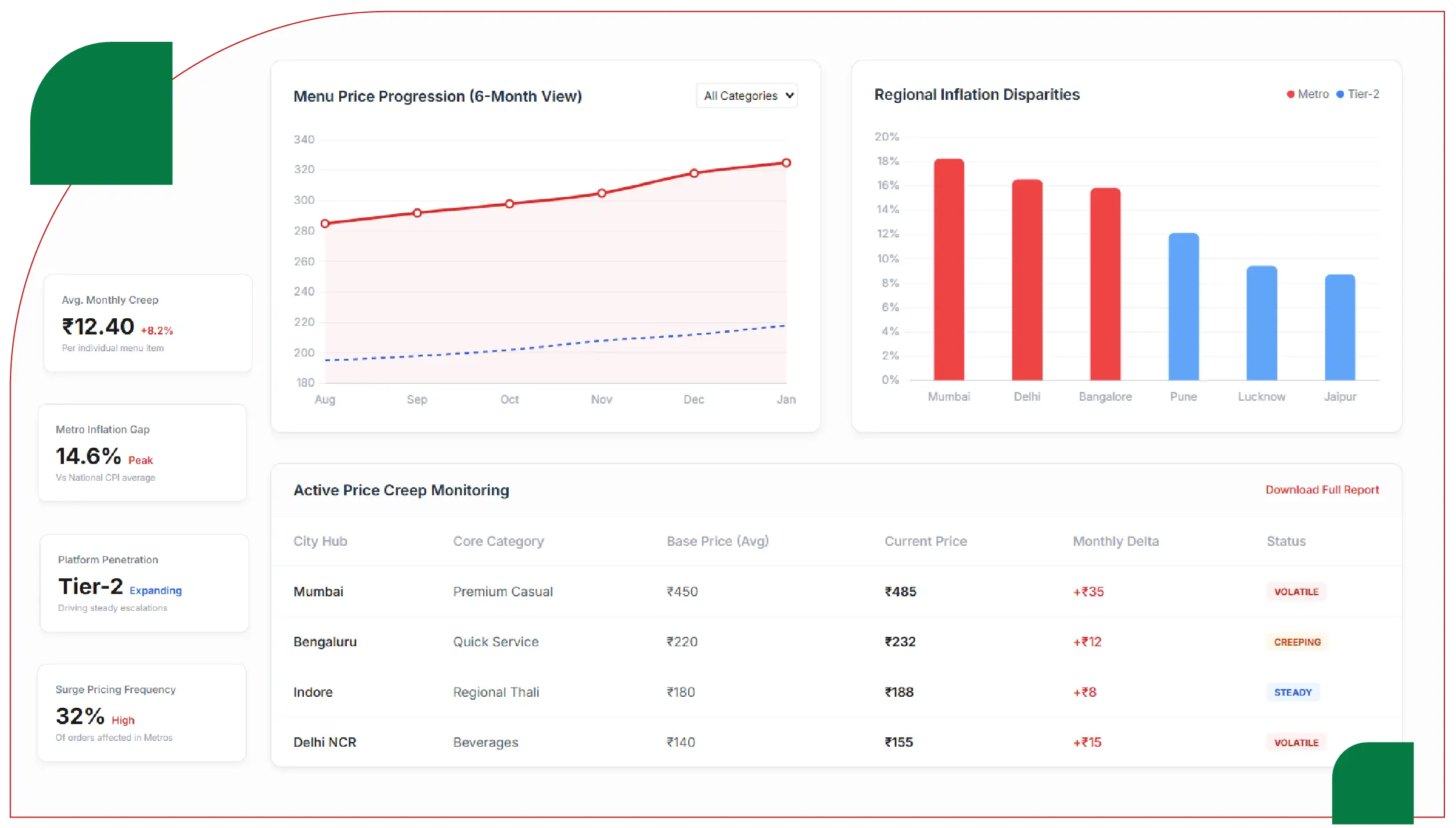
Unlike traditional food inflation indices, menu prices on food delivery apps change frequently and quietly. Small increases of ₹5–₹15 per item compound over time and significantly affect household food budgets. Using Zomato Monthly Menu Price Analytics in Indian Cities, analysts can detect persistent price creep even when base menu prices appear stable to consumers.
Consistent India City Restaurant Price Monitoring from Zomato also highlights regional disparities, where metro cities experience faster inflation due to surge pricing and higher delivery demand, while Tier-2 cities show slower but steady price escalation driven by platform penetration.
The index is constructed using standardized food baskets per cuisine category, normalized to exclude temporary discounts and promotional campaigns.
| City | Jan 2025 | Apr 2025 | Jul 2025 | Oct 2025 | Annual Inflation |
|---|---|---|---|---|---|
| Bengaluru | 100 | 104.2 | 108.1 | 112.5 | 12.5% |
| Mumbai | 100 | 103.6 | 107.4 | 110.8 | 10.8% |
| Delhi NCR | 100 | 102.9 | 106.2 | 109.6 | 9.6% |
| Hyderabad | 100 | 105.1 | 109.3 | 114.2 | 14.2% |
| Chennai | 100 | 103.8 | 107.0 | 111.1 | 11.1% |
These insights are visualized through a Zomato Menu Inflation Tracking Dashboard, which allows stakeholders to monitor inflation acceleration, city-specific volatility, and cuisine-wise price sensitivity in near real time.
By continuously updating the index, enterprises can Extract Monthly Zomato Menu Price Index in Indian Cities and correlate food inflation with consumer demand shifts, order frequency, and average order value trends.
One of the least visible drivers of inflation is combo pricing manipulation. Restaurants often retain individual item prices while altering combo composition, portion size, or mandatory add-ons. This behavior becomes evident when analyzing a comprehensive Food Delivery Dataset from Zomato, which includes item prices, combo mappings, surge charges, packaging fees, and delivery costs.
| City | Avg Combo Price Increase | Avg Surge Fee | Peak-Hour Frequency |
|---|---|---|---|
| Bengaluru | 9.8% | ₹35 | High |
| Mumbai | 8.5% | ₹40 | Very High |
| Delhi NCR | 7.2% | ₹30 | Medium |
| Hyderabad | 11.4% | ₹28 | High |
| Pune | 6.9% | ₹25 | Medium |
These datasets are collected efficiently using a scalable Zomato Food Delivery Scraping API, which supports automated scheduling, historical backfilling, and high-frequency data refresh without manual intervention.
For enterprises requiring enterprise-grade reliability, Zomato Food Delivery App Data Scraping Services ensure data continuity despite frequent changes in app structure, pricing logic, and promotional layouts.
Organizations across industries increasingly rely on Food Delivery Data Scraping Services to benchmark pricing competitiveness, monitor commission impacts, and identify cities where affordability risks could reduce order volumes.
At the restaurant level, Restaurant Menu Data Scraping allows brands to compare their pricing against competitors, detect overpricing risks, and optimize menu engineering strategies to maintain margins without losing demand.
These insights are operationalized through Food Delivery Scraping API Services, enabling seamless integration with BI tools, pricing engines, and inflation monitoring systems.
From an investment and consulting perspective, Restaurant Data Intelligence Services transform raw menu data into actionable indicators for city expansion, demand forecasting, and outlet profitability analysis.
| Cuisine Type | Average Price Increase |
|---|---|
| Biryani | 14.6% |
| Pizza | 11.2% |
| North Indian | 9.8% |
| South Indian | 8.4% |
| Fast Food | 10.9% |
Cuisine analysis shows that high-demand, delivery-friendly foods inflate faster due to peak-hour dependency and surge pricing exposure.
Tracking food inflation through delivery platforms has become essential in India’s app-driven consumption landscape. When powered by Food delivery Intelligence services, Zomato menu pricing data delivers real-time visibility into consumer affordability, restaurant cost pressures, and city-level inflation dynamics. Integrated into a centralized Food Price Dashboard, these insights empower stakeholders to respond proactively rather than reactively. Over time, structured Food Delivery Datasets become a foundational asset for understanding India’s evolving urban food economy.
If you are seeking for a reliable data scraping services, Food Data Scrape is at your service. We hold prominence in Food Data Aggregator and Mobile Restaurant App Scraping with impeccable data analysis for strategic decision-making.