The Client
The client is a rapidly growing food-tech analytics enterprise specializing in large-scale pricing intelligence solutions for the quick service restaurant industry. Their core focus is on enabling data-driven decision-making for restaurant chains operating across multiple digital ordering platforms and physical store networks.
With a strong emphasis on operational efficiency and market responsiveness, the client leverages advanced data systems to enhance QSR Restaurant Pricing Intelligence across thousands of outlets globally. Their objective is to gain a unified view of pricing behavior and competitive movements in real time.
They actively utilize advanced analytics frameworks to Extract QSR Pricing Strategy Insights, helping leadership teams understand promotional impacts, regional price differences, and competitor positioning strategies.
In addition, the organization performs Restaurant SKU-level pricing Analysis, enabling granular visibility into individual menu item performance, margin optimization, and pricing elasticity. This has significantly improved their ability to refine pricing models, strengthen competitiveness, and scale intelligent pricing strategies across diverse markets.
Key Challenges
- Lack of Real-Time Pricing Visibility
The client struggled with inconsistent and delayed visibility into competitor pricing across multiple QSR platforms, making it difficult to respond quickly to market changes. This led to gaps in decision-making and reduced pricing agility in highly competitive restaurant markets. real-time restaurant menu tracking API was required to unify live pricing updates across fragmented ordering systems for better responsiveness. - Fragmented Data Sources and Inconsistency
One of the major challenges was aggregating structured data from multiple food delivery apps, each with different formats, update cycles, and menu structures. This caused significant complexity in maintaining standardized datasets for analysis and benchmarking purposes across regions.
Web Scraping Food Delivery Data was essential to consolidate and normalize disparate data streams into a unified analytical framework. - Difficulty in SKU-Level Competitive Tracking
The client faced limitations in tracking individual menu item performance across competitors, as SKU-level pricing and variations were not consistently accessible or structured. This impacted granular pricing strategy development and margin optimization efforts. Extract Restaurant Menu Data helped enable detailed item-level visibility, supporting precise benchmarking and stronger competitive intelligence at scale.
Key Solutions
- Scalable Multi-Source Integration Architecture
We designed a high-performance integration framework capable of connecting multiple food delivery platforms simultaneously, ensuring uninterrupted data flow and harmonized outputs for downstream analytics and benchmarking use cases across QSR networks. Food Delivery Scraping API was implemented to automate structured extraction of menu, pricing, and promotional data across heterogeneous platforms in real time. - Enterprise-Grade Intelligence Transformation Layer
A robust transformation engine was developed to convert raw, inconsistent menu feeds into standardized datasets enriched with pricing context, competitive signals, and structured business attributes for strategic evaluation. Restaurant Data Intelligence enabled deep analytical modeling to identify pricing patterns, competitor positioning, and demand-sensitive menu behaviors across regions. - Continuous Market Surveillance System
We established an always-on monitoring ecosystem that tracks competitor menu updates, pricing fluctuations, and SKU-level changes across thousands of QSR outlets with high frequency and reliability. Food delivery Intelligence ensured uninterrupted visibility into market dynamics, supporting rapid pricing adjustments and competitive benchmarking at scale.
Scraped QSR Data Sample (Structured Values)
| Outlet ID | Restaurant | Item Name | Category | Price (INR) | Discount Price | City | Platform | Offer Type |
|---|---|---|---|---|---|---|---|---|
| QSR001 | Burger King | Whopper | Burger | 249 | 199 | Patna | Swiggy | Combo Deal |
| QSR002 | McDonald’s | McVeggie | Burger | 179 | 149 | Patna | Zomato | Limited Offer |
| QSR003 | KFC | Zinger Burger | Chicken | 229 | 189 | Gaya | Swiggy | Festive Offer |
| QSR004 | Domino’s | Margherita Pizza | Pizza | 299 | 249 | Patna | Direct | Flat Discount |
| QSR005 | Subway | Veg Sandwich | Sandwich | 160 | 135 | Muzaffarpur | Zomato | Promo Code |
| QSR006 | Pizza Hut | Peppy Paneer | Pizza | 319 | 259 | Gaya | Swiggy | Combo Offer |
| QSR007 | Haldiram’s | Chole Bhature | Indian | 120 | 99 | Patna | Direct | Seasonal Offer |
| QSR008 | Starbucks | Cappuccino | Beverage | 220 | 190 | Patna | Swiggy | App Offer |
| QSR009 | Dominos | Chicken Dominator | Pizza | 399 | 329 | Bhagalpur | Zomato | Discount Deal |
| QSR010 | Burger King | Fries Medium | Sides | 119 | 89 | Patna | Swiggy | - |
Methodologies Used
- Multi-Source Data Aggregation Approach
We implemented a structured multi-source collection system that consolidates information from various digital ordering platforms and restaurant listings. This ensured comprehensive coverage across regions, reduced data gaps, and enabled consistent comparison of menu items, pricing, and promotional variations across thousands of outlets. - Automated Data Extraction Pipeline
A fully automated extraction pipeline was designed to continuously capture restaurant menu, pricing, and outlet-level information at scale. The system minimized manual intervention, improved refresh frequency, and ensured timely availability of updated competitive data for analysis and decision-making purposes. - Data Normalization and Standardization Framework
We applied advanced normalization techniques to clean, structure, and standardize inconsistent data formats received from multiple sources. This included resolving duplicate entries, aligning category structures, and ensuring uniform representation of pricing and menu attributes across all restaurant datasets. - Real-Time Processing and Update Mechanism
A real-time processing framework was established to handle continuous updates from dynamic restaurant environments. This ensured that any changes in pricing, menu items, or availability were instantly captured, processed, and reflected in the centralized dataset for accurate analysis. - Scalable Analytics and Validation Layer
We developed a scalable validation system to verify data accuracy and integrity before it entered the analytics layer. This included rule-based checks, anomaly detection, and structured validation workflows to ensure reliable insights for large-scale restaurant performance evaluation.
Advantages of Collecting Data Using Food Data Scrape
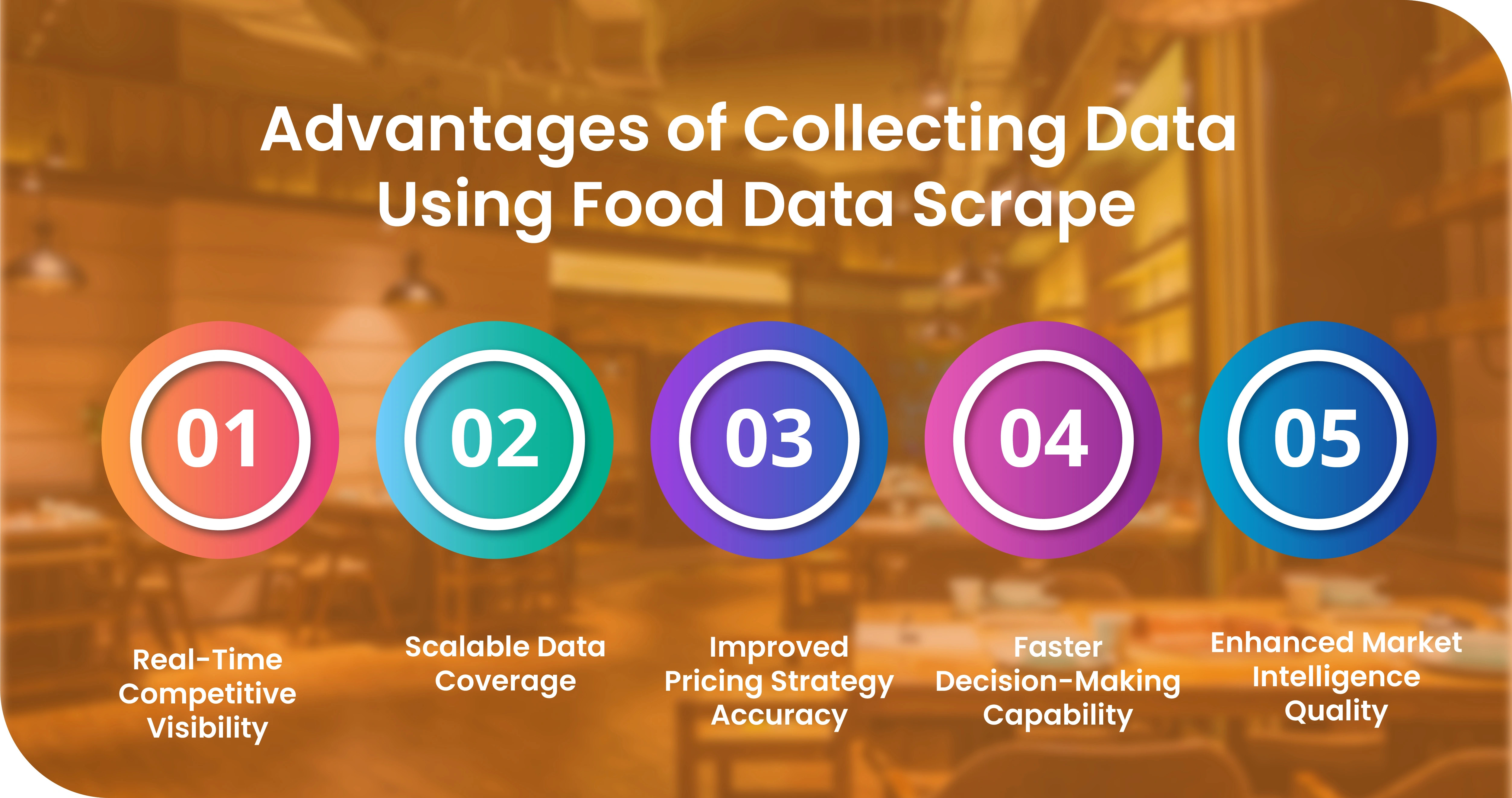
- Real-Time Competitive VisibilityOur solution provides continuous access to updated market information, enabling businesses to monitor competitor pricing, menu changes, and promotional strategies instantly. This improves responsiveness, reduces decision lag, and ensures organizations always operate with the most current market intelligence available.
- Scalable Data CoverageThe service supports large-scale extraction across thousands of restaurants and locations, ensuring broad market coverage without manual effort. This scalability allows enterprises to expand analytics capabilities effortlessly while maintaining consistent data quality across diverse geographies and competitive environments.
- Improved Pricing Strategy AccuracyAccess to structured and granular data enables organizations to refine pricing decisions with higher precision. Businesses can identify underpriced or overpriced items, optimize margins, and adjust strategies based on real-world competitor behavior and regional demand variations effectively.
- Faster Decision-Making CapabilityAutomated data delivery reduces dependency on manual research, significantly accelerating analysis cycles. Decision-makers gain instant access to structured insights, allowing faster strategic actions in dynamic markets where timely responses directly impact revenue performance and competitive positioning outcomes.
- Enhanced Market Intelligence QualityHigh-quality structured datasets improve the depth and reliability of business intelligence systems. Organizations gain clearer visibility into market trends, consumer behavior, and competitor movements, enabling stronger forecasting, better planning, and more informed long-term strategic decisions across business units.
Client’s Testimonial
We partnered to enhance our pricing intelligence capabilities across multiple regions and restaurant networks, and the results have been highly impactful. The structured and consistent data provided has significantly improved our ability to track competitor pricing, menu changes, and market trends in real time. It has reduced manual effort, improved accuracy, and enabled faster strategic decision-making across our organization. The scalability of the solution has allowed us to expand our analysis across thousands of outlets with confidence. Overall, this engagement has strengthened our pricing strategy and delivered measurable improvements in operational efficiency and competitive responsiveness.
— Head of Pricing Strategy
Final Outcome
The final outcome of the project was a fully operational, scalable intelligence system that significantly improved visibility into restaurant pricing, menu dynamics, and competitor strategies across thousands of locations. The client achieved faster decision-making, higher pricing accuracy, and improved market responsiveness through structured and continuously updated insights. The solution enabled seamless tracking of regional variations and promotional trends, strengthening overall business strategy and operational efficiency.
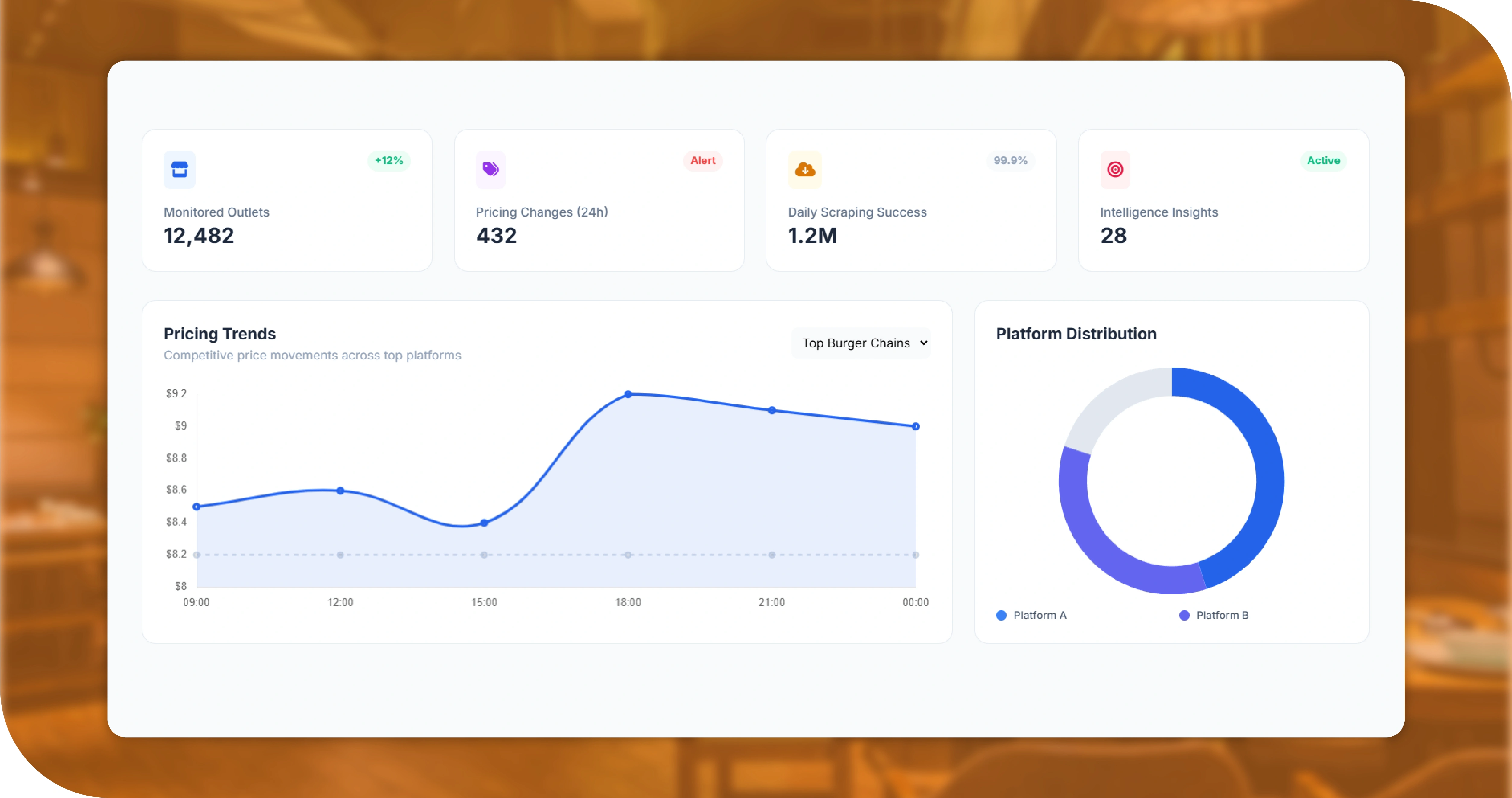
The deployment of Food Price Dashboard provided a centralized view of key pricing metrics, enabling real-time monitoring and executive-level reporting for strategic decisions.
Additionally, enriched Food Datasets empowered advanced analytics, allowing the client to identify pricing gaps, optimize margins, and enhance competitive positioning across diverse markets with confidence and precision.