
The Texas food service industry is one of the largest and most competitive in the United States, featuring a mix of national chains and influential regional brands. This research report provides a comprehensive analysis of the top food chains across Texas, focusing on store locations, menu offerings, pricing strategies, and SKU-level insights. By leveraging advanced data scraping techniques, the study captures detailed operational, competitive, and consumer intelligence, enabling businesses to monitor expansion trends, assess market penetration, and optimize decision-making. Analysts, retailers, and delivery platforms can use these datasets to gain actionable insights, support strategic planning, and enhance operational efficiency. The report also emphasizes the value of Food Delivery Data Scraping Services in maintaining real-time, accurate, and structured datasets for analytics, dashboards, and forecasting models.
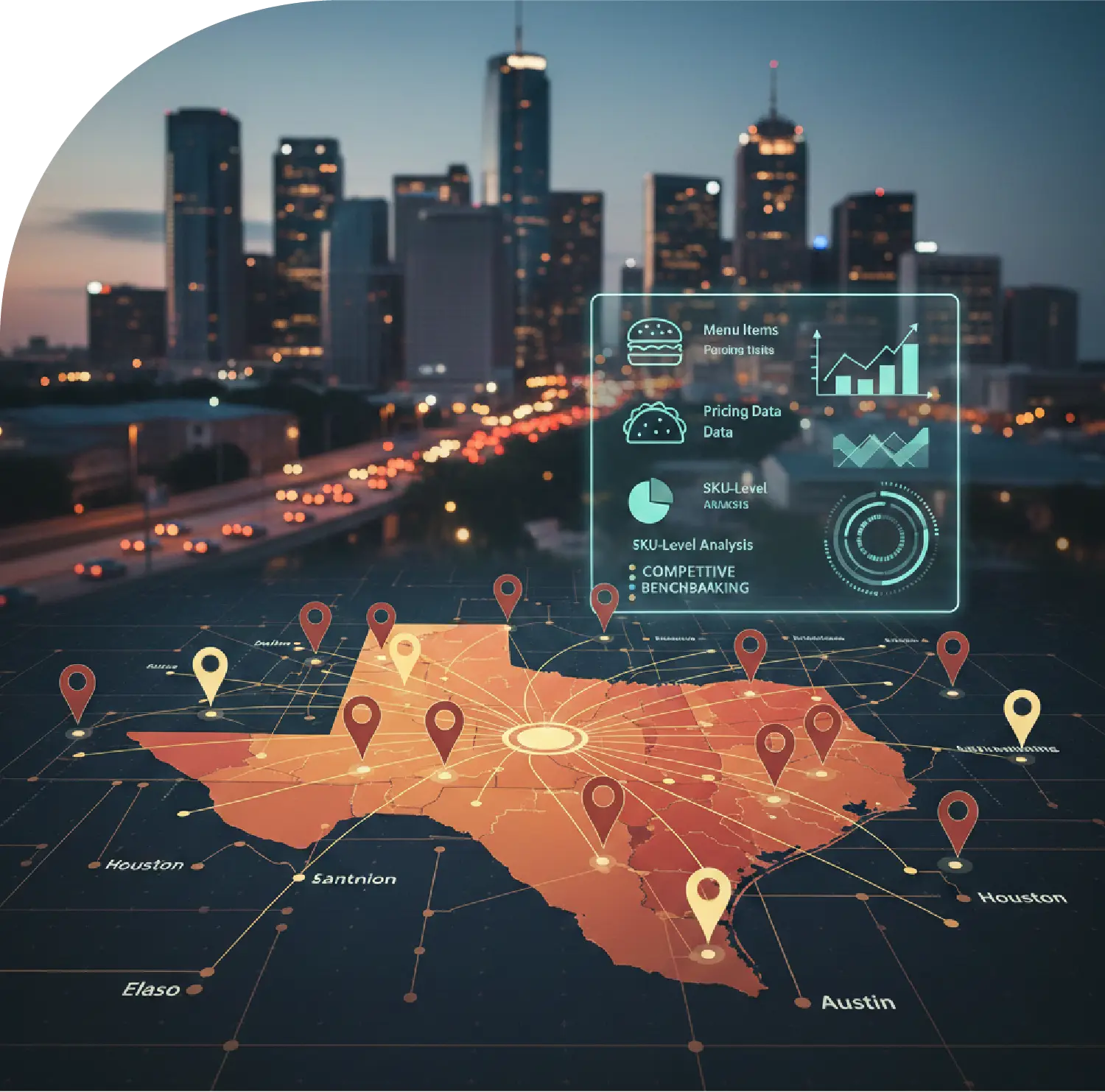
Extensive Market Coverage Covers over 1,500 locations of top food chains across major Texas cities.
Menu and Pricing Insights Provides detailed menu items, pricing data, and SKU-level analysis for competitive benchmarking.
Location Intelligence Geocoded data supports store placement optimization, delivery planning, and accessibility studies.
Competitive Analysis Tracks national and regional chains to assess market penetration and growth patterns.
Analytics-Ready Datasets Structured data can feed dashboards, machine learning models, and strategic decision-making processes.

The dining and quick-service restaurant landscape in Texas is one of the most competitive and data-rich markets in the United States. Rapid brand expansion, high consumer demand, and strong regional preferences make Texas a critical hub for food industry analytics and intelligence.
This report on Scrape Top Food Chains in Texas USA delivers a detailed examination of the most dominant and widely distributed food chain brands across the Lone Star State, covering national leaders and influential regional players. Through a strong focus on store location density, menu availability, pricing signals, and operational scale, this study is built to support analysts, data teams, and market researchers. By leveraging Texas USA Top Food Chains Data Scraping, organizations can monitor brand growth, regional penetration, and competitive positioning. Additionally, Texas Top Fast Food Chain Listings Data Extraction enables scalable analytics, reliable benchmarking, and informed strategic decision-making across the evolving food service ecosystem.
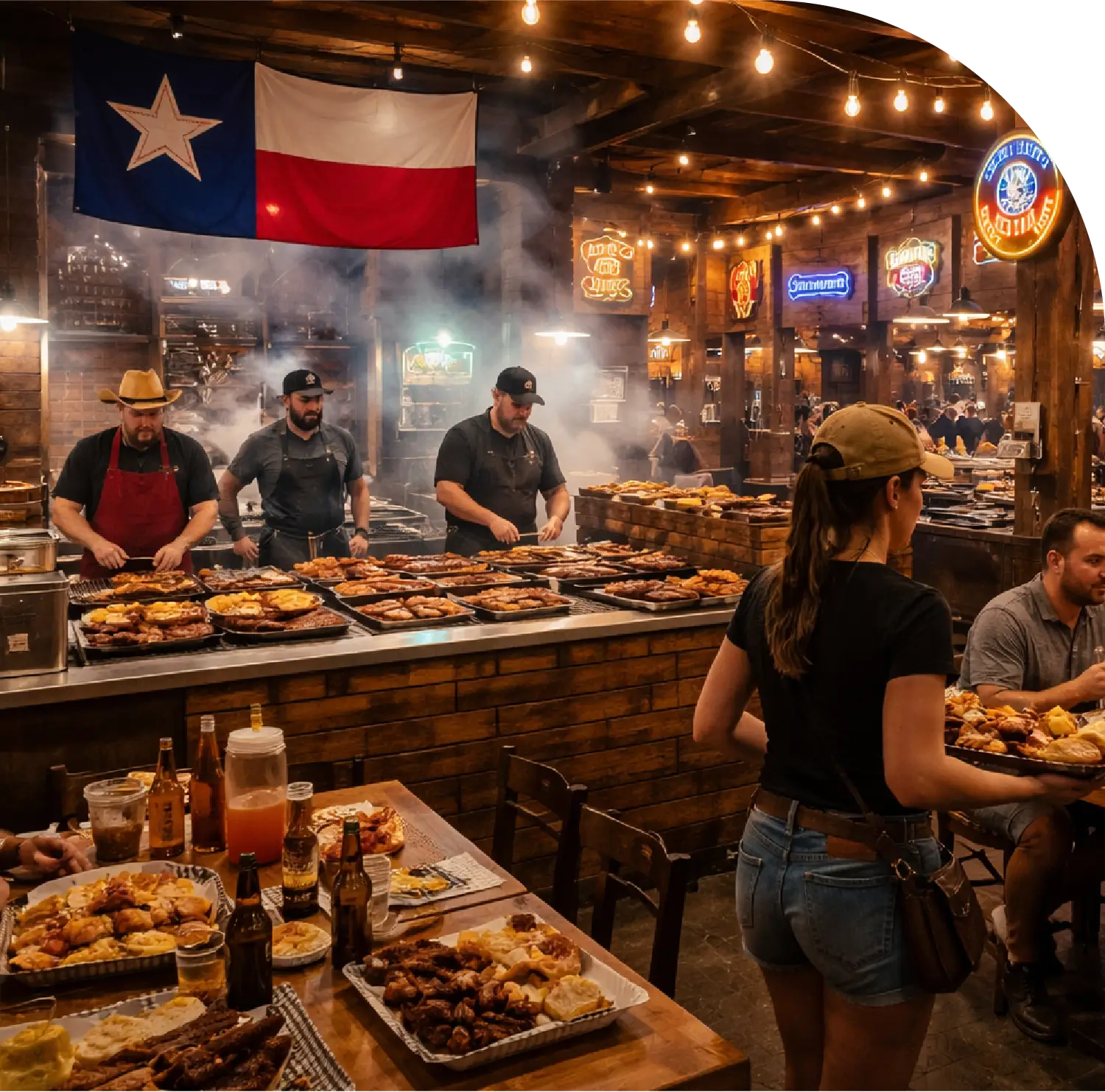
Texas’ food scene blends national powerhouses with beloved regional specialties. Many national brands have a strong foothold in the state, while Texas-origin chains remain culturally iconic. Data scraping initiatives often target these food establishments to build comprehensive location, menu, pricing, and consumer datasets for analytics or intelligence services.
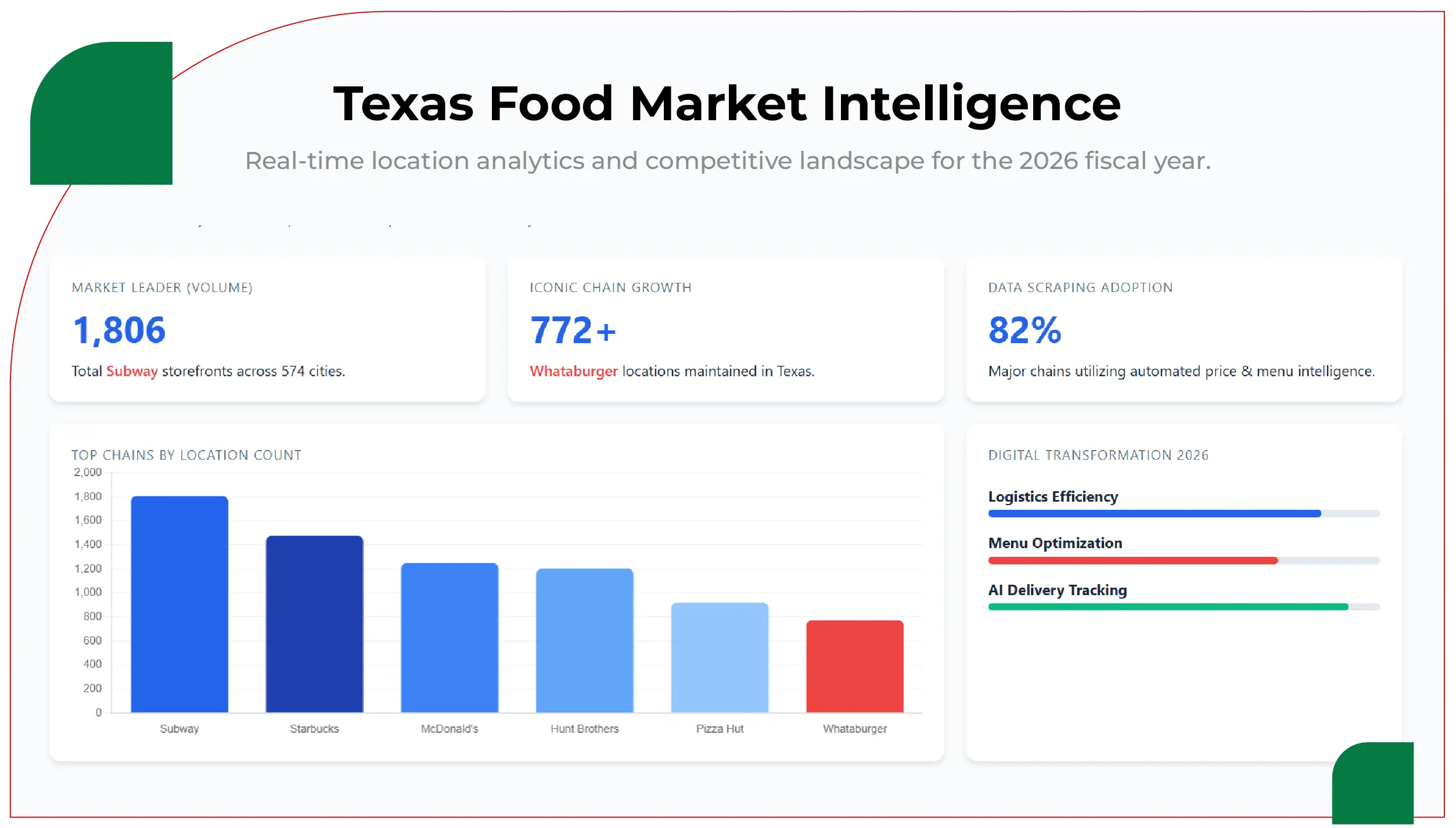
According to the latest location-based research, Subway, Starbucks, and McDonald’s are among the most widespread chains in Texas. These data points highlight both consumer demand and competitive intensity.
The table below showcases the largest food chains in Texas by the number of store locations — which is one of the most common metrics used in commercial scraping and restaurant dataset modeling.
| Rank | Food Chain | Locations in Texas |
|---|---|---|
| 1 | Subway | 1,806 |
| 2 | Starbucks | 1,474 |
| 3 | McDonald's | 1,248 |
| 4 | Hunt Brothers Pizza | 1,201 |
| 5 | Pizza Hut | 918 |
| 6 | Whataburger | 772 |
| 7 | Domino's Pizza | 765 |
| 8 | Taco Bell | 726 |
| 9 | Burger King | 562 |
| 10 | Jack in the Box | 548 |
The above dataset emphasizes chains that dominate both urban and suburban regions — and form the backbone of most restaurant POI (Point of Interest) datasets scraped for analytics.
In addition to large national brands, Texas is home to regional chains that are important for Top Food Chain Menu Scraping in Texas USA and localized consumer trend research.
| Chain | Headquarters (TX) | Type | Approx. Locations |
|---|---|---|---|
| Bush’s Chicken | Waco, Texas | Fast Food | ~75 |
| Taco Bueno | Farmers Branch, Texas | Tex-Mex Fast Food | ~133 |
| Rosa’s Cafe | Fort Worth, Texas | Tex-Mex Fast Casual | ~47 |
| Mooyah | Plano, Texas | Fast Casual | ~100 |
| Taco Palenque | Laredo, Texas | Mexican Cuisine | ~42 |
These chains may not eclipse national brands in sheer location count, but they are important when scraping Texas Top Food Chain Pricing & SKU Data and regional menu specialties.
Data scraping initiatives targeting top food chains in Texas fuel many business processes:
Organizations often tap into Texas Top Food Chain Location Data Scraping to extract structured POI data for use in dashboards and BI tools.
Note: Pricing is estimated and representative; actual scraped values will vary based on location and date.
| Chain | Menu Item | Estimated Price | Category |
|---|---|---|---|
| McDonald’s | Big Mac | $5.99 | Burger |
| Starbucks | Caffe Latte (Grande) | $4.65 | Beverage |
| Whataburger | Whataburger | $7.49 | Burger |
| Taco Bell | Crunchwrap Supreme | $6.49 | Tex-Mex |
| Domino’s Pizza | Large Pepperoni Pizza | $12.99 | Pizza |
When scraping food chain data:
Adhering to ethical practices ensures quality datasets that support Restaurant Data Intelligence Services and strategic decision-making without infringing on provider policies.
Retail analytics firms increasingly rely on structured food chain data to understand evolving consumer dining behaviors, preference shifts, and brand performance across competitive markets. Delivery platforms use scraped menu structures and pricing intelligence to refine logistics planning, improve delivery time predictions, and optimize route efficiency. At the same time, accurate menu-level data supports demand forecasting and dynamic pricing strategies. Urban planners and policy researchers also benefit from location-based extraction, using restaurant presence and coverage data to evaluate food accessibility, identify underserved communities, and analyze commercial density patterns. By applying Scrape Texas Food Chain Menu & Pricing Insights, stakeholders across industries transform raw restaurant data into practical insights that support planning, optimization, and long-term decision-making.
This research underscores the importance of structured extraction of restaurant location, menu, and pricing data. With major chains like Subway, Starbucks, McDonald’s, and Whataburger dominating the landscape, robust data scraping pipelines enable up-to-date datasets essential for competitive insights and operational analytics. By leveraging Food Delivery Data Scraping Services, stakeholders can build powerful platforms that support real-time market decisions and enrich consumer intelligence frameworks.
In the era of big data, combining structured scraping with advanced analytics transforms raw restaurant information into actionable business intelligence. This approach enables organizations to power interactive pricing and trend dashboards such as Food Price Dashboard for real-time monitoring. It also strengthens operational decision-making by enhancing Food delivery Intelligence services across competitive and regional markets. Moreover, structured and validated data pipelines help build scalable Food Delivery Datasets that support machine learning models, demand forecasting, and long-term strategic planning.
If you are seeking for a reliable data scraping services, Food Data Scrape is at your service. We hold prominence in Food Data Aggregator and Mobile Restaurant App Scraping with impeccable data analysis for strategic decision-making.