Introduction
The global grocery retail market is undergoing a massive transformation driven by digital commerce, dynamic pricing, and hyper-competitive supply chains. Supermarkets like Walmart, Kroger, Costco, and Aldi continuously adjust product prices based on demand, inventory levels, competitor behavior, and regional market conditions.
For businesses, analysts, and data platforms, manually tracking these fluctuations is no longer viable. The only scalable solution is automated, continuous data extraction from retail platforms that can capture pricing at high frequency and transform it into structured intelligence.
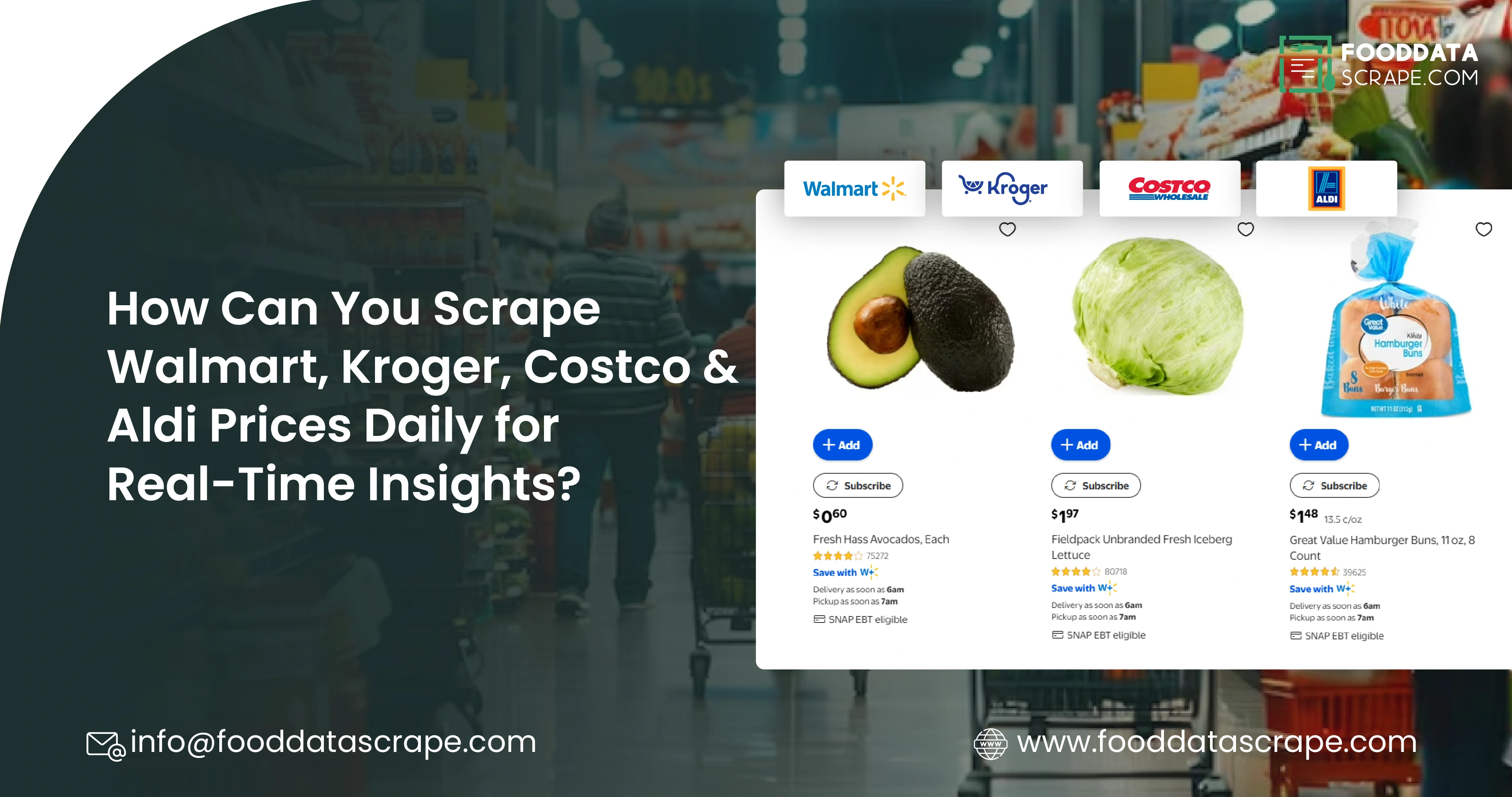
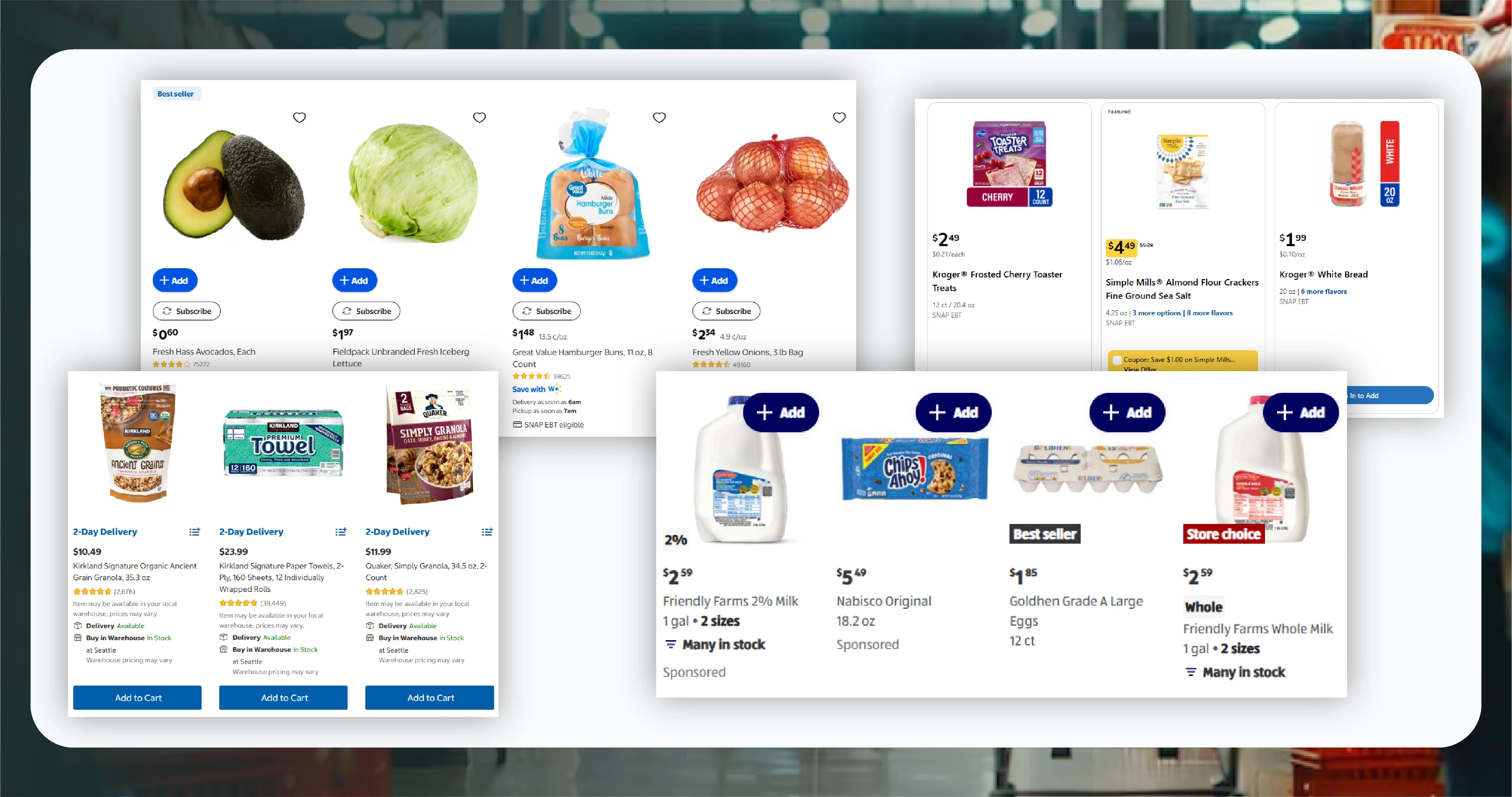
A structured approach to Scrape Walmart, Kroger, Costco & Aldi Prices Daily enables organizations to continuously observe price movements across major grocery ecosystems. Alongside this, Price Monitoring Data Scraping from Walmart, Kroger, Costco & Aldi helps standardize multi-retailer price tracking into a unified system. Additionally, Supermarket Price Scraping for Competitive Analysis allows companies to compare pricing strategies across retailers and identify market positioning gaps.
Why grocery pricing changes so frequently?
Unlike many other retail sectors, grocery pricing is extremely sensitive to multiple real-world factors. Prices can change due to:
- Seasonal demand shifts (festivals, holidays, weekends)
- Supplier cost fluctuations (fuel, logistics, agriculture output)
- Promotional campaigns and discounts
- Inventory pressure (overstock or low stock situations)
- Regional competition between supermarkets
For example, the same product like milk, rice, or cooking oil may have different prices in different cities or even different store clusters within the same region. This level of complexity makes automated tracking essential.
Building a structured data collection pipeline
Modern retail intelligence systems rely on structured pipelines that extract, clean, normalize, and store grocery data in real time. These systems typically work in layered architecture:
- Data extraction layer : collects product listings, prices, discounts, and availability
- Processing layer : cleans inconsistent formats and standardizes units
- Storage layer : stores historical and real-time snapshots
- Analytics layer : generates insights, trends, and forecasts
- Visualization layer : dashboards and reports for decision-makers
Using method to Extract Daily Price Data from Walmart, Kroger, Costco & Aldi, businesses can unify multiple retailer datasets into one structured system for easier comparison and analytics.
Walmart pricing intelligence and market signals
Walmart plays a dominant role in global grocery pricing due to its scale and aggressive low-price strategy. Its pricing data is often used as a benchmark for competitive pricing analysis.
A structured dataset like Walmart Daily Grocery Delivery Dataset provides deep insights into product-level price trends, category-level performance, and promotional cycles. Analysts can track how frequently prices change across essential goods like dairy, snacks, and packaged foods.
For real-time automation, Walmart Daily Grocery Delivery Scraping API allows continuous extraction of Walmart grocery data directly into analytics systems. This enables businesses to build live dashboards and dynamic pricing engines that respond instantly to market changes.
Kroger’s localized pricing ecosystem
Kroger operates with a strong regional pricing model, meaning prices can vary significantly across different states and store networks. This makes it an extremely valuable data source for localized retail intelligence.
With Kroger Daily Grocery Delivery Scraping API, businesses can extract live pricing, promotional offers, and category-level changes in real time. This helps in understanding regional consumer behavior and demand elasticity.
For example, Kroger may run localized discounts on dairy in one region while offering snack promotions in another, based on inventory and demand signals. Capturing this variation is critical for granular competitive analysis.
Costco’s wholesale pricing structure insights
Costco is fundamentally different from traditional supermarkets because it operates on a membership-based wholesale model. Instead of frequent discounts, it focuses on bulk pricing and value-based offerings.
Through Costco Daily Grocery Delivery Scraping API, analysts can capture bulk pack pricing, unit economics, and membership-driven discounts. This data is essential for comparing wholesale pricing structures against retail competitors.
It also helps procurement teams evaluate cost-per-unit efficiency, especially for bulk buyers, institutional procurement, and supply chain planners.
Aldi’s efficiency-driven pricing model
Aldi is known for its ultra-efficient retail model that focuses on private-label products, minimal store overhead, and highly optimized pricing strategies.
The ALDI Daily Grocery Store Dataset provides structured visibility into its pricing patterns, helping analysts understand how cost efficiency translates into lower consumer prices. Aldi often maintains a limited product assortment but ensures strong price competitiveness.
With Aldi Daily Grocery Delivery Scraping API, organizations can continuously track pricing changes and identify how Aldi maintains consistency in its low-cost retail strategy.
Role of automation in grocery data extraction
Manual tracking of thousands of grocery SKUs across multiple platforms is impossible. Automation solves this by enabling continuous data flow from retail websites into centralized systems.
A Grocery Delivery Extraction API plays a critical role in this process by providing real-time structured data feeds that integrate directly into BI tools, pricing engines, and AI systems.
Similarly, Web Scraping Grocery Data forms the foundation of these systems by enabling extraction of unstructured retail data and converting it into usable formats.
Automation ensures:
- 24/7 data collection without manual intervention
- High-frequency updates (hourly or daily snapshots)
- Scalable monitoring across multiple retailers
- Consistent data formatting across sources
Transforming data into actionable intelligence systems
Once data is collected, it must be converted into meaningful insights. This is where analytics layers become critical.
A Grocery Price Dashboard allows businesses to visualize:
- Price fluctuations over time
- Competitor price comparisons
- Category-level performance trends
- Discount frequency and intensity
- Regional pricing differences
Advanced dashboards also include alert systems that notify users when competitors change prices significantly. This enables real-time decision-making instead of delayed responses.
Advanced use cases across industries
Grocery pricing intelligence is not limited to supermarkets. It is widely used across industries:
- Retail and eCommerce
Retailers use pricing data to implement dynamic pricing models and stay competitive. - FMCG and CPG brands
Brands analyze competitor pricing to optimize promotions and shelf positioning. - Market intelligence firms
They build industry reports and trend forecasts using aggregated datasets. - Investment and financial analysis
Investors track pricing efficiency and consumer demand patterns in retail companies. - Supply chain optimization teams
They use pricing trends to forecast demand and manage inventory more efficiently.
Technical challenges in large-scale scraping systems
Building a robust grocery data scraping system requires solving several technical challenges:
- Frequent website structure changes requiring adaptive scraping logic
- Anti-bot detection mechanisms and CAPTCHAs
- Large-scale product catalog complexity
- Inconsistent product naming conventions
- Regional pricing differences and duplicate listings
- Data latency issues in real-time systems
To overcome these, modern systems use AI-based parsers, proxy rotation, headless browsing, and machine learning-based data validation techniques.
Future of grocery price intelligence systems
The future of grocery analytics is shifting from descriptive to predictive intelligence. Instead of just tracking prices, systems will increasingly forecast future pricing behavior.
Emerging capabilities include:
- AI-based price forecasting models
- Automated competitor pricing adjustments
- Hyperlocal demand prediction
- Real-time pricing optimization engines
- Self-learning retail intelligence systems
In the coming years, grocery retailers will increasingly depend on automated intelligence systems rather than manual pricing decisions.
How Food Data Scrape Can Help You?
- Faster decision-making for retail teams
Our data scraping services deliver daily updated grocery pricing insights from Walmart, Kroger, Costco, and Aldi, enabling retail teams to react quickly, optimize pricing decisions, and stay ahead in highly competitive markets. - Comprehensive product-level visibility
We capture detailed product information including SKU pricing, discounts, pack sizes, and availability across major supermarkets, giving businesses complete visibility into category performance and competitor product positioning strategies at scale. - Improved demand and trend forecasting
By analyzing continuously scraped grocery datasets, companies can identify demand shifts, seasonal buying patterns, and price elasticity trends, helping them forecast future demand more accurately and plan inventory efficiently. - Stronger promotional effectiveness analysis
Our services help track competitor promotions and discount strategies across retail platforms, allowing brands to measure campaign effectiveness, optimize promotional timing, and improve ROI on marketing and pricing strategies consistently. - Seamless enterprise data integration
We provide structured, API-ready grocery datasets that integrate easily with BI tools, dashboards, and analytics platforms, ensuring smooth data flow for automation, reporting, and advanced retail intelligence systems.
Conclusion
Daily grocery price scraping from major retailers like Walmart, Kroger, Costco, and Aldi is becoming a core capability for modern retail intelligence systems. It enables organizations to move beyond static reporting and into real-time decision-making.
With the right combination of automation, structured APIs, and analytics systems, businesses can transform raw retail data into actionable insights that improve pricing strategy, competitiveness, and operational efficiency.
By integrating systems such as Grocery Price Tracking Dashboard, companies gain continuous visibility into market movements, while Grocery Data Intelligence enables deeper strategic insights. Over time, access to reliable Grocery Datasets empowers organizations to build predictive models, optimize pricing, and lead in highly competitive grocery markets.
Are you in need of high-class scraping services? Food Data Scrape should be your first point of call. We are undoubtedly the best in Food Data Aggregator and Mobile Grocery App Scraping service and we render impeccable data insights and analytics for strategic decision-making. With a legacy of excellence as our backbone, we help companies become data-driven, fueling their development. Please take advantage of our tailored solutions that will add value to your business. Contact us today to unlock the value of your data.