Introduction: Why Drizly and Total Wine Matter for Pricing Intelligence
When it comes to understanding the American alcohol e-commerce landscape in 2026, two names stand above the rest: Drizly and Total Wine & More. Both platforms have become essential reference points for brands, distributors, retailers, and analysts trying to understand how wine, beer, and spirits move at the digital shelf. They serve overlapping but meaningfully different audiences, operate on different commercial models, and price products in noticeably different ways.
For any team running pricing intelligence, competitor benchmarking, or market entry strategy, comparing data from these two platforms side by side is no longer optional — it is foundational. That is exactly where Food Data Scrape delivers. Our platform extracts, normalizes, and harmonizes product, pricing, and availability data from both Drizly and Total Wine across the United States, giving you a single, decision-ready dataset to power smarter strategy.
This comparison guide explains why scraping both platforms matters, what makes each one unique, the methodology behind clean cross-platform data, and how to read the resulting insights. You will also see real sample records illustrating how a Drizly listing stacks up against a Total Wine listing for the same product.
Drizly and Total Wine: Two Different Worlds Under One Category
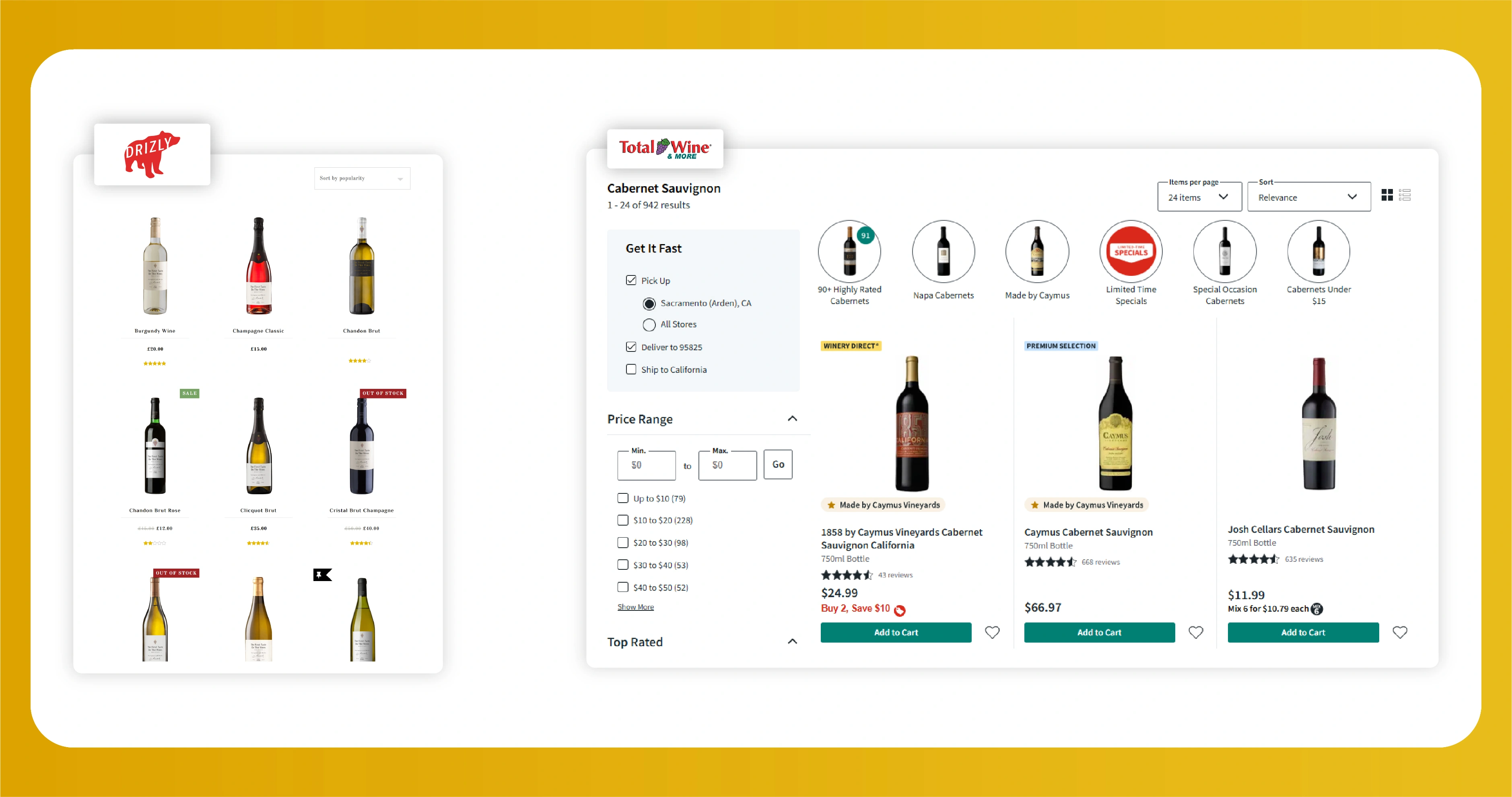
To understand why Drizly vs Total Wine comparison data is so valuable, you first need to appreciate how differently the two platforms operate.
Drizly is an on-demand alcohol delivery marketplace. It does not own inventory directly; instead, it partners with thousands of local liquor stores across the United States, surfacing their catalogs to consumers who want delivery in under an hour. This means Drizly pricing is fundamentally hyperlocal — the price of a bottle of Casamigos Reposado in one ZIP code may differ meaningfully from the same SKU just a few miles away because each price reflects a different partner store's pricing strategy.
Total Wine & More is a national retailer with both a powerful e-commerce engine and a network of large physical superstores. Total Wine controls its own pricing, runs aggressive promotional cycles, leverages exclusive labels, and applies regional pricing variation tied to state regulations. Its catalog depth — particularly in wine and craft spirits — is among the largest in the US.
The result is two platforms that sometimes carry the same SKU at materially different prices, with very different promotional rhythms, very different stock dynamics, and very different consumer experiences. Liquor retailer data scraping that captures only one of them tells half the story.
Why Compare Pricing Across Drizly and Total Wine
A robust alcohol pricing comparison strategy that includes both platforms unlocks insights that single-source data cannot.
Channel pricing benchmarks. Brand owners can verify whether Total Wine is pricing aggressively against on-demand competitors, or whether Drizly partner stores are quietly undercutting MSRP in certain neighborhoods
Promotional cadence detection. Total Wine runs structured weekly and monthly promotions; Drizly partner stores promote on their own schedules. Tracking both side by side reveals which platforms drive volume through price and which rely on convenience.
Distribution gap analysis. A SKU available on Total Wine but not on Drizly partner stores in a given metro suggests distribution gaps the brand can address. The reverse is also informative.
Consumer price perception. Even if a product costs the same, presentation and bundling differ. Comparing list prices, unit prices, and any volume discounts across both platforms illuminates how consumers perceive value
Forecasting and elasticity. Statistically meaningful price-elasticity studies require multiple price points across time and geography. Pulling from both Drizly and Total Wine roughly doubles the observable variation, sharpening any model built on top.
How Food Data Scrape Captures Drizly and Total Wine Data
Food Data Scrape operates a purpose-built infrastructure for beverage retailer scraping that ingests both Drizly and Total Wine catalogs daily and delivers harmonized datasets ready for direct analysis. Scraping Liquor Data from Drizly and Total Wine USA at scale requires more than a basic crawler — it demands country-wide coverage, channel-aware parsing, and rigorous quality controls applied consistently every day.
Drizly extraction. We capture partner-store-level listings across all major US metros where Drizly operates. Each listing is tagged with the partner store name, ZIP code, and the price as displayed to consumers in that location. Stock status is captured as visible to consumers, and delivery estimates are recorded where present.
Total Wine extraction. We capture full Total Wine product pages across every state where Total Wine operates online, applying state-level segmentation because Total Wine pricing legally varies by state. We extract list price, member price, promotional flags, in-store availability, ship-to-home availability, and curbside pickup status.
Schema harmonization. Drizly and Total Wine use different category taxonomies, different SKU naming conventions, and different size formats. Our harmonization layer maps these into a unified schema so the same bottle of Buffalo Trace is identifiable as a single product across both platforms — even when one calls it "Buffalo Trace Bourbon 750ML" and the other calls it "Buffalo Trace Kentucky Straight Bourbon 750mL."
Refresh cadence. Top-velocity SKUs refresh daily; long-tail and seasonal SKUs refresh weekly. Promotional changes trigger near-real-time recapture on both platforms.
Quality assurance. Every record passes schema validation, brand-name disambiguation, ABV and volume sanity checks, currency normalization, and outlier detection before reaching client systems.
Clients access the data through flexible delivery options: a fully documented alcohol price comparison API with filters for platform, city, brand, category, and date range; scheduled CSV or JSON exports; direct integration into Snowflake or BigQuery; and custom comparison dashboards.
How to Use This Data: Practical Applications
To illustrate what cross-platform Drizly product data and Total Wine pricing intelligence look like together, here are representative records harmonized into a single comparable view.
Sample 1: Same SKU, Two Platforms, Same Day
| Product | City | Drizly Price | Drizly Partner | Total Wine | TW Status | Delta | Date |
|---|---|---|---|---|---|---|---|
| Buffalo Trace Bourbon 750ml | Chicago, IL | $32.99 | The Beverage Store | $29.99 | In Stock | +$3.00 | 2026-04-29 |
| Tito's Vodka 1.75L | Houston, TX | $37.99 | Spec's Liquor Mart | $34.97 | In Stock | +$3.02 | 2026-04-29 |
| Casamigos Reposado 750ml | Los Angeles, CA | $59.99 | Wally's Wine | $54.97 | In Stock | +$5.02 | 2026-04-29 |
| Whispering Angel Rosé 750ml | New York, NY | $22.99 | Astor Wines | $19.97 | In Stock | +$3.02 | 2026-04-29 |
| Macallan 12 Double Cask 750ml | Boston, MA | $79.99 | Gordon's Fine Wine | $74.97 | Low Stock | +$5.02 | 2026-04-29 |
| Don Julio 1942 750ml | Miami, FL | $189.99 | Bottles Liquor | $179.97 | In Stock | +$10.02 | 2026-04-29 |
| Veuve Clicquot Brut 750ml | San Francisco, CA | $59.99 | K&L Wine Merchants | $52.97 | In Stock | +$7.02 | 2026-04-29 |
| Hennessy VS 750ml | Atlanta, GA | $39.99 | Tower Beer Wine | $34.97 | In Stock | +$5.02 | 2026-04-29 |
Sample 2: Hyperlocal Drizly Variation Within One Metro
| Product | ZIP Code | Drizly Partner Store | Price | Delivery ETA |
|---|---|---|---|---|
| Tito's Vodka 1.75L | 60611 | Streeterville Wine | $39.99 | 45 min |
| Tito's Vodka 1.75L | 60614 | Lincoln Park Liquors | $36.99 | 30 min |
| Tito's Vodka 1.75L | 60618 | Northside Beverage | $35.99 | 60 min |
| Tito's Vodka 1.75L | 60622 | Wicker Park Bottle | $37.99 | 40 min |
| Tito's Vodka 1.75L | 60647 | Logan Square Spirits | $34.99 | 50 min |
Sample 3: Total Wine Promotional Tracking
| Product | State | Original | Member | Promo Type | Promo Active | Date |
|---|---|---|---|---|---|---|
| Jameson Irish Whiskey 1.75L | TX | $44.99 | $39.97 | Member Pricing | Yes | 2026-04-29 |
| Kendall-Jackson Chardonnay | FL | $14.99 | $11.97 | Mix & Match 6 | Yes | 2026-04-29 |
| Bombay Sapphire Gin 1L | NY | $26.99 | $22.97 | Weekly Special | Yes | 2026-04-29 |
| Glenlivet 12 750ml | CA | $54.99 | $49.97 | Member Pricing | Yes | 2026-04-29 |
Sample 4: Cross-Platform Availability Gap
| Product | City | Drizly Availability | Total Wine Availability | Gap Type |
|---|---|---|---|---|
| Weller Special Reserve 750ml | Denver, CO | Out of Stock (all) | In Stock | Distribution gap |
| Empress 1908 Gin 750ml | Atlanta, GA | In Stock (3 partners) | Not Carried | Catalog gap |
| Nikka Coffey Grain 750ml | Seattle, WA | In Stock (2 partners) | Not Available Online | Channel gap |
| Pappy Van Winkle 15yr | Dallas, TX | Out of Stock | Not Carried | Allocation product |
These tables represent only a small slice of the millions of cross-platform records Food Data Scrape captures monthly across the United States.
Reading the Data: What Insights Emerge
Once Drizly and Total Wine data sit side by side in a harmonized schema, several recurring patterns become visible.
Drizly consistently runs higher. On a typical SKU, Drizly partner pricing tends to run 5 to 15 percent higher than Total Wine for the same product. This reflects the convenience premium consumers pay for on-demand delivery, plus markups partner stores apply to cover platform fees.
Total Wine drives volume through structured promotions. Total Wine's "Mix & Match," "Weekly Specials," and member pricing combine to create promotional cadences that move significant volume on featured SKUs. Brands negotiating with Total Wine's buying team can use this data to model promotional impact.
Drizly reveals neighborhood pricing dynamics. Within a single metropolitan area, the same bottle can vary by 10 to 20 percent across Drizly partner stores. This hyperlocal variation is invisible in any single-channel dataset.
Premium SKUs show wider gaps. For luxury and allocation products (Macallan 18, Pappy Van Winkle, top-shelf cognacs), the absolute price difference between platforms is often $10 to $50, reflecting both convenience markup and scarcity dynamics.
Out-of-stock signals are leading indicators. When a SKU goes out of stock simultaneously on Total Wine and across multiple Drizly partners in the same metro, it is often a leading indicator of supply chain or allocation pressure that brands and competitors should track.
These insights only emerge when the data is captured systematically, normalized rigorously, and compared at scale.
Coverage and Schema
Our wine and spirits pricing data spans the full Drizly partner network and every Total Wine online catalog across the United States. Coverage includes major metros such as New York, Los Angeles, Chicago, Miami, Houston, Dallas, Atlanta, San Francisco, Boston, Seattle, Denver, Phoenix, Las Vegas, and dozens more.
A typical harmonized record includes:
- Product name, brand, parent company, and category (spirits / wine / beer / RTD)
- Sub-category (bourbon, single malt, tequila, champagne, etc.)
- ABV, bottle size, and country of origin
- Drizly price, Drizly partner store, ZIP code, delivery ETA, and stock status
- Total Wine price, member price, promo flags, state, and fulfillment options
- Computed price delta and percentage difference
- Stock availability timeline and out-of-stock duration
- Image URLs and product page URLs from both platforms
- Consumer ratings and review counts where available
Use Cases for Cross-Platform Alcohol Data
The applications of harmonized alcohol e-commerce data stretch across multiple business functions.
For brand owners and importers: Monitor pricing compliance across both digital channels, detect distributor leakage, time new product launches against competitor activity, and quantify the e-commerce premium consumers pay for convenience.
For distributors: Identify accounts where pricing strays from suggested levels, prioritize markets where digital share is growing, and benchmark Drizly partner performance against Total Wine velocity proxies.
For pricing analysts: Build elasticity models with twice the price-point variation, run scenario simulations, and produce defensible pricing recommendations grounded in observed market behavior.
For investors and M&A teams: Validate revenue and margin assumptions during due diligence on alcohol brands, distributors, or retail platforms with hard digital evidence.
For consumer-facing apps: Power price-comparison and savings-alert features with reliable, frequently refreshed data covering both convenience and value channels.
Why Choose Food Data Scrape
Building Drizly and Total Wine scrapers in-house is harder than it looks. Drizly's partner-store layer, dynamic location-based pricing, and frequent UI changes require continuous maintenance. Total Wine's state-level pricing engine, member pricing, and complex promotional flags demand careful parsing. Most internal teams underestimate the engineering cost and the data quality work needed to make the datasets trustworthy.
Food Data Scrape provides managed infrastructure, ethical and compliant collection practices, and deep domain expertise in beverage retail. As one of the leading providers of Liquor Data Scraping Services USA, our advantages include compliance-first architecture, scalable extraction across millions of pages daily, fully customizable harmonized schemas, near-real-time refresh on priority SKUs, dedicated analyst support, and out-of-the-box comparison dashboards that highlight cross-platform deltas. Whether you need a one-time market snapshot or an always-on pipeline feeding your BI stack, our team configures a delivery model that fits.
Conclusion: Two Platforms, One Source of Truth
Drizly and Total Wine each tell an important story about American alcohol e-commerce. Drizly captures the convenience premium and the hyperlocal pulse of partner liquor stores. Total Wine captures the value channel, the promotional engine, and the deep catalog of a national retailer. Neither alone is enough to guide pricing or distribution strategy with confidence. Together, they create a panoramic view of how products are priced, promoted, and stocked across the country.
Food Data Scrape exists to give you that panorama in clean, harmonized form. Across both platforms, thousands of partner stores, every state Total Wine operates in, and millions of weekly data points, we transform raw alcohol e-commerce activity into structured intelligence ready to power decisions.
If you are ready to stop guessing about cross-platform pricing dynamics and start acting on real data, get in touch with Food Data Scrape today.