Introduction
The United States food delivery market is one of the most mature and data-rich digital ecosystems in the world. Platforms such as Uber Eats, DoorDash, Grubhub, Postmates, Instacart, and Yelp power millions of daily food orders across major cities like New York, Los Angeles, Chicago, Houston, and San Francisco. Behind these platforms lies an enormous volume of real-time data related to menus, pricing, delivery performance, and consumer behavior.
At Food Data Scrape, we help brands, restaurant chains, cloud kitchens, and analytics companies transform this raw platform data into structured, actionable intelligence. This USA-focused blog explains how scraping food delivery apps enables deep insights into menu optimization, competitive pricing, and delivery performance across American markets.
What Is Food Delivery App Scraping in the USA?
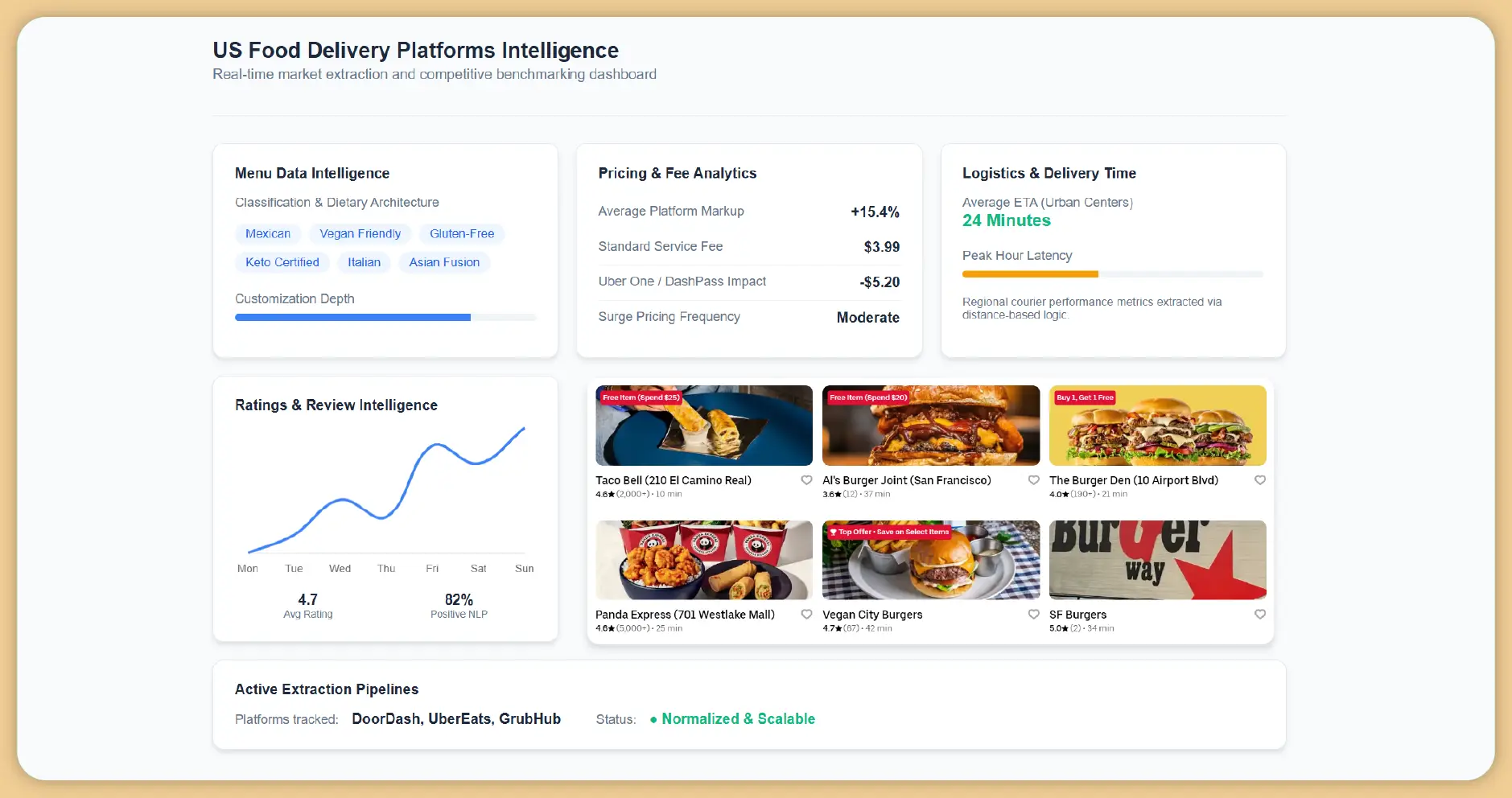
Food delivery app scraping refers to the automated extraction of publicly available data from US-based food delivery platforms via web interfaces, mobile apps, and APIs. The collected data is cleaned, normalized, and delivered in analytics-ready formats.
A typical US food delivery dataset includes:
- Restaurant listings and locations
- Menu items and descriptions
- Prices, fees, and discounts
- Delivery time estimates
- Ratings and customer reviews
- Availability and operational status
Food Data Scrape designs scraping pipelines that are scalable across multiple US cities, states, and platforms.
Why Scraping US Food Delivery Apps Matters
The US food delivery market is highly competitive, price-sensitive, and geographically diverse. Menu prices, delivery fees, and ETAs can vary significantly by:
- City or ZIP code
- Time of day
- Local demand surges
- Platform-specific pricing models
By leveraging food delivery data scraping services in the USA, businesses can:
- Monitor real-time menu and price changes
- Benchmark competitors city-by-city
- Track delivery efficiency across zones
- Understand evolving American food preferences
Key Data Extracted from US Food Delivery Platforms
Menu Data Intelligence
Menu scraping helps businesses analyze:
- Item names and descriptions
- Cuisine classification (Mexican, Italian, Asian, Vegan, etc.)
- Dietary tags (gluten-free, keto, vegan)
- Portion sizes and variants
- Add-ons and customization options
This enables menu optimization and gap analysis across US markets.
Pricing & Fee Analytics
Pricing on US food delivery apps includes multiple layers:
- Base menu price
- Platform markups
- Service fees
- Delivery fees
- Promotional discounts
A US food pricing dataset from Food Data Scrape captures:
- Item-level prices
- Discount campaigns
- Subscription-based benefits (Uber One, DashPass)
- Surge pricing indicators
This data supports price elasticity analysis and competitive benchmarking.
Delivery Time & Logistics Insights
Delivery speed is a major driver of customer satisfaction in the US. Scraped delivery data reveals:
- Estimated delivery times (ETA)
- Distance-based delivery logic
- Peak-hour congestion patterns
- Regional courier performance
Businesses use this data to improve delivery SLAs and logistics planning.
Ratings & Review Intelligence
US consumers actively leave reviews, making review data highly valuable.
Scraped review datasets include:
- Star ratings
- Review text
- Frequency and recency
- Sentiment and keyword signals
Food Data Scrape applies NLP and sentiment analysis to identify quality issues and consumer expectations.
Sample US Food Delivery Dataset
PlatformCityRestaurantCuisineItemPrice (USD)Delivery FeeETA (mins)Rating
| Platform | City | Restaurant | Cuisine | Item | Price (USD) | Delivery Fee | ETA (mins) | Rating |
|---|---|---|---|---|---|---|---|---|
| DoorDash | New York | Burger Nation | American | Cheeseburger | 11.99 | 3.99 | 32 | 4.3 |
| Uber Eats | Los Angeles | Taco Fiesta | Mexican | Chicken Taco | 4.25 | 2.49 | 28 | 4.5 |
| Grubhub | Chicago | Pasta Corner | Italian | Alfredo Pasta | 14.50 | 0.00 | 40 | 4.1 |
| Postmates | San Francisco | Sushi Zen | Japanese | Salmon Roll | 9.75 | 4.99 | 35 | 4.4 |
This dataset can scale across tens of thousands of US restaurants and millions of menu items.
Competitive Intelligence in the US Market
By combining datasets across DoorDash, Uber Eats, and Grubhub, Food Data Scrape enables:
- Cross-platform price comparison
- Menu overlap and exclusivity analysis
- Cuisine saturation by ZIP code
- Promotion intensity tracking
This intelligence is critical for US-based restaurant chains and cloud kitchens.
Use Cases of US Food Delivery App Scraping
Restaurant Chains
- Ensure pricing consistency across locations
- Track competitor promotions
- Optimize regional menus
Cloud Kitchens & Virtual Brands
- Identify high-demand cuisines by city
- Test pricing strategies
- Select optimal launch locations
Market Research & Consulting Firms
- Analyze American dining trends
- Study regional taste differences
- Generate state-wise reports
Investors & Strategy Teams
- Evaluate platform dominance
- Track expansion trends
- Assess unit economics signals
Future of Food Delivery Analytics in the USA
As AI and automation reshape food delivery, data-driven insights will power:
- Dynamic pricing engines
- Personalized menu recommendations
- Predictive delivery optimization
- Real-time competitive alert systems
Companies leveraging US food delivery datasets today will gain long-term strategic advantage.
Conclusion
Scraping food delivery apps in the USA provides unparalleled visibility into menus, pricing strategies, delivery performance, and consumer behavior. When structured and analyzed correctly, this data becomes a powerful asset for growth and innovation.
With Food Data Scrape, US-focused businesses gain access to reliable, scalable, and analytics-ready food delivery datasets that drive smarter decisions and competitive success.
If you are seeking for a reliable data scraping services, Food Data Scrape is at your service. We hold prominence in Food Data Aggregator and Mobile Restaurant App Scraping with impeccable data analysis for strategic decision-making.