The Client
The client is a U.S.-based retail intelligence firm specializing in grocery analytics and competitive benchmarking. They support supermarket chains, consumer goods brands, and market analysts by providing actionable insights into pricing, promotions, and product assortment. To maintain a competitive edge, the client required access to high-quality, up-to-date data on Trader Joe’s offerings. By leveraging our Real-Time Trader Joe’s Grocery Data Scraper USA, they automated data collection across thousands of SKUs, ensuring consistency and accuracy. With our Trader Joe’s Grocery Menu & Price Monitoring USA, the client tracked price fluctuations, seasonal variations, and new product launches across multiple categories. Additionally, the ability to Track Trader Joe’s Grocery Deals & Promotions USA allowed them to monitor short-term offers, bundle deals, and regional promotions effectively. This collaboration helped the client reduce manual effort, enhance reporting accuracy, and generate insights that supported pricing strategies, product planning, and competitive intelligence across the U.S. grocery sector.
Key Challenges
- Inconsistent Product and Price Data
The client faced challenges in tracking thousands of SKUs across regions with varying prices, promotions, and packaging. Without reliable Scrape Online Trader Joe's Grocery Delivery App Data, maintaining data accuracy and uniformity required significant manual effort and constant validation. - Limited Real-Time Market Visibility
Frequent updates, new launches, and promotional changes made manual monitoring inefficient. The absence of a robust Trader Joe's Grocery Delivery Scraping API delayed insight generation, limiting the client’s ability to react promptly to market shifts or competitive pricing trends. - Scalability and Operational Bottlenecks
Handling large-scale data collection from multiple locations and categories was resource-intensive. Without scalable Grocery App Data Scraping services, the client struggled to expand coverage, maintain historical datasets, and ensure consistent reporting for strategic and operational decisions.
Key Solutions
- Automated Data Collection & Integration
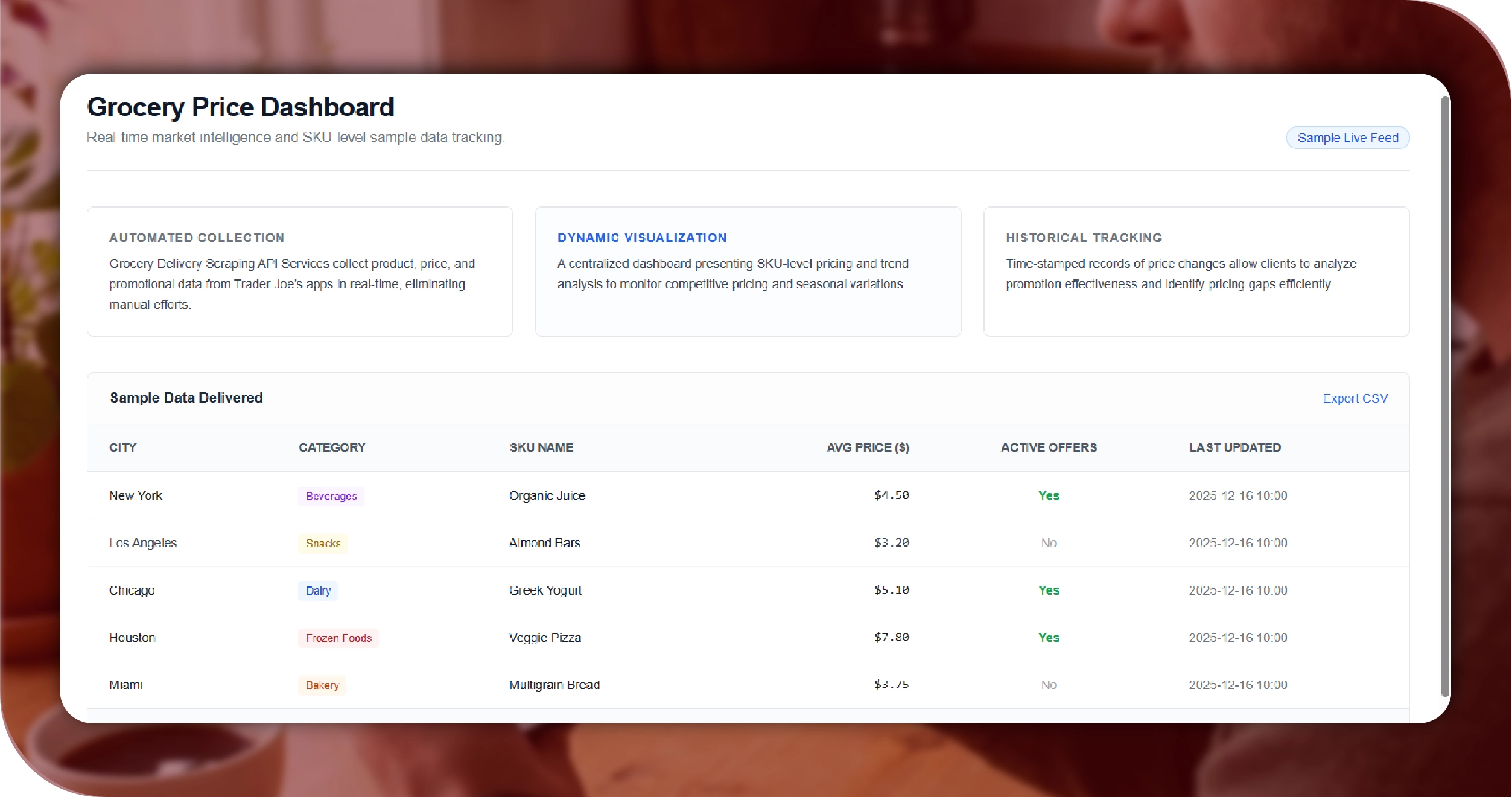
We implemented Grocery Delivery Scraping API Services to collect product, price, and promotional data from Trader Joe’s delivery apps in real-time. This automated approach eliminated manual efforts, ensured consistency, and provided scalable coverage across all categories and regions. - Dynamic Visualization & Insights
A centralized Grocery Price Dashboard was created to present SKU-level pricing, offers, and trend analysis. This allowed the client to monitor competitive pricing, seasonal variations, and promotional effectiveness, supporting faster decision-making and actionable insights. - Historical Tracking & Performance Monitoring
We delivered a Grocery Price Tracking Dashboard that maintained time-stamped records of price and offer changes. Clients could track historical trends, analyze promotion effectiveness, and identify pricing gaps across stores and categories efficiently.
Sample Data Delivered
| City | Category | SKU Name | Avg Price ($) | Active Offers | Last Updated |
|---|---|---|---|---|---|
| New York | Beverages | Organic Juice | 4.50 | Yes | 2025-12-16 10:00 |
| Los Angeles | Snacks | Almond Bars | 3.20 | No | 2025-12-16 10:00 |
| Chicago | Dairy | Greek Yogurt | 5.10 | Yes | 2025-12-16 10:00 |
| Houston | Frozen Foods | Veggie Pizza | 7.80 | Yes | 2025-12-16 10:00 |
| Miami | Bakery | Multigrain Bread | 3.75 | No | 2025-12-16 10:00 |
Methodologies Used
- Multi-Source Data Aggregation
We collected product and pricing information from multiple delivery platforms, standardizing formats and aligning SKUs across categories. This ensured a consistent, comprehensive dataset that could be easily compared and analyzed for market insights. - Real-Time Change Detection
Automated monitoring was implemented to detect updates, price shifts, new SKUs, and removed items. This approach minimized latency, allowing clients to work with the most current and accurate information without manual intervention. - Location-Based Mapping
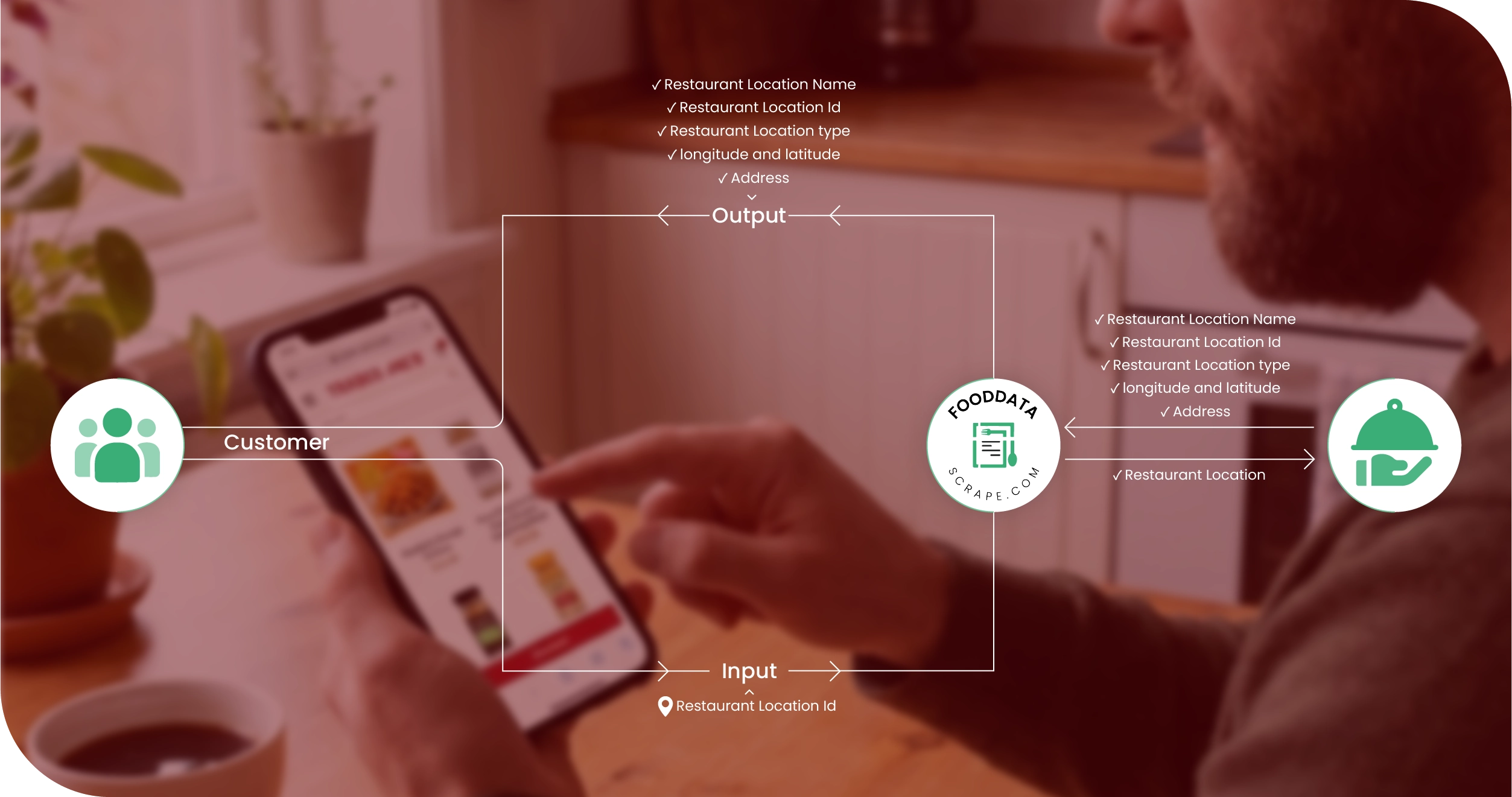
Data was organized by city, store, and delivery zone to capture regional pricing differences and hyperlocal promotions. This methodology enabled precise comparisons and analysis of market dynamics across different geographic areas. - Historical Data Versioning
We maintained time-stamped records of all products, prices, and offers, allowing clients to analyze trends, track seasonal patterns, and conduct retrospective performance assessments without losing historical context. - Quality Assurance and Validation
Automated and manual checks were applied to identify anomalies, missing values, and inconsistencies. This ensured data reliability, minimized errors, and delivered a clean, ready-to-use dataset for downstream analytics and reporting.
Advantages of Collecting Data Using Food Data Scrape
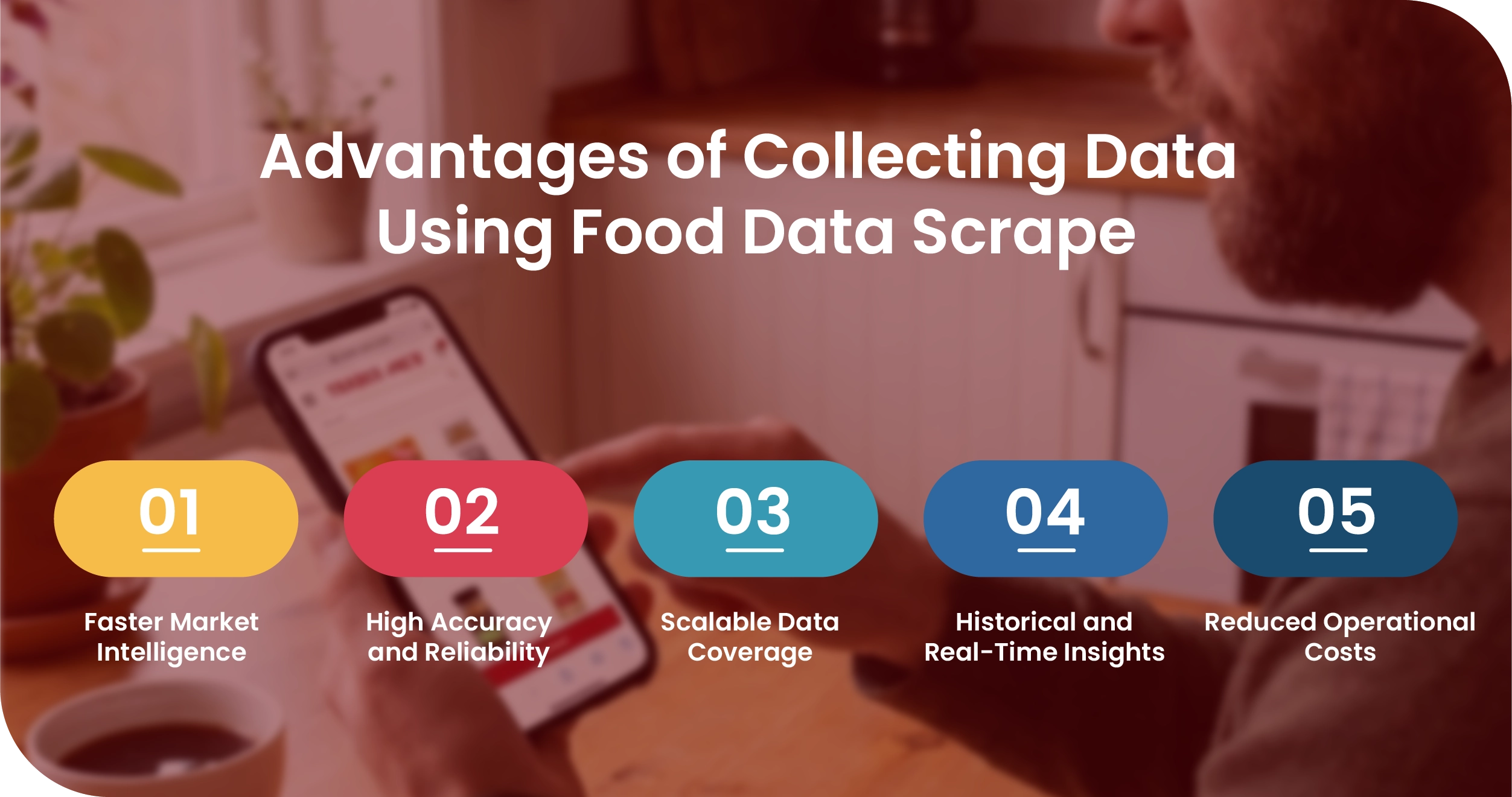
- Faster Market Intelligence
Our data scraping services deliver structured, real-time product and pricing information, eliminating manual collection. Clients gain immediate insights into trends, promotions, and competitor activity, enabling quicker decision-making and more responsive market strategies. - High Accuracy and Reliability
Rigorous validation and normalization ensure data consistency across categories and regions. Clients can trust the information for reporting, analysis, and forecasting, reducing errors and improving confidence in strategic and operational decisions. - Scalable Data Coverage
Services can easily scale across cities, stores, and product categories. As client requirements grow, data collection adapts without additional operational burden, supporting both detailed analyses and broader market monitoring initiatives. - Historical and Real-Time Insights
We provide continuous updates alongside historical records. Clients can track price trends, promotional patterns, and seasonal fluctuations over time, supporting trend analysis, forecasting, and informed strategic planning. - Reduced Operational Costs
Automating data collection and processing significantly cuts manual effort and resource use. Teams can focus on deriving insights and strategy rather than managing time-consuming data gathering and maintenance tasks.
Client’s Testimonial
Working with this team has been transformative for our grocery intelligence initiatives. Their solution provided accurate, structured data on Trader Joe’s products, prices, and promotions across the U.S., eliminating weeks of manual effort. Real-time updates and historical tracking enabled us to monitor trends, benchmark competitively, and optimize pricing strategies efficiently. The dashboards delivered clear, actionable insights that improved reporting and decision-making across our teams. Their responsiveness, professionalism, and ability to adapt to changing requirements exceeded expectations. This collaboration has strengthened our market intelligence capabilities, enhanced operational efficiency, and positioned us to make data-driven decisions confidently in the highly competitive grocery retail landscape.
Director of Retail Analytics
Final Outcome
The final outcome of the engagement delivered significant value for the client’s retail intelligence operations. By leveraging structured and continuously updated data, the client gained a unified view of product prices, SKUs, promotions, and seasonal variations across multiple U.S. cities. Decision-making became faster and more accurate, with teams shifting focus from manual collection to actionable analysis. Historical tracking enabled trend identification and performance benchmarking, while dynamic dashboards supported executive reporting and strategic planning. Access to high-quality Grocery Pricing Data Intelligence allowed the client to optimize pricing strategies, identify gaps in product assortments, and respond quickly to market changes. Comprehensive Grocery Store Datasets ensured scalable coverage, reliable insights, and enhanced competitive visibility, strengthening the client’s market position in the U.S. grocery sector.