The Client
The client is a fast-growing food and beverage brand operating across multiple cities in the UAE, with a strong presence on leading food delivery platforms. Focused on expansion and data-backed decision-making, the client aims to stay competitive in a highly dynamic and price-sensitive market. Through UAE Food Delivery Market Mapping, the client continuously tracks platform-wise coverage, cuisine demand, and neighborhood-level performance to identify high-potential locations. By choosing to Extract UAE Multi-Platform Food Menu Data, the client gains clear visibility into its own menu positioning versus competitors, including pricing consistency, portion variations, and add-on strategies. This approach supports smarter menu engineering and promotional planning. Additionally, leveraging Web Scraping Multi-Platform Food Delivery Apps Manu Data enables the client to monitor real-time changes across apps, respond quickly to competitor moves, and adapt offerings to evolving consumer preferences, ensuring sustained growth and stronger customer engagement.
Key Challenges
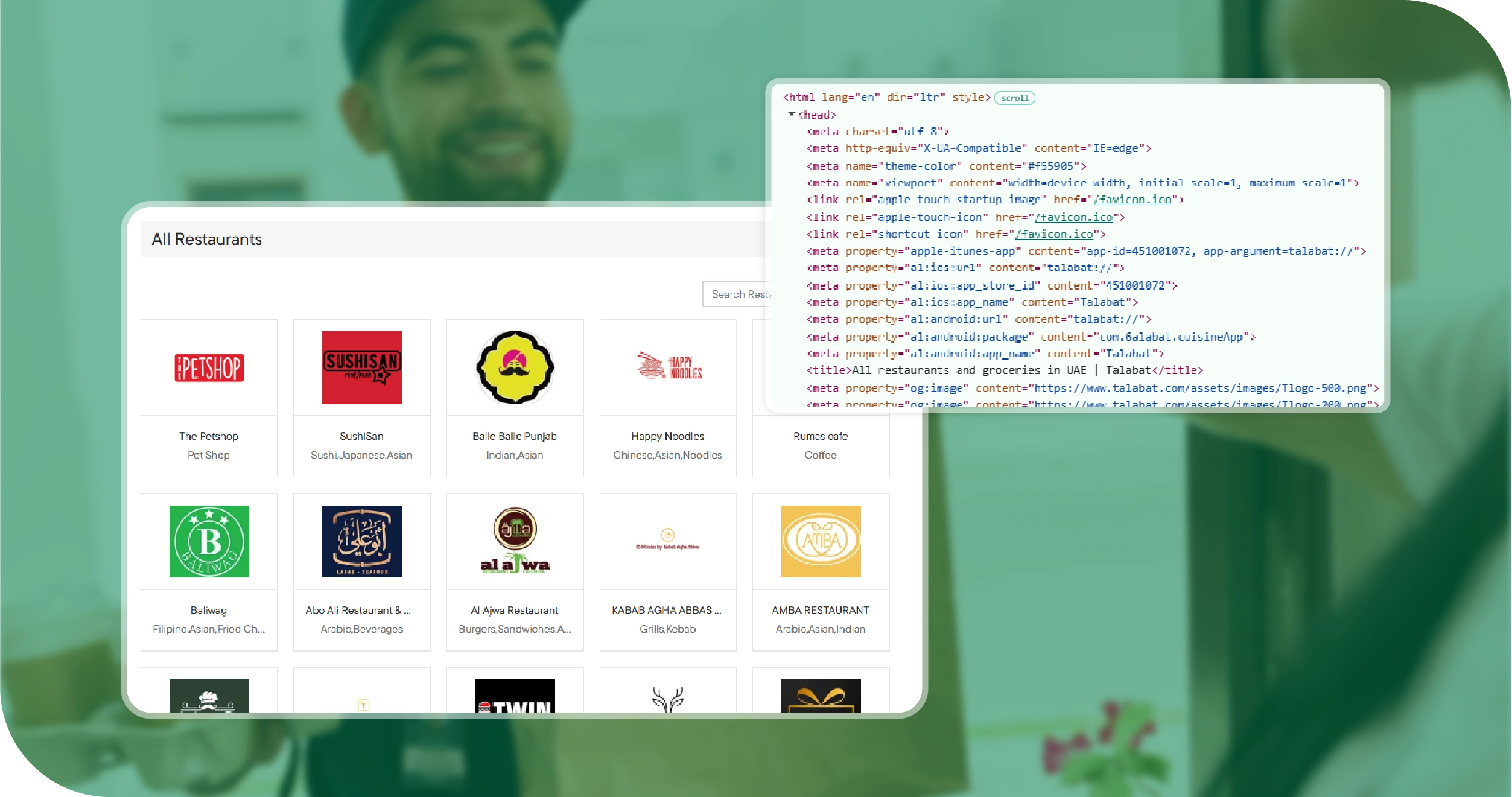
- Fragmented Platform Visibility
The client struggled with siloed data across multiple food delivery apps, making it difficult to track pricing, availability, and promotions in real time. Without a Real-Time UAE Food Delivery Insights Scraper, market changes were identified late, impacting timely decisions. - Inconsistent Menu and Pricing Data
Frequent updates to menus, add-ons, and prices across platforms created inconsistencies that confused customers and reduced conversion rates. The absence of reliable Restaurant Menu Data Scraping limited the client’s ability to maintain uniform branding and competitive pricing. - Delayed Competitive Intelligence
Manual tracking of competitors was time-consuming and error-prone, preventing rapid responses to new launches or discounts. Without scalable Food Delivery Data Scraping Services, the client faced challenges in understanding market trends and evolving consumer behavior accurately.
Key Solutions
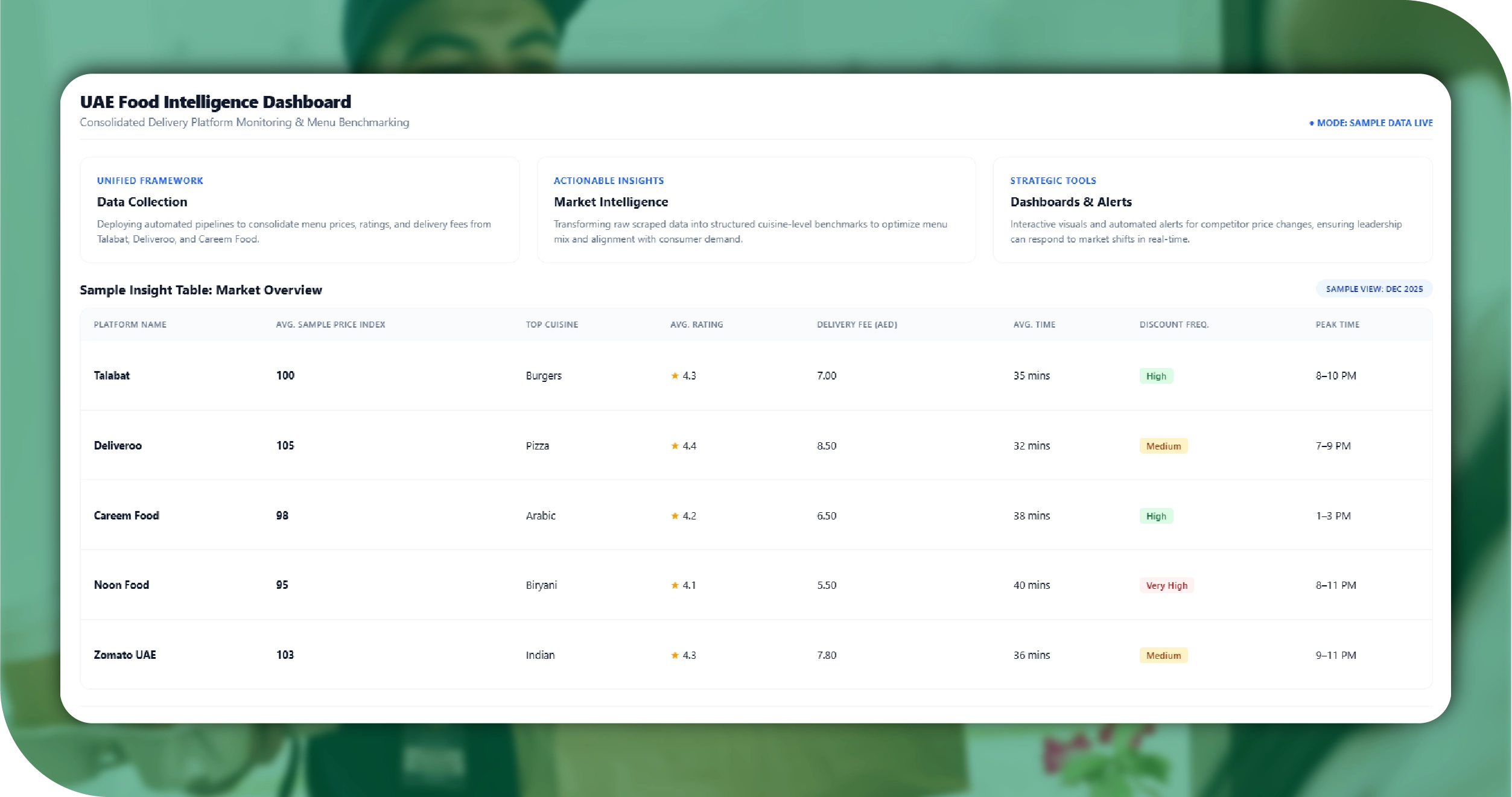
- Unified Data Collection Framework
We deployed automated pipelines to consolidate pricing, menus, availability, and ratings from all major UAE food delivery platforms. Using Food Delivery Scraping API Services, the client received accurate, near–real-time datasets that eliminated manual tracking and reduced decision latency significantly. - Actionable Market & Menu Intelligence
Our solution transformed raw scraped data into structured insights, enabling platform-wise comparisons and cuisine-level benchmarking. Through Restaurant Data Intelligence Services, the client optimized menu mix, corrected pricing gaps, and aligned offers with location-specific consumer demand patterns. - Strategic Dashboards & Alerts
We delivered interactive dashboards and automated alerts highlighting competitor moves, price changes, and demand spikes. With Food delivery Intelligence services, leadership teams could respond faster, plan promotions confidently, and drive measurable improvements in sales and customer retention.
Sample Insight Table
| Platform Name | Avg. Price Index | Top Cuisine Category | Avg. Rating | Avg. Delivery Fee (AED) | Avg. Delivery Time (mins) | Discount Frequency | Menu Item Count (Avg.) | Peak Order Time |
|---|---|---|---|---|---|---|---|---|
| Talabat | 100 | Burgers | 4.3 | 7.0 | 35 | High | 120 | 8–10 PM |
| Deliveroo | 105 | Pizza | 4.4 | 8.5 | 32 | Medium | 95 | 7–9 PM |
| Careem Food | 98 | Arabic | 4.2 | 6.5 | 38 | High | 110 | 1–3 PM |
| Noon Food | 95 | Biryani | 4.1 | 5.5 | 40 | Very High | 85 | 8–11 PM |
Methodologies Used
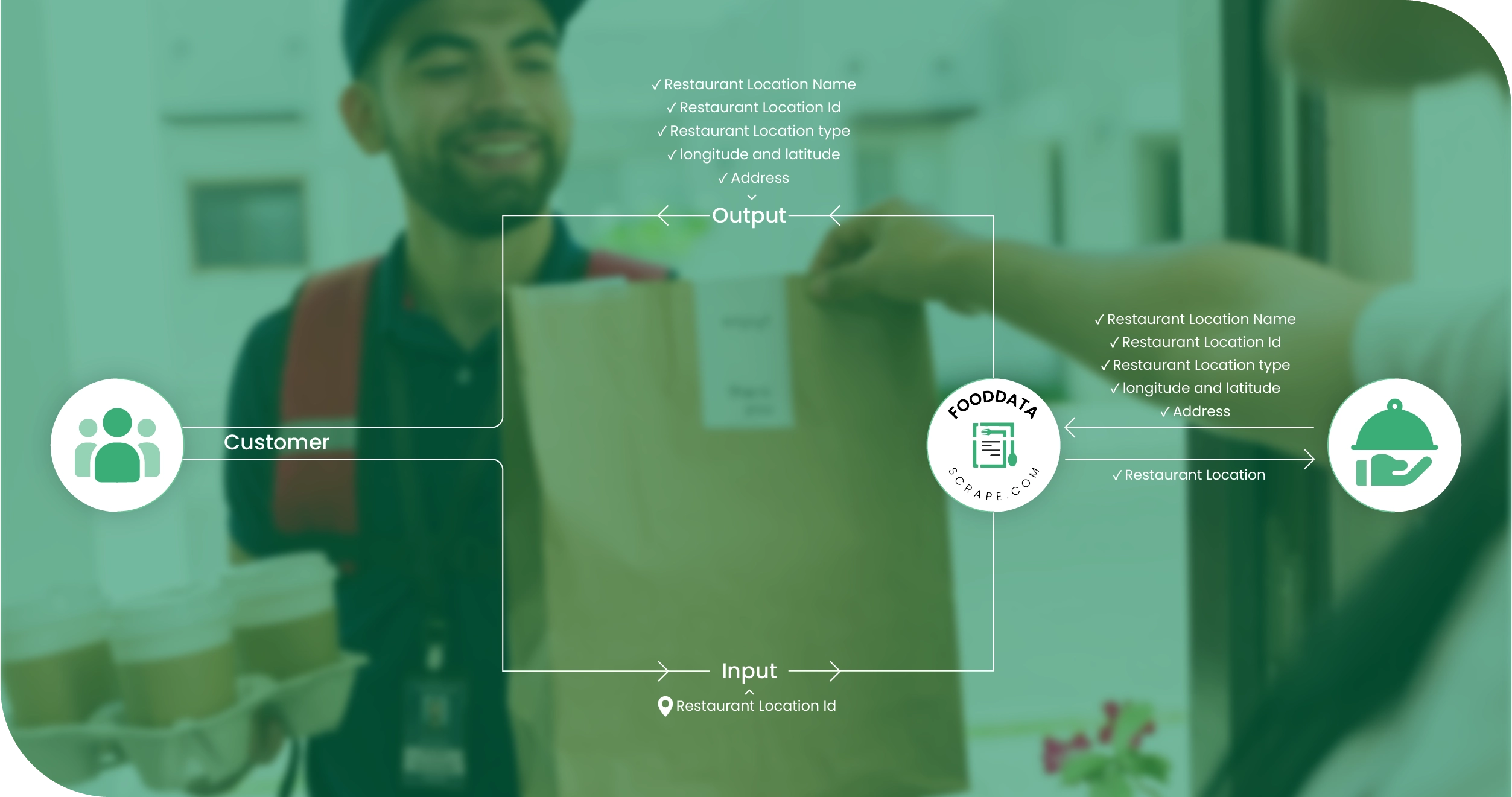
- Multi-Source Data Aggregation
We systematically collected structured and unstructured data from multiple food delivery platforms, ensuring consistency across pricing, menus, ratings, and availability. This approach removed data silos and created a single, reliable source for comprehensive analysis. - Automated Change Detection
Our systems continuously monitored platform updates to identify price shifts, menu modifications, and promotional changes. Automated alerts ensured that even minor updates were captured quickly, enabling timely responses to fast-moving market conditions. - Data Normalization and Validation
Collected data was standardized across platforms with different formats and naming conventions. Rigorous validation checks eliminated duplicates, corrected anomalies, and improved overall data accuracy for dependable reporting and decision-making. - Advanced Analytics and Segmentation
We applied analytical models to segment data by location, cuisine, time slots, and customer ratings. This revealed hidden demand patterns and performance gaps that were not visible through manual or surface-level analysis. - Insight Visualization and Reporting
The final outputs were delivered through interactive dashboards and structured reports. Clear visualizations made complex trends easy to interpret, helping stakeholders translate data insights into strategic and operational actions.
Advantages of Collecting Data Using Food Data Scrape

- Faster, Data-Driven Decisions
Our data scraping services provide timely access to market, pricing, and consumer behavior data across platforms. This speed enables teams to make informed decisions quickly, reducing reliance on assumptions and improving responsiveness to competitive and demand changes. - Complete Market Visibility
By capturing data from multiple platforms in one unified view, our services eliminate blind spots. Businesses gain clear visibility into competitor pricing, menu positioning, promotions, and customer ratings across regions and time periods. - Improved Pricing and Menu Accuracy
Automated data collection ensures menus, prices, and add-ons remain consistent and up to date across platforms. This accuracy improves customer trust, reduces order friction, and helps brands maintain competitive yet profitable pricing strategies. - Scalable Competitive Intelligence
Our solutions scale effortlessly as platforms, locations, and product lines grow. Continuous monitoring allows businesses to track competitor moves, new launches, and discount patterns without manual effort or increased operational overhead. - Actionable Insights for Growth
Beyond raw data, our services convert information into practical insights. Brands can identify high-performing cuisines, optimize promotions, improve delivery performance, and align offerings with evolving consumer preferences to drive sustained growth.
Client’s Testimonial
“Working with this team transformed how we understand the UAE food delivery landscape. Their insights gave us complete visibility across platforms, helping us optimize pricing, refine menus, and respond faster to market changes. The dashboards were intuitive, data was highly accurate, and updates were timely, which made decision-making far more confident. What impressed us most was how actionable the insights were—we could clearly see where to adjust promotions and which locations needed attention. I can confidently say their data-driven approach played a key role in improving our performance, customer engagement, and overall competitiveness across multiple food delivery platforms.”
Head of Growth & Strategy
Final Outcome
The final outcome delivered measurable improvements in how the client operated across the UAE food delivery ecosystem. With clearer visibility into pricing, menus, and consumer demand, teams could make faster, more confident decisions backed by data rather than assumptions. The implementation of the Food Price Dashboard enabled continuous monitoring of price movements, discount patterns, and platform-wise competitiveness, reducing revenue leakage and improving margin control. By leveraging structured Food Delivery Datasets, the client unified previously fragmented information into a single source of truth. This empowered leadership to identify high-performing cuisines, optimize menu placement, and tailor promotions by location and time. Overall, the solution improved operational efficiency, strengthened competitive positioning, enhanced customer satisfaction, and created a scalable foundation for sustained growth in an increasingly competitive food delivery market.