The Client
Our client is a UK-based retail intelligence and pricing strategy firm serving FMCG brands and private-label manufacturers. Their primary goal was to Track Daily Grocery Prices Across UK Supermarkets to help partners respond quickly to market fluctuations and promotional shifts. They required a scalable solution to Extract Grocery Basket Data Across UK Supermarkets, covering essential household categories such as dairy, fresh produce, beverages, and packaged foods. Accuracy, frequency, and structured outputs were critical to their analytics workflows. To support advanced benchmarking models, they also needed reliable Web Scraping Grocery Basket Data Across UK Supermarkets with SKU-level granularity, including pack sizes, multi-buy offers, availability status, and historical price changes. The client values automation, compliance, and clean datasets that integrate seamlessly into BI dashboards. Their long-term objective is to enhance competitive pricing strategies, improve demand forecasting, and provide data-driven recommendations to brands operating across the highly competitive UK grocery market.
Key Challenges
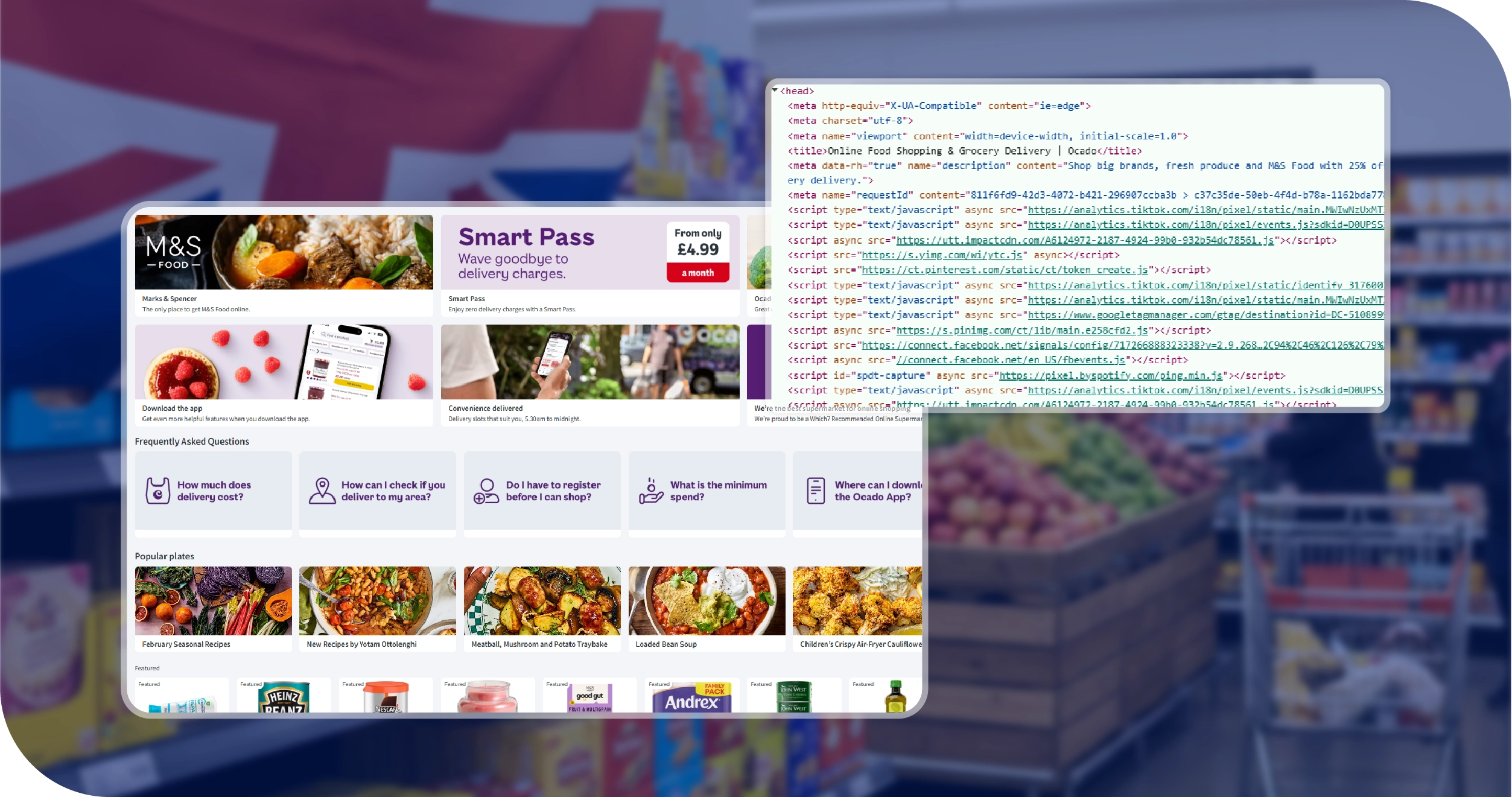
- Frequent Price Fluctuations and Short-Term Promotions: The client found it difficult to maintain accurate comparisons because grocery prices changed daily, sometimes multiple times per day. Flash discounts and multi-buy offers created inconsistencies. Integrating the Tesco Grocery Delivery Scraping API helped capture timely price updates and reduce reporting delays.
- Regional Variations in Availability: Product availability differed by postcode, leading to incomplete basket comparisons. Some SKUs were stocked in one region but unavailable in another. By leveraging the Asda Grocery Delivery Scraping API, the client gained location-specific data to ensure realistic, region-based competitive analysis.
- Complex Website Structures and Data Gaps: Each retailer structured categories and product details differently, causing mismatched fields and missing attributes. Continuous website updates also disrupted extraction. Implementing the Sainsbury’s Grocery Delivery Scraping API improved structured data capture and ensured consistent, reliable outputs for analytics dashboards.
Key Solutions
- Scalable Multi-Retailer Data Framework: We implemented a robust Web Scraping Grocery Data architecture designed to collect SKU-level information across multiple UK supermarkets. Our framework standardized product names, pack sizes, prices, and promotional tags, ensuring accurate basket comparisons and seamless integration into analytics systems.
- Automated Real-Time Data Pipelines: Using a secure Grocery Delivery Extraction API, we automated daily and intra-day data collection with postcode-level targeting. This minimized manual effort, improved data freshness, and ensured reliable tracking of availability, discounts, and pricing fluctuations across retailers.
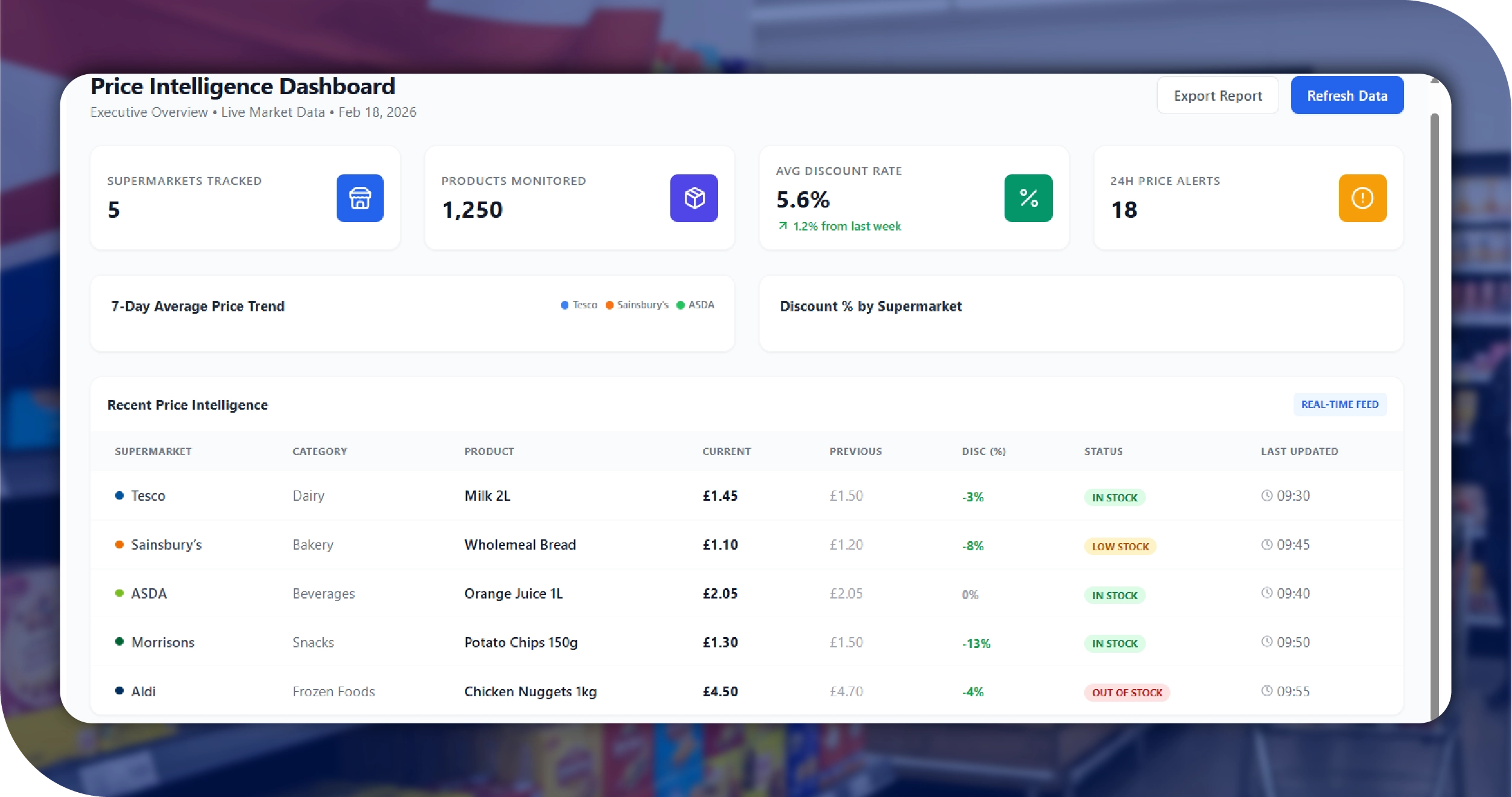
- Advanced Analytics and Visualization Layer: We deployed a centralized Grocery Price Dashboard that enabled side-by-side basket comparison, competitor gap analysis, and weekly price-change alerts. The dashboard provided structured insights, downloadable reports, and historical trend visualization for strategic decision-making.
Sample Consolidated Grocery Basket Comparison Dataset
| Date | Retailer | Postcode | Category | Product Name | Pack Size | Price (£) | Promo Type | Stock Status | Price Change (7d) | Competitor Gap (%) |
|---|---|---|---|---|---|---|---|---|---|---|
| 2026-02-01 | Tesco | SW1A 1AA | Dairy | Semi-Skimmed Milk | 2L | 1.55 | Multi-buy | In Stock | -0.05 | -2.1 |
| 2026-02-01 | Asda | SW1A 1AA | Dairy | Semi-Skimmed Milk | 2L | 1.60 | None | In Stock | 0.00 | +1.3 |
| 2026-02-01 | Sainsbury’s | SW1A 1AA | Dairy | Semi-Skimmed Milk | 2L | 1.58 | Nectar Offer | In Stock | -0.02 | +0.5 |
| 2026-02-01 | Aldi | SW1A 1AA | Bakery | Wholemeal Bread | 800g | 0.89 | None | In Stock | 0.00 | -3.4 |
| 2026-02-01 | Morrisons | SW1A 1AA | Produce | Red Apples | 1kg | 2.10 | Price Drop | Low Stock | -0.10 | -1.8 |
| 2026-02-01 | Lidl | SW1A 1AA | Beverages | Orange Juice | 1L | 1.05 | Weekly Deal | In Stock | -0.08 | -2.7 |
| 2026-02-02 | Tesco | M1 1AE | Pantry | Basmati Rice | 1kg | 2.40 | Clubcard | In Stock | +0.15 | +1.9 |
| 2026-02-02 | Asda | M1 1AE | Pantry | Basmati Rice | 1kg | 2.30 | Rollback | In Stock | -0.05 | -2.2 |
| 2026-02-02 | Sainsbury’s | M1 1AE | Frozen | Frozen Peas | 900g | 1.20 | None | In Stock | 0.00 | +0.8 |
| 2026-02-02 | Morrisons | M1 1AE | Meat | Chicken Breast Fillets | 500g | 3.75 | Price Match | In Stock | -0.12 | -1.5 |
Methodologies Used
- Structured Website Mapping: We began by analyzing the layouts of multiple supermarket websites, identifying category hierarchies, SKU patterns, and promotional structures. This helped create a blueprint for consistent data extraction and ensured accurate alignment of products across different retailers for comparison.
- Adaptive Crawling Techniques: Our team implemented dynamic crawlers capable of handling changes in website design, JavaScript-loaded content, and pagination. The crawlers intelligently adjusted to site updates, maintaining uninterrupted data collection without triggering anti-bot defenses or missing critical product details across categories.
- Data Normalization and Standardization: Extracted data from varied sources was cleaned and standardized, including product names, pack sizes, and price formats. This methodology ensured uniformity, eliminated duplicates, and allowed for accurate comparisons across multiple supermarket chains in structured datasets.
- Scheduled and Incremental Extraction: We used incremental scraping schedules to capture daily, weekly, and intra-day updates. This approach reduced server load, avoided redundant data collection, and ensured the freshest, most relevant information for competitive pricing analysis and trend monitoring.
- Quality Validation and Error Handling: Automated validation routines checked for missing fields, inconsistencies, and anomalies in the dataset. Error detection and retry mechanisms ensured reliability, while logging and monitoring allowed rapid identification and resolution of issues to maintain data integrity.
Advantages of Collecting Data Using Food Data Scrape
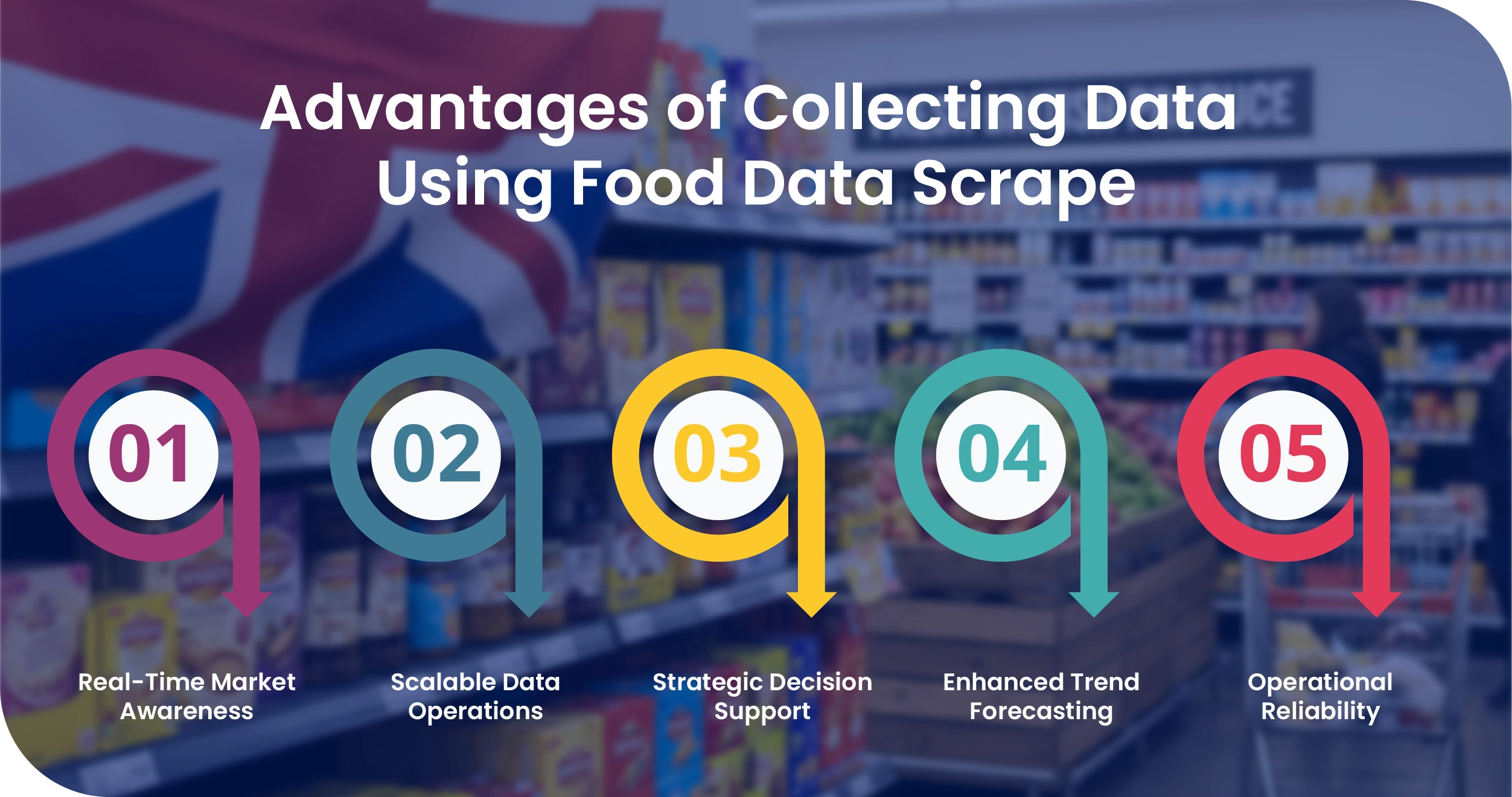
- Faster Competitive Response: Our solutions enable businesses to react quickly to competitor price changes and promotional shifts. With near real-time updates, decision-makers can adjust pricing, launch counter-offers, or refine assortments before losing market share in highly competitive grocery environments.
- Greater Data Transparency: We deliver clean, structured, and audit-ready datasets that improve transparency across departments. Marketing, procurement, and strategy teams work from the same reliable source, eliminating conflicting reports and strengthening cross-functional collaboration in decision-making processes.
- Reduced Risk of Manual Errors: Manual tracking often leads to inconsistencies and missed updates. Our automated systems minimize human intervention, significantly lowering the risk of inaccurate entries, outdated pricing records, and incomplete basket comparisons across retailers.
- Custom Reporting and Insights: Clients receive tailored reports aligned with their KPIs, including basket comparisons, promotion impact summaries, and margin analysis. Customizable outputs ensure insights directly support business goals rather than providing generic, unusable data.
- Long-Term Strategic Advantage: Consistent data collection builds a valuable historical archive that strengthens long-term strategy. Businesses can identify pricing cycles, competitor behavior patterns, and category growth opportunities, creating a sustainable advantage in the evolving retail market.
Client’s Testimonial
"Partnering with this team transformed our approach to grocery pricing intelligence. Their expertise in automating complex data extraction across multiple UK supermarkets allowed us to access accurate, real-time insights effortlessly. The structured datasets and actionable dashboards significantly improved our pricing strategy, promotional planning, and competitive benchmarking. Their attention to detail, proactive support, and commitment to data accuracy ensured seamless integration into our systems. With their solutions, we can now make informed decisions faster and monitor market trends more effectively. This collaboration has truly elevated our operational efficiency and strategic planning capabilities."
Head of Pricing Strategy
Final Outcome
The project delivered a comprehensive Grocery Price Tracking Dashboard that enabled the client to monitor prices, promotions, and availability across multiple UK supermarkets in real time. This empowered data-driven decisions, improved competitive benchmarking, and streamlined pricing strategies. Through our efforts, the client gained advanced Grocery Data Intelligence, providing actionable insights into market trends, competitor behavior, and category performance. These insights supported faster decision-making and enhanced profitability across product lines. High-quality Grocery Datasets were generated, including SKU-level details, historical price changes, and stock availability. These structured datasets allowed seamless integration into BI systems, facilitated accurate forecasting, and enabled automated reporting. Overall, the client achieved operational efficiency, improved market responsiveness, and strengthened strategic planning capabilities, positioning them for long-term success in the competitive UK grocery sector.