
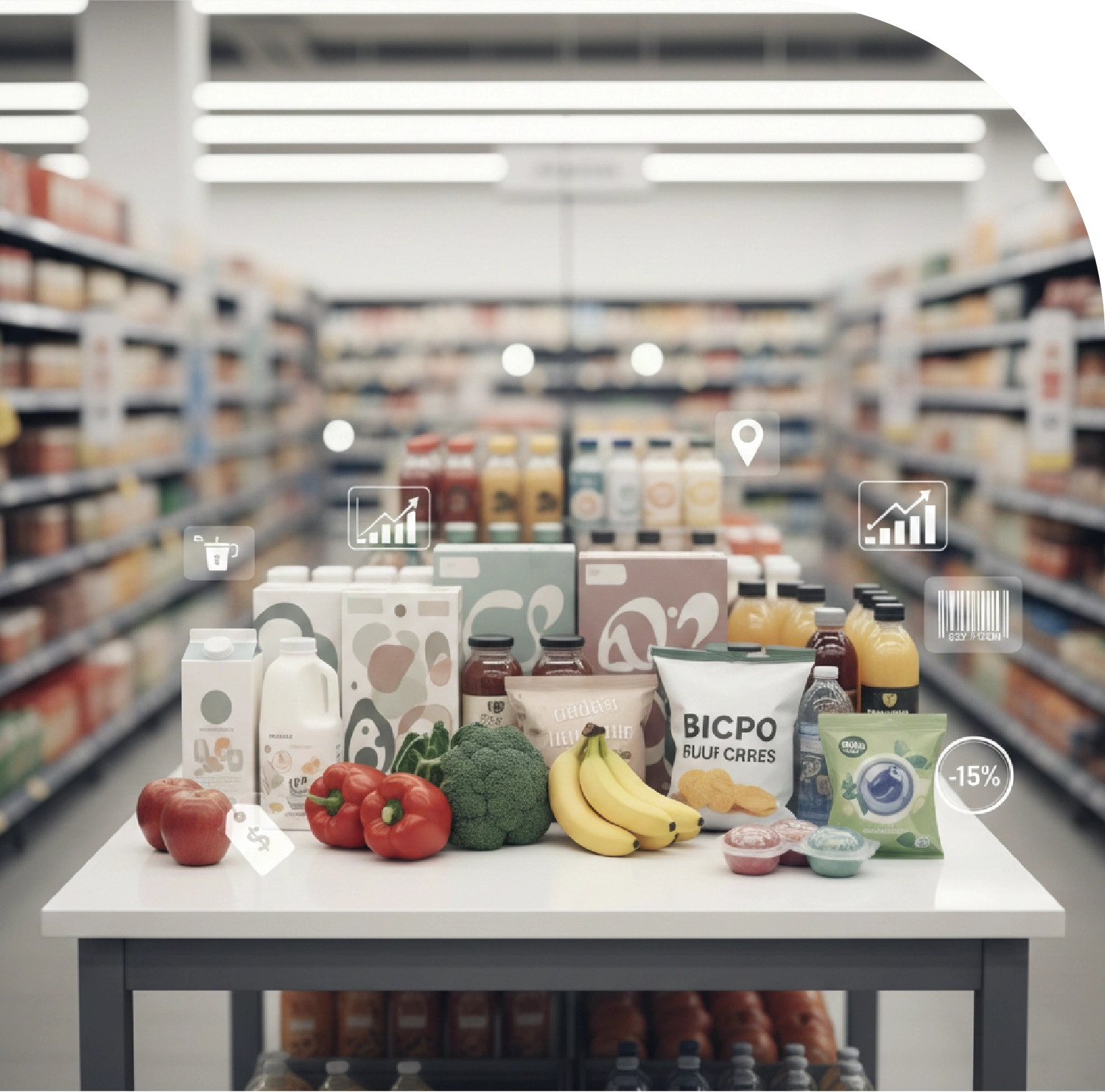
The U.S. grocery retail sector operates within a dynamic pricing environment where national and regional supermarket chains continuously adjust product prices, promotions, and assortments to maintain competitive advantage. This report explores structured methodologies for large-scale supermarket data extraction, focusing on SKU-level pricing, pack sizes, promotional markdowns, and store-specific identifiers. By systematically capturing product and pricing intelligence from leading retailers such as Walmart, Target, Costco, Aldi, and Publix, businesses can transform fragmented online listings into actionable retail datasets.
The research highlights technical approaches including web scraping, API-based integration, and third-party aggregation platforms to enable real-time monitoring of price changes and promotional trends. It also outlines how structured grocery datasets support competitive benchmarking, regional price variation analysis, and algorithmic pricing models. Ultimately, supermarket data scraping enables retailers, analysts, and technology platforms to strengthen pricing strategies, improve demand forecasting accuracy, and enhance retail intelligence across highly competitive U.S. grocery markets.
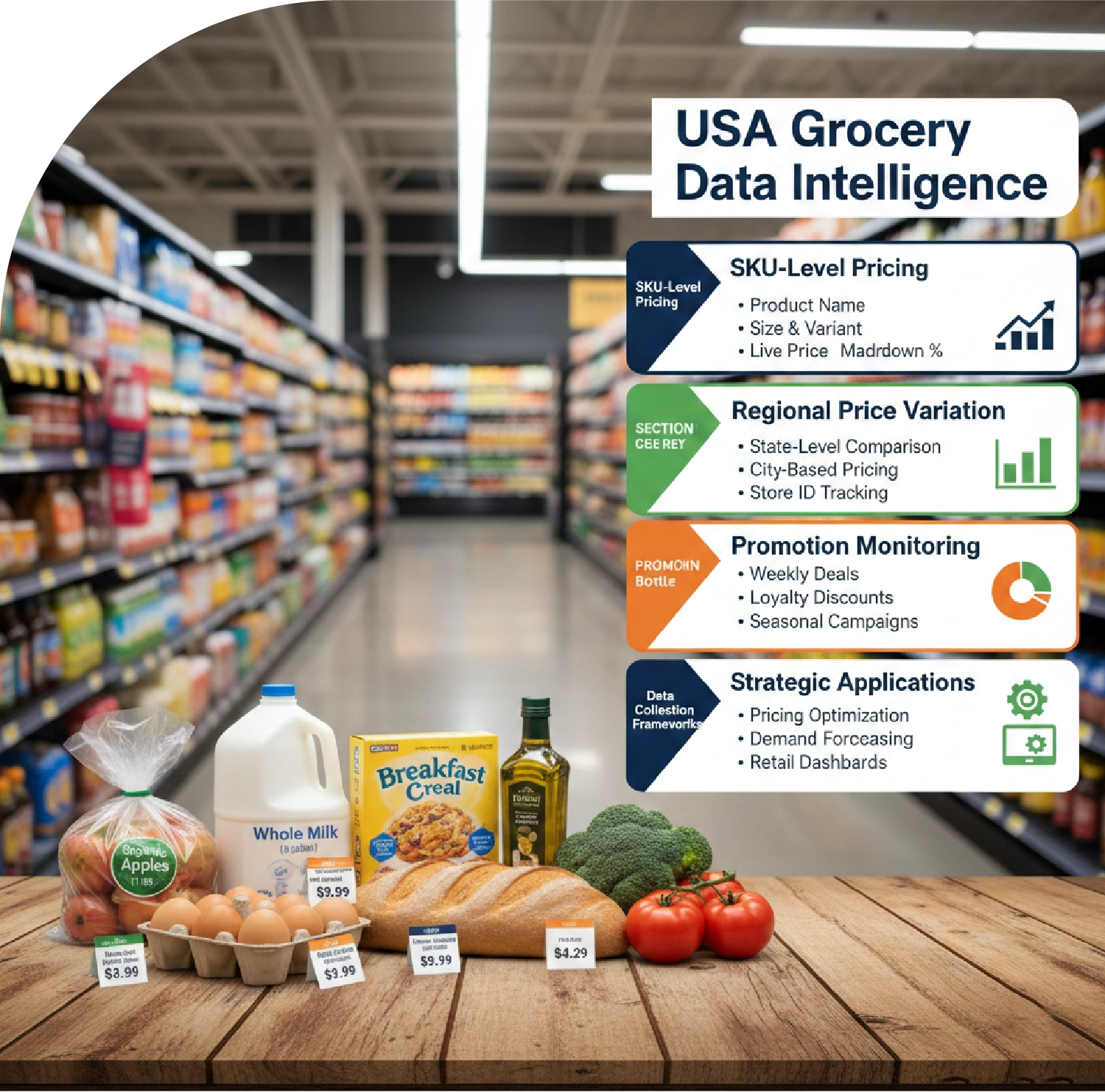
SKU-Level Pricing Intelligence: Granular extraction of product names, sizes, prices, and markdowns supports precise competitive benchmarking.
Regional Price Variation Analysis: Store identifiers and geo-metadata enable state-wise and city-level pricing comparisons.
Promotion & Markdown Tracking: Weekly deals, loyalty discounts, and seasonal campaigns can be monitored in real time.
Technical Extraction Frameworks: Web scraping, APIs, and aggregator platforms provide scalable, automated data collection methods.
Strategic Retail Applications: Structured datasets power dashboards, demand forecasting models, and dynamic pricing optimization systems.

The U.S. grocery retail landscape is highly competitive and diverse, with national and regional supermarket chains constantly adjusting prices, promotions, and product assortments. Capturing granular retail intelligence—such as product names, current prices, pack sizes, promotional discounts, and unique store identifiers—plays a critical role in competitive benchmarking, demand forecasting, and algorithmic pricing optimization. This research on USA Supermarket Chains Data Scraping highlights structured methodologies for gathering supermarket data at scale while presenting practical business and technical applications. Through comprehensive USA Supermarket Product & Pricing Data Extraction, organizations can transform raw online listings into actionable datasets. Large-scale data collection enables analysts to Scrape Product Prices, Sizes & Promotions US Supermarkets across leading retailers including Walmart, Target, Costco, and Aldi. By tracking SKU-level differences and store-specific price variations, businesses can monitor regional trends, evaluate markdown strategies, and build dynamic pricing models that respond to real-time market movements with precision and confidence.
Retailers constantly update prices and promotions based on competitors, seasonality, and inventory levels. For analysts, scraping supermarket web pages or APIs enables:
At minimum, scraped datasets should include:
Such comprehensive process is akin to Scrape US Supermarket Price and Product Data for business insights.
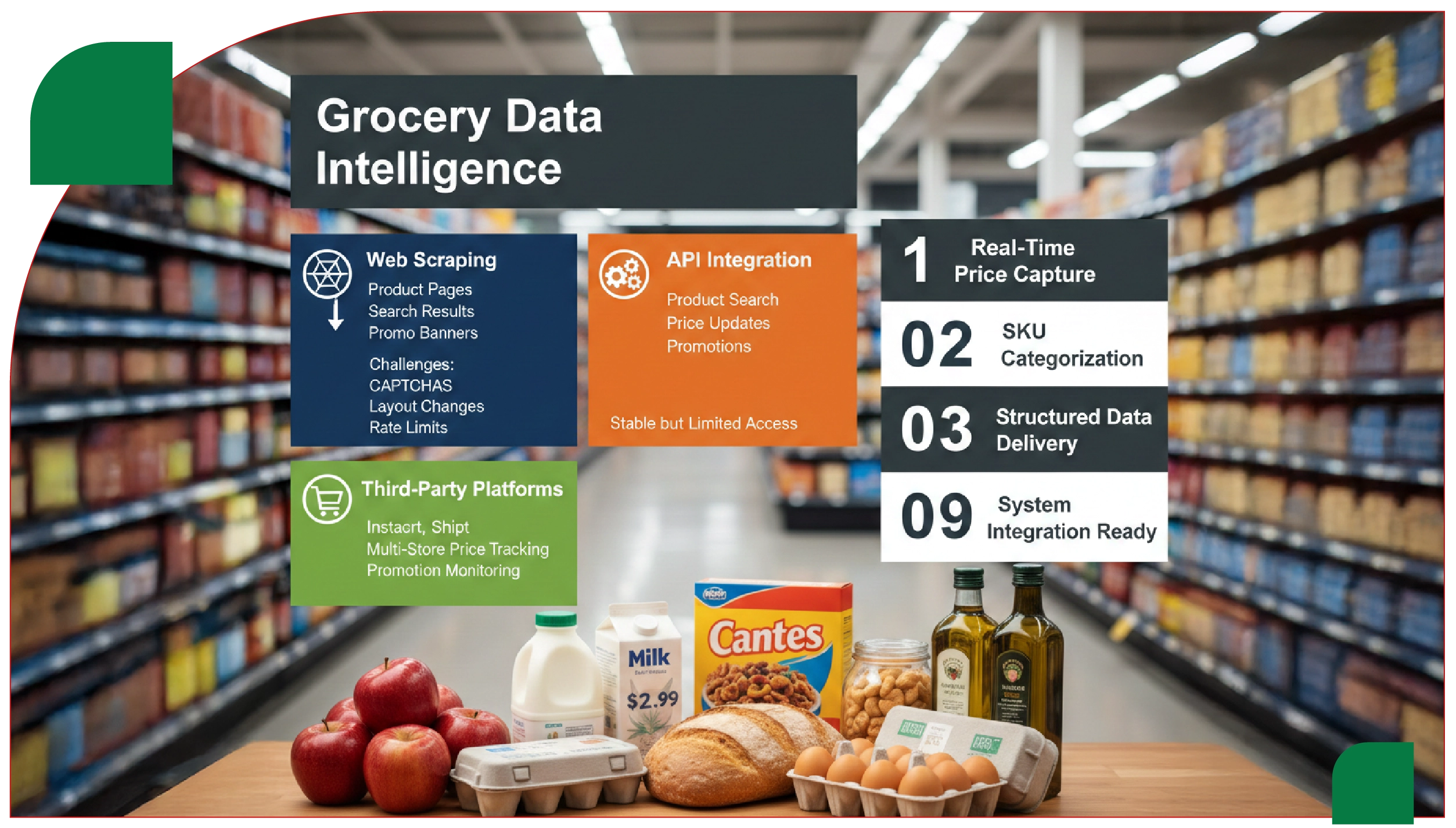
Retail chains often expose product listings on their websites. Tools like Selenium, Puppeteer, or headless Chrome scripts can automate data extraction from:
Challenges:
Some retailers or third-party services expose APIs (official or unofficial) for product searches, pricing updates, and promotion retrieval. These are more stable than screen scraping but may be limited in scope and access.
Platforms that aggregate grocery data (e.g., delivery services) can be scraped to indirectly collect pricing across multiple retailers simultaneously. Services like Instacart or Shipt list prices and promotions for grocery items from partner stores.
Services offered by data solution companies include real¬-time price capture, SKU categorization, and structured delivery of scraped data for integration into internal systems.
Note: These tables below are illustrative examples combining structured dataset output and scraping practice knowledge. They are meant to reflect typical scraped outputs for product prices, sizes, and promotions across major U.S. supermarket chains. Data is aggregated from available scraped datasets and pricing studies.
| Store | Product Name | Size / Unit | Current Price | Promotion / Markdown |
|---|---|---|---|---|
| Walmart | Great Value Whole Milk | 1 Gallon | $3.27 | – |
| Aldi | Simply Nature Organic Bananas | 2 lb | $1.49 | Weekly Fresh Deal |
| Walmart | Equate Daily Fiber Powder | 48.6 oz | $10.98 | +5% Off Member Deal |
| Aldi | Friendly Farms Vanilla Greek Yogurt | 32 oz | $3.79 | In-Store Promo |
| Target | Market Pantry Spaghetti | 24 oz | $1.50 | Holiday Savings |
| Costco | Kirkland Signature Chicken Breast | 6 lb | $19.99 | Bulk Markdown |
| Publix | Publix Brand Eggs | 12 ct | $3.49 | BOGO Offer |
| BJ’s Wholesale | Nature’s Promise Organic Flour | 5 lb | $4.99 | Member Discount |
| Stop & Shop | Stop & Shop Orange Juice | 52 oz | $3.69 | Seasonal Offer |
| Shaws | Shaws Granola Bars | 8 ct | $2.99 | Instant Savings |
Source: Aggregated from multi-store grocery product dataset examples and scraping industry sources.
| Store | Promotion Type | Typical Discount | Notes |
|---|---|---|---|
| Walmart | “Rollback” Items | 5–15% | Frequent price changes |
| Target | Seasonal Promotions | 10–20% | Includes Cartwheel deals |
| Costco | Bulk Markdown | 8–18% | Large package discounts |
| Aldi | Fresh Produce Deals | 15–25% | Price leadership strategy |
| Publix | BOGO Offers | Varies | Often seasonal |
| Stop & Shop | Loyalty Savings | 5–12% | Requires rewards card |
| Shaws | Instant Savings | 7–14% | Store coupon integrations |
| BJ’s Wholesale | Member Special | 10–18% | Club-only pricing |
| Market Basket | Weekly Special | 8–15% | Regionally targeted |
These promotions are typical markdown strategies scraped from retailer sites and delivery aggregators. Real-time scraping can capture weekly promotions to analyze pricing strategy changes.
| Store Name | Store ID | City | State | ZIP |
|---|---|---|---|---|
| Walmart Supercenter | WM12345 | Dallas | TX | 75201 |
| Aldi Grocery | AL67890 | Columbus | OH | 43215 |
| Target Grocery | TG24680 | Minneapolis | MN | 55401 |
| Costco Wholesale | CS13579 | Chicago | IL | 60601 |
| Publix Super Market | PL11223 | Orlando | FL | 32801 |
| Stop & Shop | SS44556 | Boston | MA | 02108 |
| BJ’s Wholesale Club | BJ99887 | Tampa | FL | 33602 |
| Market Basket | MB33221 | Boston | MA | 02116 |
| Shaws Supermarket | SH55123 | Providence | RI | 02903 |
| Hannaford | HF77334 | Portland | ME | 04101 |
Example store identifiers for use in geo-regional pricing analysis.
Scraped price databases consistently show that large discount-focused chains such as Walmart and Aldi tend to maintain lower average price points across essential categories like dairy, fresh produce, pantry staples, and household goods. Through systematic Web Scraping Grocery Data, analysts can observe SKU-level price differences across regions, store formats, and fulfillment channels. For example, Walmart frequently records lower average prices in categories such as milk, bread, cereal, and snacks when compared to national grocery delivery platforms or premium regional retailers.
In contrast, premium and regionally dominant players such as Publix often display comparatively higher pricing on staple goods. Community-driven price comparisons and structured datasets indicate that Publix may price select everyday essentials significantly above discount competitors, reflecting differences in service positioning, store experience, and private-label strategy.
Retailers dynamically adjust promotional campaigns throughout the year. Black Friday, Thanksgiving, Christmas, and back-to-school periods typically feature deeper markdowns across grocery and general merchandise categories. Data aggregated via a Grocery Delivery Extraction API helps track the frequency, duration, and depth of promotional discounts across multiple chains.
Walmart, Target, and Amazon Fresh often lead in aggressive seasonal discounting during peak sales events, while Costco emphasizes bulk-value pricing rather than short-term markdown intensity. These fluctuations, when visualized through a centralized Grocery Price Dashboard, allow businesses to monitor pricing volatility, promotional timing, and competitive discount patterns with greater strategic clarity.
Quantitative method to Extract USA Supermarket Chains Data supports:
This type of structural dataset is foundational for Web Scraping Grocery Data services and predictive models in e-commerce retail contexts.
In summary, Supermarket Price & Inventory Data Scraping is a powerful means of capturing consumer-relevant retail information across major U.S. grocery chains including Walmart, Target, Costco, Aldi, and more. Structured datasets containing current prices, promotions/markdowns, product names, sizes, and store identifiers can fuel competitive analytics, price optimization, and informed inventory strategies. Integrating such scraped data into analytical frameworks enables the creation of tools like a Grocery Price Tracking Dashboard tailored to observe pricing dynamics across markets. Additionally, enterprises can leverage Grocery Data Intelligence to anticipate market movements and consumer preferences. Such datasets form the backbone of modern retail analytics, often termed Grocery Datasets by practitioners and researchers alike.
Are you in need of high-class scraping services? Food Data Scrape should be your first point of call. We are undoubtedly the best in Food Data Aggregator and Mobile Grocery App Scraping service and we render impeccable data insights and analytics for strategic decision-making. With a legacy of excellence as our backbone, we help companies become data-driven, fueling their development. Please take advantage of our tailored solutions that will add value to your business. Contact us today to unlock the value of your data.
If you are seeking for a reliable data scraping services, Food Data Scrape is at your service. We hold prominence in Food Data Aggregator and Mobile Restaurant App Scraping with impeccable data analysis for strategic decision-making.