The Client
The client is a rapidly expanding food and beverage group operating across multiple cities in Saudi Arabia, with strong visibility on leading local food delivery platforms. Focused on scalability and operational efficiency, the client relies heavily on digital channels to reach urban consumers and drive consistent order volumes. Through Saudi Arabia Food Apps Menu Price Scraper, the client aims to maintain pricing accuracy, monitor competitor movements, and reduce inconsistencies across platforms. By leveraging the HungerStation Food Delivery Scraping API, the client gains deeper insight into platform-specific demand patterns, promotional intensity, and menu performance at a city and outlet level. Additionally, the Jahez Food Delivery Scraping API supports real-time monitoring of menu updates, discounts, and availability changes. Together, these capabilities help the client refine pricing strategies, optimize menus, improve customer satisfaction, and strengthen its competitive position in Saudi Arabia’s fast-growing food delivery market.
Key Challenges
- Limited Real-Time Market Visibility
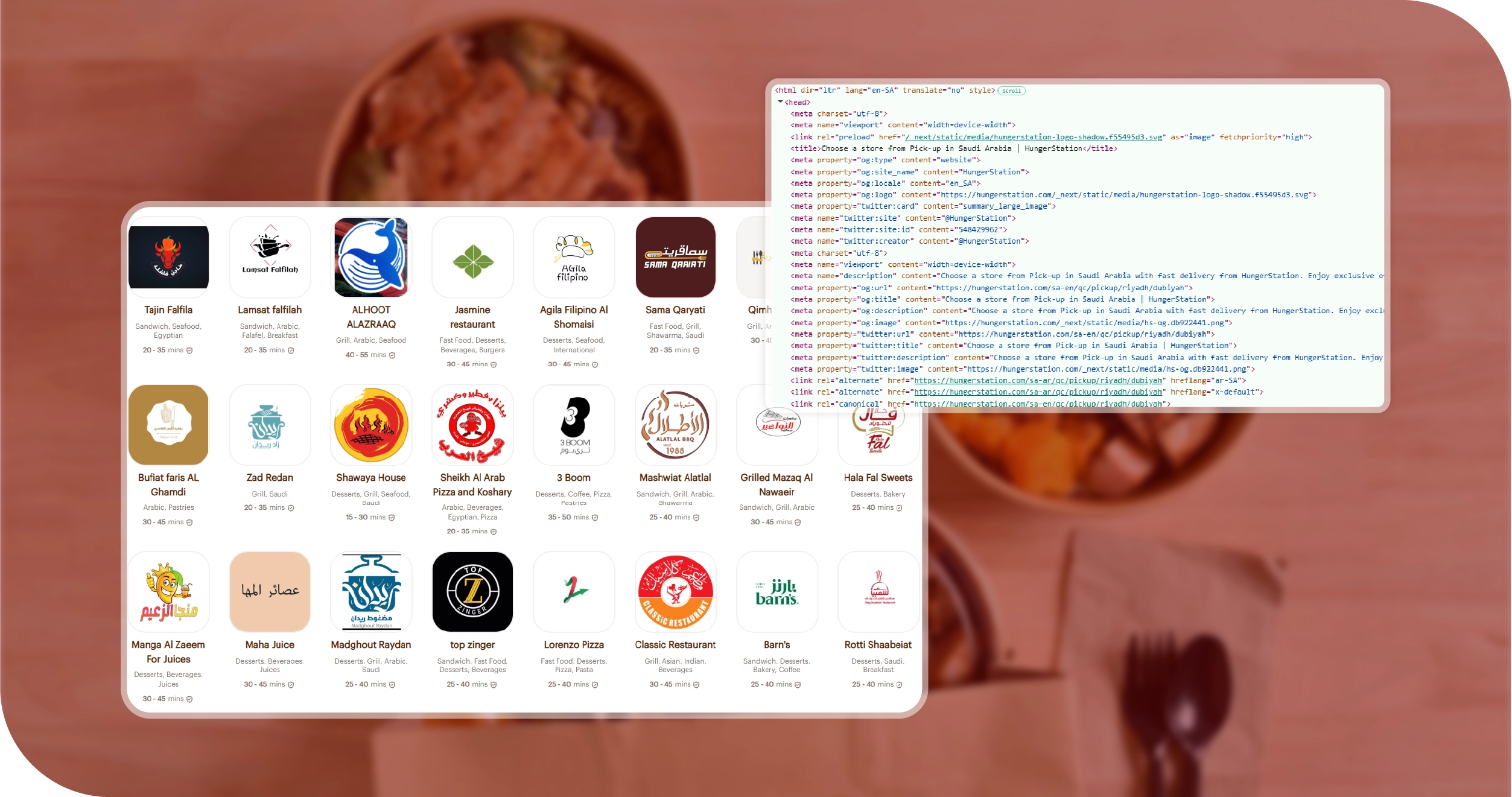
The client lacked continuous access to up-to-date pricing, menu availability, and promotions across platforms. Without the Mrsool Food Delivery Scraping API, market changes went unnoticed for hours or days, leading to delayed reactions and missed opportunities. - Frequent Menu and Price Inconsistencies
Menus, add-ons, and prices were updated manually across apps, increasing errors and mismatches. The absence of reliable Restaurant Menu Data Scraping made it difficult to maintain consistency, affecting customer trust and overall order conversion rates. - Slow Competitive Intelligence
Tracking competitor launches, discounts, and popularity trends required manual effort and scattered reports. Without scalable Food Delivery Data Scraping Services, the client struggled to identify demand shifts quickly and adapt strategies in Saudi Arabia’s fast-moving food delivery market.
Key Solutions
- Centralized Data Automation
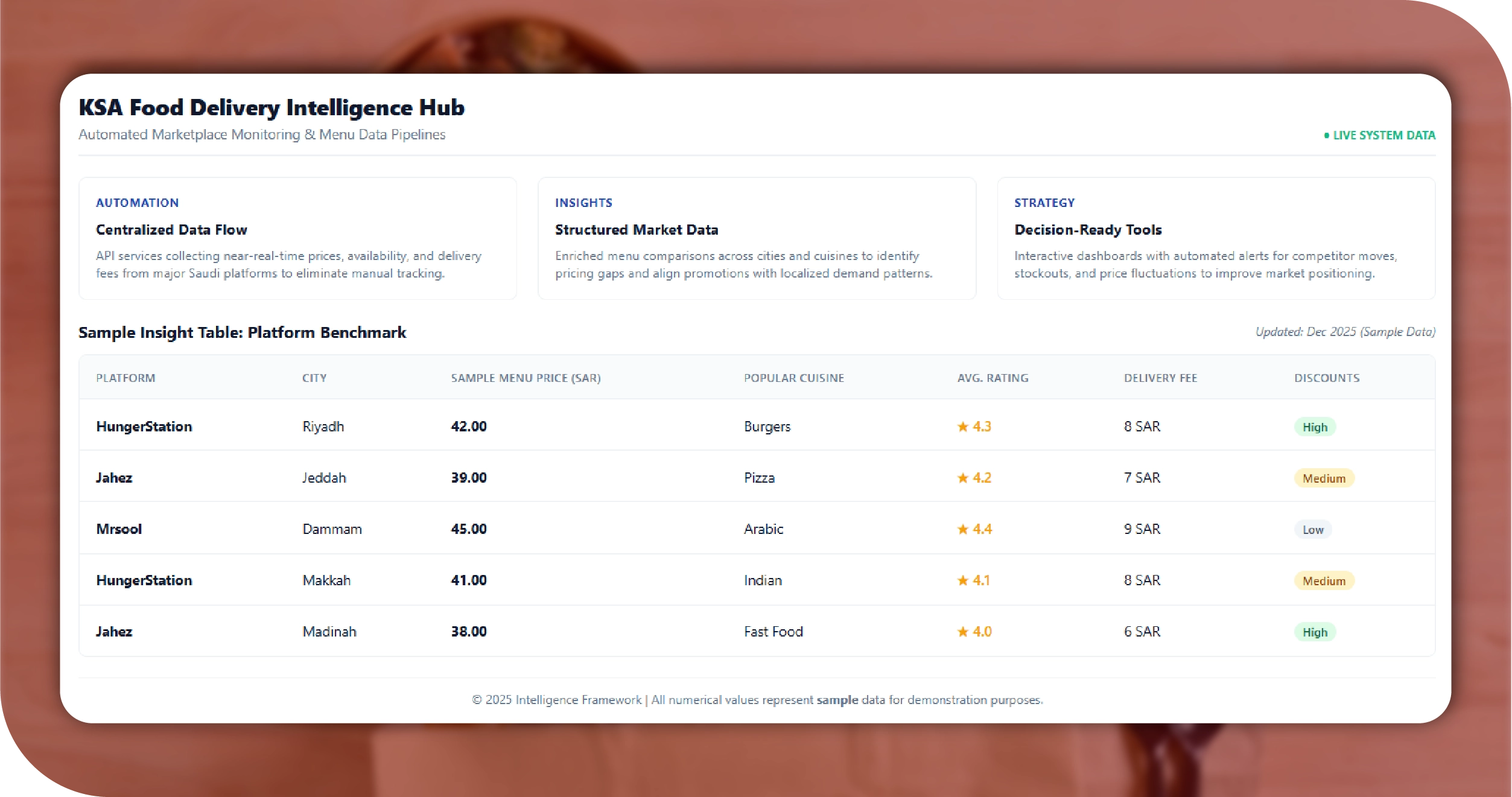
We implemented automated pipelines to collect menus, prices, availability, delivery fees, and ratings from all major Saudi food delivery platforms. Using Food Delivery Scraping API Services, the client eliminated manual tracking and achieved reliable, near–real-time data visibility. - Structured Market & Menu Insights
Raw platform data was standardized and enriched to enable outlet-level, city-level, and cuisine-level comparisons. Through Restaurant Data Intelligence Services, the client identified pricing gaps, optimized menu assortments, and aligned promotions with localized demand patterns. - Decision-Ready Dashboards & Alerts
We delivered interactive dashboards and automated alerts highlighting competitor moves, price changes, and demand spikes. Powered by Food delivery Intelligence services, leadership teams responded faster, improved pricing accuracy, and strengthened competitive positioning across platforms.
Sample Insight Table
| Platform | City | Avg. Menu Price (SAR) | Popular Cuisine | Avg. Rating | Delivery Fee (SAR) | Active Discounts |
|---|---|---|---|---|---|---|
| HungerStation | Riyadh | 42 | Burgers | 4.3 | 8 | High |
| Jahez | Jeddah | 39 | Pizza | 4.2 | 7 | Medium |
| Mrsool | Dammam | 45 | Arabic | 4.4 | 9 | Low |
| HungerStation | Makkah | 41 | Indian | 4.1 | 8 | Medium |
| Jahez | Madinah | 38 | Fast Food | 4.0 | 6 | High |
Methodologies Used
- Comprehensive Multi-Platform Data Collection
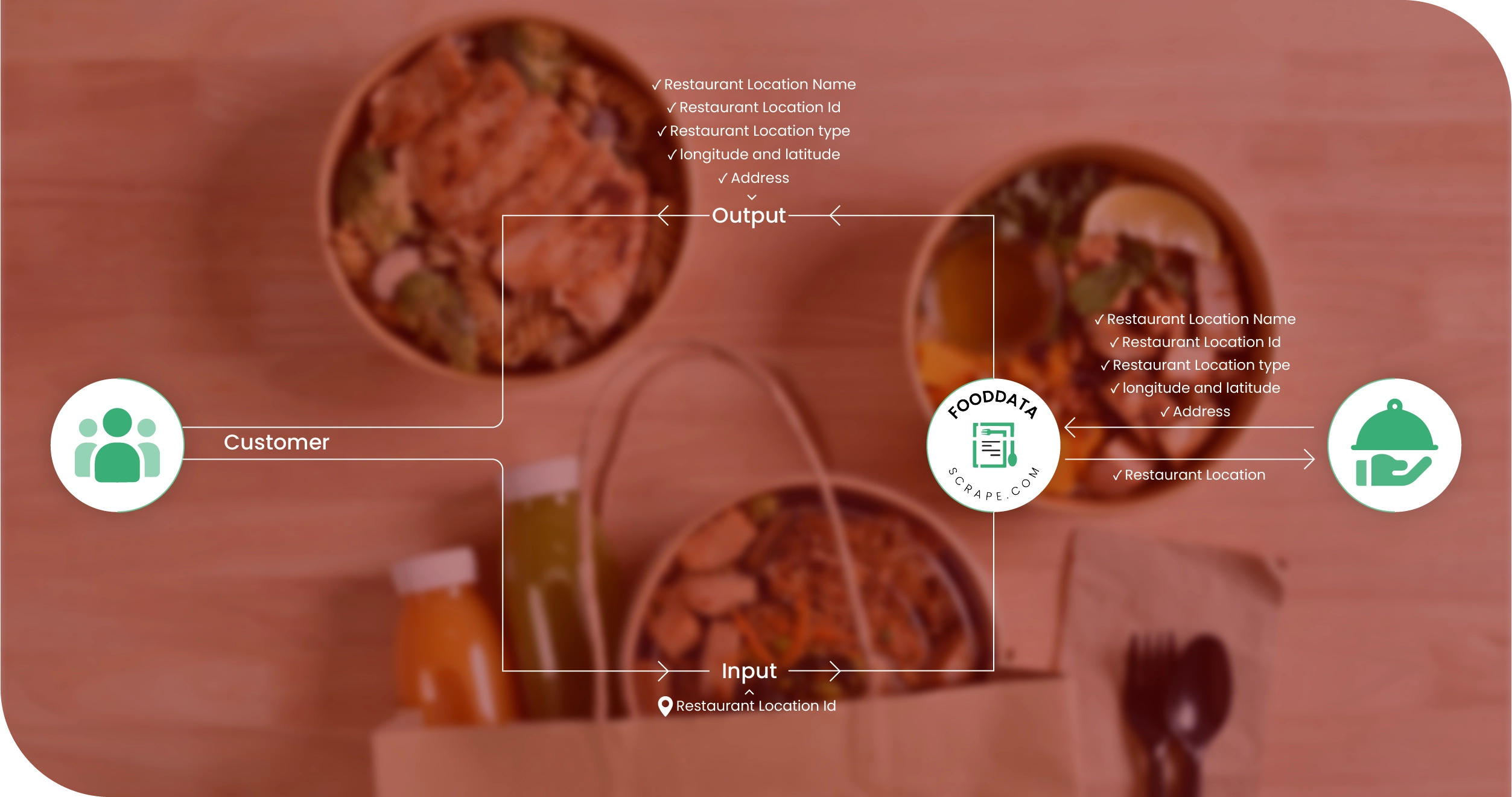
We systematically gathered structured and unstructured data from multiple food delivery platforms, including menus, prices, delivery fees, and ratings. This ensured complete coverage and removed data gaps, creating a reliable foundation for detailed market analysis. - Automated Update Monitoring
Our systems continuously tracked platform changes such as price updates, menu modifications, and promotions. Automated monitoring allowed the client to capture even minor shifts promptly, enabling faster responses to evolving market conditions without manual intervention. - Data Standardization and Validation
Collected data from different platforms was normalized to maintain consistency in naming, categories, and pricing. Rigorous validation processes removed duplicates and corrected anomalies, improving accuracy and ensuring the reliability of insights for decision-making. - Advanced Analytics and Segmentation
We applied analytical techniques to segment data by city, cuisine, time of day, and ratings. This highlighted demand patterns, performance gaps, and opportunities for targeted interventions that were not apparent through basic observation. - Interactive Visualization and Reporting
Insights were presented through dashboards and reports with intuitive visualizations. Complex trends were simplified into actionable information, allowing leadership teams to quickly understand market dynamics and make informed strategic decisions.
Advantages of Collecting Data Using Food Data Scrape
- Faster, Informed Decision-Making
Access to real-time, accurate data allows businesses to make timely decisions. Teams can respond quickly to market trends, pricing changes, and consumer behavior, reducing reliance on assumptions and improving overall operational efficiency. - Comprehensive Market Visibility
By collecting data from multiple platforms, businesses gain a complete view of competitors, pricing strategies, menu offerings, and promotions. This unified visibility helps identify gaps, benchmark performance, and uncover opportunities that would otherwise remain hidden. - Consistency Across Platforms
Automated data collection ensures menu items, pricing, and promotions remain accurate across all delivery platforms. This minimizes errors, enhances customer trust, and strengthens brand reliability, ultimately improving conversion rates and customer satisfaction. - Scalability and Flexibility
The solution easily adapts to additional locations, platforms, and product lines without increasing manual workload. Continuous monitoring and automated updates ensure businesses can scale efficiently as market presence grows. - Actionable Insights for Growth
Data is transformed into clear, practical insights that drive strategic actions. Businesses can optimize menus, adjust pricing, plan promotions, and align offerings with customer preferences, leading to sustained revenue growth and market competitiveness.
Client’s Testimonial
“Working with this team has significantly enhanced our operational efficiency across Saudi Arabia’s food delivery platforms. Their solution provided precise, real-time insights into menu performance, pricing, and competitor strategies, allowing us to make faster, data-driven decisions. The dashboards were user-friendly, and the reports were actionable, helping us optimize menus, adjust pricing dynamically, and plan targeted promotions. As a result, we increased customer engagement, improved order accuracy, and strengthened our competitive positioning. I can confidently say their expertise and tools have been instrumental in driving measurable growth and operational excellence across HungerStation, Jahez, and Mrsool platforms.”
Head of Digital Strategy
Final Outcome
The final outcome delivered substantial improvements in how the client managed and optimized their presence across Saudi Arabia’s food delivery platforms. With access to structured, real-time data, decision-makers could track pricing, menu performance, and competitor activity accurately, enabling timely interventions. The implementation of the Food Price Dashboard allowed continuous monitoring of price trends, promotions, and platform-wise competitiveness, reducing revenue leakage and enhancing profitability. By leveraging comprehensive Food Delivery Datasets, the client consolidated previously fragmented information into a single source of truth. This enabled precise menu optimization, better promotional planning, and identification of high-demand cuisines and locations. Overall, the solution enhanced operational efficiency, improved customer satisfaction, strengthened competitive positioning, and provided a scalable framework for sustained growth in Saudi Arabia’s fast-growing food delivery market.