The Client
Our client is a leading retail and consumer intelligence company that focuses on transforming fragmented marketplace data into actionable insights for global FMCG and grocery brands. They approached us because their existing systems were unable to capture consistent, real-time SKU-level visibility across highly dynamic hyperlocal markets, leading to gaps in pricing intelligence and demand forecasting accuracy.
To solve this, they adopted hyperlocal grocery data scraping solutions in their ecosystem to achieve granular store-level visibility and improved regional pricing insights.
They also required food analytics data collection to better understand consumer demand patterns, optimize product assortment, and enhance forecasting models across fast-moving retail environments.
Additionally, they integrated liquor SKU data extraction to track beverage availability, monitor competitor portfolios, and ensure accurate compliance and pricing intelligence in the alcohol retail segment.
With our support, they achieved unified, scalable, and real-time retail intelligence across grocery and beverage categories.
Key Challenges
- Massive Data Volume and SKU Complexity
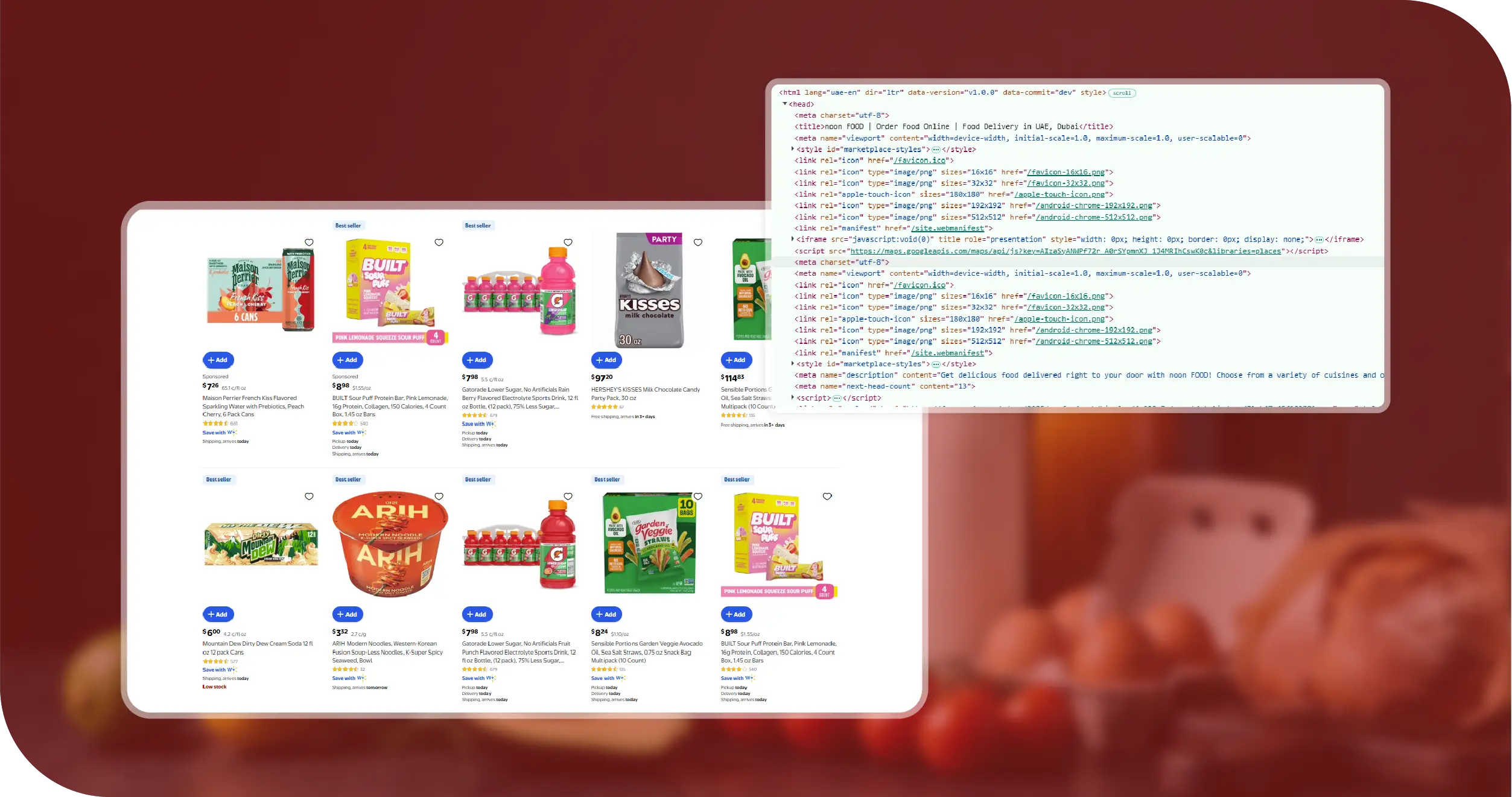
The client struggled with handling extremely large datasets across multiple grocery and FMCG platforms, where SKU structures varied widely and changed frequently. Managing normalization, deduplication, and consistency became difficult at scale. High-volume SKU tracking across retailers further intensified infrastructure load, making real-time ingestion and processing highly complex and resource-intensive. - Lack of Unified Enterprise Visibility
The client faced fragmentation in retail data sources, which prevented a consolidated view of pricing, availability, and competition across regions. This limited their ability to generate actionable insights across business units. Scaling analytics across geographies required robust frameworks for Enterprise Retail Data Intelligence at Scale, which their existing systems could not support efficiently. - Real-Time Monitoring and Accuracy Issues
Frequent price changes, stock updates, and promotional shifts made it difficult to maintain up-to-date insights. Delays in data refresh impacted decision-making accuracy. The absence of real-time retail SKU monitoring tools led to gaps in competitive tracking and reduced effectiveness in dynamic pricing and demand forecasting strategies across retail networks.
Key Solutions
1. Unified Retail Data Pipeline via Online Extraction
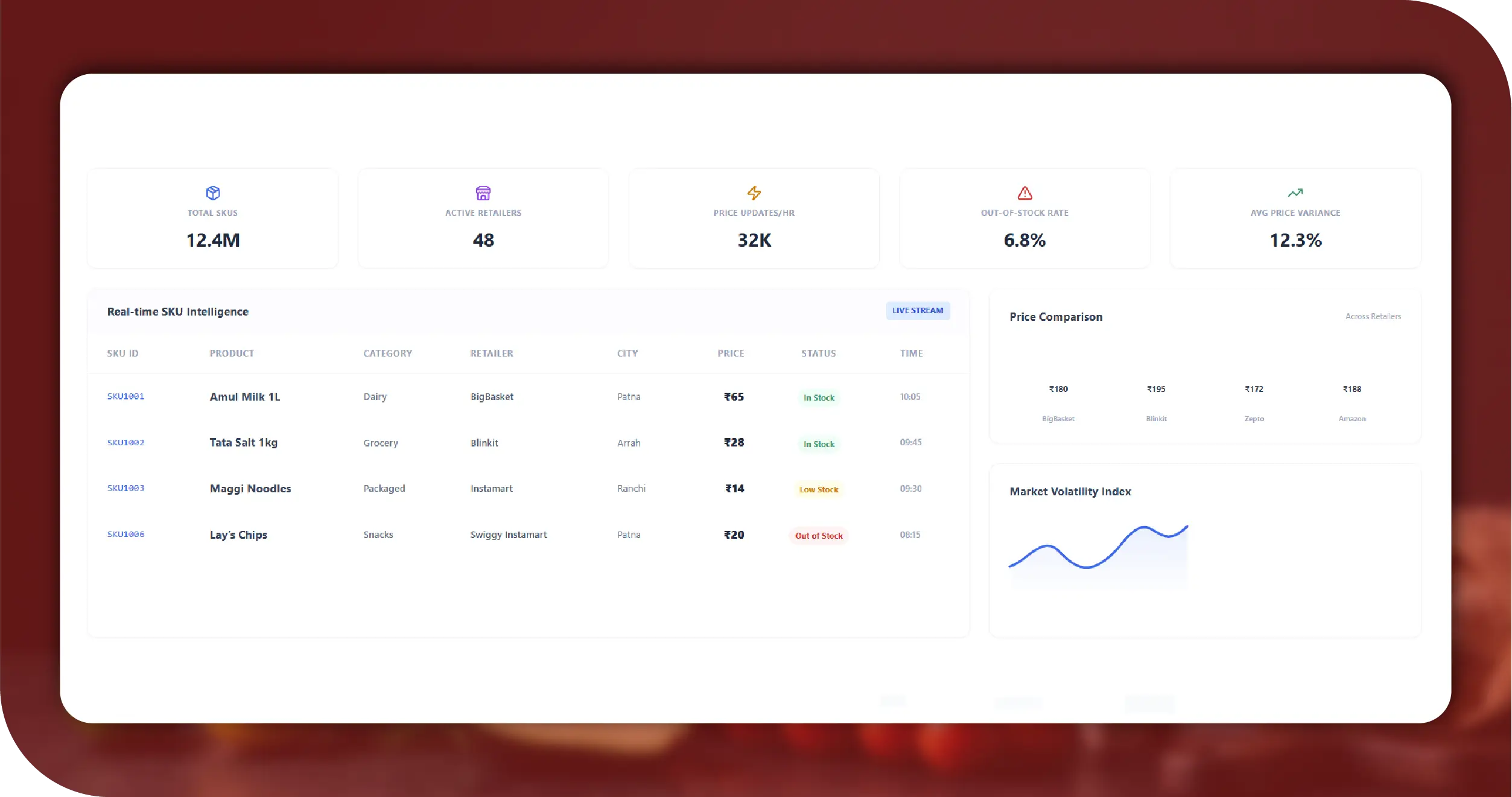
We built a scalable ingestion system that streamlined multi-retailer SKU collection and normalization into a single structured pipeline. It enabled consistent product mapping, pricing alignment, and category tagging across grocery ecosystems, significantly improving data accuracy and reducing fragmentation across diverse retail sources globally.
We implemented online store data extraction to ensure continuous, automated retrieval of SKU-level information from multiple grocery and retail platforms with high reliability and speed.
2. Large-Scale Grocery Intelligence Engine
We designed a distributed scraping architecture capable of handling millions of product records daily with fault-tolerant processing and high-speed data transformation. This enabled real-time analytics readiness and improved data freshness for pricing and availability insights across regions and store networks efficiently.
We deployed Web Scraping Grocery Data at Scale to handle high-volume SKU ingestion, ensuring uninterrupted data flow and scalable infrastructure performance across global grocery marketplaces.
3. Real-Time Food & Delivery Data Integration
We integrated APIs and scraping layers to capture dynamic pricing, menu changes, and delivery availability across multiple platforms. This enabled faster decision-making and improved competitive intelligence for FMCG and food service analytics in highly volatile retail environments.
We implemented Food Delivery Extraction API to automate structured extraction of restaurant menus, pricing updates, and delivery data for real-time analytics and forecasting.
Sample Data
| Platform | Product Category | Product / Combo Offer | MRP (₹) | Discounted Price (₹) | Combo Details | Discount % | Timestamp |
|---|---|---|---|---|---|---|---|
| BigBasket | Dairy | Amul Milk 1L | 65 | 65 | In Stock - Patna | 0% | 2026-04-28 10:05 |
| Blinkit | Grocery | Tata Salt 1kg | 28 | 28 | In Stock - Arrah | 0% | 2026-04-28 10:06 |
| Instamart | Packaged Food | Maggi Noodles | 14 | 14 | Low Stock - Ranchi | 0% | 2026-04-28 10:07 |
| Zepto | Beverages | Coca Cola 750ml | 40 | 40 | In Stock - Patna | 0% | 2026-04-28 10:08 |
| Amazon Fresh | Staples | Basmati Rice 5kg | 410 | 410 | In Stock - Gaya | 0% | 2026-04-28 10:10 |
| Swiggy Instamart | Snacks | Lay’s Chips 52g | 20 | 20 | Out of Stock - Arrah | 0% | 2026-04-28 10:12 |
| Blinkit | Chocolates | Dairy Milk 40g | 30 | 30 | In Stock - Patna | 0% | 2026-04-28 10:13 |
| BigBasket | Household | Surf Excel 1kg | 210 | 210 | In Stock - Ranchi | 0% | 2026-04-28 10:15 |
Methodologies Used
- Distributed Crawling Architecture
We implemented a distributed crawling system that enabled parallel data collection across multiple retail platforms. This approach ensured high-speed extraction, reduced server load, and improved reliability while handling large-scale product catalogs efficiently across different regions and categories without interruptions or data loss. - Structured Data Normalization Framework
A normalization layer was built to standardize inconsistent product formats, pricing structures, and category hierarchies. This ensured unified data representation across sources, enabling accurate comparisons, cleaner datasets, and improved downstream analytics for pricing, inventory, and market intelligence applications at scale. - Real-Time Data Processing Engine
We designed a streaming-based processing engine to handle continuous updates from multiple sources. It enabled near real-time transformation, validation, and enrichment of incoming records, ensuring fresh insights for pricing, availability, and competitor tracking across fast-changing retail environments efficiently. - Intelligent Deduplication and Matching Logic
Advanced matching algorithms were applied to eliminate duplicate records and align similar products across different retailers. This improved dataset accuracy, reduced redundancy, and ensured consistent SKU identity mapping, which is critical for reliable analytics and large-scale retail intelligence operations globally. - Scalable Cloud-Based Infrastructure
We deployed a cloud-native architecture that automatically scales based on data volume and traffic spikes. This ensured uninterrupted performance, high availability, and cost efficiency while supporting massive ingestion workloads and enabling seamless expansion across new markets and product categories.
Advantages of Collecting Data Using Food Data Scrape
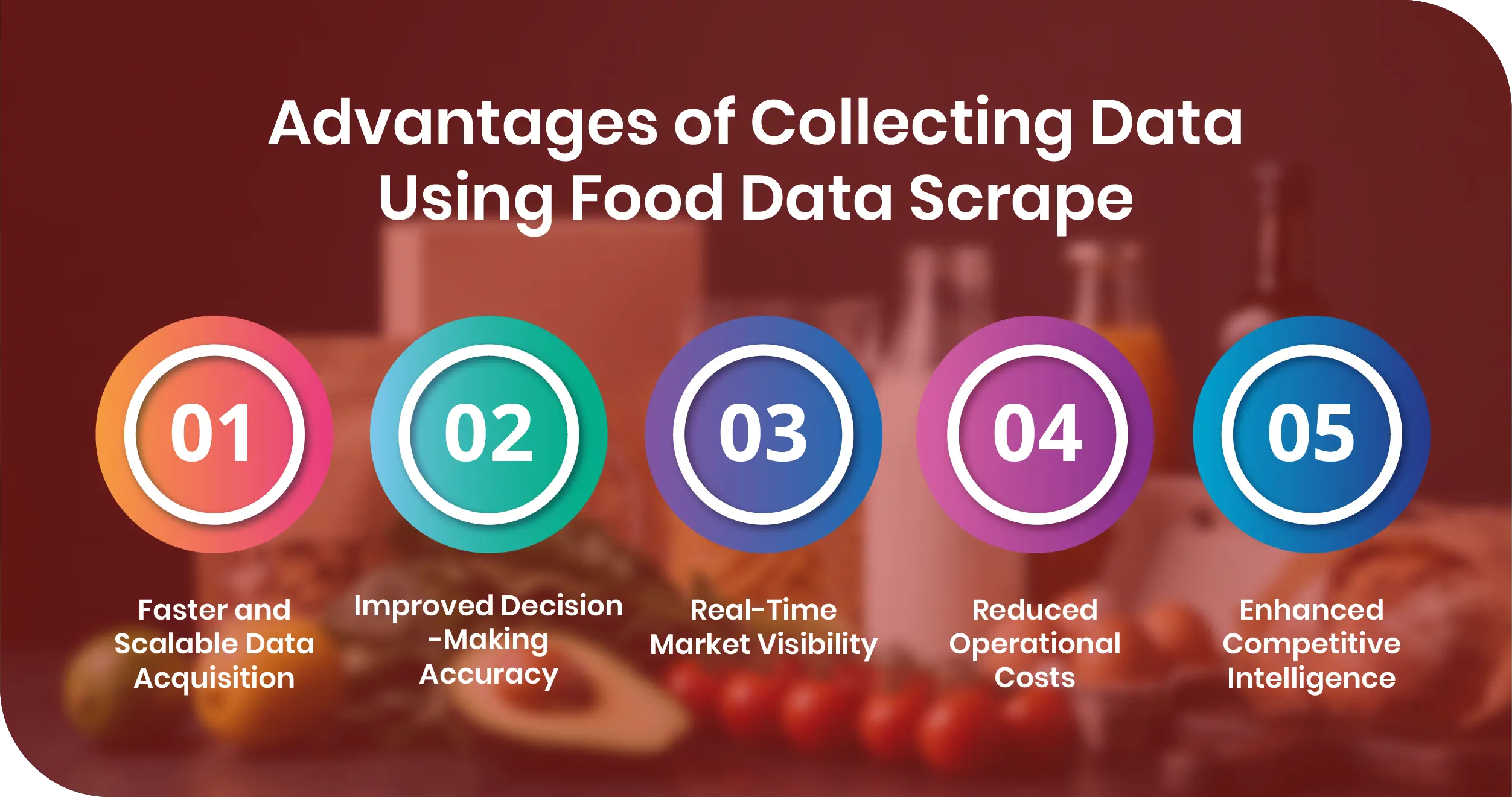
- Faster and Scalable Data Acquisition
Our solution enables rapid collection of large-scale retail information across multiple sources simultaneously. This significantly reduces manual effort, improves processing speed, and allows businesses to scale operations effortlessly while maintaining consistent data quality and operational efficiency across expanding markets globally. - Improved Decision-Making Accuracy
By delivering clean, structured, and frequently updated datasets, businesses gain highly accurate insights for pricing, demand forecasting, and inventory planning. This leads to better strategic decisions, reduced guesswork, and stronger alignment with real-time market conditions and consumer behavior trends. - Real-Time Market Visibility
Our system provides continuously updated insights into product availability, pricing changes, and competitive movements. This ensures businesses maintain real-time awareness of market dynamics, helping them react quickly to fluctuations and optimize strategies for improved performance and customer satisfaction. - Reduced Operational Costs
Automating large-scale data collection eliminates the need for manual research teams and reduces human effort significantly. This lowers operational expenses, improves efficiency, and allows organizations to allocate resources more strategically toward analytics, innovation, and business growth initiatives. - Enhanced Competitive Intelligence
Businesses gain deeper insights into competitor pricing, assortment strategies, and market positioning. This enables stronger benchmarking, faster response strategies, and improved product planning, helping organizations stay ahead in highly competitive and fast-evolving retail environments with data-driven confidence.
Client’s Testimonial
“Working with this team completely transformed our retail intelligence capabilities. We were struggling with fragmented and slow data systems that limited our decision-making speed. Their solution delivered highly structured, scalable, and near real-time insights across millions of records. The accuracy, consistency, and depth of data we now receive have significantly improved our pricing strategies and market responsiveness. What impressed us most was their ability to handle complex requirements with ease and deliver at enterprise scale without disruption. This partnership has strengthened our analytics foundation and given us a true competitive edge in a fast-moving retail environment.”
— Director of Data Strategy
Final Outcome
The final outcome of the project was a fully scalable and intelligent retail analytics ecosystem that transformed how the client interprets market data. With real-time ingestion and processing, they achieved highly accurate pricing visibility and improved category-level decision-making across grocery and beverage segments. The system enabled faster response to market fluctuations and significantly enhanced operational efficiency.
The deployment of Liquor Price Dashboard provided deep insights into beverage pricing trends and competitor movements across regions.
Additionally, the Grocery Price Tracking Dashboard enabled continuous monitoring of SKU-level price changes across multiple retailers.
Through advanced Food Data Intelligence, the client gained predictive insights into demand patterns and consumer behavior.
Finally, structured Liquor Datasets improved compliance tracking, assortment planning, and strategic pricing decisions across markets.