
The Client
The client is a fast-growing food analytics and market intelligence company serving restaurant chains, cloud kitchens, and investment firms across Asia. Their primary objective was to gain deeper visibility into pricing strategies, popular cuisines, order frequency, and location-based demand patterns. They approached us to Extract Restaurant Menu Data at scale to support benchmarking and competitive analysis. To strengthen their research capabilities, they required structured datasets generated through Scraping Keeta Restaurant Listings & Orders for Market Insights, enabling them to identify high-performing outlets and trending menu categories. Additionally, the client wanted a reliable Food Delivery Scraping API integration to automate data collection, ensure real-time updates, and maintain consistency across multiple cities. Their focus was on improving forecasting accuracy, supporting expansion planning, and delivering data-driven insights to enterprise customers in the competitive food delivery ecosystem.
Key Challenges

- Fragmented Geographic Coverage and Data Gaps: The client faced inconsistent coverage across cities, with missing outlet coordinates, incomplete delivery radius details, and irregular order metrics. Without a dependable Keeta Restaurant Location & Order Data Scraper, they struggled to build a unified, location-intelligent database for strategic expansion analysis.
- Inability to Convert Raw Data into Competitive Insights: Collecting information alone was not enough; transforming it into meaningful Restaurant Data Intelligence was a major hurdle. Disconnected datasets, duplicate listings, and inconsistent menu classifications limited their ability to benchmark competitors and evaluate demand patterns accurately.
- Scalability and Automation Constraints: Rapid platform interface changes and heavy dynamic content made Web Scraping Keeta Restaurant Listings & Order Details technically complex. Their internal tools failed to handle high-volume extraction, resulting in outdated reports, delayed analytics, and reduced responsiveness to fast-changing market conditions.
Key Solutions

- Scalable Data Extraction Framework Deployment: We implemented a robust extraction pipeline powered by a secure Keeta Food Delivery Scraping API, enabling automated collection of restaurant locations, delivery zones, menu pricing, and real-time order trends. Our solution ensured high-frequency updates, structured outputs, and minimal downtime across multiple cities.
- Structured Dataset Creation & Standardization: Our team built a comprehensive Keeta Food Delivery Dataset covering geo-coordinates, cuisine categories, average ticket size, peak-hour demand, and rating metrics. We cleaned duplicates, standardized menu taxonomy, validated pricing fields, and delivered analytics-ready data integrated directly into the client’s BI systems.
- Advanced Market & Demand Analytics Enablement: Beyond extraction, we transformed raw data into actionable Food delivery Intelligence, including hotspot mapping, competitor benchmarking dashboards, demand fluctuation reports, and price sensitivity tracking. This empowered the client to optimize expansion planning, promotional timing, and location-based strategy decisions confidently.
Sample Extracted Data Snapshot
| Date | City | Restaurant Name | Cuisine Type | Latitude | Longitude | Avg. Order Value ($) | Daily Orders | Peak Hour | Rating | Delivery Radius (km) |
|---|---|---|---|---|---|---|---|---|---|---|
| 12-Feb-26 | Delhi | Spice Junction | Indian | 28.6139 | 77.2090 | 12.50 | 320 | 8 PM | 4.3 | 5 |
| 12-Feb-26 | Mumbai | Urban Bites | Fast Food | 19.0760 | 72.8777 | 10.20 | 410 | 9 PM | 4.1 | 6 |
| 12-Feb-26 | Bangalore | Pasta Hub | Italian | 12.9716 | 77.5946 | 14.75 | 280 | 7 PM | 4.5 | 4 |
| 12-Feb-26 | Hyderabad | Biryani Express | Mughlai | 17.3850 | 78.4867 | 13.40 | 365 | 8 PM | 4.4 | 5 |
| 12-Feb-26 | Chennai | Curry House | South Indian | 13.0827 | 80.2707 | 9.80 | 295 | 7 PM | 4.2 | 4 |
| 12-Feb-26 | Pune | Grill Masters | BBQ | 18.5204 | 73.8567 | 15.10 | 250 | 9 PM | 4.6 | 6 |
| 12-Feb-26 | Kolkata | Royal Tandoor | North Indian | 22.5726 | 88.3639 | 11.60 | 310 | 8 PM | 4.3 | 5 |
| 12-Feb-26 | Ahmedabad | Flavor Fiesta | Multi-cuisine | 23.0225 | 72.5714 | 10.90 | 270 | 7 PM | 4.0 | 4 |
Methodologies Used
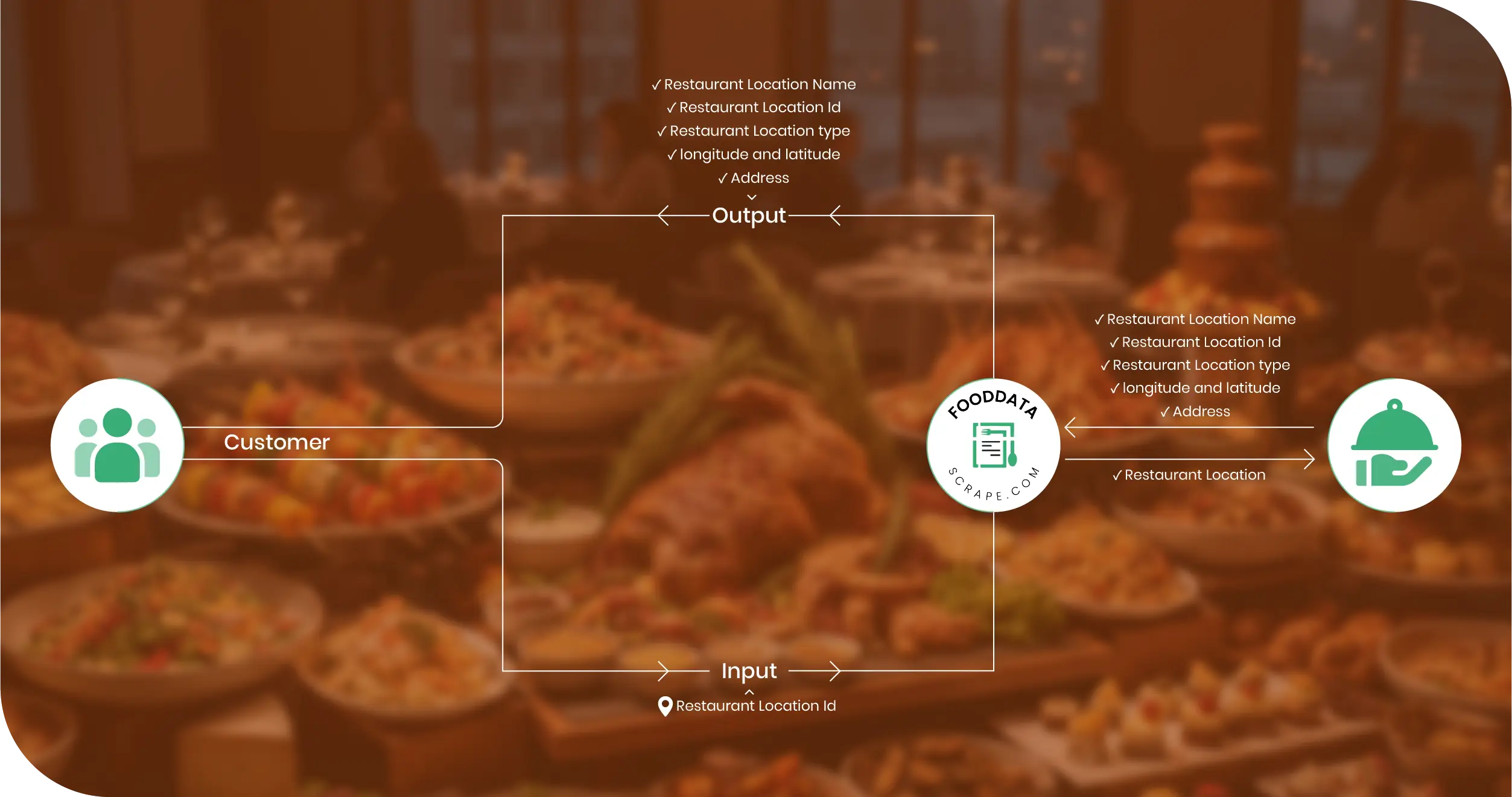
- Requirement Mapping & Data Field Finalization: We began by conducting detailed discovery sessions to define required attributes, including location coordinates, delivery zones, menu items, pricing, ratings, and order volumes. This ensured clarity on structured outputs, update frequency, validation rules, and integration requirements before deployment.
- Intelligent Crawl Architecture Design: Our engineers developed a modular crawling framework capable of handling dynamic content, pagination layers, and geo-specific variations. The architecture supported scalability across cities while maintaining session stability, automated retries, and seamless adaptation to interface structure changes.
- Proxy Rotation & Anti-Blocking Management: To ensure uninterrupted extraction, we implemented rotating IP pools, header optimization, user-agent management, and request throttling. These measures reduced detection risks, improved success rates, and maintained consistent data flow without triggering platform security mechanisms.
- Data Cleaning, Normalization & Validation: Raw extracted information was processed through automated cleaning pipelines. We removed duplicates, standardized cuisine classifications, normalized pricing formats, verified geo-coordinates, and cross-checked rating metrics to deliver analytics-ready datasets aligned with business intelligence standards.
- Automated Monitoring & Continuous Updates: We established scheduled extraction cycles combined with real-time monitoring dashboards. Automated alerts flagged anomalies, structural changes, or missing fields, ensuring ongoing data accuracy, minimal downtime, and continuous performance optimization throughout the engagement.
Advantages of Collecting Data Using Food Data Scrape

- Faster Access to Real-Time Market Data: Our services provide continuous, automated data extraction, ensuring clients receive up-to-date insights without manual effort. This enables quicker responses to pricing changes, demand fluctuations, and competitor movements, helping businesses stay agile in highly dynamic and competitive markets.
- Improved Strategic Decision-Making: By delivering structured and analytics-ready datasets, we empower organizations to make evidence-based decisions. Accurate location intelligence, pricing benchmarks, and order trends allow leadership teams to plan expansion, optimize marketing campaigns, and refine operational strategies confidently.
- Scalable and Customizable Solutions: Our scraping frameworks are designed to scale across multiple cities, categories, and platforms. We tailor data fields, frequency, and formats according to business needs, ensuring flexibility as client requirements evolve or new market opportunities emerge.
- High Data Accuracy and Quality Assurance: We implement multi-layer validation, automated cleaning processes, and structured formatting to ensure reliable outputs. This minimizes errors, eliminates duplicates, and enhances consistency, allowing clients to integrate datasets directly into dashboards, analytics tools, and reporting systems.
- Cost and Time Efficiency: Automating large-scale data collection reduces dependency on manual research teams and repetitive tasks. Clients save operational costs, shorten reporting cycles, and focus internal resources on analysis and growth initiatives rather than time-consuming data gathering processes.
Client Testimonial
"Working with this team has completely transformed how we access and analyze food delivery data. Their structured extraction process delivered accurate location insights, order trends, and pricing intelligence exactly as promised. The datasets were clean, well-organized, and ready for immediate integration into our analytics dashboards. What impressed us most was their technical expertise, timely delivery, and proactive communication throughout the project. They handled complex data challenges seamlessly and ensured consistent updates across multiple cities. Thanks to their support, we’ve strengthened our competitive benchmarking and improved strategic planning. We highly recommend their services to any data-driven organization."
Head of Market Intelligence
Final Outcome
The final outcome of the project delivered measurable business impact and long-term strategic value. By leveraging our Keeta Food Delivery App Data Scraping Services, the client gained continuous access to structured restaurant location data, order trends, pricing variations, and demand fluctuations across multiple cities. With clean and validated Food Datasets, their analytics team was able to conduct advanced benchmarking, identify high-growth zones, and monitor cuisine-specific performance with improved forecasting accuracy. We also helped them build a dynamic Food Price Dashboard that visualized average order values, peak-hour demand, competitor pricing comparisons, and delivery radius insights in real time. As a result, the client strengthened expansion planning, optimized promotional strategies, reduced manual research efforts, and significantly improved data-driven decision-making across departments.