

















Introduction: Bangkok as Southeast Asia's Most Layered Food Market
Few cities in the world rival Bangkok for sheer culinary depth. The Thai capital hosts everything from world-renowned street food stalls to Michelin-starred fine dining, with a rapidly digitizing delivery economy stitched on top. GrabFood Thailand has become the dominant digital window into this market, listing tens of thousands of merchants across the city's vibrant districts — from Sukhumvit and Silom to Sathorn, Thonglor, Ekkamai, Ari, and the residential heartlands of Lat Phrao and Bang Na.
For restaurant brands, franchise operators, hotel groups, investors, and market research firms, structured intelligence about how Bangkok's food delivery market behaves is essential. Which districts have the densest competition? How does pricing vary between expat-heavy Thonglor and locally-anchored Lat Phrao? Which cuisines are growing fastest? Where is promotional intensity highest? Answering these questions reliably demands more than periodic visits and anecdotal observation — it demands continuous, structured data capture.
That gap is exactly where Food Data Scrape delivers. Our infrastructure captures GrabFood Thailand data every day across Bangkok's priority districts, harmonizing merchant, menu, and pricing data into a single decision-ready dataset. This blog explores Bangkok's GrabFood market in depth, highlights data-driven patterns, and explains how brands can put the intelligence to work.
The Bangkok Food Delivery Context
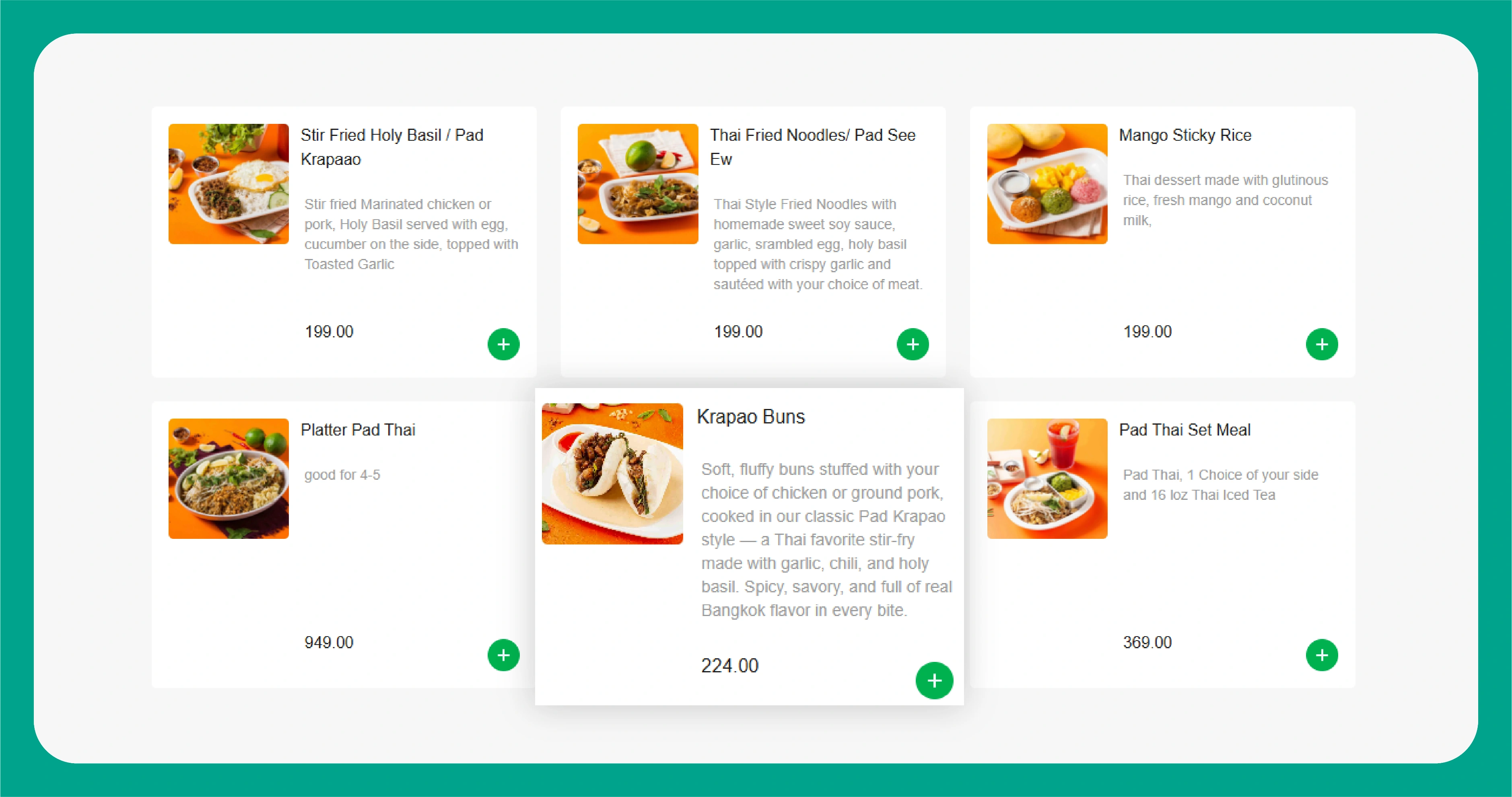
Bangkok's food delivery market is shaped by several distinct dynamics. The city has a vast street food tradition that has selectively migrated onto delivery platforms — many iconic stalls remain offline, while a growing share have established a digital presence. International hotel chains, Thai casual dining brands, Japanese and Korean specialists, and a thriving cafe culture all compete for digital visibility. Bangkok's affluent expat communities concentrate in specific neighborhoods (Sukhumvit, Sathorn, Thonglor, Ekkamai) and shape pricing dynamics there meaningfully.
GrabFood operates alongside foodpanda and LINE MAN in Thailand. The platform lists international chains, Thai casual dining brands, premium concepts, and an increasing share of cloud kitchens. Each merchant's GrabFood presence — pricing in THB, average rating, review velocity, promotional intensity, and district footprint — provides essential intelligence for any commercial decision in Bangkok F&B.
Why Bangkok District-Level Analysis Matters
A robust analysis of Bangkok restaurant data at the district level unlocks insights that aggregate city-wide data cannot deliver.
Pricing varies sharply by district: A typical Thai-style stir-fry can list at 70 THB in Lat Phrao and 180 THB in Thonglor, reflecting rent, target customer, and positioning. District-aware pricing benchmarks are essential.
Cuisine concentration is district-specific: Japanese ramen specialists cluster in Sukhumvit and Thonglor; traditional Thai street-food-style merchants dominate residential districts; international fine dining concentrates in Silom and Sathorn. New entrant strategy depends on where each cuisine has headroom.
Expat-driven pricing premiums are quantifiable: Districts with high expat concentration consistently price 30 to 60 percent above equivalent locally-anchored neighborhoods. Brands targeting expat customers should price accordingly; brands targeting local demand should not.
Tourist-flow effects in central districts: Sukhumvit's lower numbers and Silom show observable pricing premiums driven by tourist demand — particularly visible in Western, Japanese, and Thai-fusion concepts.
Cloud kitchen footprint by district: Cloud kitchen operators have selectively expanded into specific Bangkok districts, with measurable effects on competitive intensity in those areas.
Promotional cycles vary by district economics: Districts serving more price-sensitive demographics see heavier promotional activity than premium districts where positioning preserves brand equity.
How the Data Is Captured
Our infrastructure is purpose-built to Extract Bangkok Restaurant Data from GrabFood at scale. The methodology rests on six pillars designed to deliver clean, district-aware, continuously refreshed intelligence.
District-level anchoring: We anchor delivery addresses across Sukhumvit, Silom, Sathorn, Thonglor, Ekkamai, Ari, Phrom Phong, Lat Phrao, Bang Na, Ratchada, Phaya Thai, Chatuchak, and other priority districts to surface neighborhood-level patterns.
Cuisine taxonomy: Each merchant and dish is mapped into a harmonized cuisine taxonomy covering Thai (regional sub-categories), Japanese, Korean, Chinese, Western, Italian, Indian, Halal-friendly, plant-based, dessert/beverage, and emerging categories.
Currency and tax handling: Records are stored in THB with explicit tax-inclusive flags reflecting Thailand's VAT regime
Language handling: Listings appear in Thai and English. Our parsing layer handles both languages and normalizes dish and brand names so the same merchant is recognizable regardless of which language a customer sees.
Refresh cadence: Top-velocity merchants and trending concepts refresh daily; long-tail merchants refresh weekly. Promotional changes trigger near-real-time recaptur
Quality assurance: Every record passes schema validation, merchant disambiguation, cuisine reclassification, and outlier detection.
GrabFood Thailand API scraping supports filtering by district, cuisine, brand, price band, promotional status, and date range, making it easy to plug Bangkok restaurant intelligence into business intelligence pipelines.
Sample Bangkok GrabFood Data
Below are representative samples drawn from a typical Bangkok restaurant intelligence dataset. All prices in THB.
Sample 1: District-Level Pricing for Equivalent Thai Dishes
| Dish | Sukhumvit | Silom | Thonglor | Lat Phrao | Bang Na |
|---|---|---|---|---|---|
| Pad Thai Goong | 150 | 145 | 180 | 75 | 80 |
| Tom Yum Goong | 220 | 210 | 280 | 110 | 120 |
| Khao Pad Gai | 120 | 110 | 140 | 65 | 70 |
| Massaman Curry | 180 | 170 | 220 | 95 | 100 |
| Som Tam | 80 | 75 | 110 | 50 | 55 |
Sample 2: Cuisine Merchant Density by District
| District | Thai Traditional | Japanese | Korean | Western | Cafe / Dessert |
|---|---|---|---|---|---|
| Sukhumvit | 480 | 290 | 180 | 230 | 380 |
| Silom | 310 | 180 | 110 | 220 | 240 |
| Sathorn | 290 | 170 | 100 | 210 | 220 |
| Thonglor | 220 | 240 | 160 | 190 | 320 |
| Ekkamai | 180 | 200 | 140 | 150 | 280 |
| Lat Phrao | 540 | 110 | 80 | 90 | 180 |
| Bang Na | 420 | 95 | 70 | 80 | 150 |
Sample 3: Promotional Activity by District
| District | Merchants with Active Promo | Avg Discount | Promo Style |
|---|---|---|---|
| Sukhumvit | 38% | 18% | Set Discount |
| Thonglor | 32% | 16% | Combo / Bundle |
| Silom | 36% | 17% | Office Lunch Special |
| Lat Phrao | 52% | 24% | Daily Deal / BOGO |
| Bang Na | 49% | 22% | Family Bundle |
| Ari | 41% | 19% | Cafe Set |
Sample 4: Top 5 Cuisines by Active Merchant Count (Bangkok-wide)
| Rank | Cuisine | Active Merchants | Notes |
|---|---|---|---|
| 1 | Thai Traditional | 7,820 | Highest density; street-food heritage |
| 2 | Japanese | 2,180 | Strong in Sukhumvit, Thonglor |
| 3 | Cafe / Dessert | 2,640 | Fast-growing; broad coverage |
| 4 | Western | 1,920 | Concentrated in expat districts |
| 5 | Korean | 1,540 | Rapid recent growth |
These tables represent a small slice of the millions of records captured monthly across GrabFood Bangkok.
What the Data Reveals
Several consistent patterns emerge from systematic Bangkok GrabFood analysis.
Expat-heavy districts price 50 to 100 percent above residential heartlands: Pad Thai listing at 75 THB in Lat Phrao versus 180 THB in Thonglor is not an outlier — it reflects a structural pricing pattern visible across most Thai dishes. Brands serving both demographics must price intentionally.
Thonglor and Ekkamai concentrate Japanese, Korean, and cafe concepts: These adjacent districts host disproportionate counts of international cuisine merchants relative to their population, reflecting their reputation as Bangkok's most internationally-oriented neighborhoods.
Lat Phrao and Bang Na lead in promotional intensity: The two residential districts show the highest share of merchants with active promotions, reflecting more price-sensitive consumer demographics. Brands operating in these districts should expect to compete heavily on promotion.
Cafe culture has expanded materially: Cafe and dessert merchant counts have grown across Bangkok, with particularly strong presence in Thonglor, Ari, and Ekkamai. The category continues to attract new entrants.
Korean cuisine is the fastest-growing international category: Year-on-year merchant count growth in Korean concepts outpaces all other international cuisines, particularly in Sukhumvit and Thonglor.
Lunch-window pricing differs from dinner: Several office-district merchants (Silom, Sathorn) run lunch-window promotional sets that disappear by evening — a temporal pattern visible only with appropriately timed data capture.
Use Cases for Bangkok Restaurant Data
The applications of structured Thai food market intelligence span the food and beverage value chain.
Thai restaurant brands and franchise operators use the data to benchmark district-specific pricing, identify under-served districts, and time menu launches against competitive activity. International F&B chains entering Bangkok use the data to plan district-level rollout sequences. Hotel groups monitor competitor restaurant pricing and assortment to inform their own F&B strategy. Cloud kitchen operators identify which districts have headroom for new virtual brands. FMCG and ingredient suppliers track dish-level adoption of new ingredient categories. Investors validate Thai restaurant group growth assumptions during due diligence. Tourism boards and government agencies monitor restaurant sector evolution.
Schema and Coverage
A typical record includes merchant name, brand affiliation, address and geocoordinates, Bangkok district and sub-district, opening hours, average consumer rating and review count, cuisine taxonomy, dish names in Thai and English where useful, dish-level pricing in THB, VAT-inclusive flag, promotional flags, image URLs, and capture timestamp. Coverage spans all priority Bangkok districts with anchor sets configurable for additional sub-districts at client request.
Why Choose Food Data Scrape
Capturing reliable Bangkok GrabFood intelligence is harder than it appears. Bilingual listings require careful parsing, district-based personalization affects what consumers see, cuisine classification varies between merchants, and pricing shifts frequently during lunch and dinner windows. Most internal teams underestimate the engineering and Thai market context required to deliver trustworthy data.
We bring managed infrastructure, ethical and compliant data collection practices, and deep domain expertise in Thai and Southeast Asian food and beverage. Advantages include compliance-first architecture, scalable extraction across millions of public pages daily, Thai-English bilingual parsing, fully customizable harmonized schemas, near-real-time refresh on priority merchants, dedicated analyst support familiar with Bangkok market dynamics, and out-of-the-box dashboards highlighting district-by-district patterns.
Conclusion: Bangkok's Layered Market, Decoded
Bangkok's food delivery market is one of the most layered and dynamic in Southeast Asia. Pricing varies dramatically by district, cuisine concentration shifts neighborhood by neighborhood, promotional intensity tracks local economic profiles, and emerging categories like Korean cuisine and cafe culture continue to expand. Anyone making serious commercial decisions in Bangkok F&B needs structured, district-aware data to act with confidence.
Our team transforms GrabFood Thailand's public Bangkok catalog into structured intelligence ready to power strategy. Whether you need a one-time district benchmarking study, a recurring competitive dashboard, or an always-on data feed integrated into your business intelligence stack, we configure a delivery model that fits your workflow. If you are ready to act on real Bangkok restaurant data instead of intuition, get in touch with our team today.