
















Introduction
The modern grocery industry is driven by rapid price fluctuations, aggressive discounting strategies, and highly dynamic promotional campaigns. To stay competitive, retailers and analysts rely heavily on structured data pipelines that can capture real-time pricing and deals across multiple platforms.
The need to Scrape Retail Grocery On-Sale Data (HEB, Publix, Winn-Dixie, Walmart, Kroger) has become essential for businesses that want to track competitor pricing behavior and promotional cycles across major U.S. supermarket chains.
In parallel, Retail Grocery On-Sale Data Aggregation helps consolidate scattered promotional listings into a unified dataset, enabling cleaner analysis and better decision-making across multiple retail sources.
At the same time, Grocery Discount Data Extraction ensures that every discount, coupon, markdown, and limited-time offer is accurately captured and categorized for further analytics.
Why Grocery On-Sale Data Matters in Retail Intelligence?
The grocery industry operates on thin margins, making pricing strategy one of the most important competitive tools. Even small differences in price can influence customer decisions, especially for essential goods.
Retailers continuously adjust prices based on competitor activity, inventory levels, and seasonal demand. This creates a highly volatile pricing ecosystem where real-time insights become extremely valuable.
By analyzing on-sale data, businesses can:
- Understand competitor pricing strategies
- Identify peak discount periods
- Track category-level price sensitivity
- Optimize promotional campaigns
This is where structured data collection plays a critical role in transforming raw listings into actionable intelligence.
Supermarket Price Monitoring Across Major Chains
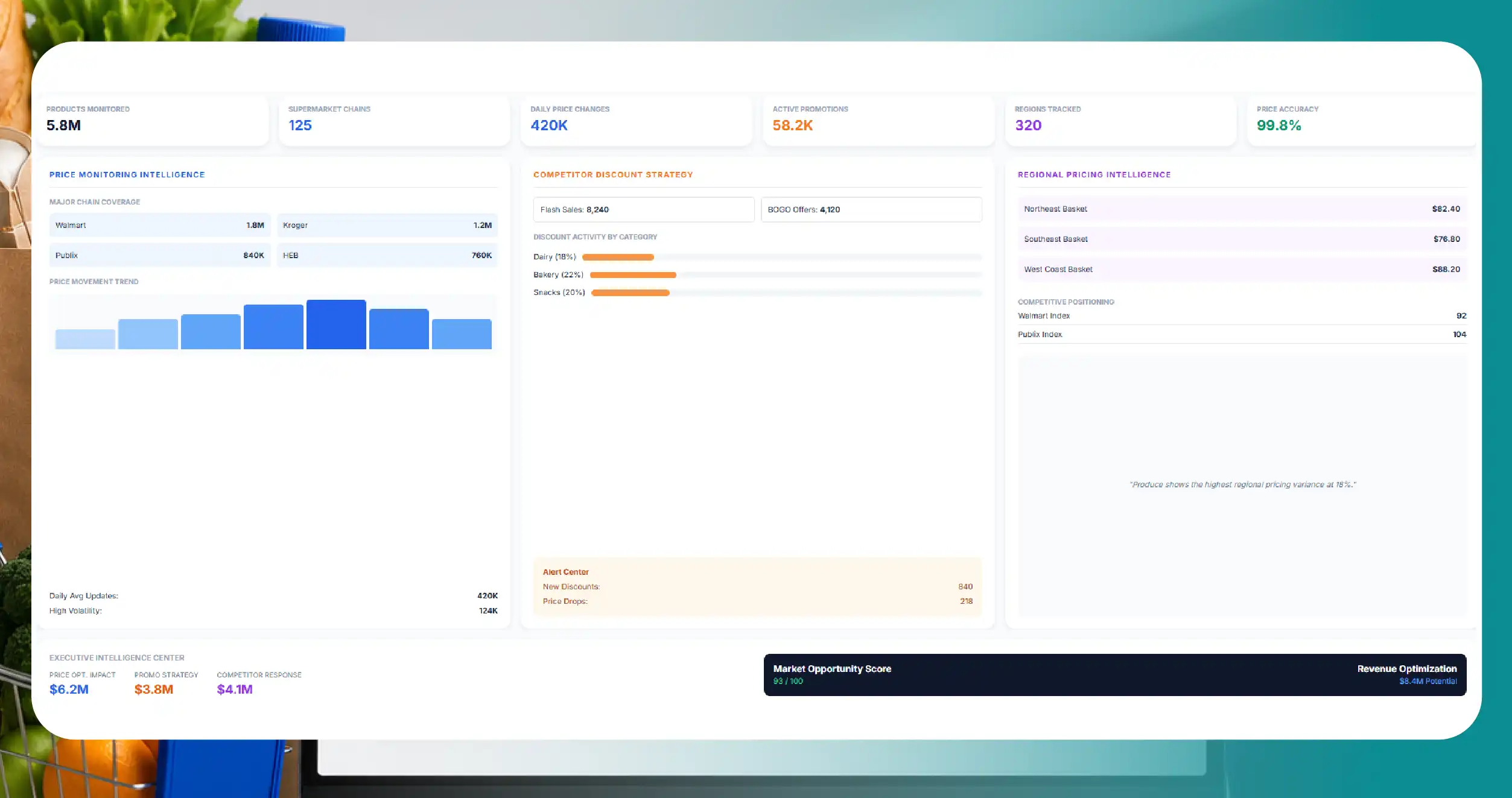
Supermarket Sale Price Monitoring allows retailers to continuously observe how prices change across leading grocery chains like Walmart, Kroger, Publix, HEB, and Winn-Dixie.
This monitoring is especially important for fast-moving consumer goods (FMCG), where prices can change weekly or even daily. For example, dairy and bakery items often see frequent promotional adjustments compared to packaged goods.
Continuous monitoring helps businesses:
- Detect sudden price drops
- Identify competitor discount strategies
- Compare regional pricing differences
- Evaluate promotional effectiveness
This type of intelligence is critical for maintaining competitive pricing in saturated grocery markets.
Grocery Deals and Promotional Tracking
Grocery Deals & Discounts Data Collection focuses on capturing structured promotional information such as BOGO offers, seasonal discounts, bundle pricing, and loyalty rewards.
Retailers use these strategies not just to increase sales but also to drive customer retention and brand loyalty.
By analyzing deal data, businesses can:
- Identify which promotions drive maximum conversions
- Track discount frequency by category
- Compare promotional depth across retailers
- Understand customer buying patterns
This allows for smarter promotional planning and better inventory management.
CTA: Unlock smarter pricing decisions with real-time grocery intelligence—connect with us today to transform raw retail data into actionable growth insights.
Multi-Retailer Grocery Data Scraping
Walmart, Kroger, Publix Grocery Data Scraping enables businesses to compare pricing and promotions across leading grocery chains in a structured format.
Each retailer follows different pricing strategies. Walmart focuses on everyday low pricing, Kroger emphasizes loyalty-based discounts, while Publix is known for BOGO-heavy promotions.
By combining data from these retailers, businesses can:
- Benchmark pricing across competitors
- Analyze regional pricing variations
- Identify underpriced or overpriced categories
- Improve strategic pricing decisions
This multi-source approach is essential for building a complete market view.
Grocery Pricing Intelligence Systems
Grocery Pricing & Promotions Intelligence transforms raw pricing data into actionable business insights. Instead of just collecting prices, this system analyzes patterns, trends, and anomalies.
It helps retailers answer key questions such as:
- When do competitors reduce prices most frequently?
- Which products receive the highest discounts?
- How long do promotional cycles last?
This intelligence layer supports predictive pricing strategies, helping retailers stay ahead of competitors rather than reacting after changes occur.
Grocery Delivery Data Ecosystem
Online grocery delivery platforms have added another layer of complexity to pricing analysis.
Walmart Grocery Delivery Dataset provides structured insights into digital pricing, delivery fees, and product availability within Walmart’s online ecosystem. This helps businesses compare in-store vs online pricing differences.
Similarly, Kroger Grocery Delivery Scraping API enables automated extraction of Kroger’s online grocery listings, including real-time updates and substitutions. This API-driven approach ensures continuous data flow for analytics platforms.
For regional markets, Publix Grocery Delivery Scraping API delivers structured data from Publix’s online grocery system, helping analysts understand localized pricing strategies and promotions.
Web Scraping and Data Extraction Frameworks
At the core of modern grocery analytics lies Web Scraping Grocery Data, which enables automated extraction of pricing, promotions, and product availability from multiple supermarket websites.
This structured extraction process eliminates manual tracking and ensures real-time accuracy across datasets.
To further streamline integration, Grocery Delivery Extraction API converts scraped data into structured formats that can be directly used in dashboards, machine learning models, and pricing systems.
Together, these technologies form the backbone of modern retail intelligence systems.
Grocery Dashboards and Visualization Tools
Data becomes powerful only when it is visualized effectively.
A Grocery Price Dashboard provides an interactive view of pricing trends across multiple retailers, allowing users to compare categories, track discounts, and analyze historical pricing patterns.
A more advanced system, Grocery Price Tracking Dashboard, enables real-time monitoring of price fluctuations. Businesses can instantly detect competitor discounts, promotional spikes, and market changes without delay.
These dashboards are essential for decision-makers in category management, procurement, and retail strategy.
Key Benefits of Grocery Data Intelligence
Grocery Data Intelligence plays a transformative role in modern retail operations. It enables organizations to move from reactive pricing strategies to proactive and predictive models.
Some key benefits include:
- Improved pricing accuracy
- Better promotional planning
- Enhanced competitor benchmarking
- Increased revenue optimization
- Faster decision-making cycles
By combining structured datasets with analytics, businesses gain a significant competitive advantage in the grocery sector.
Challenges in Grocery Data Collection
Despite its benefits, grocery data scraping and analytics come with challenges.
Data inconsistency across retailers is a major issue. Each platform structures its pricing and promotional data differently, making normalization complex.
Frequent website changes also affect scraping accuracy, requiring continuous updates to extraction systems.
Additionally, real-time data processing requires strong infrastructure to handle large volumes of rapidly changing information.
Addressing these challenges requires robust engineering, scalable APIs, and intelligent data validation systems.
How Food Data Scrape Can Help You?
Real-time competitor pricing visibility
Food Data Scrape continuously tracks Walmart, Publix, and Winn-Dixie pricing, helping businesses
instantly detect price changes, promotional shifts, and market movements to stay competitively
aligned and strategically responsive.
Accurate promotion tracking across retailers
We extract structured promotional data like BOGO offers, seasonal discounts, and bundle deals,
enabling clear comparison of how each supermarket structures incentives and influences customer
buying decisions across categories.
Category-level market intelligence
Our services organize grocery data by categories such as dairy, snacks, and household
essentials, allowing deeper insights into pricing gaps, discount intensity, and demand-driven
pricing variations across competitors.
Faster and scalable data collection
We automate large-scale extraction across thousands of SKUs daily, reducing manual effort while
ensuring consistent, structured, and up-to-date grocery pricing datasets for analytics and
business decision-making processes.
Improved strategic pricing decisions
By analyzing extracted grocery data, businesses can optimize pricing strategies, identify
profitable opportunities, and respond quickly to competitor actions, improving overall revenue
performance and market positioning efficiency.
Conclusion
The grocery retail industry is becoming increasingly data-driven, with pricing and promotions evolving at unprecedented speed. Businesses that can effectively capture and analyze this data gain a significant strategic advantage.
With systems like Grocery Price Tracking Dashboard, companies can monitor competitor pricing in real time and react faster to market changes.
The rise of Grocery Data Intelligence enables deeper insights into consumer behavior, pricing strategies, and promotional effectiveness.
Ultimately, structured Grocery Datasets form the foundation of predictive analytics, helping retailers optimize pricing, improve profitability, and stay competitive in a rapidly evolving marketplace.
Are you in need of high-class scraping services? Food Data Scrape should be your first point of call. We are undoubtedly the best in Food Data Aggregator and Mobile Grocery App Scraping service and we render impeccable data insights and analytics for strategic decision-making. With a legacy of excellence as our backbone, we help companies become data-driven, fueling their development. Please take advantage of our tailored solutions that will add value to your business. Contact us today to unlock the value of your data.