The Client
The client is a data-driven food and delivery market intelligence firm focused on understanding pricing behavior and service performance across Saudi Arabia. Their core goal is to build reliable benchmarks for restaurant pricing, delivery fees, and promotional strategies to support analytical reports and strategic consulting. By using the Real-Time Keeta Food Delivery API Data Scraper, the client ensures continuous access to fresh, location-specific delivery data. With the ability to Scrape Keeta Food Delivery Deals & Offers Data, they track discounts, surge-based promotions, and regional incentives that directly influence customer choice. Powered by the Keeta Food Delivery Scraping API, the client transforms raw app data into structured insights, enabling accurate price comparison, delivery trend analysis, and market forecasting for stakeholders operating in Saudi Arabia’s competitive food delivery ecosystem.
Key Challenges
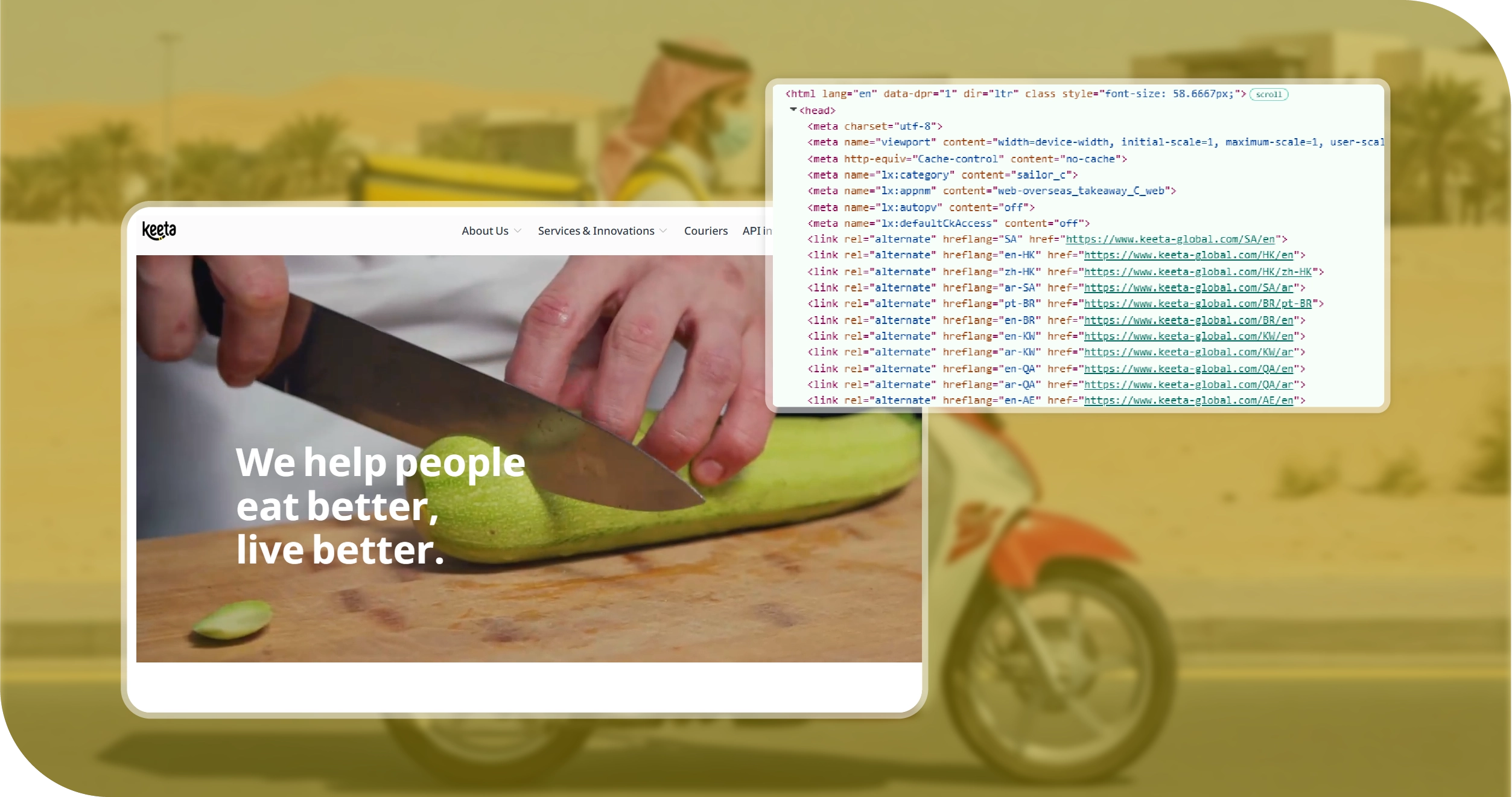
- Data Accessibility & Consistency: The client struggled to Extract Keeta Food Delivery Data reliably due to frequent app updates, dynamic content loading, and regional availability differences, which caused inconsistencies in restaurant listings, menu visibility, delivery fees, and estimated delivery times.
- Scalability & Real-Time Accuracy: Without robust Food Delivery Data Scraping Services, the client faced challenges scaling data collection across multiple Saudi cities while maintaining real-time accuracy, resulting in delays in capturing surge pricing, limited-time offers, and peak-hour delivery cost fluctuations.
- Complex Menu Structures: Managing Restaurant Menu Data Scraping was difficult because menus included variants, add-ons, combo pricing, and time-based availability, making it hard to normalize item-level data for fair price comparison and comprehensive delivery market analysis.
Key Solutions
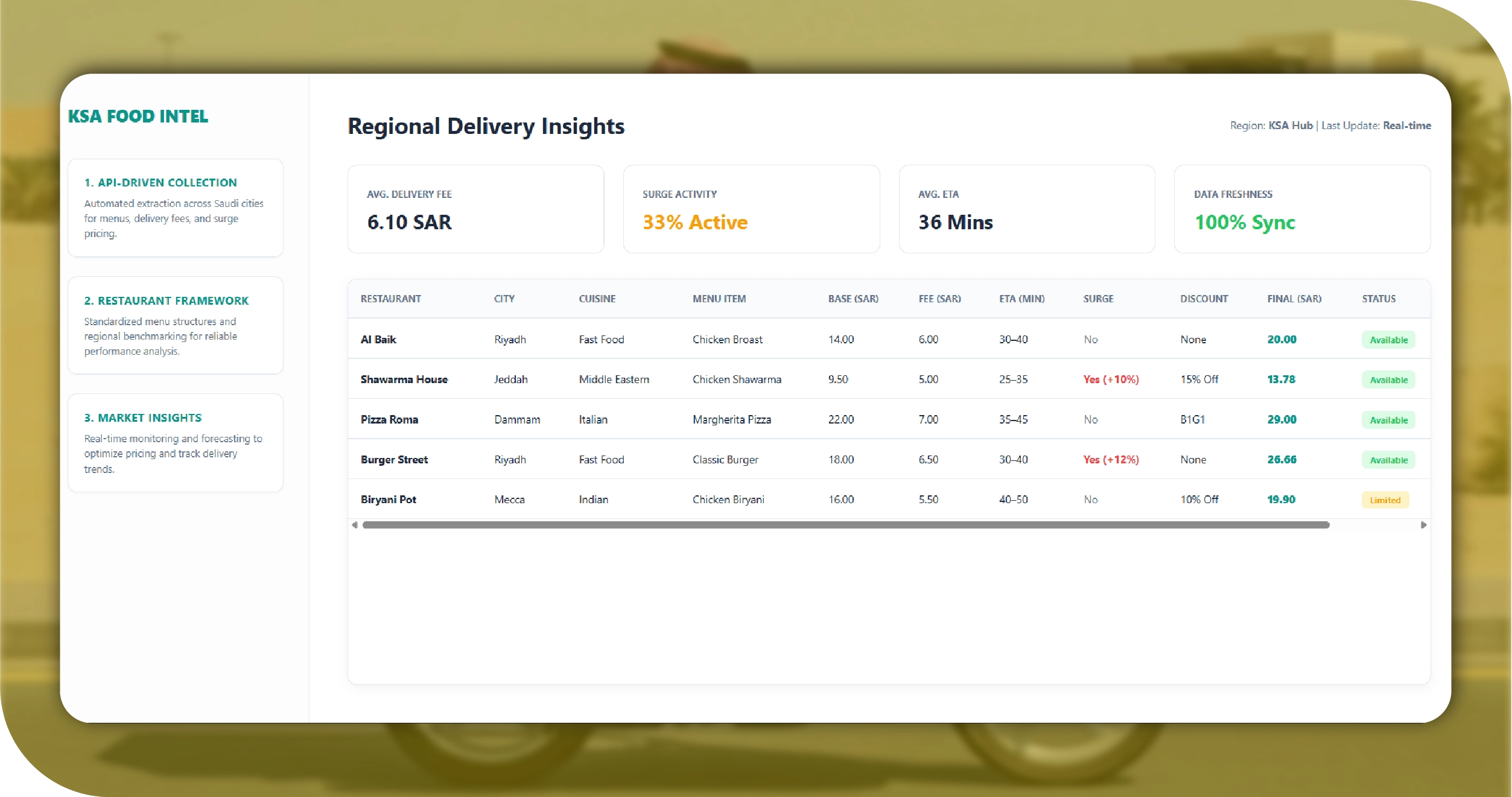
- Scalable API-Driven Data Collection: We implemented Food Delivery Scraping API Services that automated large-scale data extraction across multiple Saudi cities, ensuring stable access to restaurant listings, menus, delivery fees, surge pricing, and estimated times despite frequent platform and interface changes.
- Structured Restaurant Intelligence Framework: Through Restaurant Data Intelligence Services, we standardized complex menu structures, variants, and add-ons into clean datasets, enabling accurate price comparison, regional benchmarking, and reliable analysis of restaurant performance and delivery cost behavior.
- Actionable Market Insights Delivery: Our Food delivery Intelligence services transformed raw scraped data into decision-ready insights, supporting real-time monitoring, competitive analysis, and market forecasting to help the client identify pricing gaps, optimize strategies, and track evolving delivery trends.
Sample Extracted Data
| Restaurant Name | City | Cuisine | Menu Item | Category | Base Price (SAR) | Delivery Fee (SAR) | Estimated Time (mins) | Surge Pricing | Offer/Discount | Final Price (SAR) | Availability | Last Updated |
|---|---|---|---|---|---|---|---|---|---|---|---|---|
| Al Baik | Riyadh | Fast Food | Chicken Broast | Main | 14.00 | 6.00 | 30–40 | No | None | 20.00 | Available | Real-time |
| Shawarma House | Jeddah | Middle Eastern | Chicken Shawarma | Main | 9.50 | 5.00 | 25–35 | Yes (+10%) | 15% Off | 13.78 | Available | Real-time |
| Pizza Roma | Dammam | Italian | Margherita Pizza | Main | 22.00 | 7.00 | 35–45 | No | Buy 1 Get 1 | 29.00 | Available | Hourly |
| Burger Street | Riyadh | Fast Food | Classic Burger | Main | 18.00 | 6.50 | 30–40 | Yes (+12%) | None | 26.66 | Available | Real-time |
| Biryani Pot | Mecca | Indian | Chicken Biryani | Main | 16.00 | 5.50 | 40–50 | No | 10% Off | 19.90 | Limited | Hourly |
| Sushi Go | Khobar | Japanese | Salmon Roll | Main | 28.00 | 8.00 | 35–45 | Yes (+8%) | None | 38.24 | Available | Real-time |
Methodologies Used
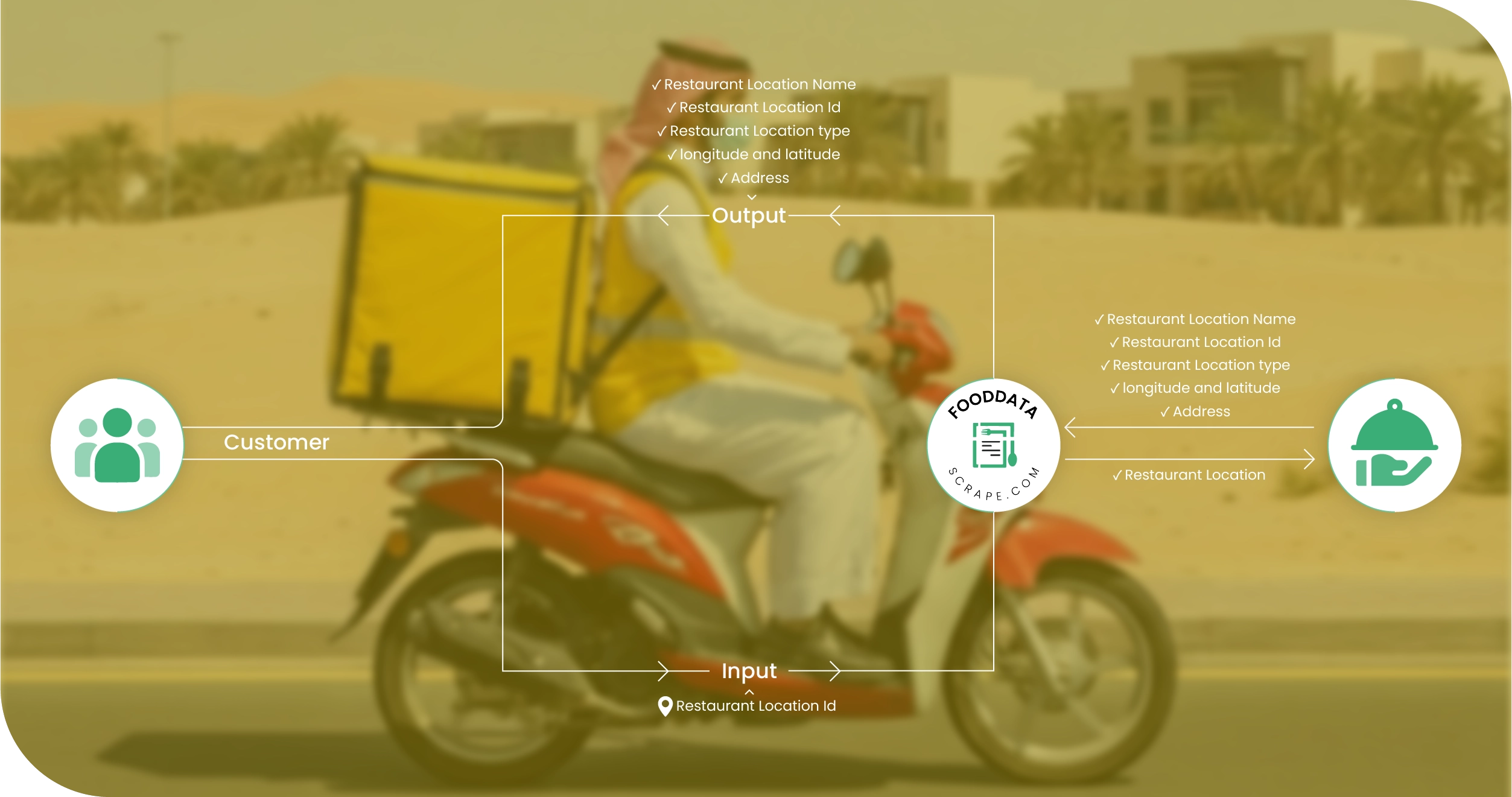
- Dynamic Data Capture Architecture: We designed a flexible extraction framework capable of handling dynamic content, location-based variations, and frequent interface changes, ensuring uninterrupted access to restaurant listings, menus, pricing, delivery fees, and estimated delivery times.
- Geo-Specific Data Mapping: Our approach simulated multiple user locations across cities to capture regional availability, localized pricing differences, delivery zones, and time-based variations, creating a realistic representation of how end users experience delivery platforms.
- Structured Data Normalization: Complex menu items, variants, add-ons, and combos were transformed into standardized formats, enabling consistent comparisons across restaurants and regions while reducing duplication, inconsistencies, and analytical bias in datasets.
- Real-Time Monitoring & Update Cycles: We implemented scheduled and event-driven refresh cycles to continuously track pricing changes, surge patterns, and delivery time fluctuations, ensuring datasets remained current and aligned with fast-moving market conditions.
- Quality Assurance & Validation Layers: Multiple validation checks were applied to detect missing fields, pricing anomalies, and timing errors, maintaining high data accuracy and reliability for downstream price comparison, benchmarking, and delivery market analysis.
Advantages of Collecting Data Using Food Data Scrape
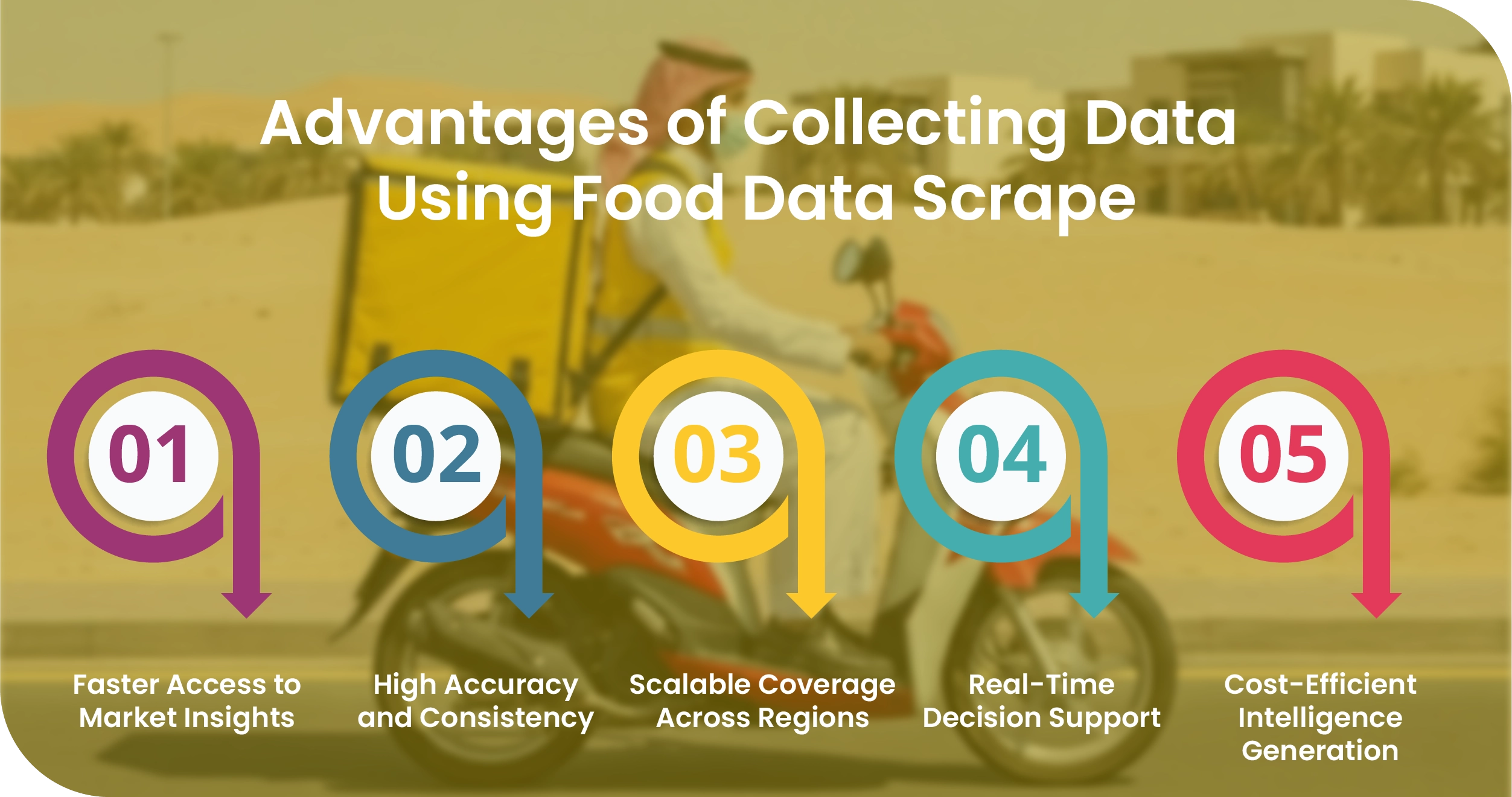
- Faster Access to Market Insights: Our services provide rapid access to structured delivery and restaurant data, enabling businesses to quickly identify pricing trends, service gaps, and regional demand patterns without relying on slow, manual data collection processes.
- High Accuracy and Consistency: We deliver clean, validated datasets with consistent formats, reducing errors caused by dynamic interfaces and frequent updates, and ensuring reliable analysis for pricing comparison, performance tracking, and strategic planning.
- Scalable Coverage Across Regions: Our infrastructure supports data collection across multiple cities and neighborhoods simultaneously, allowing clients to expand analysis seamlessly as markets grow or new locations are added.
- Real-Time Decision Support: With continuous updates and monitoring, clients can respond quickly to price changes, surge patterns, and delivery performance shifts, supporting timely operational and competitive decisions.
- Cost-Efficient Intelligence Generation: By automating data collection and processing, our approach minimizes operational costs, reduces dependency on manual research, and delivers long-term value through reusable, insight-ready datasets.
Client’s Testimonial
"Working with this data scraping team has significantly improved how we analyze the food delivery landscape in Saudi Arabia. Their structured approach helped us access accurate restaurant, menu, pricing, and delivery performance data at scale. What stood out was the consistency and freshness of the datasets, even during peak demand periods and regional pricing shifts. The insights enabled faster price comparisons, clearer competitive benchmarks, and more confident strategic decisions. Their technical reliability, responsiveness, and understanding of delivery market dynamics made them a trusted data partner. We now rely on their outputs as a core input for our ongoing market analysis and reporting initiatives."
Head of Market Intelligence
Final Outcomes:
The final outcome of the project delivered measurable value by transforming raw delivery app information into actionable intelligence. With clean, structured data feeds, the client successfully built a comprehensive Food Price Dashboard that visualized restaurant pricing, delivery fees, surge patterns, and regional variations across Saudi Arabia. The availability of standardized Food Delivery Datasets enabled accurate price comparisons, trend tracking, and performance benchmarking over time. As a result, the client gained faster access to market insights, improved confidence in pricing analysis, and reduced manual research efforts. The solution supported data-driven decisions around partnerships, promotions, and regional expansion, positioning the client to respond proactively to market shifts within the competitive food delivery ecosystem.