Introduction
The UK grocery sector is one of the most competitive retail environments in the world. Major supermarket chains continuously adjust prices, promotions, inventory availability, and product assortments to attract consumers and maintain market share. Businesses, brands, market researchers, and retail intelligence providers increasingly rely on data-driven strategies to understand these market dynamics. This has significantly increased demand to Scrape UK supermarkets data for Tesco, Sainsbury's initiatives that deliver real-time visibility into pricing and product movements.
The growing importance of UK grocery retail supermarkets analysis has encouraged organizations to leverage automated data extraction techniques for gathering comprehensive information from leading supermarket platforms. As competition intensifies, companies are also investing in UK supermarket price monitoring solutions to track daily pricing fluctuations, promotional campaigns, and product availability trends.
Understanding the UK Grocery Retail Landscape
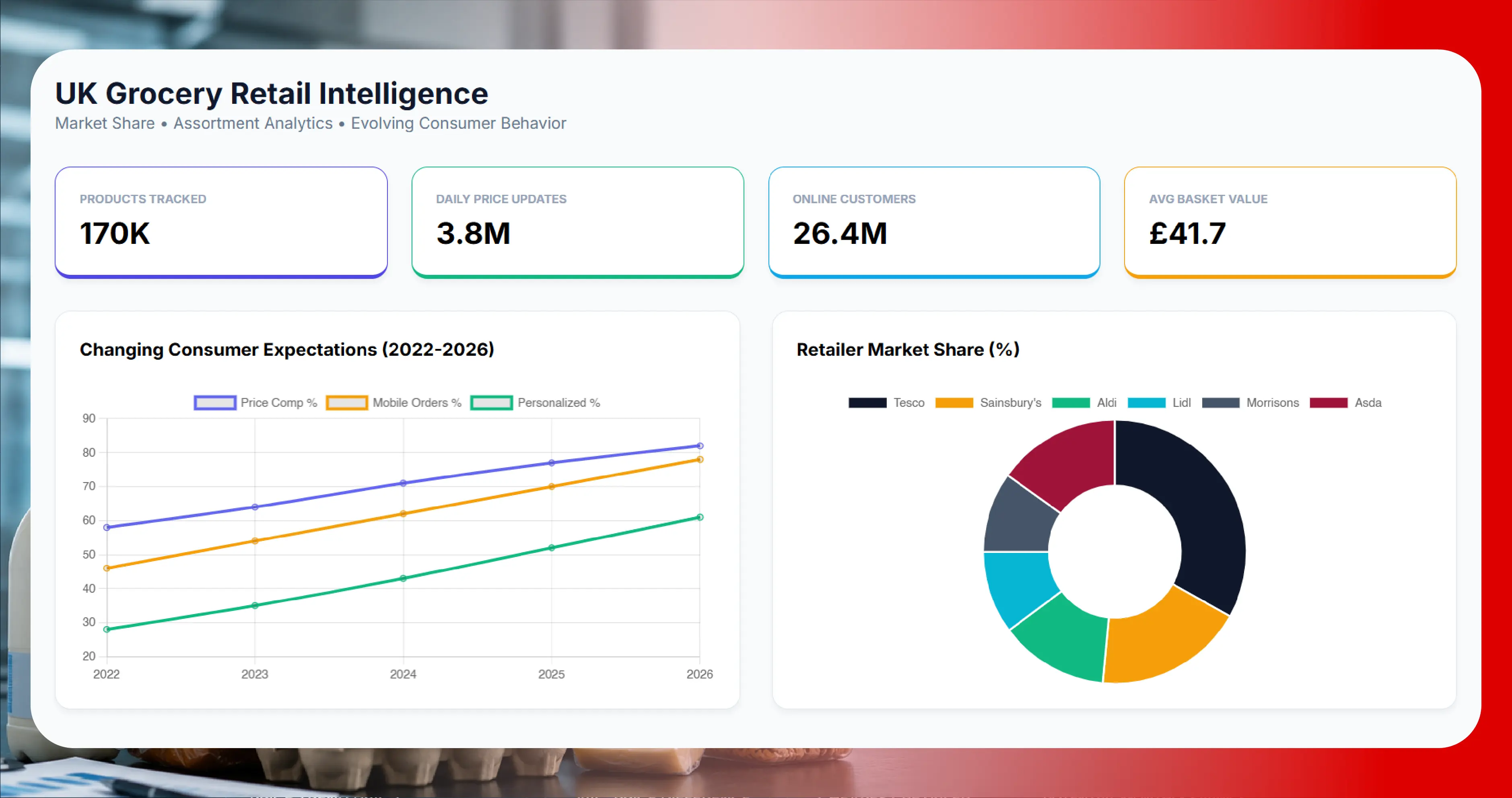
The UK supermarket industry is dominated by established retailers such as Tesco, Sainsbury's, Aldi, Lidl, Morrisons, and Asda. Among these, Tesco and Sainsbury's hold significant market influence due to their extensive product portfolios, nationwide presence, and advanced online grocery delivery systems.
Consumer buying behavior has evolved dramatically over the past decade. Customers now compare prices online before purchasing, seek personalized offers, and expect rapid delivery services. These changing expectations have transformed supermarket operations and created a need for continuous monitoring of retail data.
Data collected from supermarket websites helps businesses understand:
- Product assortment strategies
- Pricing structures
- Promotional frequency
- Inventory availability
- Brand positioning
- Seasonal demand fluctuations
Access to such insights enables organizations to make informed decisions and respond quickly to changing market conditions.
Why Tesco and Sainsbury's Data Matters?
Tesco and Sainsbury's collectively represent a substantial portion of UK grocery sales. Their pricing decisions often influence broader market trends and competitor responses.
Monitoring these platforms provides valuable intelligence for manufacturers, distributors, consumer goods companies, and e-commerce businesses. Product-level insights reveal how brands compete within different categories and how retailers structure their promotional activities.
By analyzing supermarket data, businesses can identify:
- High-demand products
- Emerging consumer preferences
- Regional pricing variations
- Promotional effectiveness
- Product placement strategies
These insights contribute to stronger planning and more effective market positioning.
The Growing Role of Retail Data Scraping
Retail data scraping involves extracting structured information from online supermarket platforms. Automated systems can gather thousands of product records across multiple categories while maintaining accuracy and consistency.
Modern scraping solutions typically capture: Product names, descriptions, prices, discounts, package sizes, stock availability, delivery options, ratings, reviews, and category classifications.
The collected information can then be transformed into actionable business intelligence dashboards that support decision-making across marketing, sales, procurement, and supply chain teams.
As supermarkets frequently update product information, automated data extraction provides a scalable way to maintain current datasets without relying on manual collection processes.
FMCG Brands and Pricing Intelligence
Fast-Moving Consumer Goods (FMCG) companies operate in an environment where even minor pricing changes can significantly impact market performance. This is why FMCG pricing intelligence UK retail chains has become an essential component of competitive strategy.
Manufacturers use supermarket data to monitor:
- Brand price consistency
- Competitor promotional activity
- Product assortment changes
- Shelf-share trends
- New product introductions
By analyzing pricing patterns across multiple retailers, FMCG brands can optimize pricing strategies while protecting profit margins and market share.
This intelligence also helps companies evaluate retailer partnerships and understand how their products perform across different supermarket ecosystems.
Tesco Price Tracking for Competitive Advantage
Tesco's extensive online grocery platform contains valuable information regarding product pricing, promotional offers, and inventory availability.
Organizations increasingly utilize Tesco supermarket price monitoring in UK initiatives to identify pricing changes across thousands of products and categories.
Price monitoring helps businesses: Understand discount cycles, track competitor pricing strategies, evaluate promotional effectiveness, and detect market opportunities before competitors.
Retailers and brands can use these insights to maintain competitive pricing while maximizing profitability.
Furthermore, historical price tracking allows analysts to evaluate long-term trends and identify recurring promotional patterns that influence consumer purchasing decisions.
Monitoring Sainsbury's Product Pricing and Promotions
Sainsbury's is another major source of market intelligence due to its strong customer base and extensive online grocery operations.
The use of Sainsbury’s supermarket price tracking in UK enables organizations to monitor category-specific pricing movements and promotional activities across multiple product segments.
Data analysis can reveal: Seasonal pricing behavior, discount frequency, bundle offers, and category-level competitive dynamics.
Such intelligence supports more accurate forecasting and helps businesses develop data-backed retail strategies that align with market conditions.
Companies can also compare pricing structures between Tesco and Sainsbury's to identify differences in competitive positioning and promotional approaches.
Ready to transform supermarket data into actionable business intelligence? Contact us today to unlock real-time Tesco and Sainsbury's pricing, inventory, and competitive insights.
Building Competitive Pricing Intelligence
Retail competition in the UK grocery market is fierce. Every pricing adjustment has the potential to influence customer behavior and impact market share.
Through UK supermarket competitor pricing intelligence, organizations gain visibility into competitor actions and market movements.
Competitive intelligence programs often focus on:
- Price comparison analysis
- Promotion tracking
- Product assortment monitoring
- Brand performance evaluation
- Category benchmarking
The resulting insights help decision-makers respond proactively rather than reactively to market developments.
Companies equipped with real-time competitor intelligence can make faster and more informed strategic decisions.
Inventory Monitoring and Stock Visibility
Pricing is only one aspect of retail intelligence. Inventory availability is equally important for understanding market conditions and consumer demand.
Effective Supermarket Inventory Data Tracking enables businesses to identify stock shortages, replenishment patterns, and inventory turnover trends.
Inventory monitoring provides several advantages: Businesses can anticipate demand fluctuations, optimize supply chain operations, and reduce the risk of stockouts.
Brands can also assess retailer performance by analyzing product availability across locations and time periods.
When inventory data is combined with pricing intelligence, organizations gain a more complete understanding of supermarket operations and customer demand patterns.
Creating High-Quality Grocery Datasets
One of the primary outcomes of supermarket data collection is the development of structured retail datasets.
A comprehensive Tesco Grocery DataSet may include thousands of products spanning fresh foods, beverages, household essentials, personal care items, frozen products, and packaged goods.
These datasets support various applications, including: Market research, price benchmarking, predictive analytics, machine learning models, demand forecasting, and retail performance measurement.
Structured datasets also enable organizations to identify hidden trends and generate deeper insights that would otherwise remain undiscovered.
As data volumes continue to grow, the importance of accurate and scalable grocery datasets will only increase.
Applications Across Industries
The value of supermarket data extends beyond retailers and FMCG manufacturers.
Consulting firms use grocery data for market analysis. Investment firms rely on retail intelligence to evaluate industry performance. Technology companies use structured datasets to build pricing engines and recommendation systems.
Additionally, supply chain organizations leverage supermarket data to improve inventory planning and procurement strategies.
The ability to access current and historical supermarket information creates opportunities for innovation across multiple industries.
How Food Data Scrape Can Help You?
Real-Time Price Monitoring
Our data scraping services collect live pricing information from Tesco and Sainsbury's platforms, enabling businesses to track market fluctuations, compare competitor prices, identify discount opportunities, and optimize pricing strategies effectively.
Competitive Market Intelligence
We gather comprehensive competitor data across product categories, helping businesses understand market positioning, monitor promotional campaigns, evaluate pricing strategies, and make informed decisions based on actionable retail intelligence.
Inventory and Stock Tracking
Our automated scraping solutions monitor product availability and stock levels continuously, allowing businesses to identify shortages, understand demand patterns, improve inventory planning, and reduce potential supply chain disruptions.
Product Catalog and Assortment Analysis
We extract detailed product information, including descriptions, categories, packaging sizes, and brand data, helping organizations analyze assortment strategies, identify market gaps, and benchmark retailer product offerings.
Custom Retail Data Solutions
Our tailored data scraping services deliver structured datasets, dashboards, and analytics customized to business objectives, empowering retailers, FMCG brands, researchers, and analysts with accurate and scalable market intelligence.
Conclusion
The UK grocery industry continues to evolve rapidly, making real-time retail intelligence more valuable than ever before. Businesses seeking market visibility can gain significant advantages through systematic data collection and analysis from leading retailers.
Whether organizations are focused on pricing optimization, inventory monitoring, consumer behavior analysis, or competitive benchmarking, Scraping Data from Sainsbury's and Tesco provides a powerful foundation for informed decision-making.
Advanced data extraction solutions make it possible to Scrape Sainsbury's Grocery Delivery App Data and uncover valuable insights related to product availability, promotions, and pricing strategies.
Similarly, businesses can Scrape Tesco Grocery Delivery App Data to monitor changing market conditions, evaluate competitor actions, and build comprehensive retail intelligence systems that support long-term growth and profitability in the highly competitive UK supermarket sector.
Are you in need of high-class scraping services? Food Data Scrape should be your first point of call. We are undoubtedly the best in Food Data Aggregator and Mobile Grocery App Scraping service and we render impeccable data insights and analytics for strategic decision-making. With a legacy of excellence as our backbone, we help companies become data-driven, fueling their development. Please take advantage of our tailored solutions that will add value to your business. Contact us today to unlock the value of your data.