Demand & Pricing
AI Demand Forecasting for Food & GroceryHOT
AI Demand Forecasting for Food & Grocery predicts SKU and menu demand by city and season using live food, grocery, and delivery data.
// forecasts refreshed against live demand signals
| item | city | week | pred_units | conf |
|---|---|---|---|---|
| Amul Gold Milk 1L | Delhi | W24 | 4,180 | 92% |
| Paneer Tikka (veg) | Pune | W24 | 1,240 | 88% |
| Cold Brew 250ml | Mumbai | W24 | 2,905 | 90% |
Overview
What is AI demand forecasting?
AI demand forecasting is the use of machine-learning models to predict how much of a product — a grocery SKU or a menu item — will sell in a given location and time window. For food and grocery businesses, it converts live delivery, menu and retail web data into per-item demand curves by city, store cluster or dark-store catchment.
Unlike static historical averages, an AI forecast blends seasonality, weather, festivals, weekday patterns and promotion effects into a single prediction for each item. That matters because food demand is highly local and time-sensitive: a product that sells out in one neighborhood may sit on shelves in another. Teams use these forecasts to reduce stockouts and waste, plan staffing and prep, and time promotions for maximum lift. Because our models are built on continuously refreshed web data across 15 markets — rather than quarterly survey panels — the forecasts stay aligned with what is actually happening in the market right now.
Capabilities
Forecasting that maps to your operations
Built on live delivery, grocery and menu data — not stale survey panels.

City-level granularity
Forecasts down to city, store cluster or dark-store catchment, not just national averages.
Seasonality modeling
Festivals, weather and weekday patterns folded into every SKU and menu-item curve.
Promo impact simulation
Estimate the demand lift of a discount or bundle before you launch it.
SKU & menu resolution
Per-item predictions for groceries, restaurant menus and q-commerce baskets.
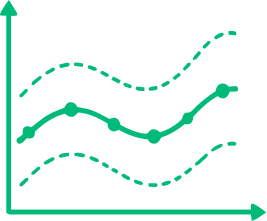
Confidence bands
Every prediction ships with an upper and lower bound, so you can size risk.
Backtested accuracy
Models validated against historical actuals before you rely on them.
What's included
Every forecast ships with
Standard fields and outputs. Anything here can be extended, trimmed or customized to your scope.
Methodology
How does AI demand forecasting work?
From raw web signals to a forecast you can act on, in four steps.
1 · Collect live signals
We continuously gather delivery, menu and grocery web data across your target markets.
2 · Engineer features
Seasonality, weather, weekday and promo effects are extracted into model features.
3 · Model & validate
Per-item models are trained and backtested against historical actuals for accuracy.
4 · Deliver forecasts
Forecasts with confidence bands arrive as CSV, JSON or API on your cadence.
Who it's for
Get answers like
Real questions our forecast answers for teams across the food economy.
"What will sell next week in Pune?"
Per-SKU weekly demand by store catchment.
"Which menu items spike in monsoon?"
Seasonal demand curves per item per city.
"How much to stock per dark store?"
Catchment-level demand for 10-min delivery.
Why FoodDataScrape
Why teams choose us for this
- Built on live web data across 15 markets, refreshed continuously
- Forecasts down to catchment level, not national averages
- Confidence bands and backtests on every prediction
- Free proof-of-concept on your own category before you commit
Delivery & integration
How is the data delivered?
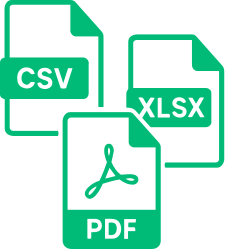
Formats
CSV, JSON or direct API — pick what plugs into your stack. Custom schemas on request.
Refresh cadence
One-time pull, daily, weekly or real-time feeds, scoped to how fast your decisions move.
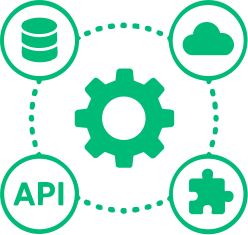
Integration
Drop into BI tools, data warehouses or apps. Webhooks and scheduled exports supported.
Questions
Frequently asked questions
We report confidence bands and backtest against historical actuals, so you can judge fit per category before relying on it.
Live delivery, grocery and menu web data across our 15 markets, blended with seasonality and promo signals.
Yes — horizons and geography are custom: city, store cluster or dark-store catchment.
From next-day through seasonal horizons; longer horizons widen the confidence band.
Yes — we use comparable-item modeling for items without their own history.
As CSV, JSON or API on the refresh cadence you choose, ready for your planning tools.
See a demand forecast for your category
Tell us the category, market and horizon. We'll return a free sample forecast with confidence bands — usually within a day.