Introductions
Stop & Shop operates across all five New York City boroughs — the only major supermarket chain that does. No Trader Joe's in the Bronx. No Trader Joes in the Bronx. No Whole Foods in Staten Island. No Wegmans in Queens or Brooklyn at meaningful scale. Stop & Shop fills the mid-market conventional grocery tier across the full five-borough geographic range, and its GO Rewards member prices vary across that range in ways that the chain doesnt publicise but that the data makes unmistakably visible. The GO Rewards price on a 2lb boneless chicken breast at the Stop & Shop in Hunts Point, Bronx: $6.99. The same SKU, same week, at Stop & Shop Great Kills, Staten Island: $5.99. An 18% gap, same chain, same loyalty programme, same 60-minute subway ride apart. The Stop & Shop New York City data scraping 2026 pipeline maps that variation across all five boroughs — 30-plus stores, 5 distinct income geographies, one chain — producing the most granular five-borough grocery price dataset in New York City.
New York City is unique in US grocery retail for a reason that amplifies the commercial value of the Stop & Shop five-borough dataset: the boroughs are not just neighbourhoods, they are structurally different economic environments operating under the same city government but with median household incomes that range from $42,000 in the Bronx to $78,000 in Staten Island — a $36,000 gap within a single metropolitan transit zone. The NYC grocery borough price data produced by Stop & Shops five-borough footprint captures how a regional New England grocery chain manages its GO Rewards deal structure across an income range that exceeds many multi-state regional grocery networks. Food Data Scrape built the NYC pipeline with borough_name, income_zone, and go_rewards_discount_pct fields from run one — tagging every record with the economic geography that explains the 18% price gap.
The Five-Borough Price Architecture — Why the 18% Gap Exists
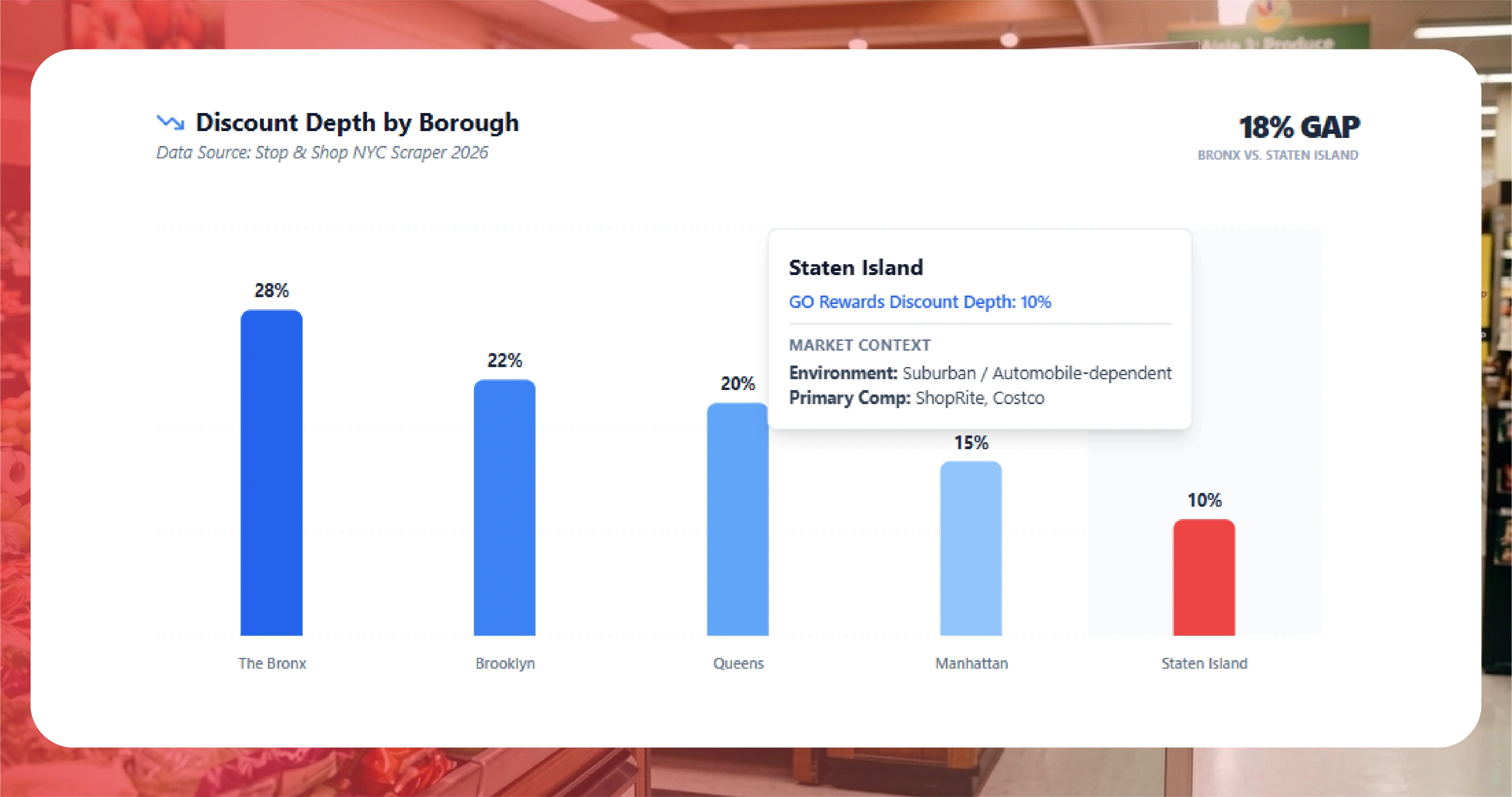
The 18% Stop & Shop GO Rewards discount depth gap between the Bronx and Staten Island doesnt exist because Stop & Shop prices differently by ZIP code through a conscious policy decision. It exists because GO Rewards deal depth responds to competitive pressure — and the competitive environments in the Bronx and Staten Island are structurally different. The Bronx Stop & Shop locations at Hunts Point, Fordham Road, and Pelham Bay compete with Key Food, Associated Supermarkets, Western Beef, and a significant number of independent bodegas and halal grocery stores that are deeply embedded in the community and offer competitive pricing on staples. That competitive density forces Stop & Shop to run deeper GO Rewards deals on protein and dairy to compete.
Staten Islands grocery competitive structure is less intense. Major supermarkets — Stop & Shop, ShopRite, and Costco in Richmond — serve a suburban automobile-dependent population without the walkable independent grocery density that characterises Bronx shopping corridors. The result: Stop & Shops Staten Island GO Rewards deals run shallower than the Bronx — not because Staten Island shoppers need less price relief (they dont; the income is higher but the grocery options are fewer), but because the competitive pressure to sharpen loyalty deals is lower. The scrape Stop & Shop prices New York City pipeline that captures both boroughs simultaneously makes that competitive-pressure-driven discount depth gradient visible.
Brooklyn and Queens add demographic complexity. Brooklyns Stop & Shop locations span the full income range from Bay Ridges $72,000 median income to East New Yorks $42,000 — the same borough, a 20-mile drive apart, two very different GO Rewards deal structures. Queens diversity is even wider: the Astoria and Jamaica Stop & Shop locations serve shopper demographics so different in income, ethnicity, and purchasing patterns that comparing their GO Rewards deal structure side-by-side reveals Stop & Shops implicit neighbourhood-level pricing calibration. The Stop & Shop NYC data scraper 2026 that captures all five boroughs at multiple store IDs per borough produces that calibration in full.
Five-Borough Store Coverage — Locations, Demographics, and Price Data Value
| Borough | Key Stores / ZIP Codes | Median HHI | Competitor Density | GO Rewards Profile | Data Value |
|---|---|---|---|---|---|
| Manhattan Upper West Side | 10025, Harlem 10037, Chelsea 10001 | $82K–$112K | Very high — Whole Foods, Trader Joes, FreshDirect | Deep — WF/TJ pressure sharpens GO Rewards | Premium competitive zone — GO Rewards vs Whole Foods Prime bilateral benchmark |
| Bronx Hunts Point | 10474, Fordham 10458, Pelham Bay 10461 | $38K–$52K | High — Key Food, Associated, independents | Deepest — 35–40% GO Rewards on proteins | Highest-discount zone — competitive independent grocery density drives deepest deals |
| Brooklyn Bay Ridge | 11220, East New York 11207, Williamsburg 11211 | $44K–$78K | Medium-high — Key Food, C-Town, Trader Joes (Wburg) | Variable — Bay Ridge shallower, ENY deepest | Widest within-borough range — $32K income spread produces 12pt GO Rewards gap |
| Queens Astoria | 11102, Jamaica 11435, College Point 11356 | $52K–$75K | Medium — Key Food, FoodTown, Costco | Moderate — Jamaica deepest, Astoria shallower | Diverse demographic — Caribbean, Latino, South Asian basket data, cultural SKU depth |
| Staten Island New Dorp | 10306, Great Kills 10308, Tottenville 10307 | $72K–$88K | Low-medium — ShopRite, Costco | Shallowest — 18–22% GO Rewards | Suburban car-dependent — lowest competitive pressure, shallowest GO Rewards in network |
Sample Stop & Shop NYC Five-Borough Data Records — 2026
The records below show the same four SKUs priced across five boroughs — the GO Rewards discount gradient that defines the NYC five-borough datasets analytical value.
| Product | Category | Borough | ZIP | Shelf $ | GO Rewards $ | Disc % | 18% Gap From |
|---|---|---|---|---|---|---|---|
| Chicken Breast Boneless 2lb | Meat | Bronx | 10474 | $9.49 | $5.99 | 36.9% | Deepest |
| Chicken Breast Boneless 2lb | Meat | Brooklyn ENY | 11207 | $9.29 | $6.29 | 32.3% | — |
| Chicken Breast Boneless 2lb | Meat | Queens Jamaica | 11435 | $9.29 | $6.49 | 30.1% | — |
| Chicken Breast Boneless 2lb | Meat | Manhattan Harlem | 10037 | $9.49 | $6.69 | 29.5% | — |
| Chicken Breast Boneless 2lb | Meat | Staten Island | 10308 | $9.49 | $7.29 | 23.2% | Shallowest |
| Ground Beef 80/20 1lb | Meat | Bronx | 10458 | $7.49 | $4.99 | 33.4% | — |
| Ground Beef 80/20 1lb | Meat | Staten Island | 10306 | $7.49 | $5.99 | 20.0% | — |
| Whole Milk 1 Gal | Dairy | Bronx | 10461 | $4.49 | $3.09 | 31.2% | — |
| Whole Milk 1 Gal | Dairy | Staten Island | 10307 | $4.29 | $3.49 | 18.6% | — |
| Large Eggs 12ct | Dairy | Brooklyn | 11220 | $3.99 | $2.79 | 30.1% | — |
Sample JSON Record — Stop & Shop Bronx Hunts Point NYC
  {
  "product_name": "Chicken Breast Boneless 2lb",
  "banner_type": "Stop & Shop",
  "store_city": "Bronx",
  "store_state": "NY",
  "store_zip": "10474",
  "borough_name": "Bronx",
  "income_zone": "low",
  "category": "Meat & Seafood",
  "shelf_price_usd": 9.49,
  "go_rewards_price_usd": 5.99,
  "go_rewards_discount_pct": 36.9,
  "staten_island_baseline_go": 7.29,
  "intra_city_go_gap_usd": 1.30,
  "competitor_density_zone": "high",
  "independent_grocery_count_1mi": 14,
  "scraped_at": "2026-03-20T09:30:00Z",
  "pipeline_store_id": "ss-bronx-ny-10474",
  "data_provider": "Food Data Scrape"
}
Stop & Shop NYC Dataset Types — 2026
| Dataset | Format | Refresh | Best For |
|---|---|---|---|
| Stop & Shop NYC Full Borough Catalogue | CSV / JSON | Weekly | All 5 boroughs — borough_name, go_rewards_discount_pct, competitor_density_zone fields |
| NYC Five Borough Grocery Price Dataset | CSV / Parquet | Weekly | Same-SKU GO Rewards pricing across all 5 boroughs — Bronx deepest to Staten Island shallowest |
| Stop & Shop NYC GO Rewards Dataset | JSON / CSV | Weekly | GO Rewards deal depth by borough — 18% gap analysis, weekly competitive pressure tracking |
| Stop & Shop Bronx Brooklyn Queens Price Data | CSV / Parquet | Weekly | Inner-borough comparative — high-density competitive zones vs suburban outer-borough |
| NYC Borough Grocery Price Comparison Data | CSV | Weekly | All boroughs + Key Food + ShopRite competitive reference — full NYC mid-market matrix |
| New York Grocery Competitive Benchmark Dataset | CSV / Parquet | Weekly | Stop & Shop GO Rewards vs competitor loyalty programmes across NYC borough zones |
| Stop & Shop NYC Price History 2026 | CSV | Weekly | 52-week five-borough longitudinal — GO Rewards discount depth evolution and seasonal patterns |
Stop & Shop NYC API Configuration — 2026
Stop & Shop operates on stopandshop.com with GO Rewards authenticated session for member pricing. The NYC five borough grocery competitive API requires a GO Rewards account to return loyalty deal prices. The Stop & Shop New York store locator API returns all New York State store IDs — filter to New York City ZIP codes (100xx–104xx for Manhattan and Bronx, 110xx–114xx for Brooklyn and Queens, 103xx for Staten Island).
The NYC grocery data API configuration should initialise with five store IDs — one per borough — to capture the full five-borough GO Rewards gradient in a single Wednesday Airflow run: Bronx Hunts Point (10474), Brooklyn East New York (11207), Queens Jamaica (11435), Manhattan Harlem (10037), Staten Island Great Kills (10308). The Stop & Shop GO Rewards API New York session expires in 7 days. The NYC grocery price feed API 2026 built on Stop & Shops five-borough architecture delivers intra_city_go_gap_usd — the difference between the Staten Island baseline and each boroughs GO Rewards price — calculated at collection time. The NYC five borough grocery competitive API covers Stop & Shop alongside Key Food (Bronx and Brooklyn), ShopRite (Staten Island), and FreshDirect delivery pricing concurrently. The Stop & Shop NYC product data API 2026 serves full catalogue data with borough_name and competitor_density_zone fields.
| Endpoint | Method | Returns | Auth |
|---|---|---|---|
| Product Search | GET | NYC borough store catalogue with shelf and GO Rewards prices | GO Rewards login |
| Weekly Ad Feed | GET | Wednesday circular — NYC borough store clusters | None |
| Store Locator | GET | All NYC Stop & Shop — filter to 100xx/103xx/104xx/110xx–114xx ZIPs | None |
| GO Rewards Deals | GET | Member deal listings — Bronx vs Staten Island discount depth visible | GO Rewards login |
| Price by Store ID | GET | GO Rewards comparison — five-borough gradient from single run | None |
| Delivery / Curbside | GET | Slot availability — Manhattan and Brooklyn stores highest online demand | Session |
Stack and Configuration — NYC Five Boroughs 2026
Five Borough Store IDs — The NYC Collection Architecture
The Stop & Shop NYC grocery dataset 2026 requires five borough-matched store IDs — one per borough — with five corresponding New York City residential IPs. Use: Bronx (10474 Hunts Point), Brooklyn (11207 East New York), Queens (11435 Jamaica), Manhattan (10037 Harlem), Staten Island (10308 Great Kills). These five store IDs, each with a borough-residential IP in the same area code (718 for Brooklyn/Queens/Staten Island, 347/929 for Bronx, 212/646 for Manhattan), produce the full five-borough GO Rewards gradient from a single Wednesday Airflow run. Expand to 3 store IDs per borough for full intra-borough analysis of the Brooklyn ENY–Bay Ridge gap or the Queens Jamaica–Astoria gap.
Calculate intra_city_go_gap at Collection Time
The intra_city_go_gap_usd field — the difference between the Staten Island GO Rewards price (shallowest in the network) and each other boroughs GO Rewards price — should be calculated at collection time using Staten Island as the baseline. The Stop & Shop Bronx Brooklyn Queens price data built with this field pre-calculated is immediately policy-relevant: the $1.30 Bronx-to-Staten-Island GO Rewards gap on chicken breast is the quantitative measure of intra-city grocery pricing inequality that NYC food equity researchers need. Tagged with competitor_density_zone, income_zone, and independent_grocery_count_1mi, it becomes a multi-variable food access analysis tool.
NYC Borough Proxy Configuration
Use borough-matched New York City residential IPs for each of the five collection nodes: Bronx (10474), Brooklyn (11207), Queens (11435), Manhattan (10037), Staten Island (10308). A general New York City (10001 Midtown) IP used for all five boroughs will sometimes return Midtown Manhattan store pricing structures rather than the borough-specific GO Rewards deals that vary by competitive density. NYCs 212, 718, and 347 area-code residential IP pools cover all five boroughs — use the specific borough sub-code for each collection node.
Who Builds the Five-Borough Dataset and Why
NYC grocery app developers building price comparison tools use the Stop & Shop NYC GO Rewards dataset to power borough-level price comparison features that show New York households which boroughs Stop & Shop offers the deepest GO Rewards deal on their frequently purchased staples. The 18% GO Rewards gap is the apps headline feature — the Bronx shopper paying $5.99 for a 2lb chicken breast while the Staten Island shopper pays $7.29 on the same chain in the same week.
NYC food equity researchers and community development organisations use the five-borough data to study how competitive grocery market density correlates with grocery pricing in Americas largest city. The Bronxs 14 independent grocery stores within 1 mile of a Stop & Shop produce deeper GO Rewards deals than Staten Islands 3 competitors within the same radius — a quantitative demonstration of how market competition lowers effective grocery prices in low-income urban neighbourhoods even when the nominal shelf prices are similar.
CPG brands selling into Stop & Shop across the NYC market use the five-borough GO Rewards data to understand how their promotional performance varies by borough. A brand running a GO Rewards deal at $5.99 in the Bronx competes in a dense promotional environment where Key Food, Associated, and Western Beef all run simultaneous protein deals. The same brand at $7.29 in Staten Island faces ShopRite as its only comparable competitor. Those two promotional environments require different depth and timing strategies, and the NYC five borough grocery competitive API makes those differences visible week by week.
Final Thoughts
Stop & Shop covers all five New York City boroughs — no other major supermarket chain does. The GO Rewards discount depth gradient that emerges from that five-borough footprint — 36% in Hunts Point, 23% in Great Kills — is both a commercial intelligence product and a grocery equity dataset, both a CPG brand managers promotional strategy tool and a food policy researchers evidence base. The 18% gap isnt a pricing anomaly. Its the measurable consequence of competitive density operating differently across five boroughs that happen to share a city government.
Build the pipeline with five borough-matched store IDs, intra_city_go_gap_usd calculated at collection time using Staten Island as the baseline, borough_name and competitor_density_zone fields from run one, GO Rewards authenticated session from the Bronx store ID as primary, and NYC borough-matched residential IPs. Wednesday 9:30am EST collection timing captures the full five-borough GO Rewards picture simultaneously.
Food Data Scrape delivers the complete Stop & Shop New York City data scraping 2026 infrastructure — five-borough store ID configuration, GO Rewards session management, intra-city gap calculation logic, Stop & Shop NYC API 2026 setup, and pre-compiled NYC five borough grocery price dataset and New York City grocery equity benchmark datasets in CSV, JSON, and Parquet.