Introduction
If you need to receive and manage live orders in your POS software, you need Zomato and Swiggy's official partner APIs — those come directly from the platforms, not from any data provider. If you need menu, pricing, ratings, availability or competitive intelligence data, that's web data extraction, which providers like FoodDataScrape deliver as datasets, feeds or APIs. This guide explains which one you need, so you don't spend weeks emailing the wrong people.
Every week, developers building POS systems, restaurant software and food apps ask us the same question in different words: "I need the Swiggy/Zomato API to integrate live orders into my software." It's one of the most common inquiries we receive — and about half the time, what the person actually needs isn't something any third-party data company can sell. Here's the honest breakdown.
What is the official Zomato/Swiggy order API?
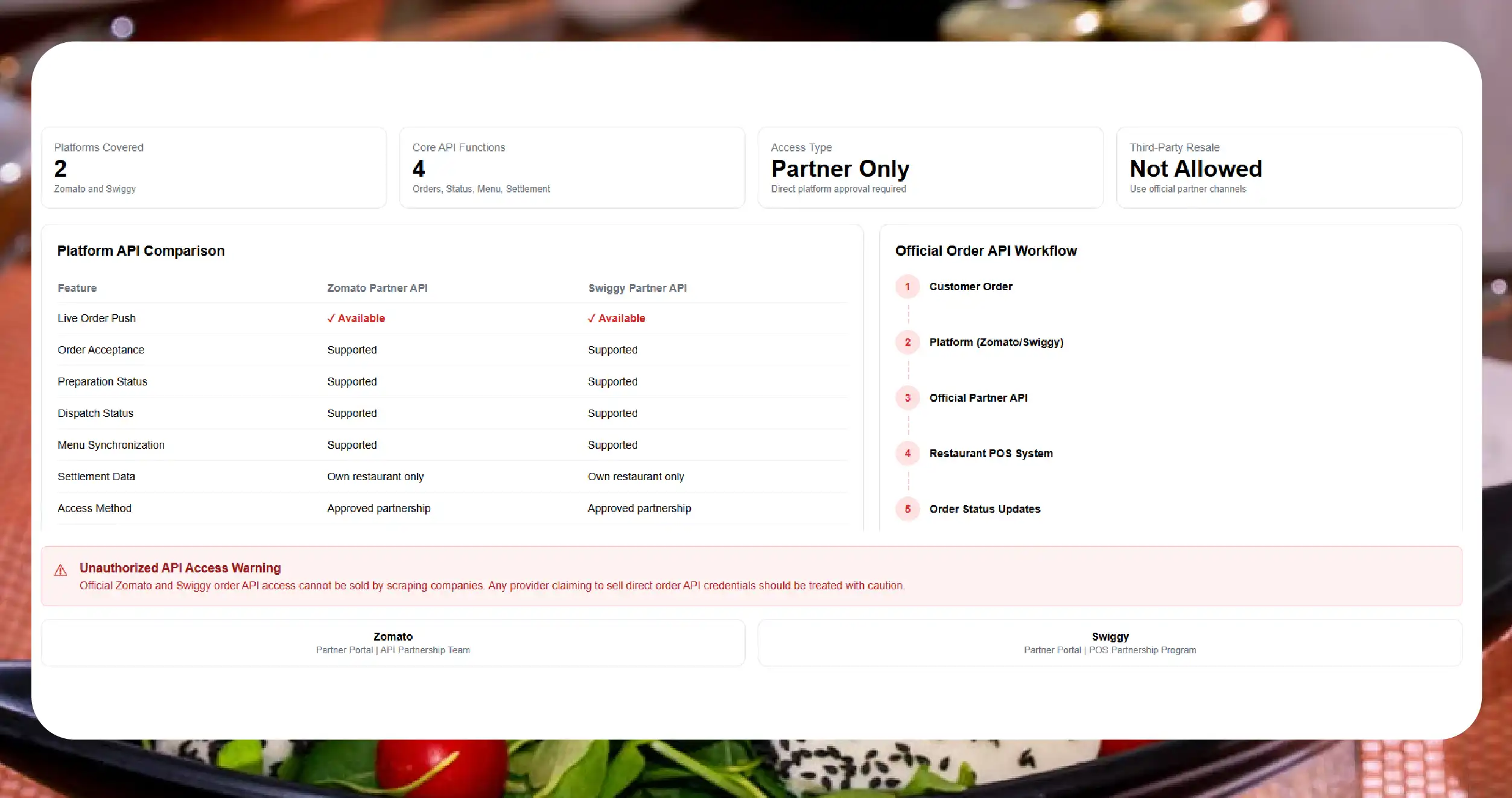
The official order (partner) APIs are integration channels that Zomato and Swiggy provide directly to restaurants and approved POS vendors. They push live orders into a restaurant's billing system, sync menus upward to the platform, and manage order status (accepted, prepared, dispatched). Access requires a partnership agreement with each platform — typically as a registered POS/technology partner — and is granted by Zomato and Swiggy themselves, not by any external provider.
What order APIs give you: live incoming orders, order status management, menu push (your menu → the platform), payout/settlement data for your own restaurant.
Who to contact: Zomato's restaurant partner/API team and Swiggy's POS partnership program directly through their partner portals. No scraping company — including us — can provide this, and anyone claiming to sell "Swiggy order API access" should be treated with caution.
What is menu data scraping (and what does it give you)?
Menu data extraction collects the publicly visible side of the platforms — the same information any customer sees when browsing: restaurant listings, full menus, item prices, discounts, ratings, review counts, delivery fees and availability, structured into JSON/CSV and refreshed on a schedule. This is the layer used for competitive intelligence, market research, pricing analytics and ML training data.
What extraction gives you: competitor menus and pricing across cities, price-change history, promotion tracking, ratings/review data, restaurant coverage by locality, dish-level analytics (e.g., "price of every French Fries listing across 5,000 restaurants").
What it can never give you: live order flow, customer personal data (names, addresses, phone numbers), or write-access to the platforms. Requests for customer delivery addresses are personal-data requests — no legitimate provider will touch them, and neither will we.
Side-by-side: which one do you need?
| Your goal | What you need | Where to get it |
|---|---|---|
| Receive live orders in my POS | Official partner/order API | Zomato & Swiggy partner programs |
| Push my restaurant's menu to the platform | Official partner API | Zomato & Swiggy partner programs |
| Track competitor menus & prices across a city | Menu data extraction | Data provider (FoodDataScrape) |
| Monitor discounts/promos on my brand vs rivals | Menu data extraction | Data provider |
| Build ML model / analytics dashboard on food data | Datasets or scheduled feeds | Data provider |
| Get customers' delivery addresses | Not possible | No one — this is private data |
| Compare my delivery fees & ETAs vs competitors | Menu + delivery-economics extraction | Data provider |
A common hybrid: POS vendors who need both
Many POS builders eventually need both layers. The official API runs their live order integration, while extracted market data powers the analytics module they sell to restaurant clients — "your price vs the 20 nearest competitors," promo benchmarking, rating trends. If that's your roadmap: pursue the partner API with the platforms for operations, and talk to a data provider for the intelligence layer. The two don't conflict; they cover different halves of the product.
What about "unofficial" order APIs?
You'll find services claiming to reverse-engineer app endpoints for order data or account-level access. Beyond reliability problems (endpoints change constantly), this crosses from public-data collection into accessing private systems — a line responsible providers don't cross. Our own policy is public data only: if it requires a login, it's out of scope. That policy is exactly what lets enterprise legal teams sign off on the data.
Questions
Frequently Asked Questions
No. Order APIs are issued directly by Zomato and Swiggy to approved partners. We provide the public-data layer: menus, pricing, ratings, promotions and availability as structured feeds.
We extract only publicly visible data with no logins or private accounts, under GDPR/CCPA-aligned processes. Many enterprises, including FMCG and QSR brands, procure this data with full legal review.
Hourly to weekly, depending on scope. Pricing and promo tracking typically runs daily; city-wide coverage snapshots weekly.
Yes — once a pipeline is live we build price-change history from each refresh. Pre-existing historical archives are available for select platforms/cities; ask what's on hand for your market.
We offer sample datasets (about 1,000 records) free for evaluation. For academic projects, our downloadable sample files usually cover what a coursework analysis needs.