
SKU-Level Matching
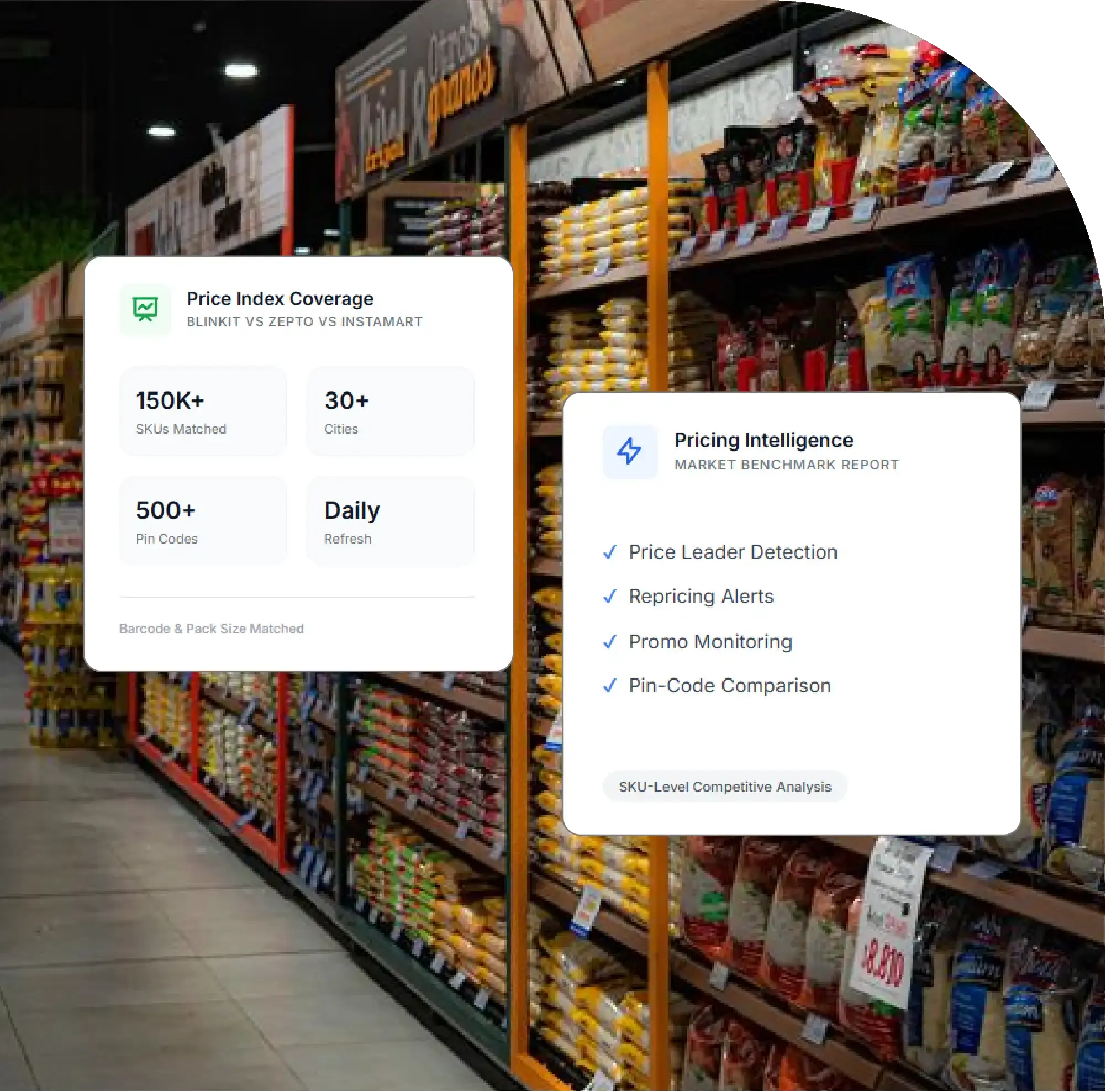
Compares identical products across all three platforms by barcode and pack size, so price differences reflect real pricing rather than mismatched pack comparisons.
Category Price Leadership
Identifies which platform leads in staples, dairy, snacks and beverages, personal care and household cleaning, and where the overall cheapest platform is the most expensive.
Pin-Code Price Spread
Quantifies how far the same SKU varies between neighbourhoods on the same platform and the same day, exposing the distribution behind any single quoted price.
Repricing Volatility
Measures how often SKUs change price within a month, which categories move most, and which platform leads price moves the others follow.
Brand Monitoring Intelligence
Supports competitor tracking, promotional analysis and pin-code pricing decisions, and extends to any custom SKU portfolio with out-of-stock signals.

Pin-code level pricing across India's three biggest quick-commerce platforms — which is cheapest, category by category, and how much prices swing between neighbourhoods.
Zepto
Cheapest basket overall (−2.9% vs avg)
8.6%
Biggest single-SKU gap (same pin, same day)
14%
Max intra-city price spread, one SKU
63%
SKUs that changed price in 4 weeks
A single "cheapest" label hides more than it reveals — but the headline basket still matters.
In July 2026, Zepto had the lowest average basket price at ₹1,842 for our standard 240-item basket, versus ₹1,878 on Blinkit and ₹1,896 on Swiggy Instamart — a 2.9% gap between cheapest and priciest. That gap narrowed from 3.7% last month, driven by Blinkit tightening staples pricing rather than any change in delivery fees.
No platform is cheapest everywhere. The leader changes by category — and so does the size of the gap.
| Category | Cheapest | Gap vs Priciest | Notable SKU |
|---|---|---|---|
| Staples (atta, rice, oil) | Swiggy Instamart | 4.2% | Aashirvaad Atta 5kg |
| Dairy & Eggs | Zepto | 3.1% | Amul Gold Milk 500ml |
| Snacks & Beverages | Zepto | 6.5% | Coca-Cola 750ml |
| Personal Care | Blinkit | 5.0% | Dove Soap 100g |
| Household Cleaning | Swiggy Instamart | 3.8% | Surf Excel 1kg |
Platforms compete hardest in snacks & beverages, where the 6.5% gap is the widest in the basket — a high-frequency, impulse-driven category where a cheaper sticker price directly pulls orders. The reversal worth flagging: Zepto, cheapest overall, is the most expensive platform for household cleaning by 3.8% — where Instamart is quietly buying share.
Price is a local variable, not a national one — this is the finding most brands miss.
Across Delhi NCR, the identical Tata Salt 1kg ranged from ₹26 to ₹30 — a 14% spread on the same platform, on the same day. For an FMCG brand this means a single "our price on Blinkit" number doesn't exist; there's only a distribution, and its width is itself a competitive signal.
Prices in quick commerce aren't sticky — a price checked on Monday is often wrong by Friday.
63% of SKUs changed price at least once in the four-week window. The most volatile category was snacks & beverages, averaging 4.1 changes per SKU. Volatility is largely promo-driven — short discount bursts that snap back within days — and Zepto repriced fastest, usually leading a move the others matched within 24–48 hours.
Availability can beat price. A lower listed price on a platform that's frequently out of stock isn't the cheaper option — it's the unavailable one. Pair every price with an OOS rate.
Monitor at pin-code level, not platform level. A 14% intra-city spread means the city-average number hides the real shelf your shopper faces.
Watch Instamart's household cleaning pricing. It's undercutting the otherwise-cheapest platform — usually a signal of where a platform wants share next.
SKU matching: 240 SKUs matched across all three platforms by barcode/UPC + pack size; ambiguous matches excluded.
Coverage: 42 pin codes across 6 cities; each sampled twice daily (morning + evening IST).
Price definition: listed selling price after platform discount, before delivery fee and cart coupons. Delivery fees tracked separately, not in the basket.
Period: 1–28 July 2026.
Collection: FoodDataScrape quick-commerce pipelines, public (logged-out) data only.
Limitations: promo pricing can vary by user cohort; we track the logged-out listed price.
Questions
In our July 2026 index of 240 matched SKUs across 42 pin codes, Zepto's basket ran ~1.9% cheaper than Blinkit's overall — but the answer flips by category and pin code, so the category table is the honest version.
We match 240 identical SKUs across Blinkit, Zepto and Swiggy Instamart by barcode and pack size, then track their listed price after platform discount daily across 42 pin codes in 6 cities. Figures reflect logged-out listed prices.
Monthly, in the first week of each month, using the previous full month's data. The URL never changes; a changelog records each refresh.
Yes — brands run the same tracking on their own SKUs alongside competitors, at pin-code level, with out-of-stock alerts.