Boo-st your food data. Save 20% on scraping services
Menus · Grocery · Alcohol · AI Intelligence, across 40+ countries

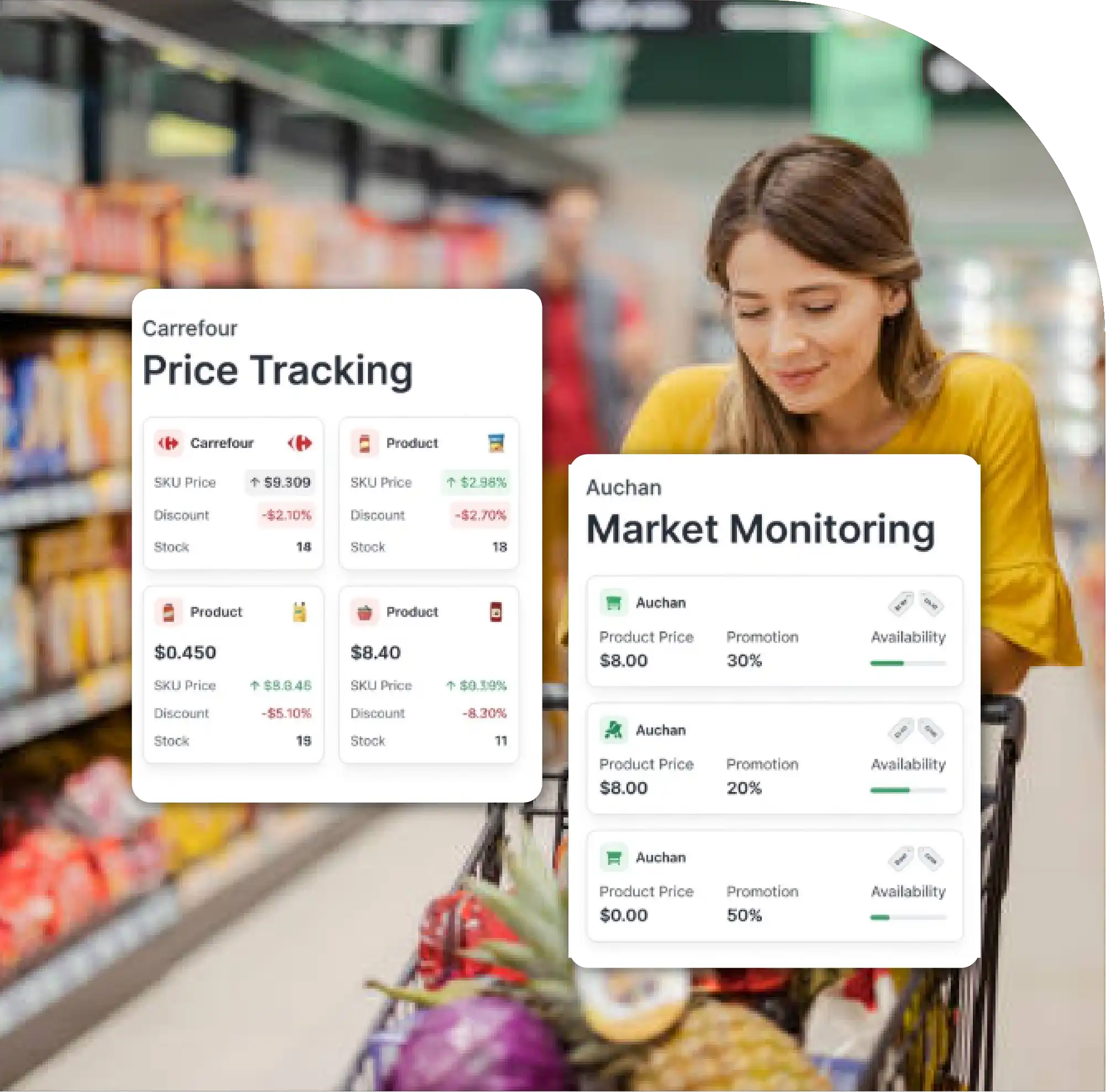
Market Comparison: Measures pricing differences and assortment overlap between leading retailers.
SKU Intelligence: Captures detailed product attributes for consistent cross-retailer comparisons.
Price Monitoring: Identifies changing prices, discounts, unit costs, and pricing patterns.
Catalog Analysis: Evaluates categories, brands, products, pack sizes, and assortment depth.
Delivery Intelligence: Tracks regional availability, fulfillment options, delivery status, and pricing.

The growth of online grocery retail has created a large and continuously changing source of product, pricing, availability, promotion, and assortment information. Carrefour & Auchan Grocery Data Extraction provides a structured approach for collecting these retail signals and transforming them into datasets suitable for competitive research, pricing analysis, market intelligence, and business decision-making.
For retailers, brands, researchers, and grocery technology companies, a well-structured Carrefour grocery product dataset can include product names, brands, categories, SKUs, package sizes, regular prices, discounted prices, unit prices, availability, ratings, images, descriptions, and promotional information. Comparable information from Auchan can be combined with Carrefour records to create a cross-retailer dataset that supports consistent product-level benchmarking.
Changes in grocery pricing occur frequently because supermarkets continuously adjust promotions, pack sizes, product availability, and competitive positioning. An Auchan supermarket pricing data scrape can therefore provide historical observations that help analysts understand how prices move across categories instead of relying on isolated price checks.
This research report examines how structured grocery extraction can support Carrefour and Auchan grocery Scraping, product catalog monitoring, competitive price comparison, promotion tracking, assortment analysis, and historical grocery market research.
Modern grocery data collection involves more than capturing product names and prices. A comprehensive extraction framework can collect information from product-detail pages, category pages, search results, grocery delivery interfaces, promotional sections, and location-specific shopping environments.
A standardized data model is important because Carrefour and Auchan may organize their product catalogs differently. One platform may categorize a product under a particular food segment while another may place an equivalent product under a different category. Normalizing these structures allows analysts to compare equivalent products and categories more accurately.
Typical fields can include product ID, SKU, EAN or GTIN where available, product name, brand, category, subcategory, package size, unit, regular price, promotional price, discount percentage, unit price, stock status, product URL, image URL, rating, review count, nutritional information, and collection timestamp.
Historical storage adds another layer of value. Instead of replacing an old price when a new value is collected, each observation can be stored with its date and time. This approach makes it possible to measure price changes, promotional frequency, stock fluctuations, and assortment changes over weeks or months.
The following table presents an illustrative research dataset showing how Carrefour and Auchan grocery information can be structured. The numbers are sample analytical values designed to demonstrate the type of dataset that can be generated and should not be interpreted as live retailer measurements.
| Grocery Category | Carrefour Products | Auchan Products | Combined SKUs | Matched SKUs | Avg Carrefour Price € | Avg Auchan Price € | Avg Price Gap € | Promo Rate Carrefour % | Promo Rate Auchan % | Availability Carrefour % | Availability Auchan % | Avg Pack Size kg/L |
|---|---|---|---|---|---|---|---|---|---|---|---|---|
| Dairy Products | 8,420 | 7,960 | 16,380 | 5,840 | 2.79 | 2.91 | 0.12 | 18.7 | 17.9 | 94.2 | 93.1 | 0.87 |
| Bakery | 5,680 | 5,210 | 10,890 | 3,920 | 2.38 | 2.46 | 0.08 | 14.9 | 15.4 | 92.8 | 91.7 | 0.51 |
| Beverages | 9,240 | 8,730 | 17,970 | 6,240 | 3.14 | 3.27 | 0.13 | 21.6 | 20.8 | 95.1 | 94.2 | 1.42 |
| Fresh Produce | 7,850 | 7,420 | 15,270 | 4,760 | 2.71 | 2.83 | 0.12 | 16.4 | 15.8 | 91.7 | 90.9 | 1.08 |
| Meat & Seafood | 6,320 | 5,940 | 12,260 | 3,870 | 7.72 | 7.96 | 0.24 | 12.8 | 13.1 | 89.6 | 88.7 | 0.74 |
| Frozen Foods | 5,910 | 5,460 | 11,370 | 3,610 | 4.51 | 4.67 | 0.16 | 19.3 | 18.6 | 93.4 | 92.3 | 0.68 |
| Snacks | 6,740 | 6,180 | 12,920 | 4,580 | 3.46 | 3.61 | 0.15 | 23.7 | 22.9 | 96.2 | 95.4 | 0.42 |
| Household | 7,360 | 6,820 | 14,180 | 4,920 | 5.18 | 5.42 | 0.24 | 17.5 | 16.8 | 94.8 | 93.6 | 1.36 |
| Personal Care | 6,280 | 5,890 | 12,170 | 4,110 | 6.37 | 6.61 | 0.24 | 20.4 | 19.7 | 93.7 | 92.5 | 0.39 |
| Baby Products | 3,840 | 3,510 | 7,350 | 2,460 | 8.02 | 8.31 | 0.29 | 15.6 | 15.1 | 90.8 | 89.6 | 0.58 |
| Total | 67,640 | 63,120 | 130,760 | 44,310 | 4.62 | 4.80 | 0.18 | 18.1 | 17.6 | 93.2 | 92.2 | 0.78 |
The table demonstrates how multiple attributes can be combined to create a more useful competitive dataset. A simple price comparison may suggest that one retailer is cheaper, but package size, unit price, availability, and promotional status can produce a substantially different interpretation.
Accurate product matching is one of the most important components of grocery intelligence. Products should ideally be matched using EAN, GTIN, SKU, brand, product name, package size, and other product attributes where available.
For example, a 1-liter branded milk product should be compared with the same 1-liter product rather than a 750-milliliter alternative. When an identical identifier is unavailable, matching algorithms can combine normalized product names, brands, package quantities, and category information.
Unit-price normalization provides another important analytical layer. A 750-gram product priced at €4.50 has a different economic value from a 1-kilogram product priced at €5.00, even though the headline prices appear relatively close. Calculating price per kilogram or liter creates a consistent basis for comparison.
These normalized comparisons strengthen Carrefour & Auchan Product and Pricing Intelligence by allowing businesses to distinguish genuine price differences from differences caused by pack sizes, product variants, or promotional conditions.
Grocery pricing becomes significantly more useful when it is tracked over time. A historical database can record the same SKU repeatedly and calculate minimum price, maximum price, average price, median price, discount depth, price volatility, and promotional frequency.
Promotions can also be classified according to their characteristics. A retailer may offer a percentage discount, temporary price reduction, multibuy promotion, loyalty offer, or category-wide campaign. Recording the original price and promotional price separately allows analysts to measure the real depth and duration of promotional activity.
The following sample table illustrates how historical monitoring could be structured across both retailers.
| Historical Metric | Carrefour | Auchan | Combined Records | Matched Products | Avg Price € | Min Price € | Max Price € | Avg Discount % | Promotion Events | Avg Promo Duration Days | Price Change % | Stock Availability % |
|---|---|---|---|---|---|---|---|---|---|---|---|---|
| Products Monitored | 67,640 | 63,120 | 130,760 | 44,310 | 4.71 | 0.79 | 48.90 | 18.1 | 28,780 | 6.4 | 7.8 | 92.7 |
| Daily Observations | 203,000 | 189,400 | 392,400 | 142,600 | 4.68 | 0.79 | 48.90 | 18.4 | 31,420 | 5.9 | 6.9 | 93.1 |
| Weekly Observations | 58,600 | 54,800 | 113,400 | 44,310 | 4.74 | 0.82 | 47.50 | 17.9 | 12,680 | 6.7 | 7.4 | 92.8 |
| Branded Products | 21,740 | 22,480 | 44,220 | 18,760 | 5.18 | 0.89 | 48.90 | 22.7 | 14,260 | 5.8 | 10.2 | 93.4 |
| Private Label | 16,720 | 15,980 | 32,700 | 11,840 | 3.74 | 0.79 | 31.60 | 15.8 | 8,940 | 6.1 | 6.4 | 95.2 |
| Fresh Grocery | 14,170 | 13,360 | 27,530 | 8,920 | 3.82 | 0.95 | 26.40 | 16.2 | 5,420 | 4.8 | 12.7 | 90.8 |
| Packaged Grocery | 25,890 | 24,670 | 50,560 | 20,480 | 4.46 | 0.79 | 42.80 | 21.3 | 13,760 | 6.5 | 7.3 | 94.7 |
| Household Items | 7,360 | 6,820 | 14,180 | 4,920 | 5.30 | 1.20 | 39.90 | 17.2 | 3,180 | 7.2 | 8.6 | 94.2 |
| Personal Care | 6,280 | 5,890 | 12,170 | 4,110 | 6.49 | 1.10 | 44.60 | 20.1 | 3,860 | 7.1 | 9.8 | 93.1 |
| Overall | 67,640 | 63,120 | 130,760 | 44,310 | 4.71 | 0.79 | 48.90 | 18.1 | 28,780 | 6.4 | 7.8 | 92.7 |
Historical observations can subsequently be used to develop category-specific price indexes. By assigning a baseline value to an initial period, analysts can measure whether grocery categories are becoming more expensive, experiencing stronger promotions, or showing greater price stability.
The combination of product, pricing, promotional, and availability information creates a broader analytical framework for Grocery Market analytics with Carrefour & Auchan. Instead of examining two retailers independently, researchers can evaluate their relative category positioning and competitive strategies.
Brands can identify where their products are positioned against competing SKUs and determine whether their price is consistently above or below comparable products. Retailers can examine categories where competitors offer larger assortments or more frequent discounts.
Market researchers can also calculate category penetration, private-label share, branded-product concentration, average discount depth, and assortment overlap. These metrics help identify areas of competitive strength and potential market gaps.
Another useful application involves identifying products that repeatedly experience availability problems. When a SKU is frequently unavailable at one retailer but consistently available at another, the pattern may indicate differences in inventory management, distribution, regional assortment, or fulfillment capacity.
Product catalog intelligence extends beyond price monitoring. A structured dataset can capture product titles, descriptions, images, category positions, nutritional information, package sizes, brands, and promotional labels.
Such information supports Supermarket Product Catalog & Pricing Analytics, allowing businesses to monitor how digital shelves change over time. New products can be identified, discontinued SKUs can be tracked, and category structures can be compared between retailers.
Brands can also monitor their digital visibility. Missing images, incomplete descriptions, incorrect attributes, or inconsistent product information can affect the quality of an online product listing. Regular data collection can therefore support digital shelf auditing alongside price intelligence.
Online grocery delivery introduces location-specific variables that are not always visible in a standard product catalog. Prices, stock status, delivery windows, and product assortment may vary depending on the selected store, region, or fulfillment location.
A properly designed Carrefour Grocery Delivery Scraping API can transform these observations into structured records that applications and analytics platforms can consume. Data can be organized by product, store, location, timestamp, price, availability, and delivery status.
Location-level analysis is particularly valuable for understanding regional price differences. The same product may be available at different prices in separate markets, while certain products may appear in one delivery zone but not another.
Mobile grocery environments can provide additional information related to availability, delivery options, store selection, and location-specific product visibility. With a structured approach, Scrape Online Carrefour Grocery Delivery App Data to support monitoring across relevant grocery delivery environments.
App-oriented extraction can complement website-based collection by creating a broader view of the online grocery ecosystem. Historical records can then be compared against website observations to identify differences in pricing, stock status, assortment, and delivery availability.
For grocery technology companies, this type of structured information can support price comparison platforms, grocery recommendation systems, market research dashboards, and competitive intelligence applications.
The resulting datasets can support multiple business functions across grocery and consumer industries. Pricing teams can use them to identify competitive price gaps, while category managers can analyze assortment and promotional intensity.
Consumer brands can monitor how their products are positioned relative to competitors. Procurement teams can study category price movements and identify changes in supplier or private-label positioning. E-commerce teams can monitor digital shelf conditions and product availability.
Historical datasets can also support forecasting. When enough observations are available, businesses can study recurring promotional cycles, seasonal price movements, product availability patterns, and category-level changes.
Reliable grocery intelligence depends on consistent extraction, normalization, validation, and storage. Product duplicates should be identified, prices should be converted into standardized numerical formats, package quantities should be parsed consistently, and historical records should retain timestamps.
Automated validation can flag unusually large price changes, missing products, unexpected category movements, and sudden availability drops. These quality checks help distinguish genuine market changes from extraction errors.
Scalable systems can store structured records in databases, cloud storage, spreadsheets, JSON, CSV, or API-ready formats. Scheduled collection can then generate daily, weekly, or customized snapshots according to the business requirement.
The Carrefour and Auchan grocery ecosystems provide a valuable foundation for product, pricing, assortment, promotional, and availability research. A structured Carrefour Grocery Dataset can support SKU-level monitoring, competitive benchmarking, product matching, price analysis, and historical market research.
The broader value of Grocery Data Scraping comes from transforming continuously changing supermarket information into consistent and timestamped datasets. When Carrefour and Auchan records are normalized, businesses can identify price gaps, promotional trends, assortment movements, availability changes, and category-level competitive patterns.
The future of this approach increasingly involves AI Grocery Intelligence, where historical grocery datasets can be combined with analytical and machine-learning models to identify anomalies, forecast prices, predict promotional behavior, detect assortment changes, and generate automated competitive alerts. By combining structured extraction, historical storage, data normalization, and advanced analytics, Carrefour and Auchan grocery data can become a continuous intelligence resource for retailers, brands, researchers, and grocery technology companies.
Are you in need of high-class scraping services? Food Data Scrape should be your first point of call. We are undoubtedly the best in Food Data Aggregator and Mobile Grocery App Scraping service and we render impeccable data insights and analytics for strategic decision-making. With a legacy of excellence as our backbone, we help companies become data-driven, fueling their development. Please take advantage of our tailored solutions that will add value to your business. Contact us today to unlock the value of your data.